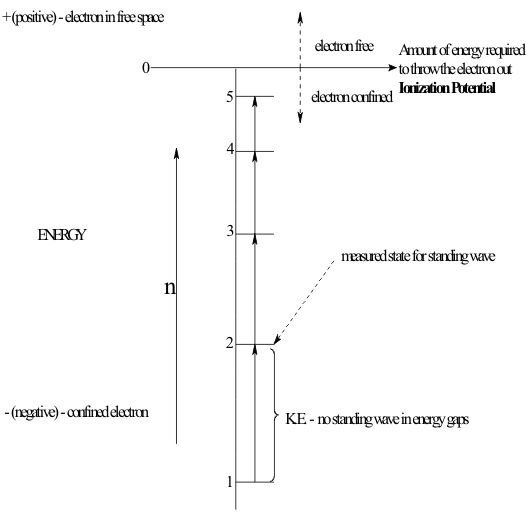
 Figure 1 Energy Levels of H Atoms as Specified
by Principal Quantum Number n
Figure 1 Energy Levels of H Atoms as Specified
by Principal Quantum Number nThe Role of the Principal Quantum Number, n, in Defining Periods
The electronic spectrum of the lightest Element Hydrogen is shown in Figure (5). As Johann Balmer realized, this sequence of observable "bands" corresponds to a mathematical series which only needed one unknown variable. This variable was called the principal quantum number and is used to "assign" each band by representing the "initial' ni and "final" nf "states" of the atom.
Figure 1 Energy Levels of H Atoms as Specified
by Principal Quantum Number nTo convert this single atom energy to the energy absorbed by one Mole of atoms from one Mole of photons of green light, called an "Einstein" of radiation, this result is multiplied by Avogadro's Number, 6.02 x 10 23 to give ;
E Mole = 2.4 x 10 5 J (2.5c) 1 / = R { 1 / n i - 1 / n f } (2.3)
In terms of the wavelength, of absorbed or emitted radiation The relationship can be restated in terms of the difference in energy, E, between the initial and final states of the absorbing atom;
E = c / = c R { 1 / n i - 1 / n f } (2.4)
where is Planck's constant of Action, 6.6 x 10 -34 J s and c is the speed of light, 3.0 x 10 8 m s-1.
To estimate the range of these radial energies, the standard values of the physical constants are substituted to define the energy absorbed by one Hydrogen atomin an "allowed transition" from its initial "ground state" n i to a final "excited state" n f.
For absorption of green light, with a wavelength of 5.0 x 10 -7 m, the energy is;
E Atom = 6.6 x 10 -34 x 3.0 x 10 8 / 5.0 x 10 -7 (2.5a)
= 4.0 x 10 -19 J (2.5b)
in which the term R is the Rydberg constant, 1.097 x 10 7 m -1
In chemical terms, this is a substantial amount of energy, equivalent to half the energy needed to break one Mole of ( C - H ) bonds. Thus, if every atom in a Mole actually did absorb this amount of energy, it would become chemically very "hot" in Stephan Boltzmann terms and very "reactive" towards other Elements.
Atomic Processes In Spectroscopy
In most circumstances, however this complete absorption does not happen. Usually the portion of atoms actually absorbing energy is very small and depends on the degree of "allowedness" of the absorption process. If increasingly higher energy photons are used, the final principal quantum number, nf. At this limit, the excited electron has enough energy to escape from the atom and this energy defines the Ionization Potential of the atom. If the atom was originally in its ground state, this also defines the stability of the "Highest Occupied Atomic Orbital". In the opposite process, an atom can attract a free electron and by releasing the appropriate photon of energy, from ni = , it can trap the electron in its "Lowest Unoccupied Atomic Orbital"identified by its finite value of n f. These propeties are summarized in the Table
Table Chemical Behaviour and Structure Aspects of Isolated Atomic Energies
|
Behaviour |
Measurement |
Structure |
|
Lose an electron |
Ionization Potential |
Highest Occupied Atomic Orbital |
|
Gain an electron |
Electron Affinity |
Lowest Unoccupied Atomic Orbital |