 Figure 1 The
Observable Energy Gaps in Absorption of Energy by Atoms
Figure 1 The
Observable Energy Gaps in Absorption of Energy by Atoms
One Electron Theory of the Periodic Table
The Structure of the Periodic Table
The problems in all empirical Periodic Tables fall into two categories. The first concerns the proper identification and sequencing of Elements. The second concerns the lack of any obvious reason for the strange pattern of growth of successive Periods. The basic strategy for this discoverry process started with John Dalton's assumption in 1805 that any reproducible Behaviour must occur inside a well defined atomic Structure. Since then, in a process which continues to the present day, efforts have been made to overcome these two basic problems both by improving the empirical data bases and by developing better theories of atomic structure to explain these empirical patterns.
To set up these theories which correlate atomic Structure to chemical Behaviour, the models have usually been built using "Occam's Razor". This Razor is a basic research tactic which "cuts through" the complexities of a system by assuming that there is one uniquely simple structural property causing its observable properties. When this Razor is applied to chemistry, it implies that there is a uniquely simple atomic Structure which will explain all of the patterns of Behaviour in the Periodic Table.
The basis of this uniquely simple atomic Structure is the Atomic Number, Z, discovered by Moseley in 1912. This predominant Structural feature represents both the number of protons in the nucleus and the balancing number of electrons in the orbitals of all neutral atoms. The unreliable atomic weight used as the independent property identifying Elements was replaced by the definitive value of Z and the consequences were immediate. The new atomic number was used to eliminate the inconsistent ordering of known Elements and to define the exact numbers of unknown Elements in the large atomic weight gaps of the Periodic Table. Specifically, it showed that Co occurs before Ni rather than after as indicated by their atomic weights. More importantly it showed that exactly one Element remained undiscovered at the end of each Period, in the "Rare Gas" Group of the Main Block and that exactly 14 Elements should be discovered in each of the Periods containing an atomic weight gap for the "Rare Earth" Block.
To determine if this Rutherford atomic Structure model was adequate, the optical methods used to measure the Ionization Potentials and the Electron Affinities of isolated atoms were refined into high resolution "spectroscopic" techniques. This made it possible to measure the absorption or emission Behaviour of the known Elements at all energies, (inverse wavelengths). To everyone's surprise, the Elements did not show black body radiation. Instead, radiation was only absorbed or emitted at particular energies, in distinct patterns of separate "bands" unique to each Element.
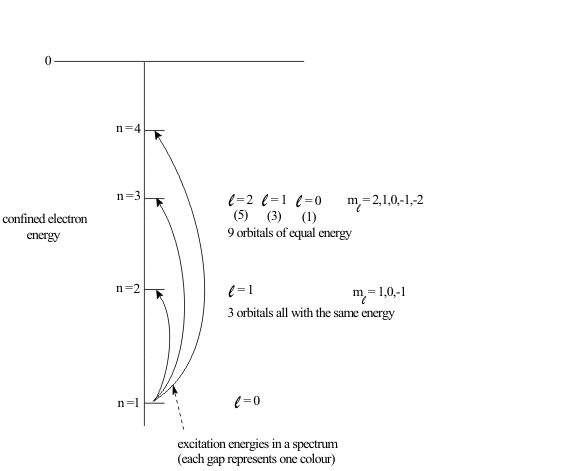
This discovery meant that the Rutherford model was useless. Instead, these "line spectra" implied that any Structure displaying these very specific "quanta of energy" must involve a highly organized binding of electrons. To start to understand such strange Structures, the Behaviour patterns of both absorption and emission band energies were catalogued into empirically reasonable groups. The bands within each grouping were then labelled with enough numbers and symbols to represented all of their distrinct features, as shown in Figure (1). (This labelling by the appearance of an unknown phenomenon is a common practice in the "taxonomy" of any field of science)
Evidence of Atomic Structure from Spectroscopic Behaviour
However, it quickly became obvious, from both the overall empirical trends and their Periodic discontinuities, that a much more detailed theory of atomic Structure was required to interpret the details of the Behaviour of the Elements. This theory came from a combination of the classical physics of electromagnetics in the last half of the 19th century and the quantum physics of the first half of the 20thcentury.
Figure 1 The
Observable Energy Gaps in Absorption of Energy by Atoms
The discovery that electrons existed and were building blocks of atoms mader it reasonable to assume that the spectroscopic Behaviour of atoms in absorbing or emitting radiation occurred by accelerating or decelerating these electrons. Before the discovery of Z, by his student Mosely, Rutherford proposed a model of atomic Structure in 1890, made up of a smooth spherical "sea" of static electrons. Following classical radiation theory, such atoms should act as "black bodies" and absorb or emit radiation at all energies, like the sun. Then, according to the classical "Stefan-Boltzmann" law, the total power P, absorbed or emitted by the atom would be found by integrating a smooth function of the fourth power of its "black body temperature" or statistically averaged temperature T, over all wavelengths, (colours);
P = f (T 4) (2.1)
The most prominent groups of bands were labelled Sharp, s, Principal, p, Diffuse, d and Fundamental, f but the groups of much fainter bands found later were simply labelled alphabetically, g, h, etc.. These patterns of band groups were then found to repeat themselves at higher energies in the spectrum and were apparently "nested" within an overall sequence. This overall sequence of nested patterns was identified as the primary Behaviour of atoms and the sets of repeated sequences therefore catalogued by a "principal quantum number", n, in the range 1 to . The bands in these nested sets of s, p, d, f, etc. groups were then identified as secondary Behaviour, labelled by an empirical "azimuthal" quantum number , in the range 0 (n-1) Finally, when the atomic spectra were examined in magnetic fields, these bands "split" into a further nested pattern of absorption or emission lines. These new bands were defined as tertiary Behaviour and labelled by an empirical "magnetic" quantum number, m, in the range -1, 0, +1.