Group 8A The Rare Gases
The Elements of Group VIII begin in the first row of the Periodic Table because the filling of the (1s)2 orbital of Helium completes the first row of the Table. All Group 8A Elements have electronic configurations [Rare Gas](ns)2(np)6, with n from 0 to 7.
Spatial and Electronic Structures of Group 8A Elements
Like the Elements in Groups 2A to 7A, the (ns)2 electrons of Group 8A Elements are stabilized because they can penetrate the cores of previously filled ([n-1]p)6 orbitals from all directions. However, unlike these earlier Elements, the, ZEFF, of the light Group VIII Elements is high enough to allow the (np)6 valence electrons to penetrate the ([n-1]p)6 shield. This makes them too stable to participate in either ionic or covalent bonds. In the heavier Elements of Group 8A, the Effective Nuclear Charge decreases and the ([n-1]p)6 core again becomes a preferentially more effective shield against the valence (np) electrons. As in the earlier Groups, this trend again leads to a progressive increase in the atomic radius and a decrease in Hardness and Electronegativity. The difference in this Group is that the trend eventually allows the heaviest Group 8A Elements to participate in chemical reactions and to form inert compounds with other Elements, in spite of the fact that their valence orbitals are formally already full and require no sharing of electrons from other sources. The correlation of electronic configurations to Structure is shown in Table 1.
Table 1 Group 8A Correlation of Electron Configuration to Electronic Structure
|
Element Name |
Structural Configuration [core electrons] (valence electrons) |
r nm |
η kJ/M |
χ kJ/M |
|
Helium |
[(1s)2] |
0.18 |
600 |
600 |
|
Neon |
[(1s)2(2s)2(2p)6] |
0.16 |
525 |
525 |
|
Argon |
[(1s)2(2s)2(2p)6(3s)2(3p)6] |
0.19 |
385 |
385 |
|
Krypton |
[(1s)2(2s)2(2p)6(3s)2(3p)6(4s)2(3d)10(4p)6] |
0.2 |
340 |
340 |
|
Xenon |
[(1s)2(2s)2(2p)6(3s)2(3p)6(4s)2(3d)10(4p)6(5s)2 (4d)10(5p)6] |
0.22 |
300 |
300 |
|
Radon |
[(1s)2(2s)2(2p)6(3s)2(3p)6(4s)2(3d)10(4p)6(5s)2 (4d)10(5p)6(6s)2(4f)14(5d)10(6p)6] |
≈0.2 |
125 |
125 |
Form of Group 8A Elements
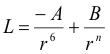
As described earlier, there can be many types of forces between any two chemical species, leading to a wide range of energies of attraction or repulsion. Strong ionic bonds form if their Structures allow direct Coulombic attraction, resulting in the formation of salts. Strong covalent or polar bonds form if their orbital Structures allow complete or partial sharing of electron pairs, resulting in the formation of molecules. If, as in Group 8A, no strong bonds are allowed, atoms are weakly attracted or repelled by London Potentials which are many “orders of magnitude” weaker than Coulombic or Quantal forces. They act over very short distances and have the general form ;
(1)
London Dispersion Forces can be attractive, indicated by the negative term in r-6 or repulsive, indicated by the positive term in r-n where n > 6. These forces are seen as deviations of the behaviour of Pressure or Volume which are predicted by the Ideal Gas Law ;
 . (2)
. (2)
The attraction term requires a correction for molecular association which reduces the volumes below the Ideal prediction. This generally occurs at low pressure when molecules combine into fewer than predicted numbers of independent particles, hence reducing the predicted pressure. The repulsion term requires a correction for incompressible molecular volume which increases the pressure above the Ideal prediction. This occurs at high pressure since no amount of excess pressure can reduce volume as predicted. Together, these correction factors are put into the Ideal Gas Law as “Virial Coefficients”. The correction for the volume is coefficient a, corresponding to the London attraction term A, and for pressure is b, corresponding to the London repulsion term B to give;
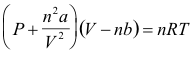
(3)
SONs of Rare Gas Elements
By the Rare Gas rule, the range of SONs for these rare gases is between 0 and +VIII in steps of +II. However, for the Elements from He to Kr, the Electronegativities of the +II ions are so large that they cannot be stabilized by oxidation with any other chemical species. However, the alternation in Electronegativity which follows the filling of the second d shell in Xe theoretically brings the Electronegativity of its +II ion down to chemically accessible values. Then, following the Pauli Principle, the intermediate SONs occur when Pauli pairs are preserved.
Thus, in Group 8A, these would be the oxidized values of +II, +IV, +VI and +VIII and the single-bonded, Group 8A compounds would have molecular formulas Z2Z’ , Z4Z’ or Z6Z’ and XeZ’8. The Element Radon, with still lower Electronegativities, should form similar compounds more readily. This prediction was confirmed had by Neil Bartlett’s discovery at the University of British Columbia in 1962 that Xe could be oxidized with the reagent (PtF6)0.
Rare Gas Halides
As with Group 7A Elements, oxidation reactions occur when a nonmetallic Element is able to acquire the valence electrons of the Group 8A atom, becoming reduced to a stable anion, while the Group 8A atom is oxidized to a cation. In oxidation reactions with the Halogens, X2, Xe is converted to a mixture of XeF2, XeF4 and XeF6 ;
Z + 3X2 ⇒ ZX6 (4)
and the resulting anion forms single σ bonds to the Group 8A cation. Again the high Polarizing Power of Group 8A results in the formation of molecular compounds instead of salts with the formulas ZZ’2, ZZ’4 or ZZ’6 corresponding to their SONs. However, like the hydrogen compounds, these halide derivatives are electron-rich. compounds, each Fluorine atom requires one electron to complete its Rare Gas Structure but each filled (5p) lobe on the electron-rich Xe atom can provide two electrons. Thus, for stable bonds to form, the excess electrons must be stabilized in non-bonding orbitals. To see if such non-bonding orbitals are available, the GOs from the valence AOs of the F atoms and the Xe atom are found from the Woodward-Hoffman symmetry rules, as shown in Figure 1.
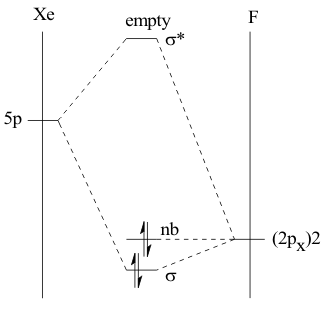
This analysis shows the overlaps needed to form the bonding and antibonding MOs with the Xe (5pz) AO. It also shows that the necessary non-bonding MOs are centred exclusively on the F atoms, since they have the wrong symmetry for overlap with Xe (5pz).
The bond energy depends entirely on the one pair in the σ bonding MO, as shown in the energy level diagram, as shown in this Figure. For the molecules XeF4 and XeF6, the same MOs and energy levels are constructed from the 5px and 5py orbitals of Xe with the neighbouring F atoms. From this MO analysis of the bonding in these compounds, the Xe-F bonds are constructed exclusively with the px py and pz orbitals of Xe. Since these MOs lie at 90° to each other, the bonds in the compounds themselves would all be at right angles. Therefore, XeF4 should be square planar and XeF6 should be octahedral but the non-bonding orbitals from the two sets of (Xe-F) bonds in the square plane become antibonding to the third set of (Xe-F) bonds on the z axis and distort the molecule. Lone pairs in crowded geometries like this almost always become anti-bonding pairs.
Rare Gas Oxides
When these compounds react with water, they are hydrolysed to the corresponding oxides;
XeF2n + nH2O ⇒ XeOn +2nHF (5)
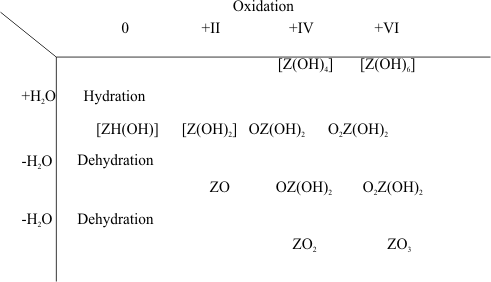
and release the corresponding number of Moles of HF. The high Polarizing Power of these high SON cations withdraws charge from the (O-H) bonds formed in these reactions so strongly that the Xe(OH)4 and Xe(OH)6 products of hydration are thermodynamically unstable. This makes them deprotonate spontaneously, releasing a Hydrogen ion by the SN1 Mechanism. This cation then attacks any basic (O-H) group within the Structure to form a molecule of H2O which is ejected from the Transition State.
When these dehydration steps leading from the “nonexistent compounds” hydroxides are included in the reaction scheme shown in Figure 2, the existing compounds can again be defined systematically, parallel to the oxides of Groups 5A to 7A as the dehydrated hydroxide derivatives of the Group 8A Elements.
Redox Activities of Rare Gas Elements
The range of SONs available for Group VIII Elements, means that Xe and Rn both span the full range of Reduction-Oxidation Activities, as shown in Table 2.
Table 2 Typical Redox Activities of Group 8A Elements
|
Species |
SONY |
Reducing Agent |
Oxidizing Agent |
Spontaneity |
Lability |
|
ZO |
+II |
- |
- |
- |
- |
|
ZO2 |
+IV |
→ |
→ |
- |
- |
|
ZO3 |
+VI |
- |
ZO3 + 6H+ + 9I- → Z + 3H2O + 3I3- |
High |
Inert |
|
ZO4 |
+VIII |
→ |
ZO4 + 8e- → Z + 2O2 |
High |
Inert |
As in Group 7A, the increase in shielding of the valence (np) AOs by the core down this Group decreases the Spontaneity of Oxidation by the oxides ZO2 and ZO3, The high spontaneities of these reactions and the fact that their products are the gases Z and O2, makes many of them explosively fast and dangerous.