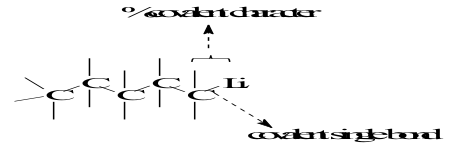
 Figure
1 The
Covalent (C-Li) Bond in the Molecule, 1-pentyllithium
Figure
1 The
Covalent (C-Li) Bond in the Molecule, 1-pentyllithiumThe Metallic Elements of Group 1A; Lithium to Cesium
The neutral atom configuration of these Elements is the half-filled (ns)1 electronic Structure in which the least stable electron occupies an s orbital by itself, outside the core of the filled p orbital. The remaining (ns)1 electron can penetrate this core from all directions but these filled p orbitals provide a shield with no defects, which makes this valence electron very unstable. This shielding is least effective for Lithium but becomes more dense and difficult to penetrate down the Group. The resulting decrease in Effective Nuclear Charge, ZEff is shown clearly by the progressive increase in the atomic radius, representing the spatial aspect of atomic Structure of and the decrease in Hardness and Electronegativity, representing the electronic aspects of atomic Structure, from Lithium down to Cesium, Table (5.3).
Bonding Structures of the Elements
Since the Structural Electronegativities of these Elements begin at a low value in Lithium and decrease further down the Group to Cesium, all Group 1A Elements in contact with other atoms tend to lose their own electrons easily and have little ability to acquire electrons from other atoms. Thus it is not surprising that, in the Activity of forming bonds to most other atoms, this valence electron is lost. This “oxidation” of the Group I atom forms a positively charged cation which can then form an ionic bond to the other atom, “reduced” to a negatively charged anion by acquiring the valence electron.
Table 1 Structure and Bonding of Metallic Group 1A Elements
|
Element |
Configuration [Core](valence) |
Size nm |
Hardness kJ/M |
Electronegativity kJ/M |
Bonding Type |
|
Li |
[ He ] (2s)1 |
0.16 |
230 |
290 |
Covalent to Ionic |
|
Na |
[ Ne ](3s)1 |
0.19 |
220 |
270 |
Ionic |
|
K |
[ Ar ](4s)1 |
0.24 |
180 |
230 |
Ionic |
|
Rb |
[ Kr ](5s)1 |
0.25 |
190 |
220 |
Extremely Ionic |
|
Cs |
[ Xe ](6s)1 |
0.26 |
170 |
200 |
Extremely Ionic |
Covalent Bonding
The only Element which is Hard and Electronegative enough to retain its own electron, in some cases, is Lithium. Then it resembles Hydrogen and, acting as a neutral atom, it forms covalent bonds to equally Hard Elements such as Carbon, as shown in Figure (5.1).
Figure
1 The
Covalent (C-Li) Bond in the Molecule, 1-pentyllithiumIonic Bonding
In all other chemistry, Group I Elements act as cations. With anions these form solid phase salts in which the positive charge on the cation exerts a Coulombic attraction on directly on anions and forms electrostatic ionic solid-state bonds within “lattice” Structures such as Sodium Chloride, shown in Figure 2.
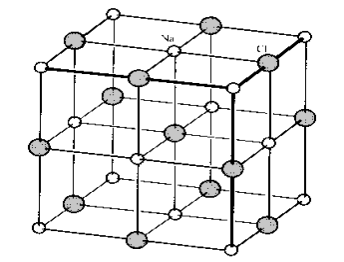 Figure 2 The Ionic (Na-Cl) Bond in Sodium
Chloride
Figure 2 The Ionic (Na-Cl) Bond in Sodium
ChlorideDonor Covalent Bonding
Complex Ions in which the high Electronegativity of the cation M+ attracts electron pairs in the HOMOs of other molecules or anions and polarizes their electron pairs into forming “Donor
Covalent Bonds” to the cation. The simplest example of this process is the dissolution of NaCl to produce a solution of fully dissociated, solvated cations and anions, as illustrated in Figure 3 ;
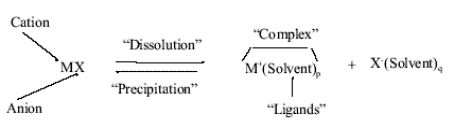 Figure 3 The Dissolution-Precipitation
Equilibrium of a Salt in conact with a Saturated Solution
Figure 3 The Dissolution-Precipitation
Equilibrium of a Salt in conact with a Saturated SolutionIn this example, as the negative end of the permanent Dipole of the water molecule approaches the surface of the solid lattice, it acts as a Lewis Base, neutralizing the excess positive charge on any Lewis acid cation and forming a new “Donor Covalent Bond”. This “Donor” negative “solvation” shown in Figure 4 ;
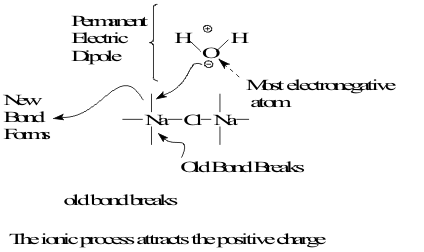 Figure
4 The
Solvation Process for a Dissociating Sodium Ion
Figure
4 The
Solvation Process for a Dissociating Sodium IonFor the cations, the solvation process continues until enough negative charge has been “Donated” by the solvating molecules to satisfy the charge requirement of the ion. The process then reaches equilibrium. If the charge is satisfied before all the lattice bonds are replaced, the ion remains attached to the lattice surface in a partially solvated form Many surfaces are “passivated” by this partially completed process. If, on the other hand, the charge requirement is only satisfied by complete replacement of the lattice bonds by new solvent bonds, then the “solvated ion” is formed and moves into the liquid phase as a completely dissolved species as shown in figure (3.4);
This complete dissociation then exposes the next lattice layer and the solvation process can continue until the solvent can no longer provide enough solvent molecules for all available cations and anions. At this point, the solution has become “saturated” and dissolution stops.
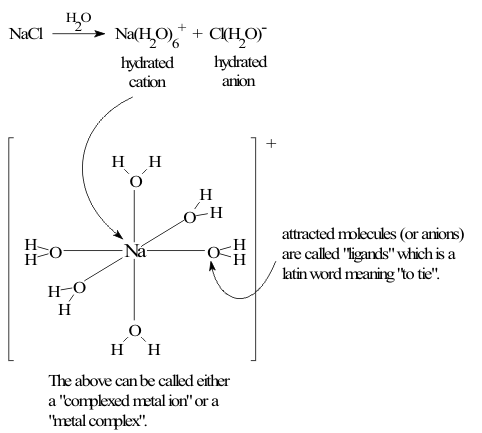 Figure
5 The
Fully Solvated Sodium Cation
Figure
5 The
Fully Solvated Sodium Cation