#
Question
Mark
1a
Give the Periodic, Group and Diagonal trends in electronegativity and hardness
Electronegativity and hardness increase
1 Along a Period from low to high atomic number
2 Up a Group from high to low atomic number
and are constant on a Diagonal from low to high atomic number.
1
b
Give the formula for calculating the lattice energy, U, of an ionic salt.
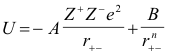
2
c
Draw the shapes of the Molecular Orbitals formed by covalent overlap of (np) atomic valence orbitals. Show all phase conditions.
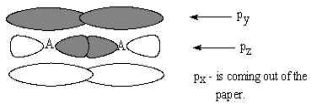
2
d
Explain the influence of filled antibonding orbitals on Bond Order.
Filled antibonds cancel the stabilization of the molecule achieved by filling the corresponding bond MO, thus reducing Bond Order by 1
1
2a
From the difference in electronegativity between Li and C and describe the bond type in LiCH3
Since electronegativity of Li < C , the bond type is a polar covalent bond.
1
b
In solvated ions, identify which components are the Lewis acid and Lewis base.
The metal cation is the electron-accepting Lewis Acid and the bound electron donating solvent molecule is the Lewis base.
1
c
Describe how the change in (M-O) bond strength from a 1A to a 2A hydrated ion affects the strength of the internal (O-H) bond in the coordinated water molecule.
The cation-water bond strength increases from 1A to 2A and this weakens the bond strength within the bound water molecule
1
d
Describe how this change in bonding leads to Hydrolysis of the bound water.
The attraction of the O-H pair towards the O atom in the 2A solvated ion weakens the O-H bond and allows the H atom to be released as an H+ ion to a water mloecule to form thre hydronium ion
1
3a
Draw the structure and describe the bonding in the diborane molecule.
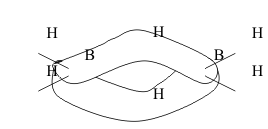
There are 2 kinds of bonds
1 the terminal B-H bonds with an electron pair.
2 the “three-centre” bridge B-H-B bonds with an electron pair
1
b
Give the equilibria for the hydrolysis reactions.from Al(OH2)63+ to Al(OH2)3(OH)3
Al(OH2)63+ <-> Al(OH2)5(OH)2+ <-> Al(OH2)4 (OH)2+ <-> Al(OH2)3(OH)3
K Equations optional
2
c
Predict the theoreticlly allowed and actual SON s of 4A elements.
Noble (rare) Gas Rule (next to previous) predicts -IV to + IV
The full range should exist because C has intermediate electronegativity.
1
d
Use shielding to explain why the chemical properties of Si are similar to those of B.
Shielding increases from B across to C but decreases by an equal amaount down from C to Si
1
4a
Use shielding to explain the large change in electronegativity from N to P.
In P the 3p orbitals are destabilized and reduced in electronegativity because they are fully shielded from the nucleus by the filled 2p core orbitasl
1
b
Draw the SON-Hydration Table for P from PH3 to P2O5.
Where p is represented by Z; the table is
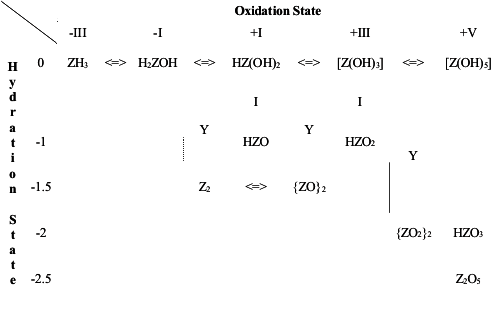
2
c
Use shielding to explkain why ClF7 and IF7 exist but BrF7 does not.
In Br, 3/5 of the shielding of the valence shell by the filled 3d core orbital is in the pi directions at 45 degrees from the sigma bond direction. This poor shielding gives the 4s orbital a high electronegativity, preventing it from losing its pair. Thus Br7+ cannot form.
1
d
Explain why the acid strength of fully rediced elements increases from AlH3 to HCl
Acid or Base strength depends on X-H bond strength, max when Δη = 0
Acid or Base type depends on X-H bond polarity, min when Δχ = 0
In AlH3 Δη is large and Δχ is large χ(Al) << χ(H). Thus AlH3 is strong base.
InHCl Δη is large and Δχ is large χ(H) << χ(Cl). Thus HCl is strong acid.
1
5a
Use shielding to explain the large change in electronegativity from F to Cl.
In P the 3p orbitals are destabilized and reduced in electronegativity because they are fully shielded from the nucleus by the filled 2p core orbitasl
1
b
Draw the SON-Hydration Table for Cl from HCl to Cl2O7
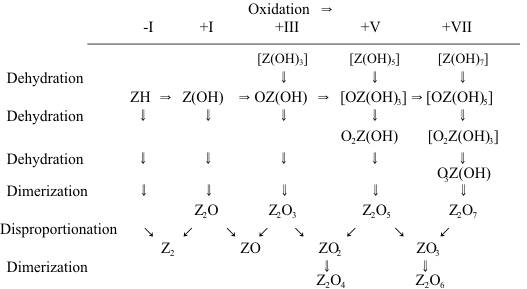
2
c
Use the Diagonal Rule to predict the chemical behaviour of the Noble Gas Xenon.
Xe is diagonally related to N then S then Br. Inall of these elements, the atoms have low enough electronegativity to be oxidized to their theoretical maximum SON. The theoretical maximum for Xe is +VIII. Thus predict compounds of the type XeO, XeO2, XeO3 and XeO4.
1
d
Why are some Xenon compunds used as reagents in organic syntesis reactions?
The XeO2, XeO3 and XeO4.molecules can be used as oxidizing agents in organic reactions because the only byproduct from the oxidizing agent is gaseous Xe.
1
25