| # |
Question |
Mark |
| 1a |
Describe the pattern oif atomic properties observed when
elements are put in order of increasing atomic weight.
Periodic “saw-tooth” pattern of slowly
rising then rapidly falling values. Graph OK |
1 |
| b |
What experiment showed that atoms were divisible ?
1 The photoelectric effect showing atoms
contained bound electrons
2 The Gold film experiment, showing
passage and reflection of alpha particles |
1 |
| c |
Explain how a closed system of bound particles becomes
“quantized”.
Bound particles become quantized when the
attraction and repulsion forces are equal. |
1 |
| d |
How did Bohr use the quantization of a classical system explain
atomic structure ?
Defined a solar system model of bound
electrons in orbits around the nucleus of protons |
1 |
| 2a |
Explain why the Uncertainty Principle made the Bohr model
obsolete.
Since it was not possible to define
postion and velocity (speed, momentum) at the same time a classical
electron orbit could not be defined. |
1 |
| b |
Define the range of values allowed for the principal quantum
number, n, the azimuthal quantum number, l and the magnetic quantum number
ml
n, 0 to infinity, l, 0 to (n-1),
ml, -l...0...+l. |
1 |
| c |
Show which structural aspects of orbitals are identified by
quantum numbers n, l and ml.
n defines the radius, l defines the
angular shape down from the vertical (azimuth), ml defines the
shape around the horizontal plane. |
2 |
| d |
Define the angular node and the radial node of a 3p orbital.
Angular node is the 2D plane separating 2
halves of the p orbital.
Radial node is the 3D surface separating
the inner half from the outter half of the p orbital. |
1 |
| 3a |
Define the opposing potentials acting on electrons bound within
atomic orbitals.
Nuclear attraction and interelectron
repulsion. |
1 |
| b |
Use Slater's Rules of shielding to define the effective charge
for valence electrons.
Slater’s Rules of orbital shielding
are;
Shielding from orbital (n-2) = 1.0, (n-1)
= 0.85, n = 0.35 and (n+1) = 0
Therefore for valence electrons
Z (eff) = Z - (#(n)(0.35) + #(n-1)(0.85) +
#(n-2)(1.0) + etc. ) |
1 |
| c |
Define the Ionization Potential of a filled orbital.
Energy absorbed by atom to remove the
electron to free space (at potential = 0) |
1
|
| d |
Define the Electron Affinity of an empty orbital.
Energy released by atom to acquire the
electron into the empty orbital. |
1 |
| 4a |
Draw the shapes and phases of bonding and antibonding p
orbitals of two atoms, showing the overlap for sigma and pi MO
interactions.
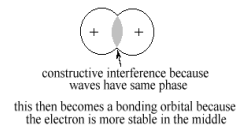 Fig 1
Bonding MO Fig 1
Bonding MO
NOTE Phases should both be +
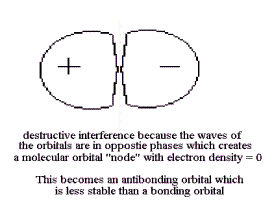 Fig 2 The sσ*
Antibonding MO
Fig 2 The sσ*
Antibonding MO
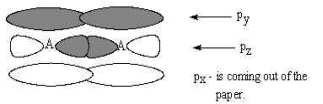
Fig 3 pz-pz (sigma) bonding and py-py (pi) bonding |
|
| b |
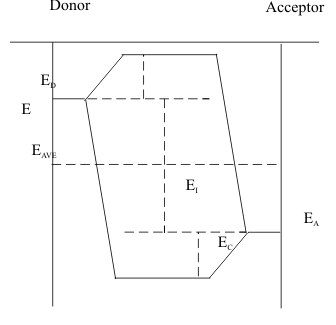
Using only the occupied valence orbitals, draw the energy level
diagram of a singly bonded heteronuclear diatomic molecule
|
2 |
| c |
On the energy level diagram show the energies contributing to
the bond strength
Check on diagram for covalent and ionic contributions |
1 |
| d |
Use these energy contributions to define the Bond type
Bond Type = Covalent Energy / Ionic Energy
|
1 |
| 5a |
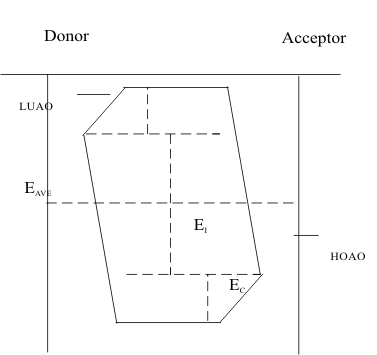
Using the Highest Occupied and Lowest Unoccupied Atomic
Orbitals of two different atoms, draw the energy level diagram of a
singly-bonded heteronuclear diatomic molecule
|
2 |
| b |
Use the energy gaps on this energy level diagram to define the
Electronegativity and Hardness values of the two atoms.
Check on diagram for the electronegativity = HOMO + LUMO
hardness
= HOMO - LUMO |
2 |
| c |
Give the Hardness criterion for Bond Strength
Atoms of equal hardness have the strongest
bonds |
1 |
| d |
Use orbital shielding to explain the trends in
Electronegativity and Hardness down any Group of Elements in the Periodic
Table.
As the number of occupied orbitals
increases down a Group of elements, the shielding of the valence electrons
increases, reducing the Z9eff) and decreasing both electronegativity and
hardness values. |
2 |
|
|
25 |