Tutorial #4
1. VSEPR
To predict the shape of a molecule using VSEPR, follow the following rules. If you don't use the rules, you will probably get it wrong!
1. Draw the Lewis structure
(i) Count the valence
electrons
(ii) Write a skeletal structure, putting the
least electronegative element at the centre.
(iii) Put
single bonds to each terminal atom (2 electrons each)
(iv)
Complete the octets around the terminal atoms, where applicable (i.e. not for
H)
(v) Put any remaining pairs of electrons or single
electrons on the central atom
(vi) make double bonds where
necessary
(vii) Write the shorthand notation of the
structure as, e.g. AX3E2, where A is the central atom,
there are three X terminal
atoms and two lone pairs (E), also on the central atom.
2. Predict the shape based on the shorthand notation developed above.
The only way to learn this is by practicing it:
e.g. predict the shape of CH4.
Count the
valence electrons: 4 for the C, 4 x 1 for the H's = 8
The structure thus has
4 bonds to the carbon, using all 8 electrons. The shorthand notation is
AX4. Must be tetrahedral
e.g. predict the shape of NH3.
5 + 3 x 1 =
8 valence electrons
The three bonds use 6 of them, leaving a lone pair on the
N atom. The shorthand notation is thus AX3E. Must be a trigonal
pyramid.
e.g. predict the shape of PCl5.
5 + 5 x 7 =
40 valence electrons
Five single bonds = 10 elecrons. Six more around each Cl
to complete the octets uses 30 more. The shorthand notation is thus
AX5. Shape is a trigonal bipyramid.
e.g predict the shape of IF5.
7 + 5 x 7 =
42 valence electrons.
As above, the bonds plus the completed octets use 40
electrons. The two extra go on the central I atom. Must be AX5E.
Shape is a square pyramid.
e.g. predict the bond angles in the molecule methyl
isocyanate, CH3NCO.
Here, there are three "central" atoms - the C,
the N and the other C. The shape around each can be predicted using VSEPR. Then
the bond angles are obvious.
Valence electrons = 8 from the two C atoms, 5 from the N, 3 from the H's and 6 from the O for a total of 22.
The skeletal structure is:
H3C - N - C - O (where
there is a single bond between the C and each H) This has used only 12
electrons. We can put 3 lone pirs on the O resulting in:
H3C - N - C - O:::
and put the last two pairs on the middle C and the N atom:
H3C - N: - C: - O::: which uses all 22 electrons. However, the N and the middle C do not have complete octets. We can therefore make double bonds by shifting the lone pair on the middle C to the left, and one lone pair on the O atom to the left as well:
H3C - N: = C = O::
Now look at each of the central atoms. The carbon at the left has four pairs
of electrons around it, all bonding pairs. The shape around this C atom is
therefore tetrahedral, with an ideal angle of 109.5 degrees.
The N atom has
two bonds and a lone pair. The shape is therefore bent (120 degrees
ideally).
The middle C atom has two bonding groups around
it and no lone pairs. Bond angle must be 180 degrees.
2. Hybrid Orbitals
If we use atomic orbitals to make molecules, the problem is that not all atomic orbitals are equivalent (they exist as s, p, d and f, for instance). However, when we make a molecule of CH4, for instance, we know that all four bonds from C to H are in fact equivalent. To explain this, we use hybrid orbitals.
In the case of carbon, the electronic configuration is 1s2 2s2 2p2. The valence electrons are the only ones of interest. Hence, 2s2 2p2. We imagine promoting an electron from the 2s to the 2p orbital so that each orbital now has one electron (2s1 2p3 - remember three are three p-orbitals). We then "make" four equivalent "hybrid" orbitals from these four atomic orbitals, and call them "sp3" orbitals (i.e. made from one s and three p orbitals).
Making CH4 then consists only of overlapping these four sp3 hybrid orbitals of C with the 1s orbitals of each H atom. Each resulting orbital in the molecule will consist of two electrons. Each of these bonds is a sigma (s) bond, since it results from the end-on overlap of the sp3 hybrid with the H 1s orbital.
In the case of ethylene (C2H2), we again promote the 2s electron of C to a 2p orbital. However, only two of the p-orbitals plus the s orbital are used to make three equivalent sp2 orbitals. These make sigma bonds with other atoms. The remaining p-orbital makes pi (p) bonds with the other C.
What you really need to know about hybrid orbitals is what kind are used in by each "central" atom in a molecule. This boils down to figuring out the number of charge clouds about the central atom, then using the following table:
| Charge Clouds | Hybridization
of Central Atom |
Shape of Charge
Clouds Around Central Atom |
2 |
sp |
linear |
3 |
sp2 |
trigonal planar |
4 |
sp3 |
tetrahedral |
5 |
sp3d |
trigonal bipyramidal |
6 |
sp3d2 |
octahedral |
3. Molecular Orbitals
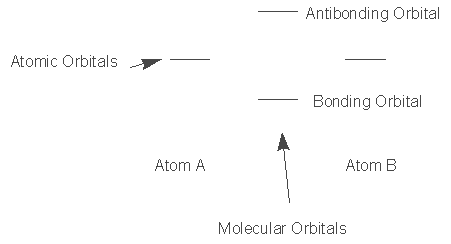
Recall that orbitals are wave functions, implying that they can be treated as wave-like objects. Thus, when two atoms bind with each other, their atomic orbitals overlap, forming molecular orbitals, which are also wave-like. Thus, these molecular orbitals can have the properties of waves, namely that nodes can exist (places of zero electron density). The ramification is that molecular orbitals can be bonding orbitals (electron density between the atoms) or anti-bonding (nodes between the atoms).
For s-type atomic orbitals, the molecular orbital diagram looks like:
Note that the bonding orbital is lower in energy than the antibonding orbital.
For instance, let’s look at the bonding between two Li atoms. Li has the electronic configuration 1s2 2s1. Only the valence electrons are of interest here. First, draw the atomic orbitals of the two Li atoms at the same energy level:

Recognize that if we start out with two (atomic) orbitals, we must have two molecular orbitals (MO’s) formed. These are a bonding (so-called s 2s) MO and an antibonding (so-called s *2s) MO. Note that the antibonding orbital is at a higher energy.
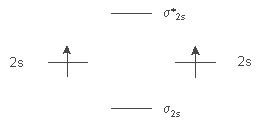
Then, all you need to do is to place the available electrons in the MO’s, starting from the bottom up. Place two in each MO, and use Hund’s rule where necessary:
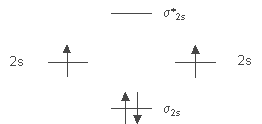
Note that we do not have four electrons now, but that the two are left in the atomic orbitals as reminders of where the electrons in the MO came from. For Li2, the bond order is (2-0)/2 = 1. Since the bond order is greater than 1, we predict that the molecule should be stable.
Following the same procedure, we can draw the MO diagram for Be2. Note that Be has two valence electrons:
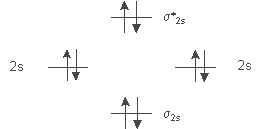
Here, the bond order is (2-2)/2 = 0, and we predict that Be2 should not exist.
For overlap of p-orbitals, the situation is the same, except that if we start with 6 p-orbitals (3 from each atom), we must also end up with 6 molecular orbitals. Some will be sigma orbitals (end-on overlap of the p-orbitals), but most will be pi-orbitals (sideways overlap). Both bonding and antibonding are possible. The result is a molecular orbital diagram that looks like the following (note that s orbitals are also shown for completeness and that the antibonding orbitals are in red):
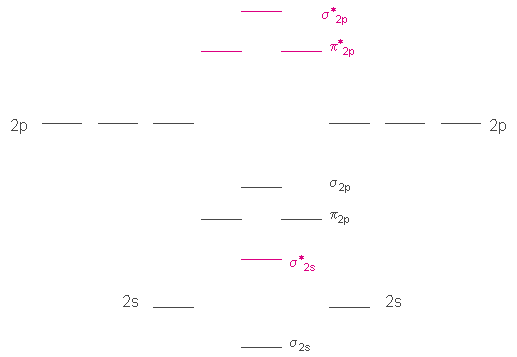
For instance, for B2, we now have three valence electrons from each atom. The s2s and s*2s orbitals are the same as for the smaller molecules shown above. However, p-orbitals can overlap in two ways. End-on overlap results in a s2p MO, while sideways overlap of the other p-orbitals results in two p2p orbitals. Both bonding and antibonding orbitals are possible. The overall MO diagram looks like:
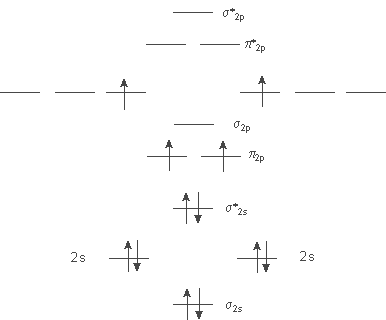
The bond order in this case is (4-2)/2 = 1, indicating a single bond between the two atoms, so we predict that the molecule is stable. Second, using Hund’s rule, we had to put two electrons in separate p2p orbitals. These unpaired electrons make the compound paramagnetic.
The F2 molecule, for example, has a total of 14 valence electrons (2s2 2p5 from each F atom). These are placed in the MO’s starting from the bottom up:
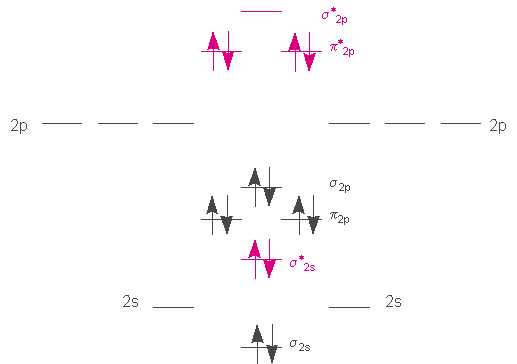
The bond order is again 1, and we predict that F2 is diamagnetic, since there are no un-paired electrons.
The third example is Ne2. We expect that this will not exist, since we refer to Neon as being a Noble or Inert gas. The MO diagram looks like:
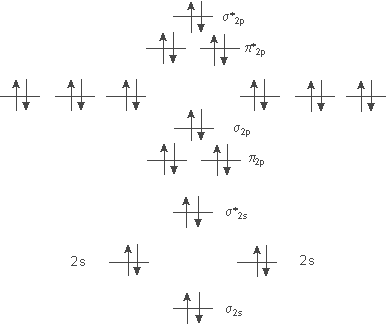
We see that the bond order = (8-8)/2 = 0, and so the molecule Ne2 does not exist.