 ,
, 
Tutorial #3
Ionic Compounds, Electronegativity, Lewis Diagrams
Predicting formulas of Ionic Compounds
This is too easy, as long as you have a periodic table handy. The group number of an element states how many electrons are in the valence shell. Metals form cations. Non-metals form anions. You need to combine the cation and anion in the appropriate ratio to make a neutral compound.
e.g. Sodium plus iodine: Na makes a +1 cation, since it is in group1A. In doing so, it becomes isoelectronic with Ne. I makes a -1 anion, since it is in group 7, and must pick up an electron to become isoelectronic with Xe. The only way to combine Na+ with I- to make a neutral compound is NaI.
e.g. Magnesium with sulfur: Mg makes a +2 ion, S makes a -2 ion. Neutral compouns in MgS.
e.g. Vanadium with oxygen: V makes a +5 ion, O makes a -2 ion. Neutral compound is V2O5
e.g. Scandium with nitrogen: Sc makes a +3 ion, N a -3 ion. Neutral compound is ScN.
e.g. Aluminum with oxygen: Al makes a +3 ion, O makes a -2 ion. Neutral compound is Al2O3.
Ionic Compounds
In an ionic compound, the species are bound together by the mutual electrostatic attraction of oppositely charged ions. The reason that there are ions in the first place is that metals (those elements left of the zig-zag line in the periodic table) tend to lose electrons, becoming positively charged. Also, the elements to the right of the line tend to gain electrons, becoming negatively charged. In both cases, the result is an octet of electrons in the outer shell upon ionization.
In an ionic compound there is no sharing of the electrons. The valence electrons spend all of their time close to the non-metal ion (the anion). In other compounds, the electrons may spend more time closer to the positively charged cation. Such compounds are termed "covalent", meaning literally "sharing of the electrons." Since ionic and covalent compounds have such different properties, it is important to be able to predict how ionic or covalent a compound will be. This is done by considering electronegativity.
Electronegativity: Ionic vs. Covalent Compounds
Electornegativity is a measure of the ability of at atom IN A COMPOUND to attract electrons towards itself. (Since we limit this idea to atoms in a compound, the idea of electron affinity does not apply, since electron affinity affinity values apply only to isolated atoms.) In general, electronegativities increase going:
Left to Right accross the periodic table, since the effective nuclear charge increases in this direction, and
Bottom to Top in a group, since valence electrons in lower shells feel a larger effective nuclear charge as well.
The difference in electronegativities determines whether the chemical bond is ionic or covalent or somewhere in between.
For example, take RbBr. The electronegativities are 0.8 for Rb and 2.8 for Br. The difference is 2.0, which is considered large. This is an ionic bond, with the Br atom having control of the electron most of the time.
In the compound CuO, the difference is (3.5 - 1.9) = 1.6, which is not ionic. However, the electrons still spend more time near the oxygen that near the Cu, so this is termed a polar covalent bond.
Consider the compound methane, CH4. Each of the four bonds in this molecule is between an H atom and a C atom. The electronegativities are 2.1 for H and 2.5 for C. The absolute difference is 0.4, which is considered small. This compound is therefore considered covalent, although some books maintain (correctly) that these bonds are polar covalent. The electrons spend slightly more time near the more electronegative C atom.
In a homonuclear diatomic such as I2, the bond must be completely covalent, since the two atoms have the same electronegativities.
Lewis Dot Diagrams
Another simple but necessary skill. Lewis dot diagrams for ionic compounds show us the bonding electrons pictorially. To begin, you need to know how to write the Lewis dot diagram for a single atom. Look at the periodic table. The group number tells you how many valence electrons the atom has. Na has 1, Mg has 2, P has 5, Cl has 7, etc. Then arrange the electrons around the atom using Hund's rule (maximum unpairing) up to a maximum of four pairs:
Na½, ½Mg½, ,
To make a compound, arrange the atoms so electrons get paired up. For instance, to make NaCl, the lone electron from the Na atom is donated to the Cl atom to make a pair:

For MgCl2, do the same, but this time making two pairs - one for each bond:
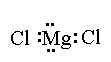
Note that this does not tell us anything about the shape of a molecule - we put the two Mg atoms opposite one another in this example, but in reality the spatial orientation may be quite different than this.
Lattice Energy
For an ionic compound, the lattice energy is the energy required to dissociate the compound into gas-phase ions. This is a large energy, since we must overcome the strong attractive forces between the ions. These energies can be approximated using a simple electrostatic model, E = K q1 q2 / d, where K is a constant, q1 and q2 are the charges on the ions, and d is the distance between them. Obviously, if the charges are greater or the interionic distance is smaller, then the energy holding them together will be greater.
e.g. Which has the larger lattice energy: NaCl or
KCl?
The anion is the same in both cases, and the cation has the smae charge
in both cases. The only thing that might make a difference is the interionic
distance. Na+ is a smaller cation than K+, thus we expect the lattice energy for
NaCl to be greater. (It is, by the way.)
e.g. Which has the larger lattice energy: KCl or
CaCl2?
K+ and Ca+2 have similar ionic radii
- note that they are isoelectronic. The major difference is charge, so we expect
the calcijm salt to have a larger lattice energy.
e.g. which has the greater lattice energy:
Li2O or LiI?
Here, the cation is the same. The anions differ is
size and in charge. Generally, the effect of charge is greater than that of
size. Thus, the oxide is expected to have a much greater lattice energy, and
does.
Born-Haber Cycles
These theoretical constructs are used to predict the energy change of a particular step in a sequence of reactions leading to the formation of a salt. We might predict the lattice energy of the salt, the ionization energy of the metal or the electron affinity of the non-metal. The steps in the Born Haber cycle for a salt are:
1. Starting with the metal, Vaporize it to a gas (requires energy)
2.
Ionize the gaseous metal atoms to cations (requires energy)
3. Dissociate the
non-metal, if required, to single atoms (requires energy)
4. Ionize the
non-metal to anions (releases energy)
5. Combine the cations and anions to
form the solid salt (releases a great deal of energy, usually)
If we know the enegies of four of these steps, we can calculate the other
one.
For instance, problem 6.53 in the textbook:
Calculate the lattice energy of CaH2 given that:
The electron
affinity of H is -72.8 kJ/mol
The first ionization potential of Ca is +589.8
kJ/mol
The second ionization potential of Ca is +1145 kJ/mol
The heat of
sublimation of Ca is +178.2 kJ/mol
The bond dissociation energy of
H2 is +435.9 kJ/mol
The net energy change for formation of
CaH2 from the elements is -186.2 kJ/mol
Arrange the reactions in order, with their energies, and solve for the unknown one:
1. Ca(s) ® Ca(g)
+178.2 kJ/mol
2. Ca(g) ®
Ca+(g) +589.8 kJ/mol
3. Ca+(g) ® Ca+2(g) +1145
kJ/mol
4. H2(g) ®
2 H(g) +435.9 kJ/mol H2
5. 2 H + 2 e- ® 2 H-(g)
2(-72.8) = -145.6 kJ
6. Ca+2(g) + 2 H-(g)
® CaH2(s) ??
kJ/mol
Sum of above:
7. Ca(s) + H2(g) ® CaH2(s) -186.2
kJ/mol
The energy of step 6 is the total energy, less the other 5 steps:
-186.2 - (+178.2 + 589.8 + 1145 + 435.9 - 145.6) = -2,389.5 kJ/mol, i.e. lots
of energy released, as expected. The lattice energy is the energy for the
opposite of step 6, i.e. +2390 kJ/mol required to dissociate the salt into its
gaseous ions.