Tutorial #2
Atomic Structure, Mole Calculations
I. Atomic Structure
Energy levels in a simple hydrogen atom can be calculated using the Balmer-Rydberg equation:
1/l = R[1/m2 - 1/n2] where R is the Rydberg constant, 0.01097 nm-1, n is the upper energy level and m is the lower one.
Note that three series of lines have been identified, differing only in the value of m. If m=2, we have the Balmer series, in the visible range. If m=1, we have the Lyman series, in the UV range. And if m=3, we have the Paschen series in the IR.
Note also that if n=infinity, this is the largest energy transition in the series, and 1/l = R[1/m2].
1. (question 5.51 fron text, 2nd ed.)
Lines in the Brackett series have m=4. Find the l of the first line in the series. Find the photon energy in kJ/mol.
1/l = R[1/m2 - 1/n2]
The first line has n=5.
Thus, 1/l = 0.01097 nm-1 [1/42
- 1/52] = 0.000247 nm-1. Thus l =
4051 nm (IR)
E = hn = hc/l
= 6.63 x 10⁻³⁴ J s (3.00 x 10⁸ m s-1) /
4051 x 10-9 m = 4.90 x 10⁻²⁰ J/photon
x 6.02 x
1023 mol-1 = 29,600 J/mol photons = 29.6 kJ/mol
Quantum Numbers
The Schroedinger equation yields three quantum numbers: n, l and ml. n is the principle quantum number. It signifies the energy of the electrons in it, and their distance from the nucleus. The value of n must be >0. We speak of the n=1 shell, the n=2 shell and so on.
Within a shell there are subshells. These are numbered l = 0, 1,...n-1. Thus, the number of subshells depends on the value of n. In the n=1 shell, l=0 only, and thus the only type of orbital is a so-called s-orbital. In the n=2 shell, l can have values of 0 or 1, which signify s or p orbitals. In the n=3 shell, there can be s, p or d orbitals, and in the n=4 shell, there can be s, p, d and f orbitals. s, p, d or f orbitals are often referred to as subshells.
Orbitals can have different orientations. The magnetic quantum number ml specifies which p, d or f orbital we are talking about. In general, -l <= ml <= l. There are thus three different p-orbitals, 5 d-orbitals and 7 f-orbitals, but only one s-orbital.
AUFBAU
Use the nmemonic to remember the orbital filling order:
1s
2s 2p
3s 3p 3d
4s 4p 4d 4f
5s 5p 5d 5f
6s 6p 6d 6f
7s 7p
7d 7f
(and draw in the diagonal lines.)
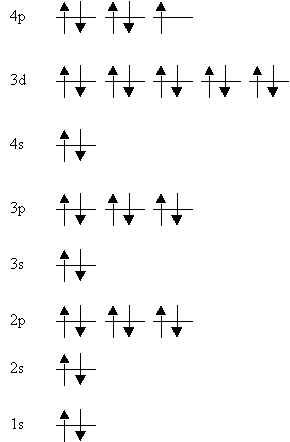
2. What is the ground electronic state of Br (element 35)?
1s2 2s2 2p6 3s2 3p6
4s2 3d10 4p5
or, [Ar] 4s2
3d10 4p5
3. Draw an orbital filling diagram for Br. Place the orbitals in ascending order of energy.
II. Use of the Mole
4. How many molecules are there in 341 mL of beer? Assume beer is mostly water, whose density = 1.00 g/mL
Thus, g water = 341 mL x 1.00 g/mL = 341 g water
MW(H2O) = 2 x
1.01 + 16.0 = 18.02 g/mol
Thus, 341 g water = 341 g / 18.02 g/mol = 18.9 mol
water
= 18.9 mol x 6.02 x 1023 molecules mol-1 = 1.14 x
1025 molecules
For a reaction, we use the balanced chemical reaction as a guide to calculating the amount of product possible from a certain amount of reactant(s). For example,
5. For the reaction 2 Na(s) + 2 H2O(l) ® 2 Na+(aq) + 2 OH-(aq) + H2(g)
calculate the mass of hydrogen gas liberated by the reaction of 1 g Na with excess water.
The method for any such calculation is:
(i)convert mass of reactant to moles of reactant
(ii) use the balanced
reaction to determine the moles of product
(iii) convert moles of product to
mass of product
For this problem,
(i) 1 g Na = 1 g / 23.0 g/mol = 0.0434 mol Na
(ii) from the reaction, 2
mol Na gives 1 mole H2(g).
Thus, moles H2(g) = 0.0434
mol Na x (1 mol H2(g) / 2 mol Na) = 0.0217 mol
H2(g)
(iii) g H2(g) = 0.0217 mol H2(g) x
2.02 g/mol = 0.0878 g H2(g).
Limiting Reactants
Often (usually, in fact), reactions are performed with one of the reactants in excess of the amonut required to completely react with the other. We need to determine how much of the products are formed under these circumstances.
6. Suppose we react 1 g of chlorine gas with 1 gram of ethene according to the reaction:
Cl2(g) + C2H4(g) ® C2H4Cl2(g)
Which reactant gets used up first, i.e. which is the limiting reactant? Also, how much product (in g) is produced?
For limiting reactant problems, the approach is similar to the above problem:
(i) calculate the moles of each reactant available
(ii) calculate which
one is in excess - the other is the limiting reactant, and will determine how
much product is formed.
1 g Cl2(g) = 1 g / 70.9 g/mol = 0.0141 mol Cl2(g)
1
g C2H4(g) = 1 g / 28.0 g/mol = 0.0357 mol
C2H4(g)
Thus, since they react in a 1:1 mol ratio, the C2H4(g) is in excess, and so the Cl2(g) is the limiting reactant.
Thus, moles C2H4Cl2(g) = moles Cl2(g) =
0.0141 mol
= 0.0141 mol x 98.9 g/mol = 1.39 g C2H4Cl2(g) produced
7. For the reaction HI + KHCO3 à KI +
H2O + CO2
(a) how much KI is produced from reacting 48
g HI with 318 g KHCO3?
481 g HI x (1 mol / 127.9 g) = 3.76 mol HI
318 g KHCO3 x (1 mol
/ 100.1 g) = 3.18 mol KHCO3
Thus, HI is in excess, since the two reactants react in a 1:1 mole ratio. Thus, the amount of KI formed is limited by the amount of KHCO3.
? g KI = 3.18 mol KHCO3 x (1 mol KI / 1 mol
KHCO3) x (166.0 g KI / 1 mol KI)
= 528 g KI
The term in red comes from inspection of the reaction, showing the
1:1 mole ratio of KI to KHCO3
(b) How much HI is consumed and how much is left over?
HI consumed = 3.18 mol KHCO3 x (1 mol HI / 1 mol KHCO3)
x (127.9 g HI / 1 mol HI)
= 407 g HI
Thus, HI left over = 481 - 407 = 74 g
HI left over.