Tutorial #1
Atomic Structure
I. Light as waves
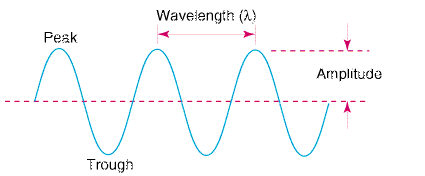
Let's first look at some properties of waves. As shown below, electromagnetic waves move (propagate), left to right as shown, at the speed of light (c = 3.00 x 10⁸ m s-1). They have a wavelength denoted by l, and they have amplitudes. The amplitude is the strength of the electric or magnetic field. Note that the wave can have zero amplitude (every point where it crosses the horizontal axis), but is still propagating.
1. Find the frequency of red light having a wavelength of 700 nm.
n = c/l = (3.00 x 10⁸ m s-1) / (700 x 10-9 m)
= 4.29 x 10¹⁴ s-1
(= 4.29 x 10¹⁴ Hz)
2. Find the frequency of blue light from a mercury lamp having a wavelength of 435.8 nm.
n = c/l = (3.00 x 10⁸ m s-1) / (435.8 x 10⁻⁹ m)
= 6.88 x 10¹⁴ s-1
(= 6.88 x 10¹⁴ Hz)
(higher that that of red light - blue light is more
energetic than red)
3. Find the frequency (n) of a g-ray having a wavelength (l) of 3.56 x 10⁻¹¹ m
n = c/l = (3.00 x 10⁸ m s-1) / (3.56 x 10⁻¹¹ m)
= 8.42 x 10¹⁸ s-1
(makes sense, since this is a higher frequency than
visible light)
4. Find the frequency of a radar wave with l = 10.3 cm
n = c/l = (3.00 x 10⁸ m s-1) / (1.03 x 10⁻¹ m)
= 2.91 x 10⁹ s-1
(much lower
frequency, as expected)
5. Find the wavelength of an FM signal having a frequency of 106.0 MHz (i.e. CHEZ-FM)
l = c/n = (3.00 x 10⁸ m s-1) / (106.0 x 10⁸ s-1)
= 2.83 m
II. Light as waves and as particles
We can also think of light as particles - photons. These will have specific energies, and we can use Planck's equation to relate their wavelike characteristics (frequencies or wavelengths) to particle-like characteristics (energies).
6. Find the energy of photons from:
(a) IR radiation having l = 1.55 x 10⁻⁶ m (=1550 nm)
E = hn = hc/l = 6.63 x 10⁻³⁴ J
s ((3.00 x 10⁸ m s-1) / 1.55 x 10⁻⁶ m))
=
1.28 x 10⁻¹⁹ J (per photon)
To find the energy per mole of photons, multiply by Avogadro's number:
E =
6.022 x 10²³ mol-1 x 1.28 x 10-19 J
= 77,300
J/mol
= 77.3 kJ/(mol photons)
(b) UV radiation having l = 250 nm
Note that this is a much shorter wavelength than the IR radiation. Thus, we expect the energy to be higher per photon. This is why UV radiation is more damaging to your skin than IR.
As above,
E = hn = hc/l = 6.63 x
10-34 J s ((3.00 x 10⁸ m s-1) / 250 x
10-9 m))
= 7.96 x 10⁻¹⁹ J/photon
To find the energy per mole of photons, multiply by Avogadro's number:
E =
6.022 x 10²³ mol-1 x 7.96 x 10-19 J/photon
=
479000 J (mol photons)-1
= 479 kJ (mol photons) -1
7. Iodine molecules (I2) can be dissociated into two iodine atoms
by light if the energy of the light is sufficient. Experiments show that the
wavelength of the light must be less than 499.5 nm.
(a) What is the
frequency of 499.5 nm light? What part of the electromagentic spectrum is this
light in?
(b) Use Planck’s equation to calculate the energy of dissociation
of iodine. Express your answer in kJ/mol.
If an electron can have wavelike properties, so can any moving object:
8. Calculate the wavelengths of:
(a) an electron moving at 1/20th the speed of light:
l = h/mv = (6.63 x 10⁻³⁴ J s) / ((9.11 x
10-31 kg) x (3.00 x 10⁸ m s-1 / 20)
= 4.85 x
10-11 m (The units work out to be m, since a
Joule (J) is a kg m2 s-2.)
(b) a neutron moving at the same speed:
l = h/mv
= (6.63 x 10⁻³⁴ J s) / ((1.67 x 10⁻²⁷ kg) x (3.00 x
108 m s-1 / 20)
= 2.65 x 10⁻¹⁴ m
(more massive particle = more energy = LOWER wavelength)
9. A major league baseball weighs approximately 5.0 ounces. Find the wavelength of a 95 mph fastball.
here, m = 5.0 oz x (28.3 g/oz) x (.001 kg/g) = 0.142 kg
and, v = 95 mile/h
x (1.62 km/mile) x (1000 m/km) x (1 h / 3600 s) = 42.8 m s-1
thus
l = h/mv = (6.63 x 10⁻³⁴ J s) / ((0.142 kg)
x (42.8 m s-1)
= 1.09 x 10⁻³⁴ m (much more massive
particle; even though the velocity is small, the wavelength is very small,
i.e.very high energy)
10. A photon strikes a metal surface and causes an electron to be ejected at 2.2 x 10³ km s-1. What part of the electromagnetic spectrum is this in?
l = h/mv = (6.63 x 10⁻³⁴ J s) / ((9.11 x
10-31 kg) x (2.2 x 10⁵ m s-1)
= 3.31 x
10-9 m = 3 nm
n = c/l = 3.00 x 10⁸ m s-1 / 3.31 x 10⁻⁹ m = 9.1 x 10¹⁶ s-1 (which is in the far UV region, close to x-ray frequencies)