 = 8.41 x
10-3 mol Cl-
= 8.41 x
10-3 mol Cl-Possible formulas for the metal halide are MCl, MCl2, MCl3, etc.
For MCl, mol M = mol Cl- = 8.41 x 10⁻³ mol M
Chapter 6
Ionic Bonds and Some Main-Group
Chemistry
6.1 (a) Ra2+ [Rn] (b) La3+
[Xe] (c) Ti4+ [Ar] (d) N3- [Ne]
Each ion has the
ground-state electron configuration of the noble gas closest to it in the
periodic table.
6.2 The neutral atom contains 30 e-
and is Zn. The ion is Zn2+.
6.3 (a) O2-; decrease
in effective nuclear charge and an increase in electron-electron repulsions lead
to the larger anion.
(b) S; atoms get larger as you go down a group.
(c)
Fe; in Fe3+ electrons are removed from a larger valence shell and
there is an increase in effective nuclear charge leading to the smaller
cation.
(d) H-; decrease in effective nuclear charge and an
increase in electron-electron repulsions lead to the larger anion.
6.4 K+ is smaller than neutral K because the ion has one less electron. K+ and Cl- are isoelectronic, but K+ is smaller than Cl- because of its higher effective nuclear charge. K is larger than Cl- because K has one additional electron and that electron begins the next shell (period). K+, r = 133 pm; Cl-, r = 184 pm; K, r = 227 pm
6.5 (a) Br (b) S (c) Se (d) Ne
6.9 Cr [Ar] 4s1 3d5 Mn [Ar] 4s2 3d5 Fe [Ar] 4s2 3d6
Cr can accept an electron into a 4s orbital. The 4s orbital is lower in energy than a 3d orbital. Both Mn and Fe accept the added electron into a 3d orbital that contains an electron, but Mn has a lower value of Zeff. Therefore, Mn has a less negative Eea than either Cr or Fe.
6.10 The least favorable Eea is for Kr (red) because it is a noble gas with filled set of 4p orbitals. The most favorable Eea is for Ge (blue) because the 4p orbitals would become half filled. In addition, Zeff is larger for Ge than it is for K (green).
6.11 (a) KCl has the higher lattice energy
because of the smaller K+.
(b) CaF2 has the higher
lattice energy because of the smaller Ca2+.
(c) CaO has the higher
lattice energy because of the higher charge on both the cation and
anion.
6.12 K(s) K(g) +89.2 kJ/mol
K(g) ® K+(g) +
e- +418.8 kJ/mol
½ [F2(g) ®2 F(g)] +79 kJ/mol
F(g) +
e- ®
F-(g) -328 kJ/mol
K+(g) + F-(g) ® KF(s) -821
kJ/mol
Sum = -562 kJ/mol
6.13 The cation and anion charges are the same for both (a) and (b). The alkaline earth oxide with the larger lattice energy is (b) because the ions are smaller and the charges are closer to each other. In (a) the lattice energy is smaller because the ions are larger and the charges are farther apart.
6.14 (a) Li2O, O -2 (b) K2O2, O -1 (c) CsO2, O -½
6.15 (a) 2 Cs(s) + 2 H2O(l)
®2
Cs+(aq) + 2 OH-(aq) + H2(g)
(b) Na(s) +
N2(g) ®
N. R.
(c) Rb(s) + O2(g) ®RbO2(s)
(d) 2
K(s) + 2 NH3(g) ®2 KNH2(s) + H2(g)
(e) 2 Rb(s) +
H2(g) ®
2 RbH(s)
6.16 (a) Be(s) + Br2(l) ® BeBr2(s)
(b)
Sr(s) + 2 H2O(l) ® Sr(OH)2(aq) + H2(g)
(c) 2 Mg(s)
+ O2(g) ® 2 MgO(s)
6.17 BeCl2(s) + 2 K(s)
® Be(s) + 2
KCl(s)
6.18 Mg(s) + S(s) ® MgS(s); In MgS, the oxidation number of S is
-2.
6.21 (a) Br2(l) + Cl2(g)
® 2 BrCl(g)
(b)
2 Al(s) + 3 F2(g) ® 2 AlF3(s)
(c) H2(g) +
I2(s) ®
2 HI(g)
6.22 Br2(l) + 2 NaI(s) ® 2 NaBr(s) +
I2(s)
Br2 gains electrons and is the oxidizing agent.
I- (from NaI) loses electrons and is the reducing agent.
6.39 Z = 30, Zn
6.48 Using Figure 6.3 as a reference:
| Lowest Ei1 | Highest Ei1 | |
| (a) | K | Li |
| (b) | B | Cl |
| (c) | Ca | Cl |
6.63 (a) Li(s) ® Li(g) +159.4 kJ/mol
Li(g)
® Li+(g)
+ e- +520 kJ/mol
½[F2(g) ® 2 F(g)] +79 kJ/mol
F(g) +
e- ®
F-(g) -328 kJ/mol
Li+(g) + F-(g)
® LiF(s) -1036
kJ/mol
Sum = -606 kJ/mol
(b) Ca(s) ® Ca(g) +178.2 kJ/mol
Ca(g) ® Ca+(g) +
e- +589.8 kJ/mol
Ca+(g) ® Ca2+(g) +
e- +1145 kJ/mol
F2(g) ®2 F(g) +158 kJ/mol
2[F(g) +
e- ®F-(g)] 2(-328) kJ/mol
Ca2+(g) +
2 F- ®
CaF2(s) -2630 kJ/mol
Sum = -1215 kJ/mol
6.80 Main-group elements tend to undergo reactions that leave them with eight valence electrons. That is, main-group elements react so that they attain a noble-gas electron configuration with filled s and p sublevels in their valence electron shell.
The octet rule works for valence-shell electrons because taking electrons away from a filled octet is difficult because they are tightly held by a high Zeff; adding more electrons to a filled octet is difficult because, with s and p sublevels full, there is no low-energy orbital available.
6.87 2 Mg(s) + O2(g) ® 2 MgO(s)
MgO(s) +
H2O(l) ®
Mg(OH)2(aq)
6.105 94.2 mL = 0.0942 L
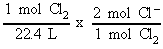
0.0942 L Cl2 x = 8.41 x
10-3 mol Cl-
Possible formulas for the metal halide are
MCl, MCl2, MCl3, etc.
For MCl, mol M = mol
Cl- = 8.41 x 10⁻³ mol M
molar mass of M = 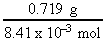 = 85.5
g/mol
= 85.5
g/mol
For MCl2, mol M = 8.41 x 10⁻³ mol Cl-
x  =
4.20 x 10⁻³ mol M
=
4.20 x 10⁻³ mol M
molar mass of M = 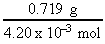 = 171
g/mol
= 171
g/mol
For MCl3, mol M = 8.41 x 10⁻³ mol Cl-
x  =
2.80 x 10⁻³ mol M
=
2.80 x 10⁻³ mol M
molar mass of M = 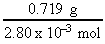 = 257
g/mol
= 257
g/mol
The best match for a metal is with 85.5 g/mol, which is Rb.
6.106 Mg(s) ® Mg(g) +147.7 kJ/mol
Mg(g)
® Mg+(g)
+ e- +738 kJ/mol
Mg+(g) ® Mg2+(g) + e-
+1451 kJ/mol
½[O2(g) ® 2 O(g)] +249.2 kJ/mol
O(g) + e-
® O-(g)
-141.0 kJ/mol
O-(g) + e- ® O2-(g)
Eea2
Mg2+(g) + O2-(g) ® MgO(s) -3791
kJ/mol
Mg(s) + ½O2(g) ® MgO(s) -601.7 kJ/mol
147.7 + 738 + 1451 + 249.2 - 141.0 +
Eea2 - 3791 = -601.7
Eea2 = -147.7 - 738 - 1451 - 249.2
+ 141.0 + 3791 - 601.7 = +744 kJ/mol
Because Eea2 is positive,
O2- is not stable in the gas phase. It is stable in MgO because of
the large lattice energy that results from the +2 and -2 charge of the ions and
their small size.