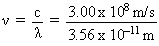
 = 8.43 x 10¹⁸ s-1 = 8.43 x 10¹⁸
Hz
= 8.43 x 10¹⁸ s-1 = 8.43 x 10¹⁸
HzChapter 5
Periodicity and Atomic
Structure
5.1 Gamma ray = 8.43 x 10¹⁸ s-1 = 8.43 x 10¹⁸
Hz
Radar wave 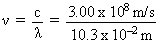 = 2.91 x 10⁹ s-1 = 2.91 x 10⁹
Hz
= 2.91 x 10⁹ s-1 = 2.91 x 10⁹
Hz
5.2 102.5 MHz = 102.5 x10⁶ Hz = 102.5 x10⁶ s-1
 = 9.55 x 10¹⁷ Hz = 9.55 x 10¹⁷ s-1

5.3 The wave with the shorter wavelength (b) has the higher frequency. The wave with the larger amplitude (b) represents the more intense beam of light. The wave with the shorter wavelength (b) represents blue light. The wave with the longer wavelength (a) represents red light.
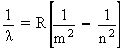
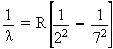
5.4 Balmer series: m = 2; R = 1.097 x 10⁻² nm-1
 ;
;
 ;
;
 2.519
x 10-3 nm-1; = 397.0 nm
2.519
x 10-3 nm-1; = 397.0 nm
5.5 Paschen series: m = 3; R = 1.097 x 10⁻² nm-1
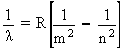 ;
;
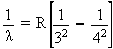 ;
;
 =
5.333 x 10⁻⁴ nm-1; = 1875 nm
=
5.333 x 10⁻⁴ nm-1; = 1875 nm
5.6 Paschen series: m = 3; R = 1.097 x 10⁻² nm-1
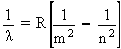 ;
; 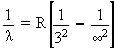 ;
;  = 1.219 x 10⁻³ nm-1; = 820.4 nm
5.7 91.2 nm = 91.2 x 10⁻⁹ m
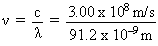 = 3.29 x 10¹⁵ s-1
E = h = (6.626 x 10⁻³⁴
Js)(3.29 x 10¹⁵ s-1) = 2.18 x 10⁻¹⁸
J/photon
E = (2.18 x 10⁻¹⁸ J/photon)(6.022 x 1023
photons/mol) = 1.31 x 10⁶ J/mol = 1310 kJ/mol
5.8 IR, = 1.55 x 10⁻⁶ m
E = 7.72 x 10⁴ J/mol = 77.2
kJ/mol
UV, = 250 nm = 250 x 10-9 m
E = 4.79 x 10⁵
J/mol = 479 kJ/mol
X ray, = 5.49 nm = 5.49 x 10⁻⁹ m
E = 2.18 x
107 J/mol = 2.18 x 10⁴ kJ/mol
5.9  = 2.34 x
10-38 m
= 2.34 x
10-38 m
5.10 (x)(mv)  ; uncertainty in
velocity = (45 m/s)(0.02) = 0.9 m/s
; uncertainty in
velocity = (45 m/s)(0.02) = 0.9 m/s

5.11
| n | l | ml | Orbital | No. of Orbitals |
| 5 | 0 | 0 | 5s | 1 |
| 1 | -1,0,+1 | 5p | 3 | |
| 2 | -2,-1,0,+1,+2 | 5d | 5 | |
| 3 | -3,-2,-1,0,1,2,3 | 5f | 7 | |
| 4 | -4,-3,-2,-1,0,1,2,3,4 | 5g | 9 |
There are 25 possible orbitals in the fifth shell.
5.12 (a) 2p (b) 4f (c) 3d
5.13 (a) 3s orbital: n = 3, l = 0, ml = 0
(b)
2p orbital: n = 2, l = 1, ml = -1, 0, +1
(c) 4d
orbital: n = 4, l = 2, ml = -2, -1, 0, +1, +2
5.14 The g orbitals have four nodal planes.
5.15 The figure represents
a d orbital, n = 4 and l = 2.
5.16 m = 1, n = ; R = 1.097 x
10-2 nm-1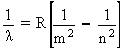 ;
; 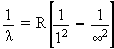 ;
;  = 1.097 x
10-2 nm-1; = 91.2 nm
= 1.097 x
10-2 nm-1; = 91.2 nm
E = 
E = 1.31 x 10⁶ J/mol = 1.31 x 10³ kJ/mol
5.17
(a) Ti, 1s2 2s2 2p6 3s2 3p6
4s2 3d2 or [Ar] 4s2 3d2
(b) Zn, 1s2 2s2 2p6 3s2 3p6 4s2 3d10 or [Ar] 4s2 3d10
(c) Sn, 1s2 2s2 2p6 3s2 3p6 4s2 3d10 4p6 5s2 4d10 5p2 or [Kr] 5s2 4d10 5p2
(d) Pb, [Xe] 6s2 4f14 5d10 6p2
5.18 For Na+, 1s2 2s2 2p6
5.19 The ground-state electron configuration contains 28 electrons. The atom is Ni.
5.20 Cr, Cu, Nb, Mo, Ru, Rh, Pd, Ag, La, Ce, Gd, Pt, Au, Ac, Th, Pa, U, Np, Cm
5.21 (a) Ba; atoms get larger as you go down a group.
(b) W; atoms get
smaller as you go across a period.
(c) Sn; atoms get larger as you go down a
group.
(d) Ce; atoms get smaller as you go across a period.
5.22 The aurora borealis begins on the surface of the sun with a massive solar flare. These flares eject a solar "gas" of energetic protons and electrons that reach earth after about 2 days and are then attracted toward the north and south magnetic poles. The energetic electrons are deflected by the earth's magnetic field into a series of sheetlike beams. The electrons then collide with O2 and N2 molecules in the upper atmosphere, exciting them, ionizing them, and breaking them apart into O and N atoms. The energetically excited atoms, ions, and molecules generated by collisions with electrons emit energy of characteristic wavelengths when they decay to their ground states. The O2+ ions emit a red light around 630 nm; N2+ ions emit violet and blue light at 391.4 nm and 470.0 nm; and O atoms emit a greenish-yellow light at 557.7 nm and a deep red light at 630.0 nm.
5.24 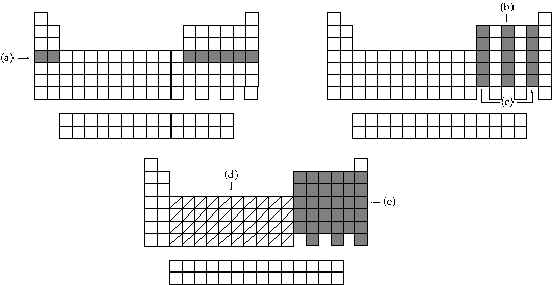
5.29 (a) 3py n = 3, l = 1 (b)  n =
4, l = 2
n =
4, l = 2
5.34 (a) = 99.5 MHz
= 99.5 x 10⁶ s-1
E = h = (6.626 x 10⁻³⁴
Js)(99.5 x 10⁶ s-1)(6.022 x 10²³ /mol)
E =
3.97 × 10⁻² J/mol = 3.97 × 10⁻⁵ kJ/mol
= 115.0 kHz =
115.0 x 10³ s-1
E = h = (6.626 x 10⁻³⁴
Js)(115.0 x 10³ s-1)(6.022 x 10²³ /mol)
E =
4.589 x 10⁻⁵ J/mol = 4.589 x 10⁻⁸ kJ/mol
The FM radio
wave (99.5 MHz) has the higher energy.
(b) = 3.44 x 10⁻⁹ m
E = 3.48 x 10⁷ J/mol = 3.48 x
104 kJ/mol
= 6.71 × 10⁻² m
E = 1.78 J/mol = 1.78 x 10⁻³
kJ/mol
The X ray ( = 3.44 x 10⁻⁹ m) has the higher
energy.
5.47 Brackett series: m = 4, n = 5; R = 1.097 x 10⁻²
nm-1
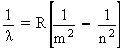 ;
; 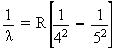 = 2.468 x
10-4 nm-1; = 4051 nm
= 2.468 x
10-4 nm-1; = 4051 nm

Brackett series: m = 4, n = 6; R = 1.097 x 10⁻² nm-1
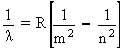 ;
; 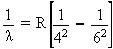 = 3.809 x
10-4 nm-1; = 2625 nm
= 3.809 x
10-4 nm-1; = 2625 nm
5.57 (a) 3s (b) 2p (c) 4f (d) 4d
5.59 Co
1s2 2s2 2p6 3s2 3p6
4s2 3d7
(a) is not allowed because for l = 0,
ml = 0 only.
(b) is not allowed because n = 4 and
l = 2 is for a 4d orbital.
(c) is allowed because n = 3 and
l = 1 is for a 3p orbital.
5.65 The n and l quantum numbers determine the energy level of an orbital in a multielectron atom.
5.71 (a) Z = 55, Cs [Kr] 5s2 4d10 5p6 6s1 (b) Z = 40, Zr [Kr] 5s2 4d2
(c) Z = 80, Hg [Xe] 6s2 4f14 5d10 (d) Z = 62, Sm [Xe] 6s2 4f6
5.77 Z = 119 [Rn] 7s25f146d107p68s1
5.81 A g orbital would begin filling at atomic number = 121 (see 5.80). There are nine g orbitals that can each hold two electrons. The first element to have a filled g orbital would be atomic number = 138.
5.83 Across a period, the effective nuclear charge increases, causing a decrease in atomic radii.
5.93 = 9,192,631,770 s-1 = 9.19263 x 10⁹ s-1
E = h = (6.626 x 10⁻³⁴ Js)(9.19263 x
109 s-1) (6.022 x
1023/mol)
(6.022 x
1023/mol)
E = 3.668 x 10⁻³ kJ/mol
Although Hf ([Xe] 6s2 4f14
5d2) is directly below Zr ([Kr] 5s2 4d2) in the
periodic table, Zr and Hf have almost identical atomic radii because the 4f
electrons in Hf are not effective in shielding the valence electrons. The
valence electrons in Hf are drawn in closer to the nucleus by the higher
Zeff.
5.101 75 W = 75 J/s; 550 nm = 550 x 10-9 m;
(0.05)(75 J/s) = 3.75 J/s
number of photons = 
5.107 (a) Cl2, 70.91 amu
M +
Cl2 ® MCl2
mol Cl2 = 0.8092 g
Cl2 x  = 0.01141 mol Cl2
mol M = 0.01141 mol Cl2
x  = 0.01141 mol M
molar mass of M =  = 87.64
g/mol
= 87.64
g/mol
atomic mass of M = 87.64 amu; M = Sr
(b) q =  = 829
kJ/mol
= 829
kJ/mol