
Chapter 2
Atoms, Molecules, and Ions
2.1 First, find the S:O ratio in each compound.
Substance 1: S:O mass ratio = (6.00 g S) / (5.99 g O) = 1.00
Substance 2:
S:O mass ratio = (8.60 g S) / (12.88 g O) = 0.668
2.2 0.0002 in x 
2.3  or approximately 40 times
2.4  has 34 protons, 34 electrons, and (75 S 34) = 41 neutrons.
2.5  has (35 S 17) = 18
neutrons.
has (35 S 17) = 18
neutrons.  has (37
S 17) = 20 neutrons.
has (37
S 17) = 20 neutrons.
2.6 The element with 47 protons is Ag. The mass number is the sum of the
protons and the neutrons, 47 + 62 = 109. The isotope symbol is  .
.
2.7 atomic mass = (0.6917 x 62.94 amu) + (0.3083 x 64.93 amu) = 63.55 amu
2.8 2.15 g x 
2.9 Figure (a) represents a mixture of two different types of
molecules.
Figure (c) represents a pure compound composed of two different
elements.
Figure (b) represents a diatomic element.
2.10 Figure (b) represents a collection of hydrogen peroxide (H2O2) molecules.
2.11
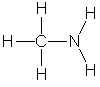
2.12 adrenaline, C9H13NO3
2.13 (a) LiBr is composed of a metal (Li) and nonmetal (Br) and is
ionic.
(b) SiCl4 is composed of only nonmetals and is
molecular.
(c) BF3 is composed of only nonmetals and is
molecular.
(d) CaO is composed of a metal (Ca) and nonmetal (O) and is
ionic.
2.14 Figure (a) most likely represents an ionic compound because there are no discrete molecules, only a regular array of two different chemical species (ions). Figure (b) most likely represents a molecular compound because discrete molecules are present.
2.15 (a) HF is an acid. In water, HF dissociates to produce
H+(aq).
(b) Ca(OH)2 is a base. In water,
Ca(OH)2 dissociates to produce OH-(aq).
(c) LiOH is a base. In water, LiOH
dissociates to produce OH-(aq).
(d)
HCN is an acid. In water, HCN dissociates to produce H+(aq).
2.16 (a) CsF, cesium fluoride
(b) K2O, potassium oxide
(c)
CuO, copper(II) oxide
(d) BaS, barium sulfide
(e) BeBr2,
beryllium bromide
2.17 (a) vanadium(III) chloride, VCl3
(b) manganese(IV) oxide,
MnO2
(c) copper(II) sulfide, CuS
(d) aluminum oxide,
Al2O3
2.18 (a) NCl3, nitrogen trichloride
(b)
P4O6, tetraphosphorus hexoxide
(c)
S2F2, disulfur difluoride
2.19 (a) disulfur dichloride, S2Cl2
(b) iodine
monochloride, ICl
(c) nitrogen triiodide, NI3
2.20 (a) Ca(ClO)2, calcium hypochlorite
(b)
Ag2S2O3, silver(I) thiosulfate or silver
thiosulfate
(c) NaH2PO4, sodium dihydrogen
phosphate
(d) Sn(NO3)2, tin(II) nitrate
(e)
Pb(CH3CO2), lead(IV) acetate
2.21 (a) lithium phosphate, Li3PO4
(b) magnesium
hydrogen sulfate, Mg(HSO4)2
(c) manganese(II) nitrate,
Mn(NO3)2 (d) chromium(III) sulfate,
Cr2(SO4)3
2.22 The ionic compound represented in the drawing has 2 anions per cation. The ionic compound is CaCl2.
2.23 (a) HIO4, periodic acid
(b) HBrO2, bromous
acid
(c) H2CrO4, chromic acid
2.24 A normal visual image results when light from the sun or other source reflects off an object, strikes the retina in our eye, and is converted into electrical signals that are processed by the brain. The image obtained with a scanning tunneling microscope, by contrast, is a three-dimensional, computer-generated data plot that uses tunneling current to mimic depth perception. The nature of the computer-generated image depends on the identity of the molecules or atoms on the surface, on the precision with which the probe tip is made, on how the data are manipulated, and on other experimental variables.
2.25 Drawing (a) depicts a collection of SO2 molecules.
2.27 Figures (b) and (d) illustrate the law of multiple proportions. The mass ratio is 2.
2.38 (a) 
This result is numerically equal to the atomic mass of H in
grams.
(b) 
This result is numerically equal to the atomic mass of O in
grams.
2.46 The subscript giving the atomic number of an atom is often left off of an isotope symbol because one can readily look up the atomic number in the periodic table.
2.56 (0.199 x 10.0129 amu) + (0.801 x 11.009 31 amu) = 10.8 amu for B
2.67 (a) The formula of ammonia is NH3.
(b) The ionic solid
potassium chloride has the formula KCl.
(c) ClS is an anion.
(d)
CH4 is a neutral molecule.
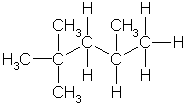
2.73
2.76 HI(aq) ® H+(aq) + IS(aq); the anion is IS
H3PO4(aq)
® H+(aq) + H2PO4S(aq); the predominant anion is
H2PO4S
H2CO3(aq)
® H+(aq) + HCO3S(aq); the predominant anion is
HCO3S
2.82 (a) SO32S
(b) PO43S
(c) Zr4+
(d)
CrO42S
(e)
CH3CO2S
(f)
S2O32S
2.89 
number of C atoms = 
time = 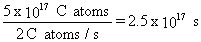
2.97 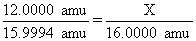 ; X = 12.0005 amu for 12C prior to 1961.
2.106 Molecular mass = (8 x 12.011 amu) + (9 x 1.0079 amu) + (1 x 14.0067 amu) + (2 x 15.9994 amu) = 151.165 amu
2.109 (a) Because X reacts by losing electrons, it is likely to be a
metal.
(b) Because Y reacts by gaining electrons, it is likely to be a
nonmetal.
(c) X2Y3
(d) X is likely to be in group 3A
and Y is likely to be in group 6A.