Chapter 17
Thermodynamics: Entropy, Free Energy, and
Equilibrium
17.1 (a) spontaneous; (b), (c), and (d)
nonspontaneous
17.2 (a) H2O(g) ® H2O(l)
A liquid
is more ordered than a gas. Therefore, DS is negative.
(b) I2(g) ® 2 I(g)
DS is positive because the
reaction increases the number of gaseous particles from 1 mol to 2
mol.
(c) CaCO3(s) ® CaO(s) +
CO2(g)
DS is positive because the reaction increases the number
of gaseous molecules.
(d) Ag+(aq) + Br-(aq)
® AgBr(s)
A
solid is more ordered than +1 and -1 charged ions in an aqueous solution.
Therefore, DS is
negative.
17.3 (a) A2 + 2 B ® 2 AB
(b) DS is negative because the
reaction decreases the number of gaseous molecules.
17.4 (a) disordered N2O
(b) silica
glass (amorphous solid, more disorder)
(c) 1 mole N2 at STP
(larger volume, more disorder)
(d) 1 mole N2 at 273 K and 0.25 atm
(larger volume, more disorder)
17.5 CaCO3(s) ® CaO(s) +
CO2(g)
DSo = [So(CaO) +
So(CO2)] - So(CaCO3)
DSo = [(1 mol)(39.7
J/(K mol)) + (1 mol)(213.6 J/(K mol))]
- (1 mol)(92.9 J/(K mol)) = +160.4
J/K
17.6 From Problem 17.5, DSsys = So
= 160.4 J/K
CaCO3(s) ® CaO(s) + CO2(g)
DHo =
[DHof(CaO) + DHof(CO2)] - DHof(CaCO3)
DHo = [(1 mol)(-635.1
kJ/mol) + (1 mol)(-393.5 kJ/mol)]
- (1 mol)(-1206.9 kJ/mol) = +178.3
kJ
DSsurr =  = -598
J/K
= -598
J/K
DStotal = DSsys + DSsurr = 160.4 J/K +
(-598 J/K) = -438 J/K
Because Stotal is negative, the reaction is
not spontaneous under standard-state conditions at 25oC.
17.7 (a) DG = DH - TDS = 57.1 kJ - (298 K)(0.1758 kJ/K) = +4.7 kJ
Because
DG > 0, the
reaction is nonspontaneous at 25oC (298 K)
(b) Set DG = 0 and solve for T.
0 = DH - TDS; T = 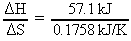 = 325 K =
52oC
= 325 K =
52oC
17.8 (a) DG = DH - TDS = 58.5 kJ/mol - (598 K)[0.0929 kJ/(K mol)] = +2.9
kJ/mol
Because DG > 0, Hg does not boil at 325oC and 1
atm.
(b) The boiling point (phase change) is
associated with an equilibrium. Set DG = 0 and solve for T, the boiling point.
0 =
DHvap -
TDSvap;
Tbp = 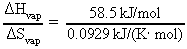 = 630 K = 357oC
17.9 DH = - (reaction involves bond making -
exothermic)
DS =
- (the reaction becomes more ordered in going from reactants (2 atoms) to
products (1 molecule)
DG = - (the reaction is spontaneous)
17.10 From Problems 17.5 and 17.6: DHo = 178.3 kJ and
DSo =
160.4 J/K = 0.1604 kJ/K
(a) DGo = DHo - TDSo = 178.3 kJ - (298 K)(0.1604 kJ/K) = +130.5
kJ
(b) Because G > 0, the reaction is nonspontaneous at 25oC
(298 K).
(c) Set DG = 0 and solve for T, the temperature above which the
reaction becomes spontaneous.
0 = DH - TDS; T = 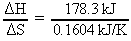 = 1112 K =
839oC
= 1112 K =
839oC
17.11 2 AB2 ® A2 + 2
B2
(a) DSo is positive because the reaction increases
the number of molecules.
(b) DHo is positive because the reaction is
endothermic.
DGo = DHo - TDSo
For the reaction to be spontaneous,
DGo must
be negative. This will only occur at high temperature where TDSo is greater than
DHo.
17.12 (a) CaC2(s) + 2
H2O(l) ® C2H2(g) +
Ca(OH)2(s)
DGo = [DGof(C2H2)
+DGof(Ca(OH)2)] -
[DGof(CaC2) + 2
DGof(H2O)]
DGo = [(1 mol)(209.2
kJ/mol) + (1 mol)(-898.6 kJ/mol)]
- [(1 mol)(-64.8 kJ/mol) + (2 mol)(-237.2
kJ/mol)] = -150.2 kJ
This reaction can be used for the synthesis of
C2H2 because DG < 0.
(b) It is not possible to synthesize
acetylene from solid graphite and gaseous H2 at 25oC and 1
atm because DGof(C2H2)
> 0.
17.13 C(s) + 2 H2(g) ®
C2H4(g)
Qp = 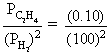 = 1.0 x
10-5
= 1.0 x
10-5
DG = DGo + RT ln
Qp
DG
= 68.1 kJ + (8.314 x 10⁻³ kJ/K)(298 K)ln(1.0 x 10⁻⁵) =
+39.6 kJ
Because DG > 0, the reaction is spontaneous in the reverse
direction.
17.14 DG = DGo + RT lnQ and Go = 15
kJ
For A2(g) + B2(g) 2 AB(g),
Qp = 
Let the number of
molecules be proportional to the partial pressure.
(1) Qp = 1.5
(2) Qp = 0.0667 (3) Qp = 18
(a) Reaction (3) has the
largest DG because
Qp is the largest. Reaction (1) has the smallest DG because Qp is the
smallest.
(b) DG
= DGo =
15 kJ because Qp = 1 and ln (1) = 0.
17.15 From Problem 17.10, DGo = +130.5
kJ
DGo = -RT ln Kp
ln Kp
=  = -52.7
Kp = e-52.7 = 1 x
10-23
17.16 H2O(l) ®
H2O(g)
Kp =  ;
Kp is equal to the vapor pressure for H2O.
;
Kp is equal to the vapor pressure for H2O.
DGo =DGof(H2O(g))
-DGof(H2O(l))
DGo = (1 mol)(-228.6
kJ/mol) - (1 mol)(-237.2 kJ/mol) = +8.6 kJ
DGo = - RT ln
Kp
ln Kp =  =
-3.5
=
-3.5
Kp =  =
e-3.5 = 0.03 atm
=
e-3.5 = 0.03 atm
17.17 DGo = - RT ln K = -(8.314 x 10⁻³
kJ/K)(298 K) ln (1.0 x 10⁻¹⁴) = 80 kJ
17.18 Photosynthetic cells in plants use the
sun's energy to make glucose, which is then used by animals as their primary
source of energy. The energy an animal obtains from glucose is then used to
build and organize complex molecules, resulting in a decrease in entropy for the
animal. At the same time, however, the entropy of the surroundings increases as
the animal releases small, simple waste products such as CO2 and
H2O. Furthermore, heat is released by the animal, further increasing
the entropy of the surroundings. Thus, an organism pays for its decrease in
entropy by increasing the entropy of the rest of the universe.
17.19 You would expect to see violations of the
second law if you watched a movie run backwards. Consider an action-adventure
movie with a lot of explosions. An explosion is a spontaneous process that
increases the entropy of the universe. You would see an explosion go backwards
if you run the the movie backwards but this is impossible because it would
decrease the entropy of the universe.
Understanding Key
Concepts
17.20 (a)
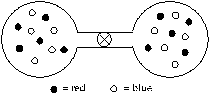
(b) DH = 0 (no heat is gained or lost in the mixing of ideal
gases)
DS = +
(the mixture of the two gases is more disordered)
DG = - (the mixing of the two
gases is spontaneous)
(c) For an isolated system, DSsurr = 0 and
DSsys =
DSTotal
> 0 for the spontaneous process.
(d) DG = + and the process is
nonspontaneous.
17.21 DH = + (heat is absorbed during
sublimation)
DS
= + (gas is more disordered than solid)
DG = - (the reaction is
spontaneous)
17.22 DH = - (heat is lost during condensation)
DS = - (liquid is more ordered
than vapor)
DG =
- (the reaction is spontaneous)
17.23 DH = 0 (system is an ideal gas
at constant temperature)
DS = - (there is more order in the smaller
volume)
DG = +
(compression of a gas is not spontaneous)
17.24 (a) 2 A2 + B2
® 2
A2B
(b) DH = - (because DS is negative, DH must also be negative in order for DG to be
negative)
DS = -
(the reaction becomes more ordered in going from reactants (3 molecules) to
products (2 molecules))
DG = - (the reaction is spontaneous)
17.25 (a) For initial state 1,
Qp < Kp (more reactant (A2) than product (A)
compared to the equilibrium state)
For initial state 2, Qp
> Kp (more product (A) than reactant (A2) compared to
the equilibrium state)
(b) DH = + (reaction involves bond breaking -
endothermic)
DS
= + (equilibrium state is more disordered than initial state 1)
DG = - (reaction spontaneously
proceeds toward equilibrium)
(c) DH = - (reaction involves bond making -
exothermic)
DS =
- (equilibrium state is more ordered than initial state 2)
G = - (reaction
spontaneously proceeds toward equilibrium)
(d) State 1 lies to the left of the minimum in
Figure 17.10. State 2 lies to the right of the minimum.
17.26 (a) DHo = + (reaction involves bond breaking -
endothermic)
DSo = + (2 A's are more disordered than
A2)
(b) DSo is for the complete conversion of 1 mole of
A2 in its standard state to 2 moles of A in its standard
state.
(c) There is not enough information to say anything about the sign of
DGo.
DGo
decreases (becomes less positive or more negative) as the temperature
increases.
(d) Kp increases as the temperature increases. As the
temperature increases there will be more A and less A2.
(e) G = 0
at equilibrium.
17.27 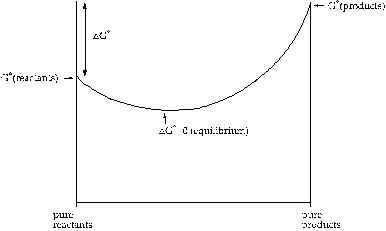
The curve has a minimum between pure reactants
and pure products because the free energy decreases when pure reactants (or pure
products) react to form the equilibrium mixture. The minimum is on the left side
of the diagram because a positive value of DGo corresponds to a
value of K less than 1.
17.28 DGo = - RT ln K where K =  or
or  or
or 
Let the number of molecules
be proportional to the concentration.
(1) K = 1, ln K =0, and DGo = 0
(2) K >
1, ln K is positive, and DGo is negative
(3) K < 1, ln K is
negative, and DGo is positive
17.29 (a) The reaction will proceed
spontaneously from left to right to reach a new equilibrium on the addition of
four A molecules. Because the reaction is spontaneous, DG is negative.
(b) 
Additional Problems
Spontaneous
Processes
17.30 A spontaneous process is one that proceeds
on its own without any external influence.
For example: H2O(s)
® H2O(l)
at 25oC
A nonspontaneous process takes place only in the presence
of some continuous external influence.
For example: 2 NaCl(s) ® 2 Na(s) +
Cl2(g)
17.31 Spontaneous does not mean instantaneous.
Even though the decomposition can occur (is spontaneous), the rate of
decomposition is determined by the kinetics of the reaction.
17.32 (a) and (d) nonspontaneous; (b) and (c)
spontaneous
17.33 (a) and (c) spontaneous; (b) and (d)
nonspontaneous.
17.34 (b) and (d) spontaneous (because of the
large positive Kp's)
17.35 (a) and (d) nonspontaneous (because of the
small K's).
Entropy
17.36 Molecular randomness or disorder is called
entropy. For the following reaction, the entropy (disorder) increases:
H2O(s) ® H2O(l) at 25oC.
17.37 Exothermic reactions can become
nonspontaneous at high temperatures if DS is negative. Endothermic reactions can become
spontaneous at high temperatures if DS is positive.
17.38 (a) + (solid gas) (b) - (liquid solid) (c)
- (aqueous ions solid) (d) + (CO2(aq) CO2(g))
17.39 (a) + (increase in moles of gas)
(b) -
(decrease in moles of gas and formation of liquid)
(c) + (aqueous ions to
gas)
(d) - (decrease in moles of gas)
17.40 (a) - (liquid solid)
(b) - (decrease in
number of O2 molecules)
(c) + (gas is more disordered in larger
volume)
(d) - (aqueous ions solid)
17.41 (a) + (solid dissolved in water) (b) +
(increase in moles of gas)
(c) + (mixed gases are more disordered) (d) +
(liquid to gas)
17.42 S = k ln W, k = 1.38 x 10⁻²³
J/K
(a) S = (1.38 x 10⁻²³ J/K) ln (412) = 2.30 x
10-22 J/K
(b) S = (1.38 x 10⁻²³ J/K) ln
(4120) = 2.30 x 10⁻²¹ J/K
(c) S = (1.38 x
10-23 J/K) ln ( ) = 11.5
J/K
) = 11.5
J/K
If all C-D bonds point in the same direction, S = 0.
17.43 S = k ln W, k = 1.38 x 10⁻²³
J/K
(a) W = 1; S = k ln (1) = 0
(b) W = 32, = 9; S = k ln
(32) = 3.03 x 10⁻²³ J/K
(c) W = 1; S = k ln (1) =
0
(d) W = 33 = 27; S = k ln (33) = 4.55 x
10-23 J/K
(e) W = 1; S = k ln (1) = 0
(f) W =  ; S = k ln
 = 9.13 J/K
S = R ln = (8.314
J/K)ln 3 = 9.13 J/K The results are the same.
= (8.314
J/K)ln 3 = 9.13 J/K The results are the same.
17.44 (a) H2 at 25oC in 50
L (larger volume) (b) O2 at 25oC, 1 atm (larger
volume)
(c) H2 at 100oC, 1 atm (larger volume and
higher T)
(d) CO2 at 100oC, 0.1 atm (larger volume and
higher T)
17.45 (a) ice at 0oC, because of the
higher temperature.
(b) N2 at STP, because it has the larger
volume.
(c) N2 at 0oC and 50 L, because it has the
larger volume.
(d) water vapor at 150oC and 1 atm, because it has
a larger volume and higher temperature.
Standard Molar Entropies and Standard
Entropies of Reaction
17.46 The standard molar entropy of a substance
is the entropy of 1 mol of the pure substance at 1 atm pressure and
25oC.
DSo = So(products) -
So(reactants)
17.47 (a) Units of So =  (b) Units of So = J/K
Standard molar entropies are called absolute
entropies because they are measured with respect to an absolute reference point,
the entropy of the substance at 0 K.
So = 0  at T = 0
K.
at T = 0
K.
17.48 (a) C2H6(g); more
atoms/molecule (b) CO2(g); more atoms/molecule
(c)
I2(g); gas is more disordered than the solid
(d)
CH3OH(g); gas is more disordered than the liquid.
17.49 (a) NO2(g); more atoms/molecule
(b) CH3CO2H(l); more atoms/molecule
(c)
Br2(l); liquid is more disordered than the solid
(d)
SO3(g); gas is more disordered than the solid
17.50 (a) 2 H2O2(l)
® 2
H2O(l) + O2(g)
DSo = [2 So(H2O(l)) +
So(O2)] - 2
So(H2O2)
DSo = [(2 mol)(69.9
J/(K mol)) + (1 mol)(205.0 J/(K mol))]
- (2 mol)(110 J/(K mol)) = +125 J/K
(+, because moles of gas increase)
(b) 2 Na(s) + Cl2(g) ® 2 NaCl(s)
DSo = 2
So(NaCl) - [2 So(Na) +
So(Cl2)]
DSo = (2 mol)(72.1 J/(K mol))
- [(2
mol)(51.2 J/(K mol)) + (1 mol)(223.0 J/(K mol))]
DSo = -181.2 J/K (-,
because moles of gas decrease)
(c) 2 O3(g) ® 3
O2(g)
DSo = 3 So(O2) - 2
So(O3)
DSo = (3 mol)(205.0 J/(K mol)) - (2 mol)(238.8
J/(K mol))
DSo = +137.4 J/K (+, because moles of gas
increase)
(d) 4 Al(s) + 3 O2(g) ® 2
Al2O3(s)
DSo = 2
So(Al2O3) - [4 So(Al) + 3
So(O2)]
DSo = (2 mol)(50.9 J/(K mol))
- [(4
mol)(28.3 J/(K mol)) + (3 mol)(205.0 J/(K mol))]
DSo = -626.4 J/K (-,
because moles of gas decrease)
17.51 (a) 2 S(s) + 3 O2(g)
® 2
SO3(g)
DSo = 2 So(SO3) - [2
So(S) + 3 So(O2)]
DSo = (2 mol)(256.6
J/(K mol))
- [(2 mol)(31.8 J/(K mol)) + (3 mol)(205.0 J/(K
mol))]
DSo = -165.4 J/K (-, because moles of gas
decrease)
(b) SO3(g) + H2O(l)
®
H2SO4(aq)
DSo =
So(H2SO4) - [So(SO3) +
So(H2O)]
DSo = (1 mol)(20 J/(K mol)) - [(1 mol)(256.6
J/(K mol)) + (1 mol)(69.9 J/(K mol))]
DSo = -306 J/K (-, because of the conversion of
a gas and water to an aqueous solution)
(c) AgCl(s) ® Ag+(aq) +
Cl-(aq)
DSo = [So(Ag+) +
So(Cl-)] - So(AgCl)]
DSo = [(1 mol)(72.7
J/(K mol)) + (1 mol)(56.5 J/(K mol))]
- (1 mol)(96.2 J/(K
mol))]
DSo = +33.0 J/K (+, because a solid is
converted to ions in aqueous solution)
(d) NH4NO3(s)
N2O(g) + 2 H2O(g)
DSo =
[So(N2O) + 2 So(H2O)] -
So(NH4NO3)
DSo = [(1 mol)(219.7
J/(K mol)) + (2 mol)(188.7 J/(K mol))]
- (1 mol)(151.1 J/(K
mol))
DSo = +446.0 J/K (+, because moles of gas
increase)
Entropy and the Second Law of
Thermodynamics
17.52 In any spontaneous process, the total
entropy of a system and its surroundings always increases.
17.53 For a spontaneous process, DStotal =
DSsys +
DSsurr
> 0. For an isolated system, DSsurr = 0, and so DSsys > 0 is the
criterion for spontaneous change. An example of a spontaneous process in an
isolated system is the mixing of two gases.
17.54 Ssurr =  ; The
temperature (T) is always positive.
; The
temperature (T) is always positive.
(a) For an exothermic reaction,
DH is negative and
DSsurr
is positive.
(b) For an endothermic reaction, DH is positive and DSsurr is
negative.
17.55 DSsurr 
Consider the surroundings as an infinitely large
constant-temperature bath to which heat can be added without changing its
temperature. If the surroundings have a low temperature, they have only a small
amount of disorder, in which case addition of a given quantity of heat results
in a substantial increase in the amount of disorder (a relatively large value of
DSsurr).
If the surroundings have a high temperature, they already have a large amount of
disorder, and addition of the same quantity of heat produces only a marginal
increase in the amount of disorder (a relatively small value of DSsurr). Thus, we
expect DSsurr to vary inversely with
temperature.
17.56 N2(g) + 2 O2(g)
®
N2O4(g)
DHo = DHof(N2O4) =
9.16 kJ
DSsys = DSo = So(N2O4)
- [So(N2) + 2
So(O2)]
DSsys = (1 mol)(304.2 J/(K mol))
- [(1
mol)(191.5 J/(K mol)) + (2 mol)(205.0 J/(K mol))] = -297.3 J/K
DSsurr = 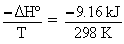 = -0.0307 kJ/K = -30.7 J/K
DStotal = DSsys + DSsurr = -297.3 J/K +
(-30.7 J/K) = -328.0 J/K
Because DStotal < 0, the reaction is
nonspontaneous.
17.57 Cu2S(s) + O2(g)
® 2 Cu(s) +
SO2(g)
DHo = DHof(SO2) - DHof(Cu2S)
DHo = (1 mol)(-296.8
kJ/mol) - (1 mol)(-79.5 kJ/mol) = -217.3 kJ
DSsys = DSo = [2
So(Cu) + So(SO2)] -
[So(Cu2S) + So(O2)]
DSsys = [(2 mol)(33.1
J/(K mol)) + (1 mol)(248.1 J/(K mol))]
- [(1 mol)(120.9 J/(K mol)) + (1
mol)(205.0 J/(K mol))] = -11.6 J/K
DSsurr = 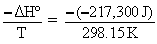 = +728.8
J/K
= +728.8
J/K
DStotal = DSsys + DSsurr = -11.6 J/K +
728.8 J/K = +717.2 J/K
Because DStotal is positive, the reaction is
spontaneous under standard-state conditions at 25oC.
17.58 (a) DSsurr = 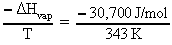 = -89.5
J/(K mol)
= -89.5
J/(K mol)
DStotal = DSvap + DSsurr = 87.0 J/(K
mol) + (-89.5 J/(K mol)) = - 2.5 J/(K mol)
(b) DSsurr = 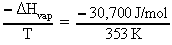 = -87.0 J/(K mol)
DStotal = DSvap + DSsurr = 87.0 J/(K
mol) + (- 87.0 J/(K mol)) = 0
(c) DSsurr = 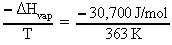 = -84.6
J/(K mol)
= -84.6
J/(K mol)
DStotal =
DSvap +
DSsurr =
87.0 J/(K mol) + (- 84.6 J/(K mol)) = +2.4 J/(K mol)
Benzene does not boil at
70oC (343 K) because DStotal is negative.
The normal boiling
point for benzene is 80oC (353 K), where DStotal =
0.
17.59 (a) DSsurr = 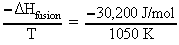 = -28.8
J/(K mol)
= -28.8
J/(K mol)
DStotal = DSsys + DSsurr = 28.1 J/(K
mol) + (-28.8 J/(K mol)) = -0.7 J/(K mol)
(b) DSsurr =  = -28.1
J/(K mol)
= -28.1
J/(K mol)
DStotal = DSsys + DSsurr = 28.1 J/(K
mol) + (-28.1 J/(K mol)) = 0
(c) Ssurr =  = -27.5
J/(K mol)
= -27.5
J/(K mol)
DStotal =
DSsys +
DSsurr =
28.1 J/(K mol) + (-27.5 J/(K mol)) = +0.6 J/(K mol)
NaCl melts at 1100 K
because Stotal > 0.
The melting point of NaCl is 1075 K, where
DStotal
= 0.
Free Energy
17.60
| DH |
DS |
DG=DH-TDS |
Reaction Spontaneity |
| - |
+ |
- |
Spontaneous at all temperatures |
| - |
- |
- or + |
Spontaneous at low temperatures where DH>TDS
Non-spontaneous
at high temperatures where DH<TDS |
| + |
+ |
+ |
Nonspontaneous at all
temperatures |
| + |
+ |
- or + |
Spontaneous at high temperatures where
TDS >
DH
Nonspontaneous at low temperature where
TDS <
DH |
17.61 When DH and DS are both positive or both
negative, the temperature determines the direction of spontaneous reaction. See
Problem 17.60 for an explanation.
17.62 (a) 0oC (temperature is below
mp); DH = +,
DS = +,
DG = +
(b)
15oC (temperature is above mp); DH = +, DS = +, DG = -
17.63 (a) DH = 0
DS = R ln  = (8.314
J/K) ln 2 = 5.76 J/K
= (8.314
J/K) ln 2 = 5.76 J/K
DG = DH - TDS
Because DH = 0, DG = -TDS = -(298 K)(5.76 J/K) = -1717 J = -1.72 kJ
(b) For a
process in an isolated system, DSsurr = 0. Therefore, DStotal =
DSsys
> 0, and the process is spontaneous.
17.64 DHvap = 30.7 kJ/mol
DSvap = 87.0 J/(K
mol) = 87.0 x 10⁻³ kJ/(K mol)
DGvap = DHvap - TDSvap
(a)
DGvap =
30.7 kJ/mol - (343 K)(87.0 x 10⁻³ kJ/(K mol)) = +0.9 kJ/mol
At
70oC (343 K), benzene does not boil because DGvap is
positive.
(b) DGvap = 30.7 kJ/mol - (353 K)(87.0 x
10-3 kJ/(K mol)) = 0
80oC (353 K) is the boiling point
for benzene because DGvap = 0
(c) DGvap = 30.7 kJ/mol - (363 K)(87.0 x
10-3 kJ/(K mol)) = -0.9 kJ/mol
At 90oC (363 K), benzene
boils because DGvap is negative.
17.65 DHfusion = 30.2 kJ/mol; Sfusion =
28.1 x 10⁻³ kJ/(K mol)
DGfusion =
DHfusion
- TDSfusion
(a) DGfusion = 30.2
kJ/mol - (1050 K)(28.1 x 10⁻³ kJ/(K mol)) = +0.7 kJ/mol
At 1050 K,
NaCl does not melt because DGfusion is positive.
(b) DGfusion = 30.2
kJ/mol - (1075 K)(28.1 x 10⁻³ kJ/(K mol)) = 0
1075 K is the
melting point for NaCl because DGfusion = 0.
(c) DGfusion = 30.2
kJ/mol - (1100 K)(28.1 x 10⁻³ kJ/(K mol)) = -0.7 kJ/mol
At 1100 K,
NaCl does melt because DGfusion is negative.
17.66 At the melting point (phase change),
DGfusion
= 0
DGfusion = DHfusion -
TDSfusion
0 = Hfusion -
TSfusion; T =  = 395 K =
122oC
= 395 K =
122oC
17.67 128oC = 401 K
At the melting
point (phase change), DGfusion = 0
DGfusion =
DHfusion
- TDSfusion
0 = DHfusion -
TDSfusion
DHfusion =
TDSfusion = (401 K)(47.7 x 10⁻³ kJ/(K
mol)) = 19.1 kJ/mol
Standard Free-Energy Changes and
Standard Free Energies of Formation
17.68 (a) DGo is the change in free energy that occurs
when reactants in their standard states are converted to products in their
standard states.
(b) DGof is the free-energy change for
formation of one mole of a substance in its standard state from the most stable
form of the constituent elements in their standard states.
17.69 The standard state of a substance (solid,
liquid, or gas) is the most stable form of a pure substance at 25oC
and 1 atm pressure. For solutes, the condition is 1 M at
25oC.
17.70 (a) N2(g) + 2 O2(g)
® 2
NO2(g)
DHo = 2 DHof(NO2) = (2 mol)(33.2
kJ/mol) = 66.4 kJ
DSo = 2 DSo(NO2) -
[So(N2) + 2 So(O2)]
DSo = (2 mol)(240.0
J/(K mol))
- [(1 mol)(191.5 J/(K mol)) + (2 mol)(205.0 J/(K
mol))]
DSo = -121.5 J/K = -121.5 x 10⁻³
kJ/K
DGo = DHo - TDSo = 66.4 kJ - (298 K)(-121.5 x
10-3 kJ/K) = +102.6 kJ
Because DGo is positive, the
reaction is nonspontaneous under standard-state conditions at
25oC.
(b) 2 KClO3(s) ® 2 KCl(s) + 3
O2(g)
DHo = 2 DHof(KCl) - 2 DHof(KClO3)
DHo = (2 mol)(-436.7
kJ/mol) - (2 mol)(-397.7 kJ/mol) = -78.0 kJ
DSo = [2
So(KCl) + 3 So(O2)] - 2
So(KClO3)
DSo = [(2 mol)(82.6 J/(K mol)) + (3 mol)(205.0
J/(K mol))] - (2 mol)(143 J/(K mol))
DSo = 494.2 J/(K mol) = 494.2 x 10⁻³
kJ/(K mol)
DGo = DHo - TDSo = -78.0 kJ - (298 K)(494.2 x
10-3 kJ/(K mol)) = -225.3 kJ
Because DGo is negative, the reaction is spontaneous
under standard-state conditions at 25oC.
(c) CH3CH2OH(l) +
O2(g) ®
CH3CO2H(l) + H2O(l)
DHo = [DHof(CH3CO2H)
+ DHof(H2O)] - DHof(CH3CH2OH)
DHo = [(1 mol)(-484.5
kJ/mol) + (1 mol)(-285.8 kJ/mol)] - (1 mol)(-277.7 kJ/mol) = -492.6
kJ
DSo =
[So(CH3CO2H) + So(H2O)] -
[So(CH3CH2OH) +
So(O2)]
DSo = [(1 mol)(160 J/(K mol)) + (1 mol)(69.9
J/(K mol))] - [(1 mol)(161 J/(K mol)) + (1 mol)(205.0 J/(K
mol))]
DSo = -136.1 J/(K mol) = -136.1 x
10-3 kJ/(K mol)
DGo = DHo - TDSo = -492.6 kJ - (298 K)(-136.1 x
10-3 kJ/(K mol)) = -452.0 kJ
Because DGo is negative, the
reaction is spontaneous under standard-state conditions at
25oC.
17.71 (a) 2 SO2(g) + O2(g)
® 2
SO3(g)
DHo = 2 DHof(SO3) - 2
DHof SO2)
DHo = (2 mol)(-395.7
kJ/mol) - (2 mol)(-296.8 kJ/mol) = -197.8 kJ
DSo = 2
So(SO3) - [2 So(SO2) +
So(O2)]
DSo = (2 mol)(256.6 J/(K mol)) - [(2 mol)(248.1
J/(K mol)) + (1 mol)(205.0 J/(K mol))]
DSo = -188.0 J/K = -188.0 x 10⁻³
kJ/K
DGo = DHo - TDSo = -197.8 kJ - (298 K)(-188.0 x
10-3 kJ/K) = -141.8 kJ
Because DGo is negative, the
reaction is spontaneous under standard-state conditions at
25oC.
(b) N2(g) + 2 H2(g)
®
N2H4(l)
DHo = DHof(N2H4)
DHo = (1 mol)(50.6
kJ/mol) = 50.6 kJ
DSo = So(N2H4)
- [So(N2) + 2
So(H2)]
DSo = (1 mol)(121.2 J/(K mol)) - [(1 mol)(191.5
J/(K mol)) + (2 mol)(130.6 J/(K mol))]
DSo = -331.5 J/K = -331.5 x 10⁻³
kJ/K
DGo = DHo - TDSo = 50.6 kJ - (298 K)(-331.5 x
10-3 kJ/K) = +149.4 kJ
Because DGo is positive, the
reaction is nonspontaneous under standard-state conditions at
25oC.
(c) CH3OH(l) + O2(g)
®
HCO2H(l) + H2O(l)
DHo =
[Hof(HCO2H) +
Hof(H2O)] -
Hof(CH3OH)
DHo = [(1 mol)(-424.7
kJ/mol) + (1 mol)(-285.8 kJ/mol)] - (1 mol)(-238.7 kJ/mol) = -471.8
kJ
DSo = [So(HCO2H) +
So(H2O)] - [So(CH3OH) +
So(O2)]
DSo = [(1 mol)(129.0 J/(K mol)) + (1 mol)(69.9
J/(K mol))] - [(1 mol)(127 J/(K mol)) + (1 mol)(205.0 J/(K
mol))]
DSo = -133.1 J/K = -133.1 x 10⁻³
kJ/K
DGo = DHo - TDSo = -471.8 kJ - (298 K)(-133.1 x
10-3 kJ/K) = -432.1 kJ
Because DGo is negative, the
reaction is spontaneous under standard-state conditions at
25oC.
17.72 (a) N2(g) + 2 O2(g)
® 2
NO2(g)
DGo = 2 DGof(NO2) = (2 mol)(51.3
kJ/mol) = +102.6 kJ
(b) 2 KClO3(s) ® 2 KCl(s) + 3
O2(g)
DGo = 2 DGof(KCl) - 2 DGof(KClO3)
DGo = (2 mol)(-409.2
kJ/mol) - (2 mol)(-296.3 kJ/mol) = -225.8 kJ
(c) CH3CH2OH(l) +
O2(g) ®
CH3CO2H(l) + H2O(l)
DGo =
[Gof(CH3CO2H)
+Gof(H2O)]
-Gof(CH3CH2OH)
DGo = [(1 mol)(-390
kJ/mol) + (1 mol)(-237.2 kJ/mol)] - (1 mol)(-174.9 kJ/mol) = -452 kJ
17.73 (a) 2 SO2(g) + O2(g)
® 2
SO3(g)
DGo = 2 DGof(SO3) - 2
DGof(SO2)
Go
= (2 mol)(-371.1 kJ/mol) - (2 mol)(-300.2 kJ/mol) = -141.8 kJ
(b)
N2(g) + 2 H2(g) ® N2H4(l)
DGo = DGof(N2H4) =
(1 mol)(149.2 kJ/mol) = 149.2 kJ
(c) CH3OH(l) + O2(g)
®
HCO2H(l) + H2O(l)
DGo = [DGof(HCO2H) +DGof(H2O)] -DGof(CH3OH)
DGo = [(1 mol)(-361.4
kJ/mol) + (1 mol)(-237.2 kJ/mol)] - (1 mol)(-166.4 kJ/mol) = -432.2
kJ
17.74 A compound is thermodynamically stable
with respect to its constituent elements at 25oC if DGof is
negative.
| |
Compond |
DGof (kJ/mol) |
Stable? |
| a |
BaCO3(s) |
-1138 |
yes |
| b |
HBr(g) |
-53.4 |
yes |
| c |
N2O(g) |
+104.2 |
no |
| d |
C2H4(g) |
+68.1 |
no |
17.75 A compound is thermodynamically stable
with respect to its constituent elements at 25oC if DGof is
negative.
| |
Compond |
DGof (kJ/mol) |
Stable? |
| a |
C6H6(l) |
+124.5 |
no |
| b |
NO(g) |
+86.6 |
no |
| c |
PH3(g) |
+13 |
no |
| d |
FeO(s) |
-255 |
yes |
17.76 CH2=CH2(g) +
H2O(l) ®
CH3CH2OH(l)
DHo =DHof(CH2CH2OH)
- [DHof(CH2=CH2)
+ DHof(H2O)]
DHo = (1 mol)(-277.7
kJ/mol) - [(1 mol)(52.3 kJ/mol) + (1 mol)(-285.8 kJ/mol)]
DHo = -44.2
kJ
DSo =
So(CH3CH2OH) -
[So(CH2=CH2) +
So(H2O)]
DSo = (1 mol)(161 J/(K mol)) - [(1 mol)(219.5
J/(K mol)) + (1 mol)(69.9 J/(K mol))]
DSo = -128 J/(K mol)
= -128 x 10-3 kJ/(K mol)
DGo = DHo - TDSo = -44.2 kJ - (298 K)(-128 x 10-3
kJ/K) = -6.1 kJ
Because DGo is negative, the reaction is spontaneous
under standard-state conditions at 25oC.
The reaction becomes
nonspontaneous at high temperatures because DSo is
negative.
To find the crossover temperature, set G = 0 and solve for T.
T
= 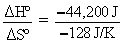 = 345 K = 72oC
The reaction becomes nonspontaneous
at 72oC.
17.77 2 H2S(g) + SO2(g)
® 3 S(s) + 2
H2O(g)
DHo = 2 DHof(H2O) - [2
DHof(H2S) + DHof(SO2)]
DHo = (2 mol)(-241.8
kJ/mol) - [(2 mol)(-20.6 kJ/mol) + (1 mol)(-296.8 kJ/mol) = -145.6
kJ
DSo = [3 So(S) + 2
So(H2O)] - [2 So(H2S) +
So(SO2)]
DSo = [(3 mol)(31.8 J/(K mol)) + (2 mol)(188.7
J/(K mol))] - [(2 mol)(205.7 J/(K mol)) + (1 mol)(248.1 J/(K
mol))]
DSo = -186.7 J/K = -186.7 x 10⁻³
kJ/K
DGo = DHo - TDSo = -145.6 kJ - (298 K)(-186.7 x
10-3 kJ/K) = -90.0 kJ
Because DGo is negative, the
reaction is spontaneous under standard-state conditions at
25oC.
The reaction becomes nonspontaneous at high temperatures
because DSo is negative.
To find the crossover
temperature set DG
= 0 and solve for T.
T =  = 780 K =
507oC
= 780 K =
507oC
The reaction becomes nonspontaneous at
507oC.
17.78 3
C2H2(g) ® C6H6(l)
DGo = DGof(C6H6) - 3
DGof(C2H2)
DGo = (1 mol)(124.5
kJ/mol) - (3 mol)(209.2 kJ/mol) = -503.1 kJ
Because DGo is negative, the
reaction is possible. Look for a catalyst.
Because DGof for
benzene is positive (+124.5 kJ/mol), the synthesis of benzene from graphite and
gaseous H2 at 25oC and 1 atm pressure is not
possible.
17.79 CH2ClCH2Cl(l)
®
CH2=CHCl(g) + HCl(g)
DGo =
[Gof(CH2=CHCl) +Gof(HCl)]
- Gof(CH2ClCH2Cl)
DGo = [(1 mol)(51.9
kJ/mol) + (1 mol)(-95.3 kJ/mol)] - (1 mol)(-79.6 kJ/mol) = +36.2 kJ
Because
DGo is
positive, the reaction is nonspontaneous under standard-state conditions at
25oC.
CH2ClCH2Cl(l) ® CH2=CHCl(g) +
HCl(g)
Sum: NaOH(aq) + HCl(g) ® Na+(aq) + Cl-(aq) +
H2O(l)
CH2ClCH2Cl(l) + NaOH(aq)
®
CH2=CHCl(g) + Na+(aq) + Cl-(aq) +
H2O(l)
DGo =
[DGof(CH2=CHCl) +
DGof(Na+) + DGof(Cl-) + DGof(H2O)] -
[DGof(CH2ClCH2Cl)
+ DGof(NaOH)]
DGo = [(1 mol)(51.9
kJ/mol) + (1 mol)(-261.9 kJ/mol) + (1 mol)(-131.3 kJ/mol) + (1 mol)(-237.2
kJ/mol)]
- [(1 mol)(-79.6 kJ/mol) + (1 mol)(-419.2 kJ/mol)] = -79.7
kJ
Using NaOH(aq), DGo = -79.7 kJ and the reaction is spontaneous.
(More generally, base removes HCl, driving the reaction to the right.)
The
synthesis of a compound from its constituent elements is thermodynamically
feasible at 25oC and 1 atm pressure if DGof is
negative.
Because DGof(CH2=CHCl) = +51.9
kJ, the synthesis of vinyl chloride from its elements is not possible at
25oC and 1 atm pressure.
Free Energy, Composition, and Chemical
Equilibrium
17.80 DG = DGo + RT ln Q
17.81 DG = DGo + RT ln Q
(a) If Q < 1, then RT ln Q is negative and
DG <
DGo.
(b) If Q = 1, then RT ln Q = 0 and G =
Go.
(c) If Q > 1, then RT ln Q is positive and DG > DGo.
As Q
increases the thermodynamic driving force decreases.
17.82 DG = DGo + RT ln
(a) DG = (-141.8 kJ) + (8.314 x
10-3 kJ/K)(298 K)ln = -176.0
kJ
= -176.0
kJ
(b) DG = (-141.8 kJ) + (8.314 x 10⁻³ kJ/K)(298
K)ln = -133.8 kJ
(c) Q = 1, ln Q = 0, DG = DGo = -141.8
kJ
17.83 DG = DGo + RT ln 
(a)
DG = -13.6 kJ +
(8.314 x 10⁻³ kJ/K)(298 K)ln = -30.7 kJ
Because DG is
negative, the reaction is spontaneous.
(b) DG = -13.6 kJ + (8.314 x
10-3 kJ/K)(298 K)ln = +3.5 kJ
Because DG is
positive, the reaction is nonspontaneous.
17.84 DGo = -RT ln K
(a) If K > 1, DGo is negative. (b)
If K = 1, DGo = 0.
(c) If K < 1, DGo is
positive.
17.85 K =  (a) If
DGo is
positive, K is small. (b) If Go is negative, K is large.
(a) If
DGo is
positive, K is small. (b) If Go is negative, K is large.
17.86 DGo = -RT ln Kp = -141.8 kJ
ln
Kp =  = 57.23
Kp = e57.23 = 7.1 x
1024
17.87 DGo = - RT ln K = -13.6 kJ
ln K =  =
5.49
=
5.49
K = e5.49 = 2.4 x 10²
17.88 C2H5OH(l)
®
C2H5OH(g)
DGo = DGof(C2H5OH(g))
- DGof(C2H5OH(l))
DGo = (1 mol)(-168.6
kJ/mol) - (1 mol)(-174.9 kJ/mol) = +6.3 kJ
DGo = -RT ln K
ln
K =  = -2.54
K = e-2.54 = 0.079; K = Kp =  = 0.079 atm
17.89 DGo = -RT ln Ka
DGo = -(8.314 x
10-3 kJ/K)(298 K)ln(3.0 x 10⁻⁴) = +20.1 kJ
17.90 2 CH2=CH2(g) +
O2(g) ®
2 C2H4O(g)
DGo = 2 DGof(C2H4O) -
2 DGof(CH2=CH2)
DGo = (2 mol)(-13.1
kJ/mol) - (2 mol)(68.1 kJ/mol) = -162.4 kJ
DGo = -RT ln K
ln
K =  = 65.55
K = Kp = e65.55 = 2.9 x
1028
17.91 CO(g) + 2 H2(g) ®
CH3OH(g)
DGo =
Gof(CH3OH) -
Gof(CO)
DGo = (1 mol)(-161.9 kJ/mol) - (1 mol)(-137.2
kJ/mol) = -24.7 kJ
DGo = -RT ln Kp
ln Kp
=  = 9.97
Kp = e9.97 = 2.1 x
104
DG = DGo + RT ln Q
DG = -24.7 kJ + (8.314 x
10-3 kJ/K)(298 K)ln = -39.5 kJ
General Problems
17.92 The kinetic parameters [(a), (b), and (h)]
are affected by a catalyst. The thermodynamic and equilibrium parameters [(c),
(d), (e), (f), and (g)] are not affected by a catalyst.
17.93 (a), (c), and (d) are nonspontaneous; (b)
is spontaneous.
17.94 (a) Spontaneous does not mean fast, just
possible.
(b) For a spontaneous reaction DStotal > 0.
DSsys
can be positive or negative.
(c) An endothermic reaction can be spontaneous
if DSsys
> 0.
(d) This statement is true because the sign of DG changes when the direction of
a reaction is reversed.
17.95
| Point Total |
Possible Ways |
Number of Ways |
| 2 |
(1+1) |
1 |
| 3 |
(2+1)(1+2) |
2 |
| 4 |
(1+3)(2+2)(3+1) |
3 |
| 5 |
(1+4)(2+3)(3+2)(4+1) |
4 |
| 6 |
(1+5)(2+4)(3+3)(4+2)(5+1) |
5 |
| 7 |
(1+6)(2+5)(3+4)(4+3)(5+2)(6+1) |
6 |
| 8 |
(2+6)(3+5)(4+4)(5+3)(6+2) |
5 |
| 9 |
(3+6)(4+5)(5+4)(6+3) |
4 |
| 10 |
(4+6)(5+5)(6+4) |
3 |
| 11 |
(6+5)(5+6) |
2 |
| 12 |
(6+6) |
1 |
Because a point total of 7 can be rolled in the
most ways, it is the most probable point total.
17.96 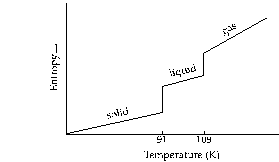
17.97 (a) Q = 1, ln Q = 0, DG = DGo = +79.9
kJ
Because DG is
positive, the reaction is spontaneous in the reverse direction.
(b)
DG = DGo + RT ln Q; Q =
[H3O+][OH-] = (1.0 x
10-7)2 = 1.0 x 10⁻¹⁴
DG = 79.9 kJ + (8.314 x
10-3 kJ/K)(298 K)ln(1.0 x 10⁻¹⁴) = 0
Because
DG = 0, the
reaction is at equilibrium.
(c) DG = DGo + RT ln Q
Q =
[H3O+][OH-] = (1.0 x 10⁻⁷)(1.0 x
10-10) = 1.0 x 10⁻¹⁷
DG = 79.9 kJ + (8.314 x
10-3 kJ/K)(298 K)ln(1.0 x 10⁻¹⁷) = -17.1 kJ
Because
DG is negative, the
reaction is spontaneous in the forward direction.
The results are consistent
with Le Châtelier's principle. When the [H3O+] and
[OH-] are larger than the equilibrium concentrations (a), the reverse
reaction takes place. When the product of [H3O+] and the
[OH-] is less than the equilibrium value, the forward reaction is
spontaneous.
DGo = -RT ln
K
ln K =  = -32.25
K = Ka = e-32.25 = 9.9 x
10-15
17.98 At the normal boiling point, DG = 0.
DG = DH - TDS; T =  = 351 K =
78oC
= 351 K =
78oC
17.99 At the normal boiling point,
DGvap =
0. 61oC = 334 K
DGvap = DHvap - TDSvap; DSvap = 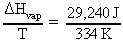 = 87.5
J/K
= 87.5
J/K
17.100 DG = DH - TDS
(a) DH must be positive (endothermic) and greater than
TDS in order for
DG to be positive
(nonspontaneous reaction).
(b) Set DG = 0 and solve for DH.
DG = 0 = DH - TDS = DH - (323 K)(104 J/K) =
DH - (33592 J) =
DH - (33.6
kJ)
DH = 33.6
kJ
DH must be
greater than 33.6 kJ.
17.101 NH4NO3(s)
® N2O(g)
+ 2 H2O(g)
(a) DGo = [DGof(N2O) + 2
DGof(H2O)] - DGof(NH4NO3)
DGo = [(1 mol)(104.2
kJ/mol) + (2 mol)(-228.6 kJ/mol)] - (1 mol)(-184.0 kJ/mol)
DGo = -169.0
kJ
Because DGo is negative, the reaction is
spontaneous.
(b) Because the reaction increases the number of moles of
gas, DSo
is positive.
DGo = DHo - TDSo
As the temperature is raised,
DGo
becomes more negative.
(c) DGo = -RT ln K
ln K =  =
68.21
=
68.21
K = Kp = e68.21 = 4.2 x
1029
(d) Q =  =
(30)(30)2 = (30)3
=
(30)(30)2 = (30)3
G = Go + RT ln Q
G =
-169.0 kJ + (8.314 x 10⁻³kJ/K)(298 K)ln[(30)3] = -143.7
kJ
17.102 (a) 2 Mg(s) + O2(g) ® 2 MgO(s)
DHo = 2 DHof(MgO)
= (2 mol)(-601.7 kJ/mol) = -1203.4 kJ
DSo = 2 So(MgO) - [2
So(Mg) + So(O2)]
DSo = (2 mol)(26.9
J/(K mol)) - [(2 mol)(32.7 J/(K mol)) + (1 mol)(205.0 J/(K
mol))]
DSo = -216.6 J/K = -216.6 x 10⁻³
kJ/K
DGo = DHo - TDSo = -1203.4 kJ - (298 K)(-216.6 x
10-3 kJ/K) = -1138.8 kJ
Because DGo is negative, the
reaction is spontaneous at 25oC. DGo becomes less
negative as the temperature is raised.
(b) MgCO3(s) ® MgO(s) + CO2(g)
DHo
= [DHof(MgO) + DHof(CO2)] - DHof(MgCO3)
DHo = [(1 mol)(-601.1
kJ/mol) + (1 mol)(-393.5 kJ/mol)] - (1 mol)(-1096 kJ/mol) = +101
kJ
DSo = [So(MgO) +
So(CO2)] - So(MgCO3)
DSo = [(1 mol)(26.9
J/(K mol)) + (1 mol)(213.6 J/(K mol))] - (1 mol)(65.7 J/(K mol))
DSo = 174.8 J/K =
174.8 x 10⁻³ kJ/K
DGo = DHo - TDSo = 101 kJ - (298 K)(174.8 x 10⁻³
kJ/K) = +49 kJ
Because Go is positive, the reaction is not
spontaneous at 25oC. DGo becomes less positive as the temperature is
raised.
(c) Fe2O3(s) + 2 Al(s)
®
Al2O3(s) + 2 Fe(s)
DHo = DHof(Al2O3) -
DHof(Fe2O3)
DHo = (1 mol)(-1676
kJ/mol) - (1 mol)(-824.2 kJ/mol) = -852 kJ
DSo =
[So(Al2O3) + 2 So(Fe)] -
[So(Fe2O3) + 2
So(Al)]
DSo = [(1 mol)(50.9 J/(K mol)) + (2 mol)(27.3
J/(K mol))] - [(1 mol)(87.4 J/(K mol)) + (2 mol)(28.3 J/(K
mol))]
DSo = -38.5 J/K = -38.5 x 10⁻³
kJ/K
DGo = DHo - TDSo = -852 kJ - (298 K)(-38.5 x 10⁻³
kJ/K) = -840 kJ
Because DGo is negative, the reaction is spontaneous at
25oC. DGo becomes less negative as the temperature is
raised.
(d) 2 NaHCO3(s) ®
Na2CO3(s) + CO2(g) +
H2O(g)
DHo = [DHof(Na2CO3) +
DHof(CO2) + DHof(H2O)] - 2
DHof(NaHCO3)
DHo = [(1
mol)(-1130.7 kJ/mol) + (1 mol)(-393.5 kJ/mol) + (1 mol)(-241.8 kJ/mol)] - (2
mol)(-950.8 kJ/mol) = +135.6 kJ
DSo =
[So(Na2CO3) + So(CO2) +
So(H2O)] - 2 So(NaHCO3)
DSo
= [(1 mol)(135.0 J/(K mol)) + (1 mol)(213.6 J/(K mol)) + (1 mol)(188.7 J/(K
mol))] - (2 mol)(102 J/(K mol))
DSo = +333 J/K = +333 x 10-3
kJ/K
DGo = DHo - TDSo = +135.6 kJ - (298 K)(+333 x
10-3 kJ/K) = +36.4 kJ
Because DGo is positive, the
reaction is not spontaneous at 25oC. DGo becomes less
positive as the temperature is raised.
17.103 (a)
| |
Hvap/Tbp |
| ammonia |
120 J/K |
| benzene |
87 J/K |
| carbon tetrachloride |
85 J/K |
| chloroform |
87 J/K |
| mercury |
90 J/K |
(b) All processes are the conversion of a liquid
to a gas at the boiling point. They should should all have similar DS values. DHvap/Tbp
is equal to DSvap.
(c) NH3 deviates from Trouton's rule
because of hydrogen bonding. Because NH3(l) is more ordered than the
other liquids, DSvap is larger.
17.104 (a) 6 C(s) + 3 H2(g)
®
C6H6(l)
DSof =
So(C6H6) - [6 So(C) + 3
So(H2)]
DSof = (1 mol)(172.8 J/(K mol)) -
[(6 mol)(5.7 J/(K mol)) + (3 mol)(130.6 J/(K mol))]
DSof = -
253 J/K = - 253 J/(K mol)
DGof = DHof -
TDSof
DSof =
![]() = - 0.253 kJ/(K
mol)
= - 0.253 kJ/(K
mol)
DSof = - 253 J/(K
mol)
Both calculations lead to the same value of DSof.
(b) Ca(s) + S(s) + 2 O2(g)
®
CaSO4(s)
DSof =
So(CaSO4) - [So(Ca) + So(S) + 2
So(O2)]
DSof = (1 mol)(107 J/(K
mol)) - [(1 mol)(41.4 J/(K mol)) + (1 mol)(31.8 J/(K mol)) + (2 mol)(205.0 J/(K
mol))]
DSof = - 376 J/K = - 376
J/(K mol)
DGof = DHof -
TDSof
Sof
=  = - 0.376 kJ/(K mol)
DSof = - 376 J/(K
mol)
Both calculations lead to the same value of DSof.
(c) 2 C(s) + 3 H2(g) + 1/2
O2(g) ®
C2H5OH(l)
DSof =
So(C2H5OH) - [So(C +
So(H2) + 1/2 So(O2)]
DSof
= (1 mol)(161 J/(K mol)) - [(2 mol)(5.7 J/(K mol)) + (3 mol)(130.6 J/(K
mol)) + (0.5 mol)(205.0 J/(K mol))]
DSof = - 345 J/K = - 345
J/(K mol)
DGof = DHof -
TDSof
DSof
= ![]() = - 0.345 kJ/(K
mol)
= - 0.345 kJ/(K
mol)
DSof = - 345 J/(K
mol)
Both calculations lead to the same value of DSof.
17.105 MgCO3(s) ® MgO(s) +
CO2(g)
From Problem 17.102(b)
DHo = +101 kJ;
DSo =
174.8 J/K = 174.8 x 10⁻³ kJ/K
The equilibrium pressure of
CO2 is equal to Kp =  .
Kp is not affected by the quantities of MgCO3 and MgO
present. Kp can be calculated from DGo.
.
Kp is not affected by the quantities of MgCO3 and MgO
present. Kp can be calculated from DGo.
DGo = DHo - TDSo
DGo = -RT ln
Kp
(a) DGo = 101 kJ - (298 K)(174.8 x 10⁻³
kJ/K) = +49 kJ
ln Kp =  = -
19.8
= -
19.8
Kp =  =
e-19.8 = 3 x 10⁻⁹ atm
=
e-19.8 = 3 x 10⁻⁹ atm
(b) DGo = 101 kJ - (553 K)(174.8 x 10⁻³
kJ/K) = 4.3 kJ
ln Kp =  =
-0.94
=
-0.94
Kp =  =
e-0.94 = 0.39 atm
=
e-0.94 = 0.39 atm
(c)  = 0.39 atm
because the temperature is the same as in (b).
= 0.39 atm
because the temperature is the same as in (b).
17.106 DGo = -RT ln Kb
At 20
oC: DGo = -(8.314 x 10⁻³ kJ/K)(293
K)ln(1.710 x 10⁻⁵) = +26.74 kJ
At 50 oC: DGo = -(8.314 x
10-3 kJ/K)(323 K)ln(1.892 x 10⁻⁵) = +29.20
kJ
DGo = DHo - TDSo
26.74 = DHo - 293DSo
29.20 =
DHo -
323DSo
Solve these two equations simultaneously for DHo and DSo.
26.74 +
293DSo =
DHo
29.20 + 323DSo = DHo Set these two
equations equal to each other.
26.74 + 293DSo = 29.20 +
323DSo
26.74 - 29.20 = 323DSo - 293
DSo
-2.46 = 30DSo
DSo = -2.46/30 = -0.0820 = -0.0820 kJ/K = -82.0
J/K
26.74 + 293DSo = 26.74 + 293(-0.0820) = DHo = +2.71
kJ
17.107 (a) DGo = DHo - TDSo and DGo = -RT ln K
Set
the two equations equal to each other.
-RT ln K = DHo - TDSo
ln K =  ;
ln K =
;
ln K =  ; ln K =
ln K = 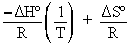 This is
the equation for a straight line (y = mx + b).
This is
the equation for a straight line (y = mx + b).
y = ln K; m = - = slope; x
=
= slope; x
=  ; b =
; b =  = intercept
(b) Plot ln K versus 1/T
DHo = -(R)(slope)
DSo =
R(intercept)
(c) For a reaction where K increases with
increasing temperature, the following plot would be obtained:
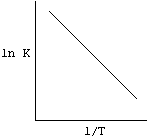
The slope is
negative.
Because DHo = -(R)(slope), DHo is positive, and
the reaction is endothermic.
This prediction is in accord with LeChâtelier's
principle because when you add heat (raise the temperature) for an endothermic
reaction, the reaction in the forward direction takes place, the product
concentrations increase and the reactant concentrations decrease. This results
in an increase in K.
17.108 Br2(l)
®
Br2(g)
DSo = So(Br2(g)) -
So(Br2(l))
DSo = (1 mol)(245.4 J/K) - (1 mol)(152.2 J/K) =
93.2 J/K = 93.2 x 10⁻³ kJ/K
Tbp = 

DHo = Tbp DSo = (332 K)(93.2 x
10-3 kJ/K) = 30.9 kJ
Kp =  =
=  = 0.299 atm
DGo = -RT ln Kp and DGo = DHo - TDSo (set equations
equal to each other)
DHo - TDSo = -RT ln Kp (rearrange)
 (solve for T)
T =  = 299 K =
26oC
= 299 K =
26oC
Br2(l) has a vapor pressure of 227 mm Hg at
26oC.
Multi-Concept
Problems
17.109 N2O4(g)
® 2
NO2(g)
DHo = 2 DHof(NO2) - DHof(N2O4) =
(2 mol)(33.2 kJ) - (1 mol)(9.16 kJ) = 57.2 kJ
DSo = 2
So(NO2) - So(N2O4) = (2
mol)(240.0 J/(K mol)) - (1 mol)(304.2 J/(K mol))
DSo = 175.8 J/K =
175.8 x 10⁻³ kJ/K
DGo = DHo - TDSo = 57.2 kJ - (373 K)(175.8 x 10⁻³
kJ/K) = -8.4 kJ
Kp = 
DGo = -RT ln Kp
ln Kp
=  = 2.71
Kp = e2.71 =
15
N2O4(g) ¾ 2
NO2(g)
| |
N2O4(g) |
NO2(g) |
| initial (atm) |
1.00 |
1.00 |
| change (atm) |
-2 |
+2x |
| equilibrium (atm) |
1.00-x |
1.00+2x |
Kp = 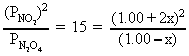
4x2 + 19x - 14 =
0
Use the quadratic formula to solve for x.
x = 
x = 0.65 and -5.4
Of the
two solutions for x, only 0.65 has physical meaning because x = -5.4 would lead
to a negative pressure for NO2.
 = 1.00 - x
= 1.00 - 0.65 = 0.35 atm;
= 1.00 - x
= 1.00 - 0.65 = 0.35 atm;  = 1.00 +
2x = 1.00 + 2(0.65) = 2.30 atm
= 1.00 +
2x = 1.00 + 2(0.65) = 2.30 atm
17.110 N2(g) + 3 H2(g)
® 2
NH3(g)
DHo = 2 DHof(NH3) - [DHof(N2) + 3 DHof(H2)] = (2 mol)(-46.1
kJ) - [0] = -92.2 kJ
DSo = 2 So(NH3) -
[So(N2) + 3 So(H2)]
DSo = (2 mol)(192.3
J/(K mol))
- [(1 mol)(191.5 J/(K mol)) + (3 mol)(130.6 J/(K mol))] = -198.7
J/K
DGo = DHo - TDSo = -92.2 kJ - (673 K)(-198.7 x
10-3 kJ/K) = 41.5 kJ
DGo = -RT ln Kp
ln Kp
=  = -7.42
Kp = e-7.42 = 6.0 x
10-4
Because Kp = Kc(RT)n,
Kc = Kp(RT)-n
Kc =
Kp(RT)2 = (6.0 x 10⁻⁴)[(0.082
06)(673)]2 = 1.83
N2, 28.01 amu; H2, 2.016
amu
Initial concentrations:
[N2] =  = 0.100 M
and [H2] =
= 0.100 M
and [H2] =  = 0.300
M
= 0.300
M
N2(g) + 3 H2(g)
¾ 2
NH3(g)
| |
N2(g) |
H2(g) |
NH3(g) |
| initial (M) |
0.100 |
0.300 |
0 |
| change (M) |
-x |
-3x |
+2x |
| equilibrium (M) |
0.100-x |
0.300-3x |
2x |
Kc =  =
= 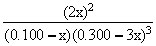 =
=  = 1.83
 =
=  = 12.35;
  =
=  = 3.515
3.515x2 - 1.703x + 0.03515 =
0
Use the quadratic formula to solve for x.
x = 
x = 0.463 and 0.0216
Of
the two solutions for x, only 0.0216 has physical meaning because x = 0.463
would lead to negative concentrations N2 and
H2.
[N2] = 0.100 - x = 0.100 - 0.0216 = 0.078
M
[H2] = 0.300 - 3x = 0.300 - 3(0.0216) = 0.235
M
[NH3] = 2x = 2(0.0216) = 0.043 M
17.111 2 SO2(g) + O2(g)
® 2
SO3(g)
DHo = 2 DHof(SO3) - 2
DHof(SO2)
DHo = (2 mol)(-395.7
kJ/mol) - (2 mol)(-296.8 kJ/mol) = -197.8 kJ
DSo = 2
So(SO3) - [2 So(SO2) +
So(O2)]
DSo = (2 mol)(256.6 J/(K mol)) - [(2 mol)(248.1
J/(K mol)) + (1 mol)(205.0 J/(K mol))]
DSo = -188.0 J/K = -188.0 x 10⁻³
kJ/K
DGo = DHo - TDSo = -197.8 kJ - (800 K)(-188.0 x
10-3 kJ/K) = -47.4 kJ
DGo = -RT ln Kp
ln Kp
=  = 7.13
Kp = e7.13 =
1249
SO2, 64.06 amu; O2, 32.00 amu
At 800 K:
 = 13.1 atm
 = 6.57 atm
2 SO2(g) +
O2(g) ¾ 2 SO3(g)
| |
SO2(g) |
O2(g) |
SO3(g) |
| initial (atm) |
13.1 |
6.57 |
0 |
| assume complete reaction (atm) |
0 |
0 |
13.1 |
| assume a small back reaction |
+2x |
+x |
-2x |
| equilibrium (atm) |
2x |
x |
13.1-2x |
Kp = 1249 = 
Solve for x. x3
= 0.0343; x = 0.325
Use successive approximations to solve for x because 2x
is not negligible compared with 13.1.
Second approximation:
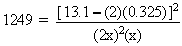 ; Solve
for x. x3 = 0.0310; x = 0.314
; Solve
for x. x3 = 0.0310; x = 0.314
Third approximation:
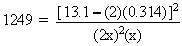 ; Solve for x. x3 = 0.0311; x = 0.315 (x has
converged)
; Solve for x. x3 = 0.0311; x = 0.315 (x has
converged)
 = 2x = 2(0.315) = 0.63 atm
 = x = 0.32
atm
= x = 0.32
atm
 = 13.1 - 2x = 13.1 - 2(0.315) = 12.5 atm
(b) The % yield of SO3 decreases with
increasing temperature because So is negative. Go becomes
less negative and Kp gets smaller as the temperature
increases.
(c) At 1000 K:
DGo = DHo - TDSo = -197.8 kJ -
(1000 K)(-188.0 x 10⁻³ kJ/K) = -9.8 kJ
DGo = -RT ln
Kp
ln Kp =  =
1.179
=
1.179
Kp = e1.179 = 3.25
 = 16.4
atm
= 16.4
atm = 8.2 atm
2 SO2(g) +
O2(g) ¾ 2 SO3(g)
| |
SO2(g) |
O2(g) |
SO3(g) |
| initial (atm) |
16.4 |
18.2 |
0 |
| assume complete reaction (atm) |
0 |
0 |
16.4 |
| assume a small back reaction |
+2x |
+x |
-2x |
| equilibrium (atm) |
2x |
x |
16.4-2x |
Kp = 3.25 = 
Solve for x. x3
= 20.7; x = 2.7
Use successive approximations to solve for x because 2x is
not negligible compared with 16.4.
Second approximation:
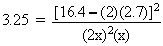 ; Solve
for x. x3 = 9.31; x = 2.1
; Solve
for x. x3 = 9.31; x = 2.1
Third approximation:
 ; Solve
for x. x3 = 11.4; x = 2.3
; Solve
for x. x3 = 11.4; x = 2.3
Fourth approximation:
 ; Solve
for x. x3 = 10.7; x = 2.2 (x has converged)
; Solve
for x. x3 = 10.7; x = 2.2 (x has converged)
 = 2x =
2(2.2) = 4.4 atm
= 2x =
2(2.2) = 4.4 atm
 = x = 2.2
atm
= x = 2.2
atm
 = 16.4 - 2x = 16.4 - 2(2.2) = 12.0 atm
Ptotal =  +
+  +
+  = 4.4 + 2.2 + 12.0 = 18.6 atm
On going from 800 K to
1000 K, Ptotal increases to 18.6 atm (because Kp
decreases, but P increases with temperature at constant volume).
17.112 Pb(s) + PbO2(s) + 2
H+(aq) + 2 HSO4-(aq) ® 2 PbSO4(s) + 2
H2O(l)
(a) DGo = [2 DGof(PbSO4) + 2
DGof(H2O)] -
[DGof(PbO2) + 2
DGof(HSO4-)]
DGo = (2 mol)(-813.2
kJ/mol) + (2 mol)(-237.2 kJ/mol)]
- [(1 mol)(-217.4 kJ/mol) + (2 mol)(-756.0
kJ/mol)] = -371.4 kJ
(b) oC = 5/9(oF - 32) = 5/9(10
- 32) = -12.2oC; -12.2oC = 261 K
DHo = [2 DHof(PbSO4) + 2
DHof(H2O)] -
[DHof(PbO2) + 2
DHof(HSO4-)]
Ho
= [(2 mol)(-919.9 kJ/mol) + (2 mol)(-285.8 kJ/mol)]
- [(1 mol)(-277 kJ/mol) +
(2 mol)(-887.3 kJ/mol)] = -359.8 kJ
DSo = [2 So(PbSO4) + 2
So(H2O)] - [So(Pb) +
So(PbO2) + 2 So(H+) + 2
So(HSO4-)]
DSo = [(2 mol)(148.6
J/(K mol)) + (2 mol)(69.9 J/(K mol))]
- [(1 mol)(64.8 J/(K mol)) + (1
mol)(68.6 J/(K mol))
+ (2 mol)(132 J/(K mol))] = 39.6 J/K = 39.6 x
10-3 kJ/K
DGo = DHo - TDSo = -359.8 kJ -(261 K)(39.6 x 10⁻³
kJ/K) = -370.1 kJ at 261 K
HSO4-(aq) +
H2O(l) ®
H3O+(aq) + SO42-(aq)
| |
HSO4-(aq) |
H3O+(aq) |
SO42-(aq) |
| initial (M) |
0.100 |
0.100 |
0 |
| change (M) |
-x |
+x |
+x |
| equilibrium (M) |
0.100-x |
0.100-x |
x |
Ka2 =  = 1.2 x
10-2 =
= 1.2 x
10-2 = 
x2 +
0.112x - (1.2 x 10⁻³) = 0
Use the quadratic formula to solve for
x.
x = 
x = -0.122 and
0.010
Of the two solutions for x, only 0.010 has physical meaning because x =
-0.122 would lead to a negative concentration of
H3O+.
[H+] = 0.100 + x = 0.100 + 0.010 =
0.110 M
[HSO4-] = 0.100 - x = 0.100 - 0.010 = 0.090
M
DG =
DGo + RT
ln
DG
= (-370.1 kJ) + (8.314 x 10⁻³ kJ/K)(261 K) ln 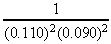 = -350.1
kJ
= -350.1
kJ