 (b)
Kc =
(b)
Kc = 
Chapter 13
Chemical Equilibrium
13.1 (a) Kc = (b)
Kc =
13.2 (a) Kc = 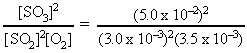 = 7.9 x
104
= 7.9 x
104
(b) Kc = 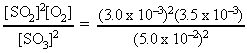 = 1.3 x
10-5
= 1.3 x
10-5
13.3 The  ratio in
the equilibrium mixture is 0.333. Only mixture (3) has this same ratio and is
also at equilibrium.
ratio in
the equilibrium mixture is 0.333. Only mixture (3) has this same ratio and is
also at equilibrium.
13.4 Kp =  =
9.48
=
9.48
13.5 2 NO(g) + O2 ¾ 2 NO2(g); n = 2
- 3 = -1
Kp = Kc(RT)n, Kc =
Kp(1/RT)
at 500 K: Kp = (6.9 x
105)[(0.0821)(500)]-1 = 1.7 x 10⁴
at 1000 K:
Kc = (1.3 x 10⁻²)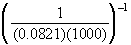 =
1.1
=
1.1
13.6 (a) Kc =  ,
Kp =
,
Kp =  (b) Kc =
[H2]2[O2], Kp =
(b) Kc =
[H2]2[O2], Kp = 
13.7 Kc = 1.2 x 10-42. Since Kc is very small, the equilibrium mixture contains mostly H2 molecules. H is in periodic group 1A. A very small value of Kc is consistent with strong bonding between 2 H atoms, each with one valence electron.
13.8 The container volume of 5.0 L must be
included to calculate molar concentrations.
(a) Qc =  = 890
= 890
Because Qc < Kc, the reaction is not at
equilibrium. The reaction will proceed to the right to reach
equilibrium.
(b) Qc =  = 1.6 x
107
= 1.6 x
107
Because Qc > Kc, the reaction is not
at equilibrium. The reaction will proceed to the left to reach
equilibrium.
13.9 (a) (2) (b) (1), reverse; (3), forward
13.10 Kc =  = 1.2 x
10-42
= 1.2 x
10-42
(a) [H] =  = 3.5 x
10-22 M
= 3.5 x
10-22 M
(b) H atoms = (3.5 x 10⁻²² mol/L)(1.0
L)(6.022 x 10²³ atoms/mol) = 210 H atoms
H2 molecules =
(0.10 mol/L)(1.0 L)(6.022 x 10²³ molecules/mol) = 6.0 x
1022 H2 molecules
13.11 CO(g) + H2O(g) ¾ CO2(g) + H2(g)
| CO(g) | H2O(g) | CO2(g) | H2(g) | |
| initial (M) | 0.150 | 0.150 | 0 | 0 |
| change (M) | -x | -x | +x | +x |
| equilibrium (M) | 0.150-x | 0.150-x | x | x |
Kc = 4.24 = 
Take the square root of
both sides and solve for x.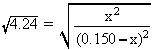 ; 2.06 =
 ; x = 0.101
At equilibrium, [CO2] = [H2] =
x = 0.101 M
[CO] = [H2O] = 0.150 - x = 0.150 - 0.101 = 0.049
M
13.12 N2O4(g) ¾ 2 NO2(g)
| N2O4(g) | NO2(g) | |
| initial (M) | 0.0500 | 0 |
| change (M) | -x | +2x |
| equilibrium (M) | 0.0500-x | 2x |
Kc = 4.64 x 10-3 = 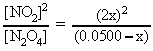
4x2 + (4.64 x
10-3)x - (2.32 x 10⁻⁴) = 0
Use the quadratic formula to
solve for x.
x = 
x = -0.008 22 and 0.007
06
Discard the solution that uses the negative square root (-0.008 22)
because it will lead to negative concentrations and that is
impossible.
[N2O4] = 0.0500 - x = 0.0500 - 0.007 06 =
0.0429 M
[NO2] = 2x = 2(0.007 06) = 0.0141 M
13.13 N2O4(g) ¾ 2
NO2(g)
Qc =  = 0.0450;
Qc > Kc
= 0.0450;
Qc > Kc
The reaction will approach equilibrium by
going from right to left.
N2O4(g) ¬ 2
NO2(g)
| N2O4(g) | NO2(g) | |
| initial (M) | 0.0200 | 0.0300 |
| change (M) | +x | -2x |
| equilibrium (M) | 0.0200+x | 0.0300-2x |
Kc = 4.64 x 10-3 = 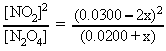
4x2 - 0.1246x +
(8.072 x 10⁻⁴) = 0
Use the quadratic formula to solve for x.
x
= 
x = 0.0220 and 0.009
19
Discard the solution that uses the positive square root (0.0220) because
it will lead to negative concentration of NO2, and that is
impossible.
[N2O4] = 0.0200 + x = 0.0200 + 0.009 19 =
0.0292 M
[NO2] = 0.0300 - 2x = 0.0300 - 2(0.009 19) = 0.0116
M
13.14 (a) CO(reactant) added, H2 concentration
increases.
(b) CO2 (product) added, H2 concentration
decreases.
(c) H2O (reactant) removed, H2 concentration
decreases.
(d) CO2 (product) removed, H2 concentration
increases.
At equilibrium, Qc = Kc =  . If some
CO2 is removed from the equilibrium mixture, the numerator in
Qc is decreased, which means that Qc < Kc
and the reaction will shift to the right, increasing the H2
concentration.
. If some
CO2 is removed from the equilibrium mixture, the numerator in
Qc is decreased, which means that Qc < Kc
and the reaction will shift to the right, increasing the H2
concentration.
13.15 (a) Because there are 2 mol of gas on both sides of the balanced equation, the composition of the equilibrium mixture is unaffected by a change in pressure. The number of moles of reaction products remains the same.
(b) Because there are 2 mol of gas on the left side and 1 mol of gas on the right side of the balanced equation, the stress of an increase in pressure is relieved by a shift in the reaction to the side with fewer moles of gas (in this case, to products). The number of moles of reaction products increases.
(c) Because there is 1 mol of gas on the left side and 2 mol of gas on the right side of the balanced equation, the stress of an increase in pressure is relieved by a shift in the reaction to the side with fewer moles of gas (in this case, to reactants). The number of moles of reaction product decreases.
13.16 
13.17 Le Châtelier's principle predicts that a stress of added heat will be relieved by net reaction in the direction that absorbs the heat. Since the reaction is endothermic, the equilibrium will shift from left to right (Kc will increase) with an increase in temperature. Therefore, the equilibrium mixture will contain more of the offending NO, the higher the temperature.
13.18 The reaction is exothermic. As the
temperature is increased the reaction shifts from right to left. The amount of
ethyl acetate decreases.
Kc = 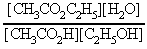
As the temperature is
decreased, the reaction shifts from left to right. The product concentrations
increase, and the reactant concentrations decrease. This corresponds to an
increase in Kc.
13.19 There are more AB(g) molecules at the higher temperature. The equilibrium shifted to the right at the higher temperature, which means the reaction is endothermic.
13.20 (a) A catalyst does not affect the equilibrium composition. The amount of CO remains the same.
(b) The reaction is exothermic. An increase in temperature shifts the reaction toward reactants. The amount of CO increases.
(c) Because there are 3 mol of gas on the left side and 2 mol of gas on the right side of the balanced equation, the stress of an increase in pressure is relieved by a shift in the reaction to the side with fewer moles of gas (in this case, to products). The amount of CO decreases.
(d) An increase in pressure as a result of the addition of an inert gas (with no volume change) does not affect the equilibrium composition. The amount of CO remains the same.
(e) Adding O2 increases the O2 concentration and shifts the reaction toward products. The amount of CO decreases.
13.21 (a) Because Kc is so large,
kf is larger than kr.
(b) Kc =  ;
kr =
;
kr = 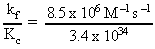 = 2.5 x 10⁻²⁸ M-1
s-1
= 2.5 x 10⁻²⁸ M-1
s-1
(c) Because the reaction is exothermic, Ea
(forward) is less than Ea (reverse). Consequently, as the temperature
decreases, kr decreases more than kf decreases, and
therefore Kc =  increases.
13.22 Hb + O2 ¾ Hb(O2)
If CO
binds to Hb, Hb is removed from the reaction and the reaction will shift to the
left resulting in O2 being released from Hb(O2). This will
decrease the effectiveness of Hb for carrying O2.
13.23 The equilibrium shifts to the left because at the higher altitude the concentration of O2 is decreased.
13.24 There are 26 electrons.
13.25 The partial pressure of O2 in
the atmosphere is 0.2095 atm.
PV = nRT
n =  = 4.28 x
10-3 mol O2
= 4.28 x
10-3 mol O2
4.28 x 10⁻³ mol O2 x
 = 2.58 x 10²¹ O2 molecules
Understanding Key Concepts
13.26 (a) (1) and (3) because the number of A
and B's are the same in the third and fourth box.
(b) Kc =  = 1.5
= 1.5
(c) Because the same number of molecules appear on both sides of the
equation, the volume terms in Kc all cancel. Therefore, we can
calculate Kc without including the volume.
13.27 (a) A2 + C2 ¾ 2 AC (most product molecules)
(b) A2 + B2 ¾ 2 AB (fewest product molecules)
13.28 (a) Only reaction (3),  = 2, is at
equilibrium.
= 2, is at
equilibrium.
(b) 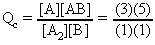 = 15 for
reaction (1). Because Qc > Kc, the reaction will go in
the reverse direction to reach equilibrium.
= 15 for
reaction (1). Because Qc > Kc, the reaction will go in
the reverse direction to reach equilibrium. = 1/3 for
reaction (2). Because Qc < Kc, the reaction will go in
the forward direction to reach equilibrium.
= 1/3 for
reaction (2). Because Qc < Kc, the reaction will go in
the forward direction to reach equilibrium.
13.29 (a) A2 + 2 B ¾ 2 AB
(b) The number of
AB molecules will increase, because as the volume is decreased at constant
temperature, the pressure will increase and the reaction will shift to the side
of fewer molecules to reduce the pressure.
13.30 When the stopcock is opened, the reaction will go in the reverse direction because there will be initially an excess of AB molecules.
13.31 As the temperature is raised, the reaction proceeds in the reverse direction. This is consistent with an exothermic reaction where "heat" can be considered as a product.
13.32 (a) AB ¾ A + B
(b) The reaction
is endothermic because a stress of added heat (higher temperature) shifts the AB
¾ A + B
equilibrium to the right.
(c) If the volume is increased, the pressure is
decreased. The stress of decreased pressure will be relieved by a shift in the
equilibrium from left to right, thus increasing the number of A atoms.
13.33 Heat + BaCO3(s) ¾ BaO(s) + CO2(g)
(a)  (b)
(b) 
13.34 (a) (b) (c)
13.35 This equilibrium mixture has
a Kc  and is less than 1. This means that kf <
kr.
and is less than 1. This means that kf <
kr.
Additional Problems
Equilibrium Expressions and Equilibrium Constants
13.36 (a)  (b)
(b)  (c) Kc =
13.37 (a) 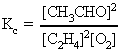 (b)
(b) 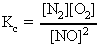 (c)
(c) 
13.38 (a) Kp =  , n = 2 and
Kp = Kc(RT)2
, n = 2 and
Kp = Kc(RT)2
(b) Kp =  ,
n = -2 and Kp = Kc(RT)-2
,
n = -2 and Kp = Kc(RT)-2
(c) Kp =
 , n = 0 and Kp = Kc
13.39 (a) Kp =  , n = -1
and Kp = Kc(RT)-1
, n = -1
and Kp = Kc(RT)-1
(b) Kp =  ,
n = 0 and Kp = Kc
,
n = 0 and Kp = Kc
(c) Kp =  , n = 1 and
Kp = Kc(RT)
, n = 1 and
Kp = Kc(RT)
13.40 
13.41 Kc = 
13.42 
13.43 
13.44 The two reactions are the reverse of each
other.
Kc(reverse) =  = 1.3 x
108
= 1.3 x
108
13.45 The two reactions are the reverse of each
other.
Kp(reverse) = 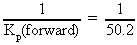 = 1.99 x
10-2
= 1.99 x
10-2
13.46 Kc =  =
0.058
=
0.058
13.47 Kp =  =
52.0
=
52.0
13.48 The container volume of 2.00 L must be
included to calculate molar concentrations.
Initial [HI] = 9.30 x
10-3 mol/2.00 L = 4.65 x 10⁻³ M = 0.004 65
M
H2(g) + I2(g) ¾ 2 HI(g)
| H2(g) | I2(g) | HI(g) | |
| initial (M) | 0 | 0 | 0.00465 |
| change (M) | +x | +x | -2x |
| equilibrium (M) | x | x | 0.00465-2x |
x = [H2] = [I2] = 6.29 x
10-4 M = 0.000 629 M
[HI] = 0.004 65 - 2x = 0.004 65 - 2(0.000
629) = 0.003 39 M
Kc =  =
29.0
=
29.0
13.49 (a) Kc = 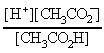
(b)
CH3CO2H(aq) ¾ H+(aq) +
CH3CO2-(aq)
| CH3CO2H(aq) | H+(aq) | CH3CO2-(aq) | |
| initial (M) | 1.0 | 0 | 0 |
| change (M) | -0.0042 | +0.0042 | +0.0042 |
| equilibrium (M) | 1.0-0.0042 | +0.0042 | +0.0042 |
Kc = 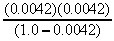 = 1.8 x
10-5
= 1.8 x
10-5
13.50 (a) 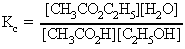
(b)
CH3CO2H(soln) + C2H5OH(soln)
¾
CH3CO2C2H5(soln) +
H2O(soln)
| CH3CO2H(soln) | C2H5OH(soln) | CH3CO2C2H5(soln) | H2O(soln) | |
| initial (M) | 1.00 | 1.00 | 0 | 0 |
| change (M) | -x | -x | +x | +x |
| equilibrium (M) | 1.00-x | 1.00-x | x | x |
x = 0.65 mol; 1.00 - x = 0.35 mol; Kc
=  = 3.4
= 3.4
Because there are the same number of molecules on both
sides of the equation, the volume terms in Kc cancel. Therefore, we
can calculate Kc without including the volume.
13.51
CH3CO2C2H5(soln) +
H2O(soln) ¾ CH3CO2H(soln) +
C2H5OH(soln)
Kc(hydrolysis) =  =
0.29
=
0.29
13.52 n = 1 and Kp = Kc(RT) = (0.575)(0.082 06)(500) = 23.6
13.53 2 SO2(g) + O2(g)
¾ 2
SO3(g); n = 2 - (2 + 1) = -1 and Kp =
3.30
Kc = Kp  =
271
=
271
13.54 Kp =  = 0.0313
atm; n = 1
= 0.0313
atm; n = 1
Kc = Kp = 1.28 x
10-3
= 1.28 x
10-3
13.55  = 1.3 x
10-4 atm
= 1.3 x
10-4 atm
Kp =  = 1.3 x
10-4; n = 1 - 0 = 1, T = 27oC = 300 K
= 1.3 x
10-4; n = 1 - 0 = 1, T = 27oC = 300 K
Kc =
Kp  = 5.3 x 10⁻⁶
13.56 (a)  ,
,  (b)
(b)  ,
, 
(c) Kc = [SO3],  (d)
Kc = [Ba2+][SO42-]
(d)
Kc = [Ba2+][SO42-]
13.57 (a) Kc =  ,
Kp =
,
Kp =  (b) Kc =
(c) Kc =  ,
Kp =
,
Kp =  (d) Kc = [CO2], Kp =

Using the Equilibrium Constant
13.58 (a) Because Kc is very large,
the equilibrium mixture contains mostly product.
(b) Because Kc is
very small, the equilibrium mixture contains mostly reactants.
13.59 (a) proceeds hardly at all toward
completion
(b) goes almost all the way to completion
13.60 (a) Because Kc is very small,
the equilibrium mixture contains mostly reactant.
(b) Because Kc
is very large, the equilibrium mixture contains mostly product.
(c) Because
Kc = 1.8, the equilibrium mixture contains an appreciable
concentration of both reactants and products.
13.61 (a) Because Kc is very large,
the equilibrium mixture contains mostly product.
(b) Because Kc =
7.5 x 10⁻³, the equilibrium mixture contains an appreciable
concentration of both reactants and products.
(c) Because Kc is
very small, the equilibrium mixture contains mostly reactant.
13.62 Kc = 1.2 x 1082 is very large. When equilibrium is reached, very little if any ethanol will remain because the reaction goes to completion.
13.63 Because Kc is very small, pure
air will contain very little O3 (ozone) at equilibrium.
3
O2(g) ¾ 2 O3(g); Kc =  = 1.7 x
10-56; [O2] = 8 x 10⁻³ M
= 1.7 x
10-56; [O2] = 8 x 10⁻³ M
[O3] =
 = 9 x 10-32 M
13.64 The container volume of 10.0 L must be
included to calculate molar concentrations.
Qc =  = 7.6 x
10-2; Kc = 2.5 x 10-3
= 7.6 x
10-2; Kc = 2.5 x 10⁻³
The reaction is not at
equilibrium because Qc > Kc. The reaction will proceed
from right to left to reach equilibrium.
13.65 Qc = 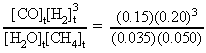 = 0.69;
Kc = 4.7
= 0.69;
Kc = 4.7
The reaction is not at equilibrium because Qc
< Kc. The reaction will proceed from left to right to reach
equilibrium.
13.66 Kc =  = 0.29; At
equilibrium, [N2] = 0.036 M and [H2] = 0.15
M
= 0.29; At
equilibrium, [N2] = 0.036 M and [H2] = 0.15
M
[NH3] =  = 5.9 x
10-3 M
= 5.9 x
10-3 M
13.67 Kc = 2.7 x 102 =
 ; Because [SO3] = [SO2], then 2.7 x
102 =
; Because [SO3] = [SO2], then 2.7 x
102 = 
[O2] = 3.7 x 10⁻³ M
13.68 N2(g) + O2(g) ¾ 2 NO(g)
| N2(g) | O2(g) | NO(g) | |
| initial (M) | 1.40 | 1.40 | 0 |
| change (M) | -x | -x | +2x |
| equilibrium (M) | 1.40-x | 1.40-x | 2x |
Kc = 1.7 x 10-3 = 
Take the square root of
both sides and solve for x. ; 4.1 x
10-2 =
; 4.1 x
10-2 =  ; x = 2.8 x 10⁻²
At equilibrium, [NO] = 2x =
2(2.8 x 10⁻²) = 0.056 M
[N2] = [O2] = 1.40 -
x = 1.40 - (2.8 x 10⁻²) = 1.37 M
13.69 N2(g) + O2(g) ¾ 2 NO(g)
| N2(g) | O2(g) | NO(g) | |
| initial (M) | 2.24 | 0.56 | 0 |
| change (M) | -x | -x | +2x |
| equilibrium (M) | 2.24-x | 0.56-x | 2x |
Kc =  = 1.7 x
10-3 =
= 1.7 x
10-3 = 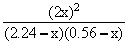
4x2 +
(4.8 x 10⁻³)x - (2.1 x 10⁻³) = 0
Use the quadratic
formula to solve for x.
x = 
x = -0.0235 and
0.0223
Discard the solution that uses the negative square root (x = -0.0235)
because it gives a negative NO concentration and that is impossible.
[N2] = 2.24 - x = 2.24 - 0.0223 = 2.22 M
[O2] =
0.56 - x = 0.56 - 0.0223 = 0.54 M; [NO] = 2x = 2(0.0223) = 0.045 M
13.70 PCl5(g) ¾ PCl3(g) + Cl2(g)
| PCl5(g) | PCl3(g) | Cl2(g) | |
| initial (M) | 0.160 | 0 | 0 |
| change (M) | -x | +x | +x |
| equilibrium (M) | 0.160-x | x | x |
Kc = 
x2 + (5.8 x
10-2)x - 0.00928 = 0
Use the quadratic formula to solve for
x.
x = 0.071 and
-0.129
Discard the solution that uses the negative square root (x = -0.129)
because it gives negative concentrations of PCl3 and Cl2
and that is impossible.
[PCl3] = [Cl2] = x = 0.071 M;
[PCl5] = 0.160 - x = 0.160 - 0.071 = 0.089 M
13.71 Qc =  = 0.020,
Qc < Kc therefore the reaction proceeds from reactants
to products to reach equilibrium.
= 0.020,
Qc < Kc therefore the reaction proceeds from reactants
to products to reach equilibrium.
| PCl5(g) | PCl3(g) | Cl2(g) | |
| initial (M) | 0.200 | 0.100 | 0.040 |
| change (M) | -x | +x | +x |
| equilibrium (M) | 0.200-x | 0.100+x | 0.040+x |
Kc = 
x2 + 0.198x -
(7.60 x 10⁻³) = 0
Use the quadratic formula to solve for
x.
x = 0.033 and
-0.231
Discard the solution that uses the negative square root (x = -0.231)
because it gives negative concentrations of PCl3 and Cl2
and that is impossible.
[PCl3] = 0.100 + x = 0.100 + 0.033 = 0.133
M
[Cl2] = 0.040 + x = 0.040 + 0.033 = 0.073 M
[PCl5]
= 0.200 - x = 0.200 - 0.033 = 0.167 M
13.72 (a) Kc =  ; x = 6.8
moles CH3CO2C2H5
; x = 6.8
moles CH3CO2C2H5
Note that the
volume cancels because the same number of molecules appear on both sides of the
chemical equation.
(b) CH3CO2H(soln) +
C2H5OH(soln) ¾
CH3CO2C2H5(soln) +
H2O(soln)
| CH3CO2H(soln) | C2H5OH(soln) | CH3CO2C2H5(soln) | H2O(soln) | |
| initial (M) | 1.00 | 10.00 | 0 | 0 |
| change (M) | -x | -x | +x | +x |
| equilibrium (M) | 1.00-x | 10.00-x | x | x |
Kc = 3.4 = 
2.4x2 - 37.4x +
34 = 0
Use the quadratic formula to solve for x.
x = 
x = 0.969 and
14.6
Discard the solution that uses the positive square root (x = 14.6)
because it leads to negative concentrations and that is impossible.
mol
CH3CO2H = 1.00 - x = 1.00 - 0.969 = 0.03 mol
mol
C2H5OH = 10.00 - x = 10.00 - 0.969 = 9.03 mol
mol
CH3CO2C2H5 = mol H2O = x
= 0.97 mol
13.73 When equal volumes of two solutions are
mixed together, their concentrations are cut in half.
CH3Cl(aq) +
OH-(aq) ¾ CH3OH(aq) + Cl-(aq)
| CH3Cl(aq) | OH-(aq) | CH3OH(aq) | Cl-(aq) | |
| initial (M) | 0.05 | 0.1 | 0 | 0 |
| assume complete reaction (M) | 0 | 0.05 | 0.05 | 0.05 |
| assume small back reaction (M) | +x | +x | -x | -x |
| equilibrium (M) | x | 0.05+x | 0.05-x | 0.05-x |
Kc =  ;
Because Kc is very large, x << 0.05.
;
Because Kc is very large, x << 0.05.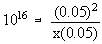 ; x = 5 x
10-18
; x = 5 x
10-18
[CH3Cl] = x = 5 x 10-18 M;
[OH-] = [CH3OH] = [Cl-] 0.05 M
13.74 ClF3(g) ¾ ClF(g) + F2(g)
| ClF3(g) | ClF(g) | F2(g) | |
| initial (atm) | 1.47 | 0 | 0 |
| change (atm) | -x | +x | +x |
| equilibrium (atm) | 1.47-x | x | x |
Kp =  = 0.140 =
 ; solve for x.
x2 + 0.140x - 0.2058 = 0
Use the
quadratic formula to solve for x.
x = 
x = 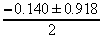
x = 0.389 and -
0.529
Discard the solution that uses the negative square root (- 0.529)
because it gives negative partial pressures and that is impossible. = x = 0.389 atm
 = 1.47 - x
= 1.47 - 0.389 = 1.08 atm
= 1.47 - x
= 1.47 - 0.389 = 1.08 atm
13.75 Fe2O3(s) + 3 CO(g) ¾ 2 Fe(s) + 3 CO2(g)
| CO(g) | CO2(g) | |
| initial (atm) | 0.978 | 0 |
| change (atm) | -3x | +3x |
| equilibrium (atm) | 0.978-3x | 3x |
Kp =  = 19.9 =
 ; take the cube root of both sidea and solve for x.
 = 2.71 =
2.65 - 8.13x = 3x
2.65 = 11.13x
x = 0.238 atm = 0.978 - 3x = 0.978 - 3(0.238) = 0.264 atm
 = 3x =
3(0.238) = 0.714 atm
= 3x =
3(0.238) = 0.714 atm
Le Châtelier's Principle
13.76 (a) Cl- (reactant) added,
AgCl(s) increases
(b) Ag+ (reactant) added, AgCl(s)
increases
(c) Ag+ (reactant) removed, AgCl(s) decreases
(d)
Cl- (reactant) removed, AgCl(s) decreases
Disturbing the
equilibrium by decreasing [Cl-] increases Qc
(Qc =  ) to a value greater than Kc. To reach a new
state of equilibrium, Qc must decrease, which means that the
denominator must increase; that is, the reaction must go from right to left,
thus decreasing the amount of solid AgCl.
) to a value greater than Kc. To reach a new
state of equilibrium, Qc must decrease, which means that the
denominator must increase; that is, the reaction must go from right to left,
thus decreasing the amount of solid AgCl.
13.77 (a) ClNO (product) added, NO2
concentration decreases
(b) NO (reactant) added, NO2 concentration
increases
(c) NO (reactant) removed, NO2 concentration
decreases
(d) ClNO2 (reactant) added, NO2 concentration
increases
Adding ClNO2 decreases the value of Qc
(Qc =  ). To reach a new state of equilibrium, the reaction must
go from left to right, thus increasing the concentration of
NO2.
). To reach a new state of equilibrium, the reaction must
go from left to right, thus increasing the concentration of
NO2.
13.78 (a) Because there are 2 mol of gas on the left side and 3 mol of gas on the right side of the balanced equation, the stress of an increase in pressure is relieved by a shift in the reaction to the side with fewer moles of gas (in this case, to reactants). The number of moles of reaction products decreases.
(b) Because there are 2 mol of gas on both sides of the balanced equation, the composition of the equilibrium mixture is unaffected by a change in pressure. The number of moles of reaction product remains the same.
(c) Because there are 2 mol of gas on the left side and 1 mol of gas on the right side of the balanced equation, the stress of an increase in pressure is relieved by a shift in the reaction to the side with fewer moles of gas (in this case, to products). The number of moles of reaction products increases.
13.79 As the volume increases, the pressure decreases at constant temperature.
(a) Because there is 1 mol of gas on the left side and 2 mol of gas on the right side of the balanced equation, the stress of an increase in volume (decrease in pressure) is relieved by a shift in the reaction to the side with the larger number of moles of gas (in this case, to products).
(b) Because there are 3 mol of gas on the left side and 2 mol of gas on the right side of the balanced equation, the stress of an increase in volume (decrease in pressure) is relieved by a shift in the reaction to the side with the larger number of moles of gas (in this case, to reactants).
(c) Because there are 3 mol of gas on both sides of the balanced equation, the composition of the equilibrium mixture is unaffected by an increase in volume (decrease in pressure). There is no net reaction in either direction.
13.80 CO(g) + H2O(g) ¾ CO2(g) +
H2(g) Ho = -41.2 kJ
The reaction is exothermic.
[H2] decreases when the temperature is increased.
As the
temperature is decreased, the reaction shifts to the right. [CO2] and
[H2] increase, [CO] and [H2O] decrease, and Kc
increases.
13.81 Because Ho is positive, the
reaction is endothermic.
heat + 3 O2(g) ¾ 2
O3(g)
Kc = 
As the temperature
increases, heat is added to the reaction, causing a shift to the right. The
[O3] increases, and the [O2] decreases. This results in an
increase in Kc.
13.82 (a) HCl is a source of Cl-
(product), the reaction shifts left, the equilibrium
CoCl42- increases.
(b) Co(NO3)2
is a source of Co(H2O)62+ (product), the
reaction shifts left, the equilibrium CoCl42-
increases.
(c) All concentrations will initially decrease and the reaction
will shift to the right, the equilibrium CoCl42-
decreases.
(d) For an exothermic reaction, the reaction shifts to the left
when the temperature is increased, the equilibrium CoCl42-
increases.
13.83 (a) Fe(NO3)3 is a
source of Fe3+. Fe3+ (reactant) added; the
FeCl2+ concentration increases.
(b) Cl- (reactant)
removed; the FeCl2+ concentration decreases.
(c) An endothermic
reaction shifts to the right as the temperature increases; the FeCl2+
concentration increases.
(d) A catalyst does not affect the composition of
the equilibrium mixture; no change in FeCl2+
concentration.
13.84 (a) The reaction is exothermic. The amount
of CH3OH (product) decreases as the temperature increases.
(b)
When the volume decreases, the reaction shifts to the side with fewer gas
molecules. The amount of CH3OH increases.
(c) Addition of an inert
gas (He) does not affect the equilibrium composition. There is no change.
(d)
Addition of CO (reactant) shifts the reaction toward product. The amount of
CH3OH increases.
(e) Addition or removal of a catalyst does not
affect the equilibrium composition. There is no change.
13.85 (a) An endothermic reaction shifts to the
right as the temperature increases. The amount of acetone increases.
(b)
Because there is 1 mol of gas on the left side and 2 mol of gas on the right
side of the balanced equation, the stress of an increase in volume (decrease in
pressure) is relieved by a shift in the reaction to the side with the larger
number of moles of gas (in this case, to products). The amount of acetone
increases.
(c) The addition of Ar (an inert gas) with no volume change does
not affect the composition of the equilibrium mixture. The amount of acetone
does not change.
(d) H2 (product) added; the amount of acetone
decreases.
(e) A catalyst does not affect the composition of the equilibrium
mixture. The amount of acetone does not change.
Chemical Equilibrium and Chemical Kinetics
13.86 A + B
¾ C
ratef =
kf[A][B] and rater = kr[C]; at equilibrium,
ratef = rater
kf[A][B] = kr[C];

13.87 An equilibrium mixture that contains large amounts of reactants and small amounts of products has a small Kc. A small Kc has kf < kr (c).
13.88 Kc = 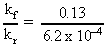 =
210
=
210
13.89 Kc =  ;
kr =
;
kr =  = 6 x 10-22
M-1s-1
= 6 x 10-22
M-1s-1
13.90 kr increases more than kf, this means that Ea (reverse) is greater than Ea (forward). The reaction is exothermic when Ea (reverse) > Ea (forward).
13.91 kf increases more than kr, this means that Ea (forward) is greater than Ea (reverse). The reaction is endothermic when Ea (forward) > Ea (reverse).
General Problems
13.92 (a) [N2O4] =  = 0.125 M
N2O4(g) ¾ 2 NO2(g)
| N2O4(g) | NO2(g) | |
| initial (M) | 0.125 | 0 |
| change (M) | -(0.793)(0.125) | +(2)(0.793)(0.125) |
| equilibrium (M) | 0.125-(0.793)(0.125) | +(2)(0.793)(0.125) |
At equilibrium, [N2O4] =
0.125 - (0.793)(0.125) = 0.0259 M
[NO2] = (2)(0.793)(0.125) =
0.198 M
Kc = 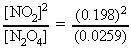 =
1.51
=
1.51
n = 2 - 1 = 1 and Kp = Kc(RT)n;
Kp = Kc(RT) = (1.51)(0.0821)(400) = 49.6
(b) 

13.93 Kc is very large.
The reaction goes essentially to completion.
Kc =  ;
[CO2] =
;
[CO2] =  = 6.2 x
10-25 M
= 6.2 x
10-25 M
13.94 Kc =  =
0.291
=
0.291
At equilibrium, [N2] = 1.0 x 10⁻³ M and
[H2] = 2.0 x 10⁻³ M
[NH3] =  = 1.5 x
10-6 M
= 1.5 x
10-6 M
13.95 (a) Kp =  = 7.83 at
1500 K
= 7.83 at
1500 K
PF =  = 1.25
atm
= 1.25
atm
(b) F2(g) ¾ 2 F(g)
| F2(g) | F(g) | |
| initial (atm) | x | 0 |
| change (atm) | -y | +2y |
| equilibrium (atm) | x-y | 2y |
2y = 1.25 so y = 0.625
x - y = 0.200; x =
0.200 + y = 0.200 + 0.625 = 0.825
f =  =
0.758
=
0.758
(c) The shorter bond in F2 is expected to be stronger. However, because of the small size of F, repulsion between the lone pairs of the two halogen atoms are much greater in F2 than in Cl2.
13.96 2 HI(g) ¾ H2(g) +
I2(g)
Calculate Kc. Kc =  =
0.0206
=
0.0206
[HI] =  = 0.40 M
| HI(g) | H2(g) | I2(g) | |
| initial (atm) | 0.40 | 0 | 0 |
| change (atm) | -2x | +x | +x |
| equilibrium (atm) | 0.40-2x | x | x |
Kc = 0.0206 = 
Take the square root of
both sides, and solve for x. ; 0.144 =
 ; x = 0.045
At equilibrium, [H2] = [I2] =
x = 0.045 M; [HI] = 0.40 - 2x = 0.40 - 2(0.045) = 0.31 M
13.97 Note the container volume is 5.00
L
[H2] = [I2] = 1.00 mol/5.00 L = 0.200 M
[HI] =
2.50 mol/5.00 L = 0.500 M
| H2(g)HI(g) | I2(g) | HI(g) | |
| initial (atm) | 0.200 | 0.200 | 0.500 |
| change (atm) | -x | -x | +2x |
| equilibrium (atm) | 0.200-x | 0.200-x | 0.500+2x |
Kc = 
Take the square root of
both sides, and solve for x. ; 11.4 =
 ; x = 0.133
[H2] = [I2] = 0.200 - x =
0.200 - 0.133 = 0.067 M
[HI] = 0.500 + 2x = 0.500 + 2(0.133) = 0.766
M
13.98 [H2O] =  = 1.20
M
= 1.20
M
C(s) + H2O(g) ¾ CO(g) + H2(g)
| H2O(g) | CO(g) | H2(g) | |
| initial (M) | 1.20 | 0 | 0 |
| change (M) | -x | +x | +x |
| equilibrium (M) | 1.20-x | x | x |
Kc = 
x2 + (3.0 x
10-2)x - 0.036 = 0
Use the quadratic formula to solve for x.
x
= 
x = 0.176 and
-0.206
Discard the solution that uses the negative square root (x = -0.206)
because it leads to negative concentrations and that is impossible.
[CO] =
[H2] = x = 0.18 M; [H2O] = 1.20 - x = 1.20 - 0.18 = 1.02
M
13.99 (a) Because Kp is larger at the higher temperature, the reaction has shifted toward products at the higher temperature, which means the reaction is endothermic.
(b) (i) Increasing the volume causes the
reaction to shift toward the side with more mol of gas (product side). The
equilibrium amounts of PCl3 and Cl2 increase while that of
PCl5 decresases.
(ii) If there is no volume change, there is no
change in equilibrium concentrations.
(iii) Addition of a catalyst does not
affect the equilibrium concentrations.
13.100 A decrease in volume (a) and the addition
of reactants (c) will affect the composition of the equilibrium mixture, but
leave the value of Kc unchanged.
A change in temperature (b)
affects the value of Kc.
Addition of a catalyst (d) or an inert
gas (e) affects neither the composition of the equilibrium mixture nor the value
of Kc.
13.101 (a) Addition of a solid does not affect
the equilibrium composition. There is no change in the number of moles of
CO2.
(b) Adding a product causes the reaction to shift toward
reactants. The number of moles of CO2 decreases.
(c) Decreasing
the volume causes the reaction to shift toward the side with fewer mol of gas
(reactant side). The number of moles of CO2 decreases.
(d) The
reaction is endothermic. An increase in temperature shifts the reaction toward
products. The number of moles of CO2 increases.
13.102 2 monomer
¾ dimer
(a) In benzene, Kc =
1.51 x 10²
| monomer | dimer | |
| initial (M) | 0.100 | 0 |
| change (M) | -2x | +x |
| equilibrium (M) | 0.100-2x | x |
Kc = 
604x2 - 61.4x
+1.51 = 0
Use the quadratic formula to solve for x.
x = 
x = 0.0600 and
0.0417
Discard the solution that uses the positive square root (x = 0.0600)
because it gives a negative concentration of the monomer and that is
impossible.
[monomer] = 0.100 - 2x = 0.100 - 2(0.0417) = 0.017 M; [dimer] = x
= 0.0417 M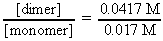 = 2.5
= 2.5
(b) In H2O, Kc = 3.7
x 10-2
2 monomer ¾ dimer
| monomer | dimer | |
| initial (M) | 0.100 | 0 |
| change (M) | -2x | +x |
| equilibrium (M) | 0.100-2x | x |
Kc = 
0.148x2 -
1.0148x + 0.000 37 = 0
Use the quadratic formula to solve for x.
x = 
x = 6.86 and 3.7 x
10-4
Discard the solution that uses the positive square root (x =
6.86) because it gives a negative concentration of the monomer and that is
impossible.
[monomer] = 0.100 - 2x = 0.100 - 2(3.7 x 10⁻⁴) = 0.099
M; [dimer] = x = 3.7 x 10⁻⁴ M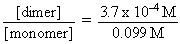 =
0.0038
=
0.0038
(c) Kc for the water solution is so much smaller than Kc for the benzene solution because H2O can hydrogen bond with acetic acid, thus preventing acetic acid dimer formation. Benzene cannot hydrogen bond with acetic acid.
13.103 C(s) + CO2(g) ¾ 2 CO(g)
| CO2(g) | CO(g) | |
| initial (M) excess | 1.50 mol / 20 L | 0 |
| change (M) | -x | +2x |
| equilibrium (M) | 0.075 - x | 2x |
[CO] = 2x = 7.00 x 10⁻² M; x = 0.0350
M
(a) [CO2] = 0.0750 - x = 0.0750 - 0.0350 = 0.0400 M
(b)
Kc =  = 0.122
13.104 (a) [PCl5] = 1.000 mol/5.000 L
= 0.2000 M
PCl5(g) ¾ PCl3(g) + Cl2(g)
| PCl5(g) | PCl3(g) | Cl2(g) | |
| initial (M) | 0.200 | 0 | 0 |
| change (M) | -(0.200)(0.785) | +(0.200)(0.785) | +(0.200)(0.785) |
| equilibrium (M) | 0.0430 | 0.1570 | 0.1570 |
Kc =  =
= 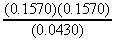 = 0.573
n = 1 and Kp = Kc(RT) =
(0.573)(0.082 06)(500) = 23.5
(b) Qc =  =
=  = 0.18
Because Qc < Kc, the reaction
proceeds to the right to reach equilibrium.
PCl5(g)
¾ PCl3(g) +
Cl2(g)
| PCl5(g) | PCl3(g) | Cl2(g) | |
| initial (M) | 0.500 | 0.150 | 0.600 |
| change (M) | -x | +x | +x |
| equilibrium (M) | 0.500-x | 0.150+x | 0.600+x |
Kc =  = 0.573 =
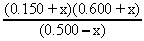 ; solve for x.
x2 + 1.323x - 0.1965 = 0
x = 
x = - 1.458 and
0.135
Discard the solution that uses the negative square root (- 1.458)
because it will lead to negative concentrations and that is
impossible.
[PCl5] = 0.500 - x = 0.500 - 0.135 = 0.365
M
[PCl3] = 0.150 + x = 0.150 + 0.135 = 0.285 M
[Cl2]
= 0.600 + x = 0.600 + 0.135 = 0.735 M
13.105 Qp =  = 1.00,
Qp < Kp therefore the reaction proceeds from reactants
to products to reach equilibrium.
= 1.00,
Qp < Kp therefore the reaction proceeds from reactants
to products to reach equilibrium.
PCl5(g)
¾ PCl3(g) +
Cl2(g)
| PCl5(g) | PCl3(g) | Cl2(g) | |
| initial (atm) | 3.00 | 2.00 | 1.50 |
| change (atm) | -x | +x | +x |
| equilibrium (atm) | 3.00-x | 2.00+x | 1.50+x |
Kp = 
x2 + 4.92x -
1.26 = 0
Use the quadratic formula to solve for x.
x = 0.245 and
-5.165
Discard the solution that uses the negative square root (x = -5.165)
because it gives negative partial pressures and that is impossible. = 3.00 - x = 3.00 - 0.245 = 2.76 atm
 = 2.00 +
x = 2.00 + 0.245 = 2.24 atm
= 2.00 +
x = 2.00 + 0.245 = 2.24 atm = 1.50 + x
= 1.50 + 0.245 = 1.74 atm
= 1.50 + x
= 1.50 + 0.245 = 1.74 atm
Ptotal =  +
+  +
+  = 2.76 + 2.24 + 1.74 = 6.74 atm
13.106 (a) 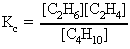
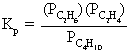
(b) Kp = 12; n =
1; Kc = Kp =
0.19
=
0.19
(c) C4H10(g)
¾ C2H6(g) +
C2H4(g)
| C4H10(g) | C2H6(g) | C2H4(g) | |
| initial (atm) | 50 | 0 | 0 |
| change (atm) | -x | +x | +x |
| equilibrium (atm) | 50-x | x | x |
Kp = 12 =  ;
x2 + 12x - 600 = 0
;
x2 + 12x - 600 = 0
Use the quadratic formula to solve for x.
x
= 
x = -31.22 and
19.22
Discard the solution that uses the negative square root (x = -31.22)
because it leads to negative concentrations and that is impossible.
%
C4H10 converted =  =
38%
=
38%
Ptotal =  = (50 -
x) + x + x = (50 - 19) + 19 + 19 = 69 atm
= (50 -
x) + x + x = (50 - 19) + 19 + 19 = 69 atm
(d) A decrease in volume would
decrease the % conversion of C4H10.
13.107 (a) Because n = 0, Kp =
Kc = 1.0 x 10⁵
(b) Kp = 1.0 x 105
=  ; Pcyclopropane =
 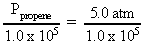 = 5.0 x
10-5 atm
= 5.0 x
10-5 atm
(c) The ratio of the two concentrations is equal
to Kc. The ratio (Kc) cannot be changed by adding
cyclopropane. The individual concentrations can change but the ratio of
concentrations can't. Because there is one mole of gas on each side of the
balanced equation, the composition of the equilibrium mixture is unaffected by a
decrease in volume. The ratio of the two concentrations will not change.
(d)
Because Kc is large, kf > kr.
(e) Because
the C-C-C bond angles are 60o and the angles between sp3
hybrid orbitals are 109.5o, the hybrid orbitals are not oriented
along the bond directions. Their overlap is therefore poor, and the C-C bonds
are correspondingly weak.
13.108 (a) Kp = 3.45; n = 1;
Kc = Kp =
0.0840
=
0.0840
(b) [(CH3)3CCl] = 1.00 mol/5.00 L = 0.200
M
(CH3)3CCl(g)
¾
(CH3)2C=CH2(g) + HCl(g)
| (CH3)3CCl(g) | (CH3)2C=CH2(g) | HCl(g) | |
| initial (M) | 0.200 | 0 | 0 |
| change (M) | -x | +x | +x |
| equilibrium (M) | 0.200-x | x | x |
Kc = 0.0840 =  ;
x2 + 0.0840x - 0.0168 = 0
;
x2 + 0.0840x - 0.0168 = 0
Use the quadratic formula to solve for
x.
x = 
x = -0.178 and
0.094
Discard the solution that uses the negative square root (x = -0.178)
because it leads to negative concentrations and that is
impossible
[(CH3)2C=CCH2] = [HCl] = x =
0.094 M
[(CH3)3CCl] = 0.200 - x = 0.200 - 0.094 = 0.106
M
(c) Kp =
3.45
(CH3)3CCl(g)
¾
(CH3)2C=CH2(g) + HCl(g)
| (CH3)3CCl(g) | (CH3)2C=CH2(g) | HCl(g) | |
| initial (atm) | 0 | 0.400 | 0.600 |
| change (atm) | +x | -x | -x |
| equilibrium (atm) | x | 0.400-x | 0.600-x |
Kp = 3.45 = 
x2 - 4.45x +
0.240 = 0
Use the quadratic formula to solve for x.
x = 
x = 0.055 and
4.40
Discard the solution that uses the positive square root (x = 4.40)
because it leads to a negative partial pressures and that is impossible.
Pt-butyl chloride = x = 0.055 atm; Pisobutylene =
0.400 - x = 0.400 - 0.055 = 0.345 atm
PHCl = 0.600 - x = 0.600 -
0.055 = 0.545 atm
13.109 (a) The Arrhenius equation gives for the
forward and reverse reactions and
and 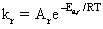
Addition of a catalyst
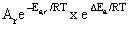
decreases the activation energies by Ea, so =
= 
and  =
= 
Therefore, the rate
constants for both the forward and reverse reactions increase by the same
factor,  .
.
(b) The equilibrium constant is given by
Kc = 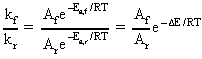
where E =
Ea,f - Ea,r. Addition of a catalyst decreases the
activation energies by Ea.
So, Kc = 
Kc is unchanged
because of cancellation of  , the
factor by which the two rate constants increase.
, the
factor by which the two rate constants increase.
13.110 The activation energy (Ea) is
positive, and for an exothermic reaction, Ea,r >
Ea,f.
kf = Af  ,
kr = Ar
,
kr = Ar 
Kc = 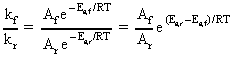
(Ea,r - Ea,f) is positive,
so the exponent is always positive. As the temperature increases, the exponent,
 , decreases and the value for Kc decreases as
well.
, decreases and the value for Kc decreases as
well.
Multi-Concept Problems
13.111 (a) H2O, 18.015 amu; 125.4 g
H2O x  = 6.96 mol H2O
Given that mol CO = mol
H2O = 6.96 mol = 40.0
atm
= 40.0
atm
CO(g) + H2O(g) ¾ CO2(g) + H2(g)
| CO(g) | H2O(g) | CO2(g) | H2(g) | |
| initial (atm) | 40.0 | 40.0 | 0 | 0 |
| equilibrium (atm) | 9.80 | 9.80 | 40.0-9.80=30.2 | 40.0-9.80=30.2 |
Kp = 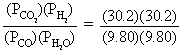 =
9.50
=
9.50
(b) 31.4 g H2O x  = 1.743
mol H2O
= 1.743
mol H2O = 10.0
atm
= 10.0
atm has been increased by 10.0 atm; a new equilibrium will be
established.
has been increased by 10.0 atm; a new equilibrium will be
established.
CO(g) + H2O(g) ¾ CO2(g) + H2(g)
| CO(g) | H2O(g) | CO2(g) | H2(g) | |
| initial (atm) | 9.80 | 9.80+10.0 | 30.2 | 30.2 |
| change (atm) | -x | -x | +x | +x |
| equilibrium (atm) | 9.80-x | 19.8-x | 30.2+x | 30.2+x |
Kp = 
8.50x2 - 341.6x
+ 931.34 = 0
Use the quadratic formula to solve for x.
x = 
x = 37.25 and
2.94
Discard the solution that uses the positive square root (x = 37.25)
because it leads to a negative partial pressures and that is impossible.
 = 9.80 - x = 9.80 - 2.94 = 6.86 atm
 = 19.8 - x
= 19.8 - 2.94 = 16.9 atm
= 19.8 - x
= 19.8 - 2.94 = 16.9 atm = 30.2 + x
= 30.2 + 2.94 = 33.1 atm
= 30.2 + x
= 30.2 + 2.94 = 33.1 atm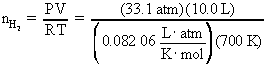 = 5.76
mol H2
= 5.76
mol H2 = 3.47 x
1020 H2 molecules/cm3
= 3.47 x
1020 H2 molecules/cm3
13.112 (a) CO2, 44.01 amu; CO, 28.01
amu
79.2 g CO2 x  = 1.80
mol CO2
= 1.80
mol CO2
CO2(g) + C(s)
¾ 2 CO(g)
| CO2(g) | CO(g) | |
| initial (mol) | 1.80 | 0 |
| change (mol) | -x | +2x |
| equilibrium (mol) | 1.80-x | 2x |
total mass of gas in flask = (16.3 g/L)(5.00 L)
= 81.5 g
81.5 = (1.80 - x)(44.01) + (2x)(28.01)
81.5 = 79.22 - 44.01x +
56.02x; 2.28 = 12.01x; x = 2.28/12.01 = 0.19
 = 1.80 - x
= 1.80 - 0.19 = 1.61 mol CO2;
= 1.80 - x
= 1.80 - 0.19 = 1.61 mol CO2;  = 2x =
2(0.19) = 0.38 mol CO
= 2x =
2(0.19) = 0.38 mol CO = 26.4
atm
= 26.4
atm = 6.24 atm
Kp =  =
1.47
=
1.47
(b) At 1100K, the total mass of gas in flask =
(16.9 g/L)(5.00 L) = 84.5 g
84.5 = (1.80 - x)(44.01) + (2x)(28.01)
84.5 =
79.22 - 44.01x + 56.02x; 5.28 = 12.01x; x = 5.28/12.01 = 0.44 = 1.80 - x
= 1.80 - 0.44 = 1.36 mol CO2;
= 1.80 - x
= 1.80 - 0.44 = 1.36 mol CO2;  = 2x =
2(0.44) = 0.88 mol CO
= 2x =
2(0.44) = 0.88 mol CO
 = 24.6
atm
= 24.6
atm = 15.9 atm
Kp =  =
10.3
=
10.3
(c) In agreement with Le Châtelier's principle, the reaction is endothermic because Kp increases with increasing temperature.
13.113 CO2, 44.01 amu; CO, 28.01 amu;
BaCO3, 197.34 amu
1.77 g CO2 x  = 0.0402
mol CO2
= 0.0402
mol CO2
CO2(g) + C(s)
¾ 2 CO(g)
| CO2(g) | CO(g) | |
| initial (mol) | 0.0402 | 0 |
| change (mol) | -x | +2x |
| equilibrium (mol) | 0.0402-x | 2x |
3.41 g BaCO3 x 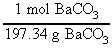 x
x  = 0.0173 mol CO2
mol CO2 = 0.0173 = 0.0402
- x; x = 0.0229
mol CO = 2x = 2(0.0229) = 0.0458 mol CO = 1.562
atm
= 1.562
atm = 4.134 atm
Kp =  =
11.0
=
11.0
13.114 (a) N2O4, 92.01
amu
14.58 g N2O4 x  = 0.1585
mol N2O4
= 0.1585
mol N2O4
PV = nRT = 5.20
atm
= 5.20
atm
N2O4(g) ¾ 2 NO2(g)
| N2O4(g) | NO2(g) | |
| initial (atm) | 5.20 | 0 |
| change (atm) | -x | +2x |
| equilibrium (atm) | 5.20-x | 2x |
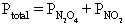 = (5.20
- x) + (2x) = 9.15 atm
= (5.20
- x) + (2x) = 9.15 atm
5.20 + x = 9.15 atm
x = 3.95 atm = 5.20 - x
= 5.20 - 3.95 = 1.25 atm
= 5.20 - x
= 5.20 - 3.95 = 1.25 atm = 2x =
2(3.95) = 7.90 atm
= 2x =
2(3.95) = 7.90 atm
Kp = 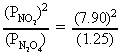 =
49.9
=
49.9
n = 1 and Kc = Kp  =
1.52
=
1.52
(b) Horxn = [2
Hof(NO2)] -
Hof(N2O4)
Horxn
= [(2 mol)(33.2 kJ/mol)] - [(1mol)(9.16 kJ/mol)] = 57.2 kJ
PV = nRT
moles
N2O4 reacted = n = 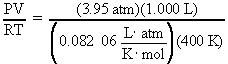 = 0.1203
mol N2O4
= 0.1203
mol N2O4
q = (57.24 kJ/mol
N2O4)(0.1203 mol N2O4) = 6.89
kJ
13.115
C10H8(s) ¾ C10H8(g)
(a) Kc =
[C10H8] = 5.40 x 10⁻⁶
room volume = 8.0 ft x
10.0 ft x 8.0 ft = 640 ft2
room volume = 640 ft2 x  x
x  x
x  = 18122.8
L
= 18122.8
L
C10H8 molecules = (5.40 x 10⁻⁶
mol/L)(18122.8 L)(6.022 x 10²³ molecules/mol)
= 5.89 x 10²²
C10H8 molecules
(b) C10H8, 128.17
amu
mol C10H8 = (5.40 x 10⁻⁶ mol/L)(18122.8
L) = 0.0979 mol C10H8
mass C10H8
= 0.0979 mol C10H8 x  = 12.55 g
C10H8
= 12.55 g
C10H8
moth ball: r = 12.0 mm/2 = 6.0 mm = 0.60
cm
volume of moth ball = (4/3)r3 = (4/3)(0.60cm)3 =
0.905 cm3
mass of moth ball = (0.905 cm3/moth
ball)(1.16 g/cm3) = 1.05 g/moth ball
number of moth balls =  = 12 moth balls
13.116 The atmosphere is 21% (0.21)
O2;  = (0.21)
 = 0.199
atm
= 0.199
atm
2 O3(g) ¾ 3 O2(g)
Kp =  ;
;  = 2.46 x 10⁻³⁰ atm
vol = 10 x 106
m3 x 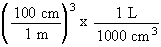 = 1.0 x 10¹⁰ L
 = 1.0 x
10-21 mol O3
= 1.0 x
10-21 mol O3
O3 molecules = 1.0 x
10-21 mol O3 x  = 6.0 x
102 O3 molecules
= 6.0 x
102 O3 molecules