(a) -
 = 4.8 x 10⁻⁴ M/s
  = 1.6 x 10⁻⁴ M/s
 (b) -
 =
(2)(1.6 x 10⁻⁴ M/s) = 3.2 x 10⁻⁴ M/s
=
(2)(1.6 x 10⁻⁴ M/s) = 3.2 x 10⁻⁴ M/s
12.1 3 I-(aq) +
H3AsO4(aq) + 2 H+(aq)
I3-(aq) + H3AsO3(aq) +
H2O(l)
(a) - = 4.8 x 10⁻⁴ M/s = 1.6 x 10⁻⁴ M/s
(b) - =
(2)(1.6 x 10⁻⁴ M/s) = 3.2 x 10⁻⁴ M/s
12.2 2 N2O5(g)® 4
NO2(g) + O2(g)
|
|
|
|
|
|
|
|
|
|
|
|
Rate of decomposition of
N2O5 =  = 2.2
x 10-5 M/s
= 2.2
x 10-5 M/s
Rate of formation
of O2 =  = 1.1
x 10-5 M/s
= 1.1
x 10-5 M/s
12.3 Rate =
k[BrO3-][Br-][H+]2
1st order in BrO3-, 1st
order in Br-, 2nd order in H+, 4th order overall
Rate = k[H2][I2], 1st
order in H2, 1st order in I2, 2nd order overall
Rate = k[CH3CHO]3/2, 3/2
order in CH3CHO, 3/2 order overall
12.4 H2O2(aq) + 3
I-(aq) + 2 H+(aq) I3-(aq) + 2
H2O(l)
Rate =  =
k[H2O2]m[I-]n
=
k[H2O2]m[I-]n
(a)  =
2
=
2  = 2
= 2
Because both ratios
are the same, m = 1.  = 2
= 2 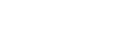 =
2
=
2
Because both ratios are the same, n =
1.
The rate law is: Rate =
k[H2O2][I-]
(b) k = 
Using data from Experiment 1: k =  = 1.15 x 10⁻² /(M s)
(c) Rate = k[H2O2][I-] = [1.15 x 10⁻²/(M s)](0.300 M)(0.400 M) = 1.38 x 10⁻³ M/s
12.5 Rate Law Units of k
Rate = k[(CH3)3CBr] 1/s
Rate = k[Br2] 1/s
Rate =
k[BrO3-][Br-][H+]2
1/(M3 s)
Rate =
k[H2][I2] 1/(M s)
Rate = [CH3CHO]3/2
1/(M1/2 s)
12.6 (a) The reactions in vessels (a) and (b)
have the same rate, the same number of B molecules, but different numbers of A
molecules. Therefore, the rate does not depend on A and its reaction order is
zero. The same conclusion can be drawn from the reactions in vessels (c) and
(d).
The rate for the reaction in vessel
(c) is four times the rate for the reaction in vessel (a). Vessel (c) has twice
as many B molecules than does vessel (a). Because the rate quadruples when the
concentration of B doubles, the reaction order for B is two.
(b) rate = k[B]2
12.7 (a) ln 
k = 6.3 x 10⁻⁶/s; t = 10.0 h
x  = 36,000 s
ln[Co(NH3)5Br2+]t
=  +
ln[Co(NH3)5Br2+]0
+
ln[Co(NH3)5Br2+]0
ln[Co(NH3)5Br2+]t
=  + ln(0.100)
ln[Co(NH3)5Br2+]t
= -2.5294; After 10.0 h, [Co(NH3)5Br2+] =
e-2.5294 = 0.080 M
(b)
[Co(NH3)5Br2+]0 = 0.100 M
If 75% of the
Co(NH3)5Br2+ reacts then 25% remains.
[Co(NH3)5Br2+]t
= (0.25)(0.100 M) = 0.025 M
ln  ; t =
; t = 
t =  =
2.2 x 10⁵ s; t = 2.2 x 10⁵ s x
=
2.2 x 10⁵ s; t = 2.2 x 10⁵ s x  = 61 h
12.8 
Slope = - 0.03989/min = - 6.6 x
10-4/s and k = - slope
A plot
of ln[cyclopropane] versus time is linear, indicating that the data fit the
equation for a first-order reaction. k = 6.6 x 10⁻⁴/s
(0.040/min)
12.9 (a) k = 1.8 x 10⁻⁵/s
t1/2 = 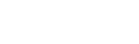 =
38,500 s; t1/2 = 38,500 s x
=
38,500 s; t1/2 = 38,500 s x  = 11
h
= 11
h
(b) 0.30 M - 0.15 M in
t1/2
0.15 - 0.075 M in
t1/2
0.075 - 0.0375 M in
t1/2
0.0375 - 0.019 M in
t1/2
(c) Because 25% of the
initial concentration corresponds to 1/4 or (1/2)2 of the initial
concentration, the time required is two half-lives: t = 2t1/2 = 2(11
h) = 22 h
12.10 After one half-life, there would be four A molecules remaining. After two half-lives, there would be two A molecules remaining. This is represented by the drawing at t = 10 min. 10 min is equal to two half-lives, therefore, t1/2 = 5 min for this reaction. After 15 min (three half-lives) only one A molecule would remain.

12.11


(a) A plot of 1/[HI] versus time is
linear. The reaction is second order.
(b) k = slope = 0.0308/(M min)
(c) 
(d) It requires one half-life (t1/2)
for the [HI] to drop from 0.400 M to 0.200 M.
t1/2 =  =
81.2 min
=
81.2 min
12.12 (a)
NO2(g) + F2(g) NO2F(g) +
F(g)
F(g) + NO2(g)
NO2F(g)
2
NO2(g) + F2(g) 2 NO2F(g) (Overall
reaction)
Because F(g) is produced in the first reaction
and consumed in the second, it is a reaction intermediate.
(b) In each reaction there are two reactants, so each
elementary reaction is bimolecular.
12.13 (a) Rate = k[O3][O] (b) Rate = k[Br]2[Ar] (c) Rate = k[Co(CN)5(H2O)2-]
12.14
Co(CN)5(H2O)2-(aq)
Co(CN)52-(aq) + H2O(l) (slow)
Co(CN)52-(aq) +
I-(aq) Co(CN)5I3-(aq)
(fast)
Co(CN)5(H2O)2-(aq) +
I-(aq) Co(CN)5I3-(aq) +
H2O(l) (Overall reaction)
The predicted rate law for the overall reaction
is the rate law for the first (slow) elementary reaction: Rate =
k[Co(CN)5(H2O)2-]
The predicted rate law is in accord with the observed
rate law.
12.15 (a) Ea = 100 kJ/mol - 20 kJ/mol
= 80 kJ/mol
(b) The reaction is
endothermic because the energy of the products is higher than the energy of the
reactants.
(c)
12.16 (a) 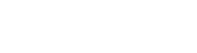
k1 = 3.7 x 10⁻⁵/s,
T1 = 25oC = 298 K
k2 = 1.7 x 10⁻³/s, T2 =
55oC = 328 K
Ea
= 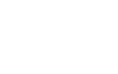
Ea =  =
104 kJ/mol
=
104 kJ/mol
(b) k1 = 3.7 x 10⁻⁵/s,
T1 = 25oC = 298 K
solve for k2, T2 = 35oC
= 308 K
ln k2
= 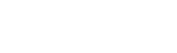
ln k2 = 
ln k2 = -8.84; k2 =
e-8.84 = 1.4 x 10⁻⁴/s
12.17 (a) Going from vessel (a) to vessel (b),
the reaction rate doubles, the concentration of A doubles, the concentrations of
B and C remain the same. Because the rate doubles when the concentration of A
doubles, the reaction order for A is one.
Going from vessel (a) to vessel (c), the reaction rate
does not change, the concentration of B doubles, the concentrations of A and C
remain the same. Because the rate does not change when the concentration of B
doubles, the reaction order for B is zero.
Going from vessel (a) to vessel (d), the reaction rate
doubles, the concentration of C doubles, the concentrations of A and B remain
the same. Because the rate doubles when the concentration of C doubles, the
reaction order for C is one.
(b) rate = k[A][C]
(c)
A +
C AC (rate determining step)
AC + B
AB + C
A + B
AB (Overall reaction)
(d) C is a catalyst. C does not appear in the overall reaction because it is consumed in the first step and then regenerated in the second step of the reaction mechanism.
12.18 Nitroglycerin contains three nitro groups per molecule. Because the bonds in nitro groups are relatively weak (about 200 kJ/mol) and because the explosion products (CO2, N2, H2O, and O2) are extremely stable, a great deal of energy is released (very exothermic) during an explosion.
12.19 Secondary explosives are generally less sensitive to heat and shock than primary explosives. This would indicate that secondary explosives should have a higher activation energy than primary explosives.
12.20 C5H8N4O12(s) 4 CO2(g) + 4 H2O(g) + 2 N2(g) + C(s)
Horxn = [4
Hof (CO2) + 4 Hof
(H2O)] - Hof
(C5H8N4O12)
Horxn = [(4 mol)(-393.5 kJ/mol) +
(4 mol)(-241.8 kJ/mol)] - [(1 mol)(537 kJ/mol)]
Horxn = - 3078 kJ
12.21
C5H8N4O12(s) 4 CO2(g) + 4
H2O(g) + 2 N2(g) + C(s)
C5H8N4O12,
316.14 amu; 1.54 kg = 1.54 x 10³ g; 800oC = 1073 K
From the reaction, 1 mole of PETN produces 10
moles of gas.
mol gas = 1.54 x
103 g PETN x 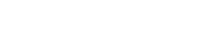 =
48.7 mol
=
48.7 mol
PV = nRT
V =  =
4.40 x 10³ L
=
4.40 x 10³ L
Understanding Key Concepts
12.22 Because Rate = k[A][B], the rate is proportional to the product of the number of A molecules and the number of B molecules. The relative rates of the reaction in vessels (a) - (d) are 2 : 1 : 4 : 2.
12.23 Because the same reaction takes place in each vessel, the k's are all the same.
12.24 (a) Because Rate = k[A], the rate is
proportional to the number of A molecules in each reaction vessel. The relative
rates of the reaction are 2 : 4 : 3.
(b)
For a first-order reaction, half-lives are independent of concentration. The
half-lives are the same.
(c)
Concentrations will double, rates will double, and half-lives will be
unaffected.
12.25 (a) For the first-order reaction, half of the A molecules are converted to B molecules each minute.
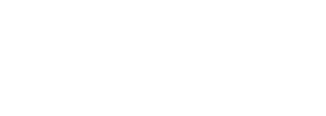
(b) Because half of the A molecules are converted to B molecules in 1 min, the half-life is 1 min.
12.26 (a) Because the half-life is inversely
proportional to the concentration of A molecules, the reaction is second order
in A.
(b) Rate = k[A]2
(c) The second box represents the passing of
one half-life, and the third box represents the passing of a second half-life
for a second-order reaction. A relative value of k can be calculated.
k = 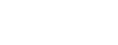 =
0.0625
=
0.0625
t1/2 in going from box
3 to box 4 is: t1/2 = 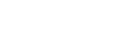 = 4
min
= 4
min
(For fourth box, t = 7 min)
12.27 (a) bimolecular (b) unimolecular (c) termolecular
12.28 2 AB2 A2 + 2
B2
(a) Measure the
concentration of AB2 as a function of time.
(b) If an ln [AB2] versus time plot is linear,
the reaction is first order. If a 1/[AB2] versus time plot is linear,
the reaction is second order.
(c)  (x =
reaction order)
(x =
reaction order)
12.29 A B + C
(a) Measure the initial rate of the reaction at several
different temperatures.
(b) Calculate
k,  , at the different temperatures. Graph ln k versus 1/K, where K
is the kelvin temperature. Determine the slope of the line. Ea = - R
· slope where R = 8.314 x 10⁻³ kJ/(K · mol).
, at the different temperatures. Graph ln k versus 1/K, where K
is the kelvin temperature. Determine the slope of the line. Ea = - R
· slope where R = 8.314 x 10⁻³ kJ/(K · mol).
12.30 (a) Rate = k[B2][C]
(b) B2 + C CB + B (slow)
CB + A AB + C (fast)
(c) C is a catalyst. C does not appear in the chemical
equation because it is consumed in the first step and regenerated in the second
step.
12.31 (a) BC + D B + CD
(b) 1. B-C + D (reactants), A (catalyst); 2. B---C---A
(transition state), D (reactant);
3. A-C
(intermediate), B (product), D (reactant); 4. A---C---D (transition
state),
B (product); 5. A (catalyst),
C-D + B (products)
(c) The first step is
rate determining because the first maximum in the potential energy curve is
greater than the second (relative) maximum; Rate = k[A][BC]
(d) Endothermic
12.32 (a)
(b) Reaction 2 is the fastest (smallest
Ea), and reaction 3 is the slowest (largest Ea).
(c) Reaction 3 is the most endothermic
(positive E), and reaction 1 is the most exothermic (largest negative E).
12.33 
Additional Problems
Reaction Rates
12.34 M/s or 
12.35 molecules/(cm3 s)
12.36 (a) Rate =  =
3.6 x 10⁻³ M/min
=
3.6 x 10⁻³ M/min
Rate = 3.6 x
10-3 = 6.0 x 10⁻⁵ M/s
(b) Rate =  =
2.0 x 10⁻³ M/min
=
2.0 x 10⁻³ M/min
Rate = 2.0 x
10-3 = 3.3 x 10⁻⁵ M/s
12.37 (a) Rate =  =
2.0 x 10⁻⁵ M/s
=
2.0 x 10⁻⁵ M/s
(b) Rate =  =
1.5 x 10⁻⁵ M/s
=
1.5 x 10⁻⁵ M/s
12.38 
(a) The instantaneous rate of decomposition of
N2O5 at t = 200 s is determined from the slope of the
curve at t = 200 s.
Rate =  = 2.4 x 10⁻⁵ M/s
(b) The initial rate of decomposition of
N2O5 is determined from the slope of the curve at
t = 0 s. This is equivalent to the slope of the
curve from 0 s to 100 s because in this time interval the curve is almost
linear.
Initial rate = -  = 3.1 x 10⁻⁵ M/s
12.39
(a) The instantaneous rate of decomposition of
NO2 at t = 100 s is determined from the slope of the curve at t = 100
s.
Rate =  =
1.8 x 10⁻⁵ M/s
=
1.8 x 10⁻⁵ M/s
(b) The
initial rate of decomposition of NO2 is determined from the slope of
the curve at
t = 0 s. This is equivalent
to the slope of the curve from 0 s to 50 s because in this time interval the
curve is almost linear.
Initial rate =
-  = 2.8 x 10⁻⁵ M/s
12.40 (a) 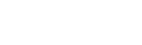 ; The
rate of consumption of H2 is 3 times faster.
; The
rate of consumption of H2 is 3 times faster.
(b) 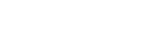 ; The
rate of formation of NH3 is 2 times faster.
; The
rate of formation of NH3 is 2 times faster.
12.41 (a)  ; The
rate of consumption of O2 is 1.25 times faster.
; The
rate of consumption of O2 is 1.25 times faster.
(b)  ; The
rate of formation of NO is the same.
; The
rate of formation of NO is the same.  ; The rate of formation of H2O is 1.5 times
faster.
; The rate of formation of H2O is 1.5 times
faster.
12.42 N2(g) + 3 H2(g) 2
NH3(g); - 
12.43 (a) 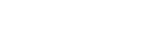 =
3(1.5 x 10⁻³ M/s) = 4.5 x 10⁻³ M/s
=
3(1.5 x 10⁻³ M/s) = 4.5 x 10⁻³ M/s
(b) 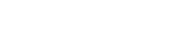 =
2(1.5 x 10⁻³ M/s) = 3.0 x 10⁻³ M/s
=
2(1.5 x 10⁻³ M/s) = 3.0 x 10⁻³ M/s
Rate Laws
12.44 Rate = k[NO]2[Br2]; 2nd order in NO; 1st order in Br2; 3rd order overall
12.45 Rate = k[CHCl3][Cl2]1/2; 1st order in CHCl3; 1/2 order in Cl2; 3/2 order overall
12.46 Rate = k[H2][ICl]; units for k
are  or 1/(M s)
12.47 Rate = k[NO]2[H2], units for k are 1/(M2 s)
12.48 (a) Rate =
k[CH3Br][OH-]
(b)
Because the reaction is first order in OH-, if the [OH-]
is decreased by a factor of 5, the rate will also decrease by a factor of
5.
(c) Because the reaction is first
order in each reactant, if both reactant concentrations are doubled, the rate
will increase by a factor of 2 x 2 = 4.
12.49 (a) Rate =
k[Br-][BrO3-][H+]2
(b) The overall reaction order is 1 + 1 + 2 =
4.
(c) Because the reaction is second
order in H+, if the [H+] is tripled, the rate will
increase by a factor of 32 = 9.
(d) Because the reaction is first order in both
Br- and BrO3-, if both reactant concentrations
are halved, the rate will decrease by a factor of 4 (1/2 x 1/2 = 1/4).
12.50 (a) Rate =
k[CH3COCH3]m
m =  = 1;
Rate = k[CH3COCH3]
= 1;
Rate = k[CH3COCH3]
(b) From Experiment 1: k = 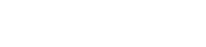 =
8.7 x 10⁻³/s
=
8.7 x 10⁻³/s
(c) Rate = k[CH3COCH3] =
(8.7 x 10⁻³/s)(1.8 x 10-3M) = 1.6 x 10⁻⁵
M/s
12.51 (a) Rate = k[CH3NNCH3]m
m =  = 1;
Rate = k[CH3NNCH3]
= 1;
Rate = k[CH3NNCH3]
(b) From Experiment 1: k =  =
2.5 x 10⁻⁴/s
=
2.5 x 10⁻⁴/s
(c) Rate =
k[CH3NNCH3] = (2.5 x 10⁻⁴/s)(0.020 M) = 5.0 x
10-6 M/s
12.52 (a) Rate =
k[NH4+]m[NO2-]n
m = 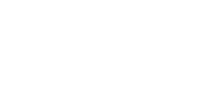 = 1;
n =
= 1;
n =  = 1
= 1
Rate =
k[NH4+][NO2-]
(b) From Experiment 1: k =  =
3.0 x 10⁻⁴/(M s)
=
3.0 x 10⁻⁴/(M s)
(c) Rate =
k[NH4+][NO2-] = [3.0 x
10-4/(M s)](0.39 M)(0.052 M) = 6.1 x 10⁻⁶ M/s
12.53 (a) Rate = k[NO]m[Cl2]n
m =  = 2;
n =
= 2;
n =  = 1
= 1
Rate =
k[NO]2[Cl2]
(b)
From Experiment 1: k = 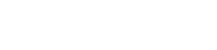 =
3.0/(M2 s)
=
3.0/(M2 s)
(c) Rate =
k[NO]2[Cl2] = [3.0/(M2 s)](0.12
M)2(0.12 M) = 5.2 x 10--3 M/s
Integrated Rate Law; Half-Life
12.54 ln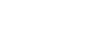 , k =
6.7 x 10⁻⁴/s
, k =
6.7 x 10⁻⁴/s
(a) t = 30 min x  =
1800 s
=
1800 s
ln[C3H6]t
=  + ln[C3H6]0 =
  + ln(0.0500) = - 4.202
[C3H6]t = e- 4.202 = 0.015 M
(b) t =  =
=  = 2402 s; t = 2402 s x
  = 40
min
= 40
min
(c) [C3H6]0 =
0.0500 M; If 25% of the C3H6 reacts then 75%
remains.
[C3H6]t = (0.75)(0.0500
M) = 0.0375 M.
t =  =
=  = 429 s; t = 429 s x
  = 7.2
min
= 7.2
min
12.55 ln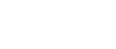 , k =
5.11 x 10⁻⁵/s
, k =
5.11 x 10⁻⁵/s
(a) t = 2.00 hr
x 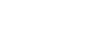 = 7200 s
ln[CH3NC]t =  +
ln[CH3NC]0 =
+
ln[CH3NC]0 =  +
ln(0.0340) = -3.749 [CH3NC]t = e-3.749 = 0.0235
M
+
ln(0.0340) = -3.749 [CH3NC]t = e-3.749 = 0.0235
M
(b) t =  =
=  = 2449 s; t = 2449 s x
  =
40.8 min
=
40.8 min
(c)
[CH3NC]0 = 0.0340 M; If 20% of the CH3NC reacts
then 80% remains.
[CH3NC]t = (0.80)(0.0340 M) =
0.0272 M.
t =  =
=  = 4367 s; t = 4367 s x
  = 72.8 min
12.56 t1/2 = 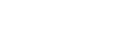 =
1034 s = 17 min
=
1034 s = 17 min
t =  =
4140 s
=
4140 s
t = 4140 s x  = 69
min
= 69
min
This is also 4 half-lives. 100 - 50 - 25 - 12.5 - 6.25 (each step is a half-life)
12.57 t1/2 = 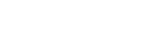 =
13,562 s
=
13,562 s
t1/2 = 13,562 s x 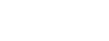 =
3.77 hr
=
3.77 hr
t =  =
40,694 s
=
40,694 s
t = 40,694 s x 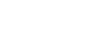 =
11.3 hr
=
11.3 hr
This is also 3 half-lives. 100 - 50 - 25 - 12.5 (each step is a half life)
12.58 t1/2 = 8.0 h
0.60 M - 0.30 M - 0.15 M requires 2 half-lives so it will
take 16.0 h.
12.59 t1/2 = 3.33 h
0.800 M - 0.400 M - 0.200 M - 0.100 M - 0.0500 M requires
4 half-lives so it will take 13.3 h.
12.60 kt = 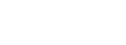 , k
= 4.0 x 10⁻²/(M s)
, k
= 4.0 x 10⁻²/(M s)
(a) t =
1.00 h x  = 3600 s
 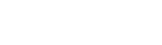 =
= 
 = 194/M and
[C4H6] = 5.2 x 10⁻³ M
= 194/M and
[C4H6] = 5.2 x 10⁻³ M
(b) t = 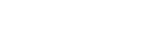
t =  =
11,250 s
=
11,250 s
t = 11,250 s x 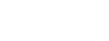 = 3.1 h
12.61 kt =  , k =
9.7 x 10⁻⁶/(M s)
, k =
9.7 x 10⁻⁶/(M s)
(a) t = 6.00
day x  = 518,400 s
 =
= 
 = 15.03/M and [HI] = 0.067
M
= 15.03/M and [HI] = 0.067
M
(b) t = 
t =  =
4,123,711 s
=
4,123,711 s
t = 4,123,711 s x 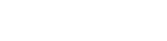 = 48 days
12.62 t1/2 =  =
1250 s = 21 min
=
1250 s = 21 min
t = t1/2
=  = 2500 s = 42 min
12.63 t1/2 =  =
1,030,928 s
=
1,030,928 s
1,030,928 s x  = 12 days
t =
t1/2 =  =
4,123,711 s
=
4,123,711 s
4,123,711 s x  = 48 days
12.64
|
|
|
|
|
|
|
|
|
|
|
|
|
|
|
|
|
|
|
|
|
|
|
|
|
|
|
|
|
|


A plot of ln [N2O] versus time is
linear. The reaction is first order in N2O.
k = - (slope) = - (-2.28 x 10⁻³/min) = 2.28 x
10-3/min
k = 2.28 x
10-3/min x  =
3.79 x 10⁻⁵/s
=
3.79 x 10⁻⁵/s
12.65
|
|
|
|
|
|
|
|
|
|
|
|
|
|
|
|
|
|
|
|
|
|
|
|
|
|
|
|
|
|
A plot of 1/[NOBr] versus
time is linear. The reaction is second order in NOBr. k = slope = 0.80/(M
s)
12.66 k = 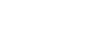 =
2.79 x 10--3/s
=
2.79 x 10--3/s
12.67 t1/2 =  ;
t1/2 = 25 min x
;
t1/2 = 25 min x  =
1500 s
=
1500 s
k = 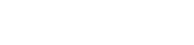 =
1.8 x 10⁻² M-1 s-1
=
1.8 x 10⁻² M-1 s-1
Reaction Mechanisms
12.68 An elementary reaction is a description of an individual molecular event that involves the breaking and/or making of chemical bonds. By contrast, the overall reaction describes only the stoichiometry of the overall process but provides no information about how the reaction occurs.
12.69 Molecularity is the number of reactant molecules or atoms for an elementary reaction. Reaction order is the sum of the exponents of the concentration terms in the rate law.
12.70 There is no relationship between the coefficients in a balanced chemical equation for an overall reaction and the exponents in the rate law unless the overall reaction occurs in a single elementary step, in which case the coefficients in the balanced equation are the exponents in the rate law.
12.71 The rate-determining step is the slowest step in a multistep reaction. The coefficients in the balanced equation for the rate-determining step are the exponents in the rate law.
12.72 (a)
H2(g) + ICl(g) HI(g) + HCl(g)
HI(g) + ICl(g) I2(g) +
HCl(g)
H2(g) + 2 ICl(g)
I2(g) + 2 HCl(g) (Overall reaction)
(b) Because HI(g) is produced in the first step
and consumed in the second step, it is a reaction intermediate.
(c) In each reaction there are two reactant molecules, so
each elementary reaction is bimolecular.
12.73 (a)
NO(g) + Cl2(g) NOCl2(g)
NOCl2(g) + NO(g) 2
NOCl(g)
2 NO(g) + Cl2(g)
2 NOCl(g) (Overall reaction)
(b) Because NOCl2 is produced in the
first step and consumed in the second step, NOCl2 is a reaction
intermediate.
(c) Each elementary step
is bimolecular.
12.74 (a) bimolecular, Rate =
k[O3][Cl] (b) unimolecular, Rate = k[NO2]
(c) bimolecular, Rate = k[ClO][O] (d) termolecular, Rate
= k[Cl]2[N2]
12.75 (a) unimolecular, Rate = k[I2]
(b) termolecular, Rate = k[NO]2[Br2]
(c) bimolecular, Rate =
k[CH3Br][OH--] (d) unimolecular, Rate =
k[N2O5]
12.76 (a)
NO2Cl(g) NO2(g) + Cl(g)
Cl(g) + NO2Cl(g)
NO2(g) + Cl2(g)
2 NO2Cl(g) 2 NO2(g) +
Cl2(g) (Overall reaction)
(b) 1. unimolecular; 2. bimolecular
(c) Rate = k[NO2Cl]
12.77 (a)
Mo(CO)6 Mo(CO)5 + CO
Mo(CO)5 + L
Mo(CO)5L
Mo(CO)6 + L Mo(CO)5L +
CO (Overall reaction)
(b) 1. unimolecular; 2. bimolecular
(c) Rate = k[Mo(CO)6]
12.78
NO2(g) + F2(g) NO2F(g) +
F(g) (slow)
F(g) + NO2(g)
NO2F(g) (fast)
12.79
O3(g) + NO(g) O2(g) +
NO2(g) (slow)
NO2(g) + O(g) O2(g) + NO(g)
(fast)
The Arrhenius Equation
12.80 Very few collisions involve a collision energy greater than or equal to the activation energy, and only a fraction of those have the proper orientation for reaction.
12.81 The two reactions have frequency factors that differ by a factor of 10.
12.82 Plot ln k versus 1/T to determine the
activation energy, Ea 
Slope = -1.25 x 10⁴ K
Ea = - (R)(slope) = - (8.314 x 10⁻³
kJ/(K mol))(- 1.25 x 10⁴ K) = 104 kJ/mol
12.83 Plot ln k versus 1/T to determine the
activation energy, Ea. 
Slope = -1.359 x 10⁴ K
Ea = -R(slope) = -(8.314 x 10⁻³
kJ/(K mol))(-1.359 x 10⁴ K) = 113 kJ/mol
12.84 (a) 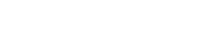
k1 = 1.3/(M s), T1 = 700
K
k2 = 23.0/(M s),
T2 = 800 K
Ea
= 
Ea
= 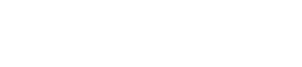 = 134 kJ/mol
(b) k1 = 1.3/(M s), T1 =
700 K
solve for k2,
T2 = 750 K
ln k2
= 
ln k2
=  = 1.795
k2 = e1.795 = 6.0/(M s)
12.85 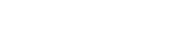
(a) Because the rate doubles, k2 =
2k1
k1 = 1.0 x
10-3/s, T1 = 25oC = 298 K
k2 = 2.0 x 10⁻³/s, T2 =
35oC = 308 K
Ea
= 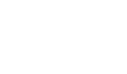
Ea
=  = 53 kJ/mol
(b) Because the rate triples, k2 =
3k1
k1 = 1.0 x
10-3/s, T1 = 25oC = 298 K
k2 = 3.0 x 10⁻³/s, T2 =
35oC = 308 K
Ea
=  = 84 kJ/mol
12.86 
assume k1 = 1.0/(M s) at
T1 = 25oC = 298 K
assume k2 = 15/(M s) ad T2 =
50oC = 323 K
Ea
= 
Ea =  =
87 kJ/mo1
=
87 kJ/mo1
12.87 
assume k1 = 1.0/(M s) at
T1 = 15oC = 288 K
assume k2 = 6.37/(M s) at T2 =
45oC = 318 K
Ea
= 
Ea
=  = 47.0 kJ/mo1
12.88 (a) (b)

12.89 (a)
(b) 
Catalysis
12.90 A catalyst does participate in the reaction, but it is not consumed because it reacts in one step of the reaction and is regenerated in a subsequent step.
12.91 A catalyst doesn't appear in the chemical equation for a reaction because a catalyst reacts in one step of the reaction but is regenerated in a subsequent step.
12.92 A catalyst increases the rate of a reaction by changing the reaction mechanism and lowering the activation energy.
12.93 A homogeneous catalyst is one that exists
in the same phase as the reactants.
Example: NO(g) acts as a homogeneous catalyst for the
conversion of O2(g) to O3(g).
A heterogeneous catalyst is one that exists in a
different phase from the reactants.
Example: solid Ni, Pd, or Pt for catalytic hydrogenation,
C2H4(g) + H2(g)
C2H6(g).
12.94 (a) O3(g) + O(g) 2
O2(g) (b) Cl acts as a catalyst.
(c) ClO is a reaction intermediate.
(d) A catalyst reacts in one step and is regenerated in a
subsequent step. A reaction intermediate is produced in one step and consumed in
another.
12.95 (a)
2 SO2(g) + 2 NO2(g) 2
SO3(g) + 2 NO(g)
2 NO(g) +
O2(g) 2 NO2(g)
2 SO2(g) + O2(g) 2
SO3(g) (Overall reaction)
(b) NO2(g) acts as a catalyst because it is used in the first step and regenerated in the second. NO(g) is a reaction intermediate because it is produced in the first step and consumed in the second.
12.96 (a)
NH2NO2(aq) + OH-(aq)
NHNO2-(aq) + H2O(l)
NHNO2-(aq) N2O(g) +
OH-(aq)
NH2NO2(aq) N2O(g) +
H2O(l) (Overall reaction)
(b)
OH- acts as a catalyst because it is used in the first step and
regenerated in the second. NHNO2- is a reaction
intermediate because it is produced in the first step and consumed in the
second.
(c) The rate will decrease
because added acid decreases the concentration of OH-, which appears
in the rate law since it is a catalyst.
12.97 The reaction in Problem 12.79 involves a catalyst (NO) because NO is used in the first step and is regenerated in the second step. The reaction also involves an intermediate (NO2) because NO2 is produced in the first step and is used up in the second step.
General Problems
12.98 The first maximum represents the potential energy of the transition state for the first step. The second maximum represents the potential energy of the transition state for the second step. The saddle point between the two maxima represents the potential energy of the intermediate products.
12.99 Because 0.060 M is half of 0.120 M, 5.2 h
is the half-life.
For a first-order
reaction, the half-life is independent of initial concentration. Because 0.015 M
is half of 0.030 M, it will take one half-life, 5.2 h.
k =  =
0.133/h
=
0.133/h
ln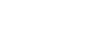
t =  =
=  = 26 h (Note that t is five half-lives.)
12.100 (a) The reaction rate will increase with
an increase in temperature at constant volume.
(b) The reaction rate will decrease with an increase in
volume at constant temperature because reactant concentrations will
decrease.
(c) The reaction rate will
increase with the addition of a catalyst.
(d) Addition of an inert gas at constant volume will not
affect the reaction rate.
12.101 As the temperature of a gas is raised by 10oC, even though the collision frequency increases by only 2%, the reaction rate increases by 100% or more because there is an exponential increase in the fraction of the collisions that leads to products.
12.102 (a) Rate =
k[C2H4Br2]m[I-]n
m =  =
1
=
1
n =  =
1
=
1
Rate = k[C2H4Br2][I-]
(b) From Experiment 1:
k =  =
4.98 x 10⁻³/(M s)
=
4.98 x 10⁻³/(M s)
(c) Rate = k[C2H4Br2][I-] = [4.98 x 10⁻³(M s)](0.150 M)(0.150 M) = 1.12 x 10⁻⁴ M/s
12.103 (a) From the data in the table for
Experiment 1, we see that 0.20 mol of A reacts with 0.10 mol of B to produce
0.10 mol of D. The balanced equation for the reaction is: 2 A + B D
(b) From the data in the table, initial Rates
=  have been calculated.
For example, from Experiment 1:
Initial rate =  =
3.33 x 10⁻³ M/s
=
3.33 x 10⁻³ M/s
Initial
concentrations and initial rate data have been collected in the table
below.
|
|
|
|
|
|
|
|
|
|
|
|
|
|
|
|
|
|
|
|
|
|
|
|
|
|
|
|
|
|
(c) Rate = k[A][C]
(d) C is a catalyst. C appears in the rate law, but it is
not consumed in the reaction.
(e)
A + C AC (slow)
AC + B AB + C (fast)
A + AB D (fast)
(f) From data in Expt 1:
k =  =
3.4 x 10⁻⁴/(M s)
=
3.4 x 10⁻⁴/(M s)
12.104 For
Ea = 50 kJ/mol
f =  = 2.0 x 10--9
For Ea = 100 kJ/mol
f =  =
3.9 x 10--18
=
3.9 x 10--18
12.105 ln 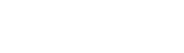
k2 = 2.5k1
k1 = 1.0, T1 =
20oC = 293 K
k2 =
2.5, T2 = 30oC = 303 K
Ea = 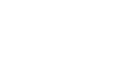
Ea =  = 68
kJ/mol
= 68
kJ/mol
k1 = 1.0,
T1 = 120oC = 393 K
k2 = ?, T2 = 130oC = 403
K
Solve for k2.
ln k2 =  +
ln k1
+
ln k1
ln k2
=  + ln(1.0) = 0.516
k2 = e0.516 = 1.7; The rate
increases by a factor of 1.7.
12.106 (a) 2 NO(g) + Br2(g) 2
NOBr(g)
(b) Since NOBr2 is
generated in the first step and consumed in the second step, NOBr2 is
a reaction intermediate.
(c) Rate =
k[NO][Br2]
(d) It can't be
the first step. It must be the second step.
12.107 (a)
2 NO(g) N2O2(g) (fast)
N2O2(g) +
H2(g) N2O(g) + H2O(g) (slow)
N2O(g) + H2(g)
N2(g) + H2O(g) (fast)
2 NO(g) +
2 H2(g) N2(g) + 2 H2O(g)
(Overall reaction)
(b) N2O2 and
N2O are reaction intermediates because they are produced in one step
of the reaction and used up in a subsequent step.
(c) Rate =
k2[N2O2][H2]
(d) Because the forward and reverse rates in step 1 are
equal, k1[NO]2 =
k-1[N2O2]. Solving for
[N2O2] and substituting into the rate law for the second
step gives
Rate =
k2[N2O2][H2] =  [NO]2[H2]
Because the rate law for the overall reaction is equal to
the rate law for the rate-determining step, the rate law for the overall
reaction is
Rate =
k[NO]2[H2] where k = 
12.108 (a) I-(aq) +
OCl-(aq) Cl-(aq) + OI-(aq)
(b) From the data in the table, initial rates =  have been calculated.
For example, from Experiment 1:
Initial rate =  =
2.30 x 10⁻⁶ M/s
=
2.30 x 10⁻⁶ M/s
Initial
concentrations and initial rate data have been collected in the table
below.
|
|
|
|
|
|
| 1 | 2.40 x 10⁻⁴ | 1.60 x 10⁻⁴ | 1.00 | 2.30 x 10⁻⁶ |
| 2 | 1.20 x 10⁻⁴ | 1.60 x 10⁻⁴ | 1.00 | 1.20 x 10⁻⁶ |
| 3 | 2.40 x 10⁻⁴ | 4.00 x 10⁻⁵ | 1.00 | 6.00 x 10⁻⁷ |
| 4 | 1.20 x 10⁻⁴ | 1.60 x 10⁻⁴ | 2.00 | 6.00 x 10⁻⁷ |
Rate =
k[I-]m[OCl-]n[OH-]p
From Expts 1 and 2, [I-] is cut in
half and the initial rate is cut in half ; therefore m = 1.
From Expts 1 and 3, [OCl-] is reduced by a
factor of four and the initial rate is reduced by a factor of four; therefore n
= 1.
From Expts 2 and 4,
[OH-] is doubled and the initial rate is cut in half; therefore p =
-1.
Rate = k
From data in Expt 1:
k =  =
60/s
=
60/s
(c) The reaction does not occur by a single-step
mechanism because OH- appears in the rate law but not in the overall
reaction.
(d)
OCl-(aq) + H2O(l) HOCl(aq) +
OH-(aq) (fast)
HOCl(aq) +
I-(aq) HOI(aq) + Cl-(aq) (slow)
HOI(aq) + OH-(aq) H2O(l) +
OI-(aq) (fast)
I-(aq) + OCl-(aq)
Cl-(aq) + OI-(aq) (Overall reaction)
Because the forward and reverse rates in step 1
are equal, k1[OCl-][H2O] =
k-1[HOCl][OH-]. Solving for [HOCl] and substituting into
the rate law for the second step gives
Rate = k2[HOCl][I-]
= 

[H2O] is constant and can be
combined into k.
Because the rate law
for the overall reaction is equal to the rate law for the rate-determining step,
the rate law for the overall reaction is
Rate = k where k =
12.109 2 N2O(g) 2 N2(g) +
O2(g)  (in exit gas) = 1.0 mm Hg; Ptotal = 1.50 atm =
1140 mm Hg
(in exit gas) = 1.0 mm Hg; Ptotal = 1.50 atm =
1140 mm Hg
From the reaction
stoichiometry:  (in exit gas) = 2
  =
2.0 mm Hg
=
2.0 mm Hg  (in exit gas) = Ptotal -
  -
-  =
1140 - 2.0 - 1.0 = 1137 mm Hg
=
1140 - 2.0 - 1.0 = 1137 mm Hg
Assume  (initial) = Ptotal = 1140 mm Hg (In assuming a
constant total pressure in the tube, we are neglecting the slight change in
pressure due to the reaction.)
(initial) = Ptotal = 1140 mm Hg (In assuming a
constant total pressure in the tube, we are neglecting the slight change in
pressure due to the reaction.)
Volume of
tube = r2l = (1.25 cm)2(20 cm) = 98.2 cm3 =
0.0982 L
Time, t, gases are in the tube
=  = 7.86 s
At
time t,  = 0.997 37
Because k = A and
A = 4.2 x 10⁹ s-1, k has units of s-1.
Therefore, this is a first-order reaction and the appropriate integrated rate
law is
and
A = 4.2 x 10⁹ s-1, k has units of s-1.
Therefore, this is a first-order reaction and the appropriate integrated rate
law is  .
.
k
= 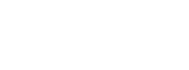 = 3.35 x 10⁻⁴ s-1
From the Arrhenius equation, ln k = ln A
- 
T =  = 885 K
12.110 (a) Ratef = kf[A]
and Rater = kr[B]
(b) 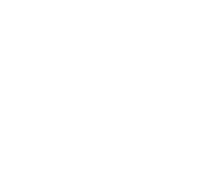
(c) When Ratef = Rater,
kf[A] = kr[B], and 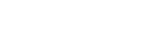 = 3
= 3
12.111 (a) 1 --> 1/2 --> 1/4 -->
1/8
After three half-lives, 1/8 of the
strontium-90 will remain.
(b) k
=  = 0.0239/y = 0.024/y
(c) t =  =
193 y
=
193 y
12.112 k =  =
1.21 x 10⁻⁴/y
=
1.21 x 10⁻⁴/y
t = 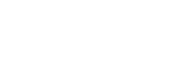 = 1.6 x 10⁴ y
Multi-Concept Problems
12.113 (a) k = A =
(6.0 x 10⁸/(M · s))
=
(6.0 x 10⁸/(M · s))  =
4.7 x 10⁷/(M · s)
=
4.7 x 10⁷/(M · s)
(b)  N
has 3 electron clouds, is sp2 hybridized, and the molecule is
bent.
N
has 3 electron clouds, is sp2 hybridized, and the molecule is
bent.
(c) 
(d) The reaction has such a low activation energy because the F-F bond is very weak and the N-F bond is relatively strong.
12.114
2
HI(g) H2(g) + I2(g)
(a) mass HI = 1.50 L x  =
15.15 g HI
=
15.15 g HI
15.15 g HI x  = 0.118 mol HI
[HI]
=  = 0.0787 mol/L
 = (0.031/(M · min))(0.0787
M)2 = 1.92 x 10⁻⁴ M/min
= (0.031/(M · min))(0.0787
M)2 = 1.92 x 10⁻⁴ M/min
2 HI(g) H2(g) + I2(g)
 =
=  =
9.60 x 10⁻⁵ M/min
=
9.60 x 10⁻⁵ M/min
(9.60 x
10-5 M/min)(1.50 L)(6.022 x 10²³ molecules/mol) = 8.7 x
1019 molecules/min
(b) Rate =
k[HI]2  = (0.031/(M · min))
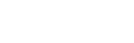 +
+  =
27.59/M
=
27.59/M
[HI]t =  = 0.0362 M
From
stoichiometry, [H2]t = 1/2 ([HI]o -
[HI]t) = 1/2 (0.0787 M - 0.0362 M) = 0.0212 M
410oC = 683 K
PV = nRT  =
=  =
=  = 1.2 atm
12.115 2 NO2(g) 2 NO(g) +
O2(g)
k = 4.7/(M · s)
(a) The units for k indicate a second order
reaction.
(b) 383oC = 656
K
PV = nRT
[NO2]o = 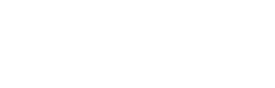 =
0.01823 mol/L
=
0.01823 mol/L
initial rate = k = [4.7/(M · s)](0.01823 mol/L)2 = 1.56 x
10-3 mol/(L · s)
= [4.7/(M · s)](0.01823 mol/L)2 = 1.56 x
10-3 mol/(L · s)
initial rate
for O2 =  =
7.80 x 10⁻⁴ mol/(L · s)
=
7.80 x 10⁻⁴ mol/(L · s)
initial rate for O2 = [7.80 x 10⁻⁴
mol/(L · s)](32.00 g/mol) = 0.025 g/(L · s)
(c) 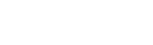 =
= 
 = 336.9/M and [NO2] = 0.00297 M
2 NO2(g) 2 NO(g) +
O2(g)
before reaction (M)
0.01823 0 0
change (M) -2x +2x +x
after 1.00 min (M) 0.01823 - 2x 2x x
after 1.00 min [NO2] = 0.00297 M =
0.01823 - 2x
x = 0.00763 M =
[O2]
mass O2 =
(0.00763 mol/L)(5.00 L)(32.00 g/mol) = 1.22 g O2
12.116 N2O5, 108.01
amu
[N2O5]o =  = 0.0125 mol/L
ln
[N2O5]t = -kt + ln
[N2O5]o = -(1.7 x 10⁻³
s-1)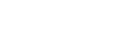 + ln (0.0125) = -5.71
[N2O5]t =
e-5.71 = 3.31 x 10⁻³ mol/L
After 13.0 min, mol N2O5 = (3.31 x
10-3 mol/L)(2.00 L) = 6.62 x 10⁻³ mol
N2O5
N2O5(g) 2 NO2(g) + 1/2
O2(g)
before reaction (mol)
0.0250 0 0
change (mol) -x +2x
+1/2x
after reaction (mol) 0.0250 - x 2x
1/2x
After 13.0 min, mol
N2O5 = 6.62 x 10-3 = 0.0250 - x
x = 0.0184 mol
After 13.0 min, ntotal =  =
(6.62 x 10⁻³) + 2(0.0184) + 1/2(0.0184)
=
(6.62 x 10⁻³) + 2(0.0184) + 1/2(0.0184)
ntotal = 0.0526 mol
55oC = 328 K
PV = nRT  =
=  =
=  = 0.71 atm
12.117 (a) N2O5(g) 2
NO2(g) + 1/2 O2(g)
Horxn = 2
Hof(NO2) -
Hof(N2O5)
= (2 mol)(33.2 kJ/mol) - (1 mol)(11 kJ/mol) = 55.4 kJ =
5.54 x 10⁴ J
initial rate =
k[N2O5]o = (1.7 x 10⁻³
s-1)(0.0125 mol/L) = 2.125 x 10⁻⁵ mol/(L · s)
initial rate absorbing heat = [2.125 x
10-5 mol/(L · s)](2.00 L)( 5.54 x 10⁴ J/mol) = 2.4
J/s
(b)
ln [N2O5]t = -kt + ln
[N2O5]o = -(1.7 x 10⁻³
s-1)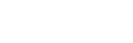 + ln (0.0125) = -5.40
[N2O5]t =
e-5.40 = 4.52 x 10⁻³ mol/L
After 10.0 min, mol N2O5 = (4.52 x
10-3 mol/L)(2.00 L) = 9.03 x 10⁻³ mol
N2O5
N2O5(g) 2 NO2(g) + 1/2
O2(g)
before reaction (mol);
0.0250, 0, 0
change (mol) -x, +2x,
+1/2x
after reaction (mol); 0.0250 - x,
2x, 1/2x
after 10.0 min, mol
N2O5 = 9.03 x 10-3 = 0.0250 - x
x = 0.0160 mol
heat absorbed = (0.0160 mol)(55.4 kJ/mol) = 0.89
kJ
12.118 H2O2, 34.01
amu
mass H2O2 =
(0.500 L)(1000 mL/1 L)(1.00 g/ 1 mL)(0.0300) = 15.0 g
H2O2
mol
H2O2 = 15.0 g H2O2 x  = 0.441 H2O2
[H2O2]o =  = 0.882 mol /L
k
=  =
=  =
6.48 x 10⁻²/h
=
6.48 x 10⁻²/h
ln
[H2O2]t = -kt + ln
[H2O2]o
ln [H2O2]t = -(6.48 x
10-2/h)(4.02 h) +ln (0.882)
ln [H2O2]t = -0.386;
[H2O2]t = e -0.386 = 0.680
mol/L
mol H2O2 =
(0.680 mol/L)(0.500 L) = 0.340 mol
2
H2O2(aq) 2 H2O(l) + O2(g)
before reaction (mol); 0.441, 0, 0
change (mol); - 2x, +2x, +x
after reaction; 0.441 - 2x, 2x, x
after 4.02 h, mol H2O2 = 0.340 mol
= 0.441 - 2x; solve for x.
2x =
0.101
x = 0.0505 mol = mol
O2
P = 738 mm Hg x  =
0.971 atm
=
0.971 atm
PV = nRT
V = 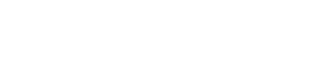 =
1.25 L
=
1.25 L
PV = (0.971 atm)(1.25 L) = 1.21
L·atm
w = - PV = - 1.21 L·atm = (- 1.21
L·atm) = - 122 J