Solutions and Their Properties
11.1 Toluene is nonpolar and is insoluble in water.
Br2 is nonpolar but because of its size is polarizable and is soluble in water.
KBr is an ionic compound and is very soluble in water.
toluene < Br2 < KBr (solubility in H2O)
11.2 (a) Na+ has the larger (more negative) hydration energy because the Na+ ion is smaller than the Cs+ ion and water molecules can approach more closely and bind more tightly to the Na+ ion.
(b) Ba2+ has the larger (more negative) hydration energy because of its higher charge.
11.3 NaCl, 58.44 amu; 1.00 mol NaCl = 58.44 g
1.00 L H2O = 1000 mL = 1000 g (assuming a density of 1.00 g/mL)
mass % NaCl = 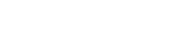 = 5.52
mass %
= 5.52
mass %
11.4 ppm = 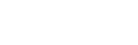 x
106 ppm
x
106 ppm
total mass of solution = density x volume = (1.3 g/L)(1.0 L) = 1.3 g
35 ppm =  x
106 ppm
x
106 ppm
mass of CO2 =  = 4.6
x 10-5 g CO2
= 4.6
x 10-5 g CO2
11.5 Assume 1.00 L of sea water.
mass of 1.00 L = (1000 mL)(1.025 g/mL) = 1025 g
 = 3.50
mass %; mass NaCl =
= 3.50
mass %; mass NaCl =  = 35.88
g
= 35.88
g
There are 35.88 g NaCl per 1.00 L of solution.
M =  =
0.614 M
=
0.614 M
11.6 C27H46O, 386.7 amu;
CHCl3, 119.4 amu; 40.0 g x  =
0.0400 kg
=
0.0400 kg
molality = 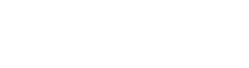 =
0.0249 m
=
0.0249 m

 =
=  = 2.96 x 10⁻³
11.7 CH3CO2Na, 82.03 amu
kg H2O =  =
0.300 kg H2O
=
0.300 kg H2O
(0.150 mol CH3CO2Na) = 12.3 g CH3CO2Na
mass of solution needed = 300 g + 12.3 g = 312 g
11.8 Assume you have a solution with 1.000 kg (1000 g) of H2O. If this solution is 0.258 m, then it must also contain 0.258 mol glucose.
mass of glucose = 0.258 mol x  = 46.5
g glucose
= 46.5
g glucose
mass of solution = 1000 g + 46.5 g = 1046.5 g
density = 1.0173 g/mL
volume of solution =  =
1028.7 mL
=
1028.7 mL
volume = 1028.7 mL x  =
1.029 L; molarity =
=
1.029 L; molarity =  =
0.251 M
=
0.251 M
11.9 Assume 1.00 L of solution.
mass of 1.00 L = (1.0042 g/mL)(1000 mL) = 1004.2 g of solution
0.500 mol CH3CO2H x  = 30.02 g CH3CO2H
1004.2 g - 30.02 g = 974.2 g = 0.9742 kg of
H2O; molality =  =
0.513 m
=
0.513 m
11.10 Assume you have 100.0 g of seawater.
mass NaCl = (0.0350)(100.0 g) = 3.50 g NaCl
mass H2O = 100.0 g - 3.50 g = 96.5 g H2O
NaCl, 58.44 amu; mol NaCl = 3.50 g x  = 0.0599 mol NaCl
mass H2O = 96.5 g x  =
0.0965 kg H2O; molality =
=
0.0965 kg H2O; molality =  =
0.621 m
=
0.621 m
11.11 M = k P; k =  = 3.2
x 10-2 mol/(L atm)
= 3.2
x 10-2 mol/(L atm)
11.12 (a) M = k P = [3.2 x 10⁻² mol/(L atm)](2.5 atm) = 0.080 M
(b) M = k P = [3.2 x 10⁻² mol/(L atm)](4.0 x 10-4 atm) = 1.3 x 10⁻⁵ M
11.13 C7H6O2, 122.1 amu; C2H6O, 46.07 amu
 =
0.981
=
0.981
Psoln = Psolv Xsolv = (100.5 mm Hg)(0.981) = 98.6 mm Hg
11.14 Psoln = Psolv
Xsolv;  =
=  = 0.976
NaBr dissociates into two ions in aqueous solution.
Xsolv = 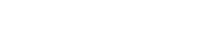
Xsolv = 0.976 = 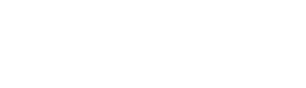
0.976 = 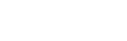 ;
solve for x.
;
solve for x.
x = 0.171 mol Na+ = 0.171 mol Br- = 0.171 mol NaBr
NaBr, 102.9 amu; mass NaBr = 0.171 mol x  = 17.6 g NaBr
11.15 At any given temperature, the vapor pressure of a solution is lower than the vapor pressure of the pure solvent. The upper curve represents the vapor pressure of the pure solvent. The lower curve represents the vapor pressure of the solution.
11.16 C2H5OH, 46.07 amu; H2O, 18.02 amu
(a) 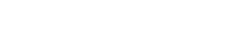 =
0.5426 mol C2H5OH
=
0.5426 mol C2H5OH
100.0 g H2O x  =
5.549 mol H2O
=
5.549 mol H2O
 =
0.08907
=
0.08907
 =
0.9109
=
0.9109
Psoln = 
Psoln = (0.08907)(61.2 mm Hg) + (0.9109)(23.8 mm Hg) = 27.1 mm Hg
(b) 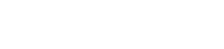 =
2.171 mol C2H6O
=
2.171 mol C2H6O
25.0 g H2O x  =
1.387 mol H2O
=
1.387 mol H2O
 =
0.6102
=
0.6102
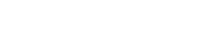 =
0.3898
=
0.3898
Psoln = 
Psoln = (0.6102)(61.2 mm Hg) + (0.3898)(23.8 mm Hg) = 46.6 mm Hg
11.17 At any given temperature, the vapor pressure of a mixture of two pure liquids falls between the individual vapor pressures of the two pure liquids themselves. The upper and lower curves represent the vapor pressures of the two pure liquids. The middle curve represents the vapor pressure of the mixture.
11.18 C9H8O4,
180.2 amu; CHCl3 is the solvent. For CHCl3, Kb
= 3.63 
75.00 g x  =
0.075 00 kg
=
0.075 00 kg
Tb = Kb m = 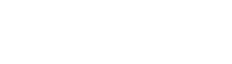 = 0.40oC
solution boiling point = 61.7oC + Tb = 61.7oC + 0.40oC = 62.1oC
11.19 K2SO4, 174.3 amu; there are 3 ions (solute particles)/K2SO4
Tf = Kf (3 m) =
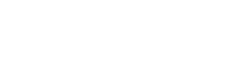 = 2.15oC
Solution freezing point = 0.00oC - Tf = 0.00oC - 2.15oC = -2.15oC
11.20 There are 2 ions/KBr. Tf = Kf 2 m
freezing point = -2.95oC = 0.00oC - Tf; Tf = 2.95oC
m = 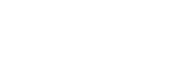 =
0.793 m
=
0.793 m
11.21 The red curve represents the vapor pressure of pure chloroform.
(a) The normal boiling point for a liquid is the temperature where the vapor pressure of the liquid equals 1 atm (760 mm Hg). The approximate boiling point of pure chloroform is 62oC.
(b) The approximate boiling point of the solution is 69oC.
Tb = 69oC - 62oC = 7oC
Tb = Kb m;
m =  =
=  = 2
m
= 2
m
11.22 For CaCl2 there are 3 ions (solute particles)/CaCl2
= MRT; For CaCl2, = 3MRT
= (3)(0.125 mol/L) (310
K) = 9.54 atm
(310
K) = 9.54 atm
11.23 = MRT; M =  =
0.156 M
=
0.156 M
11.24 Tf = Kf m;
m =  = 0.0557 m
0.0557 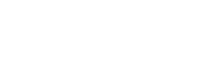 ;
solve for the molar mass.
;
solve for the molar mass.
molar mass = 128 g/mol
11.25 = MRT; M =  =
8.02 x 10-3
=
8.02 x 10⁻³ 
molarity = 8.02 x 10⁻³ 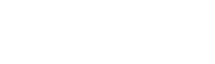
Solve for the molar mass. molar mass = 342 g/mol
11.26 (a) and (c)
(b) The mixture will begin to boil at ~50oC.
(d) After two cycles of boiling and condensing, the approximate composition of the liquid would 90% dichloromethane and 10% chloroform.
11.27 Both solvent molecules and small solute particles can pass through a semipermeable dialysis membrane. Only large colloidal particles such as proteins can't pass through. Only solvent molecules can pass through a semipermeable membrane used for osmosis.
Understanding Key Concepts
11.28 (a) < (b) < (c)
11.29 At any given temperature, the vapor pressure of a mixture of two pure liquids falls between the individual vapor pressures of the two pure liquids themselves. Because the vapor pressure of the mixture is greater than the vapor pressure of the solvent, the second liquid is more volatile (has a higher vapor pressure) than the solvent.
11.30  Assume that only the
blue (open) spheres (solvent) can pass through the semipermeable membrane. There
will be a net transfer of solvent from the right compartment (pure solvent) to
the left compartment (solution) to achieve equilibrium.
Assume that only the
blue (open) spheres (solvent) can pass through the semipermeable membrane. There
will be a net transfer of solvent from the right compartment (pure solvent) to
the left compartment (solution) to achieve equilibrium.
11.31 NaCl is a nonvolatile solute. Methyl alcohol is a volatile solute. When NaCl is added to water, the vapor pressure of the solution is decreased, which means that the boiling point of the solution will increase. When methyl alcohol is added to water, the vapor pressure of the solution is increased which means that the boiling point of the solution will decrease.
11.32 When 100 mL of 9 M H2SO4 at 0oC is added to 100 mL of liquid water at 0oC, the temperature rises because Hsoln for H2SO4 is exothermic.
When 100 mL of 9 M H2SO4 at 0oC is added to 100 g of solid ice at 0oC, some of the ice will melt (an endothermic process) and the temperature will fall because the H2SO4 (solute) lowers the freezing point of the ice/water mixture.
11.33 Hsoln for HBr is exothermic. The HBr solution will be warm to touch.
Hsoln for AgNO3 is endothermic. The AgNO3 solution will be cool to touch.
11.34 The vapor pressure of the NaCl solution is lower than that of pure H2O. More H2O molecules will go into the vapor from the pure H2O than from the NaCl solution. More H2O vapor molecules will go into the NaCl solution than into pure H2O. The result is represented by (b).
11.35  (b)
~95oC
(b)
~95oC
Additional Problems
Solutions and Energy Changes
11.36 The surface area of a solid plays an important role in determining how rapidly a solid dissolves. The larger the surface area, the more solid-solvent interactions, and the more rapidly the solid will dissolve. Powdered NaCl has a much larger surface area than a large block of NaCl, and it will dissolve more rapidly.
11.37 (a) a gas in a liquid -- carbonated soft drink
(b) a solid in a solid -- metal alloys (14-karat gold)
(c) a liquid in a solid -- dental amalgam (Hg in Ag)
11.38 Substances tend to dissolve when the solute and solvent have the same type and magnitude of intermolecular forces; thus the rule of thumb "like dissolves like."
11.39 Both Br2 and CCl4 are nonpolar, and intermolecular forces for both are dispersion forces. H2O is a polar molecule with dipole-dipole forces and hydrogen bonding. Therefore, Br2 is more soluble in CCl4.
11.40 Energy is required to overcome intermolecular forces holding solute particles together in the crystal. For an ionic solid, this is the lattice energy. Substances with higher lattice energies tend to be less soluble than substances with lower lattice energies.
11.41 SO42- has the larger hydration energy because of its higher charge. Both SO42- and ClO4- are comparable in size, so size is not a factor.
11.42 Ethyl alcohol and water are both polar with small dispersion forces. They both can hydrogen bond, and are miscible.
Pentyl alcohol is slightly polar and can hydrogen bond. It has, however, a relatively large dispersion force because of its size, which limits its water solubility.
11.43 The intermolecular forces associated with octane are dispersion forces. Both pentyl alcohol and methyl alcohol can hydrogen bond. Pentyl alcohol has relatively large dispersion forces because of its size. Methyl alcohol does not. Pentyl alcohol is soluble in octane; methyl alcohol is not.
11.44 CaCl2, 110.98 amu
For a 1.00 m solution:
heat released = 81,300 J
mass of solution = 1000 g H2O + 110.98 g CaCl2 = 1110.98 g
T =  =
=
 = 17.5 K = 17.5oC
Final temperature = 25.0oC + 17.5oC = 42.5oC
11.45 NH4ClO4, 117.48 amu
For a 1.00 m solution:
heat absorbed = 33,500 J
mass of solution = 1000 g H2O + 117.48 g NH4ClO4 = 1117.48 g
T =  =
=
 = -7.2 K = -7.2oC
Final temperature = 25.0oC - 7.2oC = 17.8oC
Units of Concentration
11.46 molarity = 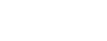 ;
molality =
;
molality = 
11.47 A saturated solution contains enough solute so that there is an equilibrium between dissolved solute and undissolved solid.
A supersaturated solution contains a greater-than-equilibrium amount of solute.
11.48 (a) Dissolve 0.150 mol of glucose in water; dilute to 1.00 L.
(b) Dissolve 1.135 mol of KBr in 1.00 kg of H2O.
(c) Mix together 0.15 mol of CH3OH with 0.85 mol of H2O.
11.49 (a) Dissolve 15.5 mg urea in 100 mL water
(b) Choose a K+ salt, say KCl, and dissolve 0.0075 mol (0.559 g) in water; dilute to
100 mL.
11.50 C7H6O2, 122.12 amu, 165 mL = 0.165 L
mol C7H6O2 =
0.165 L x  = 0.004 42 mol
mass C7H6O2 =
0.004 42 mol x  = 0.540 g
Dissolve 4.42 x 10⁻³ mol (0.540 g) of C7H6O2 in enough CHCl3 to make 165 mL of solution.
11.51 C7H6O2, 122.12 amu
0.0268 mol
C7H6O2 x 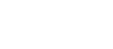 =
3.27 g C7H6O2
=
3.27 g C7H6O2
Dissolve 3.27 g of C7H6O2 in 1.000 kg of CHCl3, and take 165 mL of the solution.
11.52 (a) KCl, 74.6 amu
A 0.500 M KCl solution contains 37.3 g of KCl per 1.00 L of solution.
A 0.500 mass % KCl solution contains 5.00 g of KCl per 995 g of water.
The 0.500 M KCl solution is more concentrated (that is, it contains more solute per amount of solvent).
(b) Both solutions contain the same amount of solute. The 1.75 M solution contains less solvent than the 1.75 m solution. The 1.75 M solution is more concentrated.
11.53 (a) KI, 166.00 amu; KBr, 119.00 amu; assume 1.000 L = 1000 mL = 1000 g solution
10 ppm =  x
106 ; mass KI = 0.010 g
x
106 ; mass KI = 0.010 g
10,000 ppb =  x
109 ; mass KBr = 0.010 g
x
109 ; mass KBr = 0.010 g
Both solutions contain the same mass of solute in the same amount of solvent. Because the molar mass of KBr is less than that of KI, the number of moles of KBr is larger than the number of moles of KI. The KBr solution has a higher molarity than the KI solution.
(b) Because the mass % of the two solutions is the same, they both contain the same mass of solute and solution. Because the molar mass of KCl is less than that of citric acid, the number of moles of KCl is larger than the number of moles of citric acid. The KCl solution has a higher molarity than the citric acid solution.
11.54 (a) C6H8O7, 192.12 amu
0.655 mol
C6H8O7 x 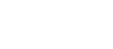 = 126
g C6H8O7
= 126
g C6H8O7
mass % C6H8O7 =
 = 11.2 mass %
(b) 0.135 mg = 0.135 x 10⁻³ g
(5.00 mL H2O)(1.00 g/mL) = 5.00 g H2O
mass % KBr =  =
0.002 70 mass % KBr
=
0.002 70 mass % KBr
(c) mass % aspirin =  =
3.65 mass % aspirin
=
3.65 mass % aspirin
11.55 (a) molality =  =
0.655 m
=
0.655 m
(b) KBr, 119.00 amu; 5.00 g = 0.005 00 kg
molality = 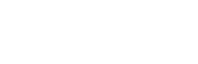 =
2.27 x 10⁻⁴ m
=
2.27 x 10⁻⁴ m
(c) C9H8O4, 180.16 amu; 145 g = 0.145 kg
molality = 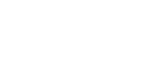 =
0.211 m
=
0.211 m
11.56 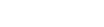
 = 1.2
x 10-7
= 1.2
x 10-7
Assume one mole of air (29 g/mol)
mol O3 = nair  = (1 mol)(1.2 x 10⁻⁷) = 1.2 x 10⁻⁷ mol
O3
= (1 mol)(1.2 x 10⁻⁷) = 1.2 x 10⁻⁷ mol
O3
O3, 48.00 amu; mass O3 =
1.2 x 10⁻⁷ mol x  = 5.8
x 10-6 g O3
= 5.8
x 10-6 g O3
ppm O3 =  x
106 = 0.20 ppm
x
106 = 0.20 ppm
11.57 Assume 1 mL of blood weighs 1 g. 1 dL = 0.1 L = 100 mL = 100 g
ppb =  x
109 = 100 ppb
x
109 = 100 ppb
11.58 (a) H2SO4, 98.08
amu; molality = 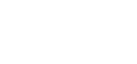 = 0.196 m
(b) C10H14N2, 162.23 amu; CH2Cl2, 84.93 amu
2.25 g C10H14N2
x  = 0.0139 mol
C10H14N2
= 0.0139 mol
C10H14N2
80.0 g CH2Cl2 x 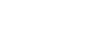 = 0.942 mol CH2Cl2
 =
0.0145
=
0.0145
 =
0.985
=
0.985
11.59 NaOCl, 74.44 amu
A 5.0 mass % aqueous solution of NaOCl contains 5.0 g NaOCl and 95 g H2O.
molality =  =
0.71 m
=
0.71 m
5.0 g NaOCl x  =
0.0672 mol NaOCl
=
0.0672 mol NaOCl
95 g H2O x  = 5.27
mol H2O
= 5.27
mol H2O
 =
0.013
=
0.013
11.60 16.0 mass % = 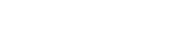
H2SO4, 98.08 amu; density = 1.1094 g/mL
volume of solution = 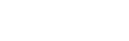 =
90.14 mL = 0.090 14 L
=
90.14 mL = 0.090 14 L
molarity =  =
1.81 M
=
1.81 M
11.61 C2H6O2, 62.07 amu
A 40.0 mass % aqueous solution of C2H6O2 contains 40.0 g C2H6O2 and 60.0 g H2O.
density = 1.0514 g/mL
volume of solution = 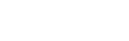 =
95.1 mL = 0.0951 L
=
95.1 mL = 0.0951 L
molarity = 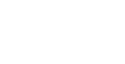 =
6.78 M
=
6.78 M
11.62 molality =  =
10.7 m
=
10.7 m
11.63 molality =  =
1.94 m
=
1.94 m
11.64 C19H21NO3, 311.34 amu; 1.5 mg = 1.5 x 10⁻³ g
1.3 x 10⁻³ 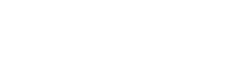 ;
solve for kg of solvent.
;
solve for kg of solvent.
kg of solvent = 0.0037 kg
Because the solution is very dilute, kg of solvent kg of solution.
g of solution = (0.0037 kg) = 3.7
g
= 3.7
g
11.65 C12H22O11, 342.30 amu
32.5 g
C12H22O11 x  =
0.0949 mol C12H22O11
=
0.0949 mol C12H22O11
0.850 m = 0.850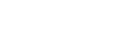 ; kg
of H2O =
; kg
of H2O =  =
0.112 kg
=
0.112 kg
mass of H2O = 0.112 kg x  = 112 g H2O
11.66 C6H12O6, 180.16 amu; H2O, 18.02 amu; Assume 1.00 L of solution.
mass of solution = (1000 mL)(1.0624 g/mL) = 1062.4 g
mass of solute = 0.944 mol x  =
170.1 g C6H12O6
=
170.1 g C6H12O6
mass of H2O = 1062.4 g - 170.1 g = 892.3 g H2O
mol C6H12O6 =
0.944 mol; mol H2O = 892.3 g x  =
49.5 mol
=
49.5 mol
(a)  =
0.0187
=
0.0187
(b) mass % =  x
100% = 16.0%
x
100% = 16.0%
(c) molality =  =
1.06 m
=
1.06 m
11.67 C12H22O11, 342.30 amu; Assume 1.00 L of solution.
mass of solution = (1000 mL)(1.0432 g/mL) = 1043.2 g
mass of solute = 0.335 mol
C12H22O11 x 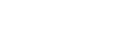 =
114.7 g C12H22O11
=
114.7 g C12H22O11
mass of H2O = 1043.2 g - 114.7 g = 928.5 g H2O
mol C12H22O11 =
0.335 mol; 928.5 g H2O x  =
51.53 mol H2O
=
51.53 mol H2O
 =
0.006 46
=
0.006 46
mass %
C12H22O11 =  =
11.0 mass % C12H22O11
=
11.0 mass % C12H22O11
molality =  =
0.361 m
=
0.361 m
Solubility and Henry's Law
11.68 M = k P = (0.091  )(0.75
atm) = 0.068 M
)(0.75
atm) = 0.068 M
11.69 M = k P; k =  =
0.195 mol/(L atm)
=
0.195 mol/(L atm)
P = 25.5 mm Hg x  =
0.0336 atm
=
0.0336 atm
M = k P = (0.195  )(0.0336 atm) = 6.55 x 10⁻³ M
11.70 M = k P
Calculate k: k = 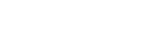 =
2.21 x 10-3
=
2.21 x 10⁻³ 
Convert 4 mg/L to mol/L:
4 mg = 4 x 10⁻³ g
O2 molarity = 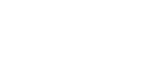 =
1.25 x 10⁻⁴ M
=
1.25 x 10⁻⁴ M
 =
0.06 atm
=
0.06 atm
11.71 k = 1.93 x 10⁻³ mol/(L atm)
M = k P = [1.93 x 10⁻³ mol/(L
atm)]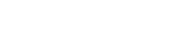 = 1.73 x 10⁻⁴ mol/L
1.73 x 10⁻⁴ mol/L x  =
5.5 mg/L
=
5.5 mg/L
11.72 [Xe] = 10 mmol/L = 0.010 M at STP
M = k P; k =  =
0.010 mol/(L atm)
=
0.010 mol/(L atm)
11.73 Assuming H2O as the solvent, NH3 does not obey Henry's law because NH3 can both hydrogen bond and react with H2O.
Colligative Properties
11.74 The difference in entropy between the solvent in a solution and a pure solvent is responsible for colligative properties.
11.75 Osmotic pressure is the amount of pressure that needs to be applied to cause osmosis to stop.
11.76 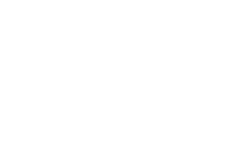
11.77 Molality is a temperature independent concentration unit. For freezing point depression and boiling point elevation, molality is used so that the solute concentration is independent of temperature changes. Molarity is temperature dependent. Molarity can be used for osmotic pressure because osmotic pressure is measured at a fixed temperature.
11.78 (a) CH4N2O, 60.06 amu; H2O, 18.02 amu
10.0 g CH4N2O x  = 0.167 mol CH4N2O
150.0 g H2O x  =
8.32 mol H2O
=
8.32 mol H2O
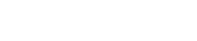 =
0.980
=
0.980
Psoln =  =
(71.93 mm Hg)(0.980) = 70.5 mm Hg
=
(71.93 mm Hg)(0.980) = 70.5 mm Hg
(b) LiCl, 42.39 amu; 10.0 g LiCl x  = 0.236 mol LiCl
LiCl dissociates into Li+(aq) and Cl-(aq) in H2O.
mol Li+ = mol Cl- = mol LiCl = 0.236 mol
150.0 g H2O x  =
8.32 mol H2O
=
8.32 mol H2O
 =
0.946
=
0.946
Psoln =  =(71.93 mm Hg)(0.946) = 68.0 mm Hg
11.79 C6H12O6, 180.16 amu; CH3OH, 32.04 amu
16.0 g C6H12O6
x  = 0.0888 mol C6H12O6
80.0 g CH3OH x  =
2.50 mol CH3OH
=
2.50 mol CH3OH
 =
0.966
=
0.966
Psoln =  =
(140 mm Hg)(0.966) = 135 mm Hg
=
(140 mm Hg)(0.966) = 135 mm Hg
11.80 For H2O, Kb = 0.51
 ; 150.0 g = 0.1500 kg
(a) Tb = Kb m =
 = 0.57oC
solution boiling point = 100.00oC + Tb = 100.00oC + 0.57oC = 100.57oC
(b) Tb = Kb m =
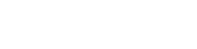 = 1.6oC
solution boiling point = 100.00oC + Tb = 100.00oC + 1.6oC = 101.6oC
11.81 For H2O, Kf = 1.86
 ; 150.0 g = 0.1500 kg
(a) Tf = Kf m =
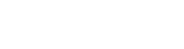 = 2.07oC
solution freezing point = 0.00oC - Tf = 0.00oC - 2.07oC = -2.07oC
(b) Tf = Kf m =
 = 5.85oC
solution freezing point = 0.00oC - Tf = 0.00oC - 5.85oC = -5.85oC
11.82 Acetone, C3H6O,
58.08 amu,  = 285 mm Hg
Ethyl acetate,
C4H8O2, 88.11 amu,  = 118
mm Hg
= 118
mm Hg
25.0 g C3H6O x  = 0.430 mol C3H6O
25.0 g C4H8O2 x
 = 0.284 mol C4H8O2
 =
0.602;
=
0.602;  = 0.398
Psoln = 
Psoln = (285 mm Hg)(0.602) + (118 mm Hg)(0.398) = 219 mm Hg
11.83 CHCl3, 119.38 amu,  = 205 mm Hg; CH2Cl2, 84.93 amu,
  = 415 mm Hg
15.0 g CHCl3 x  =
0.126 mol CHCl3
=
0.126 mol CHCl3
37.5 g CH2Cl2 x 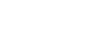 = 0.442 mol CH2Cl2
 =
0.222;
=
0.222;  = 0.778
Psoln = 
Psoln = (205 mm Hg)(0.222) + (415 mm Hg)(0.778) = 368 mm Hg
11.84 In the liquid, Xacetone = 0.602 and Xethyl acetate = 0.398
In the vapor, PTotal = 219 mm Hg
Pacetone =  Xacetone = (285 mm Hg)(0.602) = 172 mm Hg
Pethyl acetate =  Xethyl acetate = (118 mm Hg)(0.398) = 47 mm Hg
 =
0.785;
=
0.785;  = 0.215
11.85 In the liquid,  =
0.222 and
=
0.222 and  = 0.778
In the vapor, Ptotal = 368 mm Hg
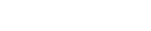 =
(205 mm Hg)(0.222) = 45.5 mm Hg
=
(205 mm Hg)(0.222) = 45.5 mm Hg
 =
(415 mm Hg)(0.778) = 323 mm Hg
=
(415 mm Hg)(0.778) = 323 mm Hg
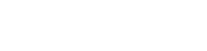 =
0.124;
=
0.124;  = 0.876
11.86 C9H8O4, 180.16 amu; 215 g = 0.215 kg
Tb = Kb m =
0.47oC; Kb =  =
3.6
=
3.6 
11.87 C6H8O6, 176.13 amu; 50.0 g = 0.0500 kg
Tf = Kf m =
1.33oC; Kf = 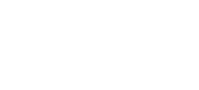 =
3.90
=
3.90 
11.88 Tb = Kb m =
1.76oC; m =  =
0.573 m
=
0.573 m
11.89 C6H12O6, 180.16 amu
For ethyl alcohol, Kb = 1.22  ; 285 g = 0.285 kg
Tb = Kb m = 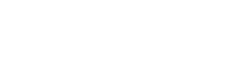 = 0.618oC
solution boiling point = normal boiling point + Tb = 79.1oC
normal boiling point = 79.1oC - Tb = 79.1oC - 0.618oC = 78.5oC
11.90 = MRT
(a) NaCl 58.44 amu; 350.0 mL = 0.3500 L
There are 2 moles of ions/mole of NaCl
= (2) =
13.0 atm
=
13.0 atm
(b) CH3CO2Na, 82.03 amu; 55.0 mL = 0.0550 L
There are 2 moles of ions/mole of CH3CO2Na
= (2)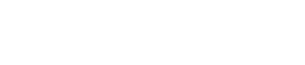 =
65.2 atm
=
65.2 atm
11.91 = MRT = 
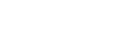 (298 K) = 0.007 11 atm
= 0.007 11 atm x  =
5.41 mm Hg
=
5.41 mm Hg
height of H2O column = 5.41 mm Hg x
 = 73.2 mm
height of H2O column = 73.2 mm x  = 0.0732 m
11.92 = MRT; M = 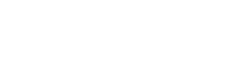 =
0.197 M
=
0.197 M
11.93 = MRT; M = 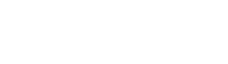 =
0.30 M
=
0.30 M
Uses of Colligative Properties
11.94 Osmotic pressure is most often used for the determination of molecular mass because, of the four colligative properties, osmotic pressure gives the largest colligative property change per mole of solute.
11.95 C6H12O6 does not dissociate in aqueous solution. LiCl and NaCl both dissociate into two solute particles per formula unit in aqueous solution. CaCl2 dissociates into three solute particles per formula unit in aqueous solution. Assume that you have 1.00 g of each substance. Calculate the number of moles of solute particles in 1.00 g of each substance.
C6H12O6, 180.2
amu; moles solute particles = 1.00 g x  =
0.005 55 moles
=
0.005 55 moles
LiCl, 42.4 amu; moles solute particles = 2 = 0.0472 moles
NaCl, 58.4 amu; moles solute particles = 2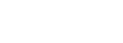 = 0.0342 moles
CaCl2, 111.0 amu; moles solute
particles = 3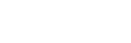 = 0.0270 moles
LiCl produces more solute particles/gram than any of the other three substances. LiCl would be the most efficient per unit mass.
11.96 = 407.2 mm Hg x  =
0.5358 atm
=
0.5358 atm
= MRT; M = 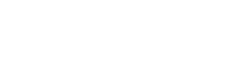 =
0.021 90 M = 0.021 90 mol/L
=
0.021 90 M = 0.021 90 mol/L
M = 0.021 90 mol/L =  ;
solve for the molar mass
;
solve for the molar mass
molar mass of cellobiose = 342.5 g/mol; molecular mass = 342.5 amu
11.97 height of Hg column = 32.9 cm
H2O x 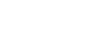 =
2.43 cm Hg
=
2.43 cm Hg
= 2.43 cm Hg x  =
0.0320 atm
=
0.0320 atm
= MRT; M = 
M = 0.001 31 mol/L = 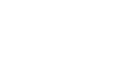 ;
solve for the molar mass.
;
solve for the molar mass.
molar mass of met-enkephalin = 573 g/mol; molecular mass = 573 amu
11.98 HCl is a strong electrolyte in H2O and completely dissociates into two solute particles per each HCl.
HF is a weak electrolyte in H2O. Only a few percent of the HF molecules dissociates into ions.
11.99 Na2SO4, 142.0 amu;
m =  = 0.50 m
T = Kb m =  (0.50 m) = 0.26oC
The experimental T is approximately 3 times that predicted by the equation above because Na2SO4 dissociates into three solute particles (2 Na+ and SO42-) in aqueous solution.
11.100 First, determine the empirical formula:
Assume 100.0 g of -carotene.
10.51% H 10.51 g H x  =
10.43 mol H
=
10.43 mol H
89.49% C 89.49 g C x  =
7.45 mol C
=
7.45 mol C
C7.45H10.43; Divide each subscript by the smaller, 7.45.
C7.45 / 7.45H10.43 / 7.45
CH1.4
Multiply each subscript by 5 to obtain integers. Empirical formula is C5H7, 67.1 amu.
Second, calculate the molecular mass:
Tf = Kf m;
m = 
m = 0.0310 mol/kg =  ;
solve for the molar mass.
;
solve for the molar mass.
molar mass of -carotene = 538 g/mol; molecular mass = 538 amu
Finally, determine the molecular formula:
Divide the molecular mass by the empirical formula mass.
 ;
molecular formula is C(8 x 5)H(8 x 7), or
C40H56
;
molecular formula is C(8 x 5)H(8 x 7), or
C40H56
11.101 First, determine the empirical formula:
Assume a 100.0 g sample of lysine.
49.29% C 49.29 g C x  =
4.10 mol C
=
4.10 mol C
9.65% H 9.65 g H x  =
9.57 mol H
=
9.57 mol H
19.16% N 19.16 g N x  =
1.37 mol N
=
1.37 mol N
21.89% O 21.89 g O x  =
1.37 mol O
=
1.37 mol O
C4.10H9.57N1.37O1.37; Divide each subscript by the smallest, 1.37.
C4.10 / 1.37H9.57 / 1.37N1.37 / 1.37O1.37 / 1.37
Empirical formula is C3H7NO, 73.09 amu
Second, calculate the molecular mass:
Tf = Kf m = 1.37
oC; m =  =
0.171 m = 0.171 mol/kg
=
0.171 m = 0.171 mol/kg
m = 0.171 mol/kg =  ;
solve for the molar mass.
;
solve for the molar mass.
molar mass of lysine = 146 g/mol; molecular mass = 146 amu
Finally, determine the molecular formula:
Divide the molecular mass by the empirical formula mass.
 = 2;
molecular formula is C(2 x 3)H(2 x 7)N(2 x
1)O(2 x 1), or
C6H14N2O2
= 2;
molecular formula is C(2 x 3)H(2 x 7)N(2 x
1)O(2 x 1), or
C6H14N2O2
General Problems
11.102 Kf for snow (H2O)
is 1.86  . Reasonable amounts of salt are capable of lowering the
freezing point (Tf) of the snow below an air temperature of
-2oC. Reasonable amounts of salt, however, are not capable of causing
a Tf of more than 30oC which would be required if it is to
melt snow when the air temperature is -30oC.
. Reasonable amounts of salt are capable of lowering the
freezing point (Tf) of the snow below an air temperature of
-2oC. Reasonable amounts of salt, however, are not capable of causing
a Tf of more than 30oC which would be required if it is to
melt snow when the air temperature is -30oC.
11.103 KBr, 119.00 amu; there are 2 ions/KBr; 125 g = 0.125 kg
Tb = 103.2 oC - 100.0 oC = 3.2 oC
Tb = Kb 2 m;
m = 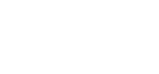 = 3.137 mol/kg
m = 3.137 mol/kg =  ;
solve for the mass of KBr.
;
solve for the mass of KBr.
mass of KBr = 47 g
11.104 C2H6O2, 62.07 amu; Tf = 22.0oC
Tf = Kf m;
m =  = 11.8 m
m = 11.8 
Solve for the mass of ethylene glycol. mass of ethylene glycol = 2600 g = 2.60 x 10³ g
11.105 The vapor pressure of toluene is lower than the vapor pressure of benzene at the same temperature. When 1 mL of toluene is added to 100 mL of benzene, the vapor pressure of the solution decreases, which means that the boiling point of the solution will increase. When 1 mL of benzene is added to 100 mL of toluene, the vapor pressure of the solution increases, which means that the boiling point of the solution will decrease.
11.106 When solid CaCl2 is added to liquid water, the temperature rises because Hsoln for CaCl2 is exothermic.
When solid CaCl2 is added to ice at 0oC, some of the ice will melt (an endothermic process) and the temperature will fall because the CaCl2 lowers the freezing point of an ice/water mixture.
11.107 AgCl, 143.32 amu; there are 2 ions/AgCl
= 2MRT
= 2
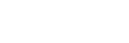 (278 K) = 0.002 atm
11.108 C10H8, 128.17 amu; 150.0 g = 0.1500 kg; Tf = 0.35oC
Tf = Kf m;
m = 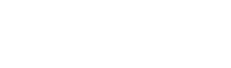
m = 0.0684 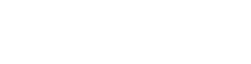
Solve for the mass of C10H8. mass of C10H8 = 1.3 g
11.109 Br2, 159.81 amu; CCl4, 153.82 amu
 =
228.8 mm Hg
=
228.8 mm Hg
 =
123.8 mm Hg
=
123.8 mm Hg
1.50 g Br2 x  =
9.39 x 10⁻³ mol Br2
=
9.39 x 10⁻³ mol Br2
145.0 g CCl4 x  =
0.943 mol CCl4
=
0.943 mol CCl4
 =
0.009 86
=
0.009 86
 =
0.990
=
0.990
Psoln = 
Psoln = (228.8 mm Hg)(0.009 86) + (123.8 mm Hg)(0.990) = 125 mm Hg
11.110 NaCl, 58.44 amu; there are 2 ions/NaCl
A 3.5 mass % aqueous solution of NaCl contains 3.5 g NaCl and 96.5 g H2O.
molality = 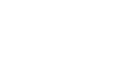 =
0.62 m
=
0.62 m
Tf = Kf 2 m =
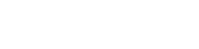 = 2.3oC
freezing point = 0.0oC - Tf = 0.0oC - 2.3oC = -2.3oC
Tb = Kb 2 m =
 = 0.63oC
boiling point = 100.00oC + Tb = 100.00oC + 0.63oC = 100.63oC
11.111 (a) Assume a total mass of solution of 1000.0 g.
ppm = 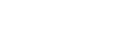 x
106
x
106
For each ion: mass of solute ion = 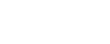
Ion Mass Moles
Cl- 19.0 g 0.536 mol
Na+ 10.5 g 0.457 mol
SO42- 2.65 g 0.0276 mol
Mg2+ 1.35 g 0.0555 mol
Ca2+ 0.400 g 0.009 98 mol
K+ 0.380 g 0.009 72 mol
HCO3- 0.140 g 0.002 29 mol
Br- 0.065 g 0.000 81 mol
Total 34.5 g 1.099 mol
Mass of H2O = 1000.0 g - 34.5 g = 965.5 g H2O = 0.9655 kg H2O
molality =  =
1.138 m
=
1.138 m
(b) Assume M = m for a dilute solution.
= MRT = (1.138  )(0.082 06
  )(300
K) = 28.0 atm
)(300
K) = 28.0 atm
11.112 (a) 90 mass % isopropyl alcohol = 
Solve for the mass of H2O.
mass of H2O = 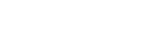 =
1.2 g
=
1.2 g
mass of solution = 10.5 g + 1.2 g = 11.7 g
11.7 g of rubbing alcohol contains 10.5 g of isopropyl alcohol.
(b) C3H8O, 60.10 amu
mass C3H8O = (0.90)(50.0 g) = 45 g
45 g C3H8O x 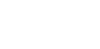 = 0.75 mol C3H8O
11.113 C6H12O6, 180.16 amu; 50.0 mL = 0.0500 L; 17.5 mg = 17.5 x 10⁻³ g
= MRT
T =  =
312 K
=
312 K
11.114 First, determine the empirical formula.
3.47 mg = 3.47 x 10⁻³ g sample
10.10 mg = 10.10 x 10⁻³ g CO2
2.76 mg = 2.76 x 10⁻³ g H2O
mass C = 10.10 x 10⁻³ g
CO2 x  =
2.76 x 10⁻³ g C
=
2.76 x 10⁻³ g C
mass H = 2.76 x 10⁻³ g H2O
x 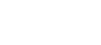 = 3.09 x 10⁻⁴ g H
mass O = 3.47 x 10⁻³ g - 2.76 x 10⁻³ g C - 3.09 x 10⁻⁴ g H = 4.01 x 10⁻⁴ g O
2.76 x 10⁻³ g C x  =
2.30 x 10⁻⁴ mol C
=
2.30 x 10⁻⁴ mol C
3.09 x 10⁻⁴ g H x  =
3.07 x 10⁻⁴ mol H
=
3.07 x 10⁻⁴ mol H
4.01 x 10⁻⁴ g O x  =
2.51 x 10⁻⁵ mol O = 0.251 x 10⁻⁴ mol O
=
2.51 x 10⁻⁵ mol O = 0.251 x 10⁻⁴ mol O
To simplify the empirical formula, divide each mol quantity by 10-4.
C2.30H3.07O0.251; Divide all subscripts by the smallest, 0.251.
C2.30 / 0.251H3.07 / 0.251O0.251 / 0.251
C9.16H12.23O, empirical formula is C9H12O (136 amu)
Second, determine the molecular mass.
7.55 mg = 7.55 x 10⁻³ g estradiol;
0.500 g x  = 5.00 x 10⁻⁴ kg camphor
Tf = Kf m;
m = 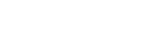 = 0.0557 m
m = 
mol estradiol = m x (kg solvent) = (0.0557 mol/kg)(5.00 x 10-4 kg) = 2.79 x 10⁻⁵ mol
molar mass =  =
271 g/mol; molecular mass = 271 amu
=
271 g/mol; molecular mass = 271 amu
Finally, determine the molecular formula:
Divide the molecular mass by the empirical formula mass.
 = 2;
molecular formula is C(2 x 9)H(2 x 12)O(2 x 1),
or C18H24O2
= 2;
molecular formula is C(2 x 9)H(2 x 12)O(2 x 1),
or C18H24O2
11.115 CCl3CO2H(aq) H+(aq) + CCl3CO2-(aq)
1.00 - x x x
T = Kf m; m = 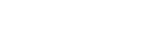 = 1.36 m
1.36 = 1.00 - x + x + x = 1 + x; x = 0.36
36% of the acid molecules are dissociated.
11.116 (a) H2SO4, 98.08
amu; 2.238 mol H2SO4 x 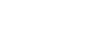 =
219.50 g H2SO4
=
219.50 g H2SO4
mass of 2.238 m solution = 219.50 g H2SO4 + 1000 g H2O = 1219.50 g
volume of 2.238 m solution =  1219.50 g x
  =
1084.68 mL = 1.0847 L
=
1084.68 mL = 1.0847 L
molarity of 2.238 m solution =  = 2.063 M
The molarity of the H2SO4 solution is less than the molarity of the BaCl2 solution. Because equal volumes of the two solutions are mixed, H2SO4 is the limiting reactant and the number of moles of H2SO4 determines the number of moles of BaSO4 produced as the white precipitate.
(0.05000 L) x (2.063 mol
H2SO4/L) x 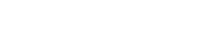 =
24.07 g BaSO4
=
24.07 g BaSO4
(b) More precipitate will form because of the excess BaCl2 in the solution.
11.117 KCl, 74.55amu; KNO3, 101.10 amu; Ba(NO3)2, 261.34 amu
= MRT; M = 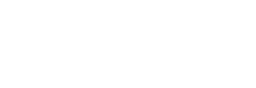 =
0.040 07 M
=
0.040 07 M
0.040 07 M =  ; mol
ions = (0.040 07 mol/L)(0.500 L) = 0.020 035 mol ions
; mol
ions = (0.040 07 mol/L)(0.500 L) = 0.020 035 mol ions
mass Cl = 1.000 g x 0.2092 = 0.2092 g Cl
mass KCl =  =
0.440 g KCl
=
0.440 g KCl
mol ions from KCl = 0.440 g KCl x  =
0.0118 mol ions
=
0.0118 mol ions
mol ions from KNO3 and Ba(NO3)2 = 0.020 035 - 0.0118 = 0.008 235 mol ions
Let x = mass KNO3 and y = mass Ba(NO3)2
x + y = 1.000 g - 0.440 g = 0.560 g
 =
0.008 235 mol ions
=
0.008 235 mol ions
x = 0.560 - y
0.0198x + 0.0115y = 0.008 235
0.0198(0.560 - y) + 0.0115y = 0.008 235
0.011 09 - 0.0198y + 0.0115y = 0.008 235
0.002 855 = 0.0083y; y =  =
0.3440; x = 0.560 - 0.3440 = 0.216
=
0.3440; x = 0.560 - 0.3440 = 0.216
mass % KCl =  =
44.0%
=
44.0%
mass % KNO3 =  =
21.6%
=
21.6%
mass % Ba(NO3)2 =  = 34.4%
11.118 Let x =  and y
=
and y
=  and assume ntotal = 1.00 mol
(14.5 mm Hg)x + (82.5 mm Hg)y = 39.4 mm Hg
(26.8 mm Hg)x + (140.3 mm Hg)y = 68.2 mm Hg
x = 
 +
82.5y = 39.4
+
82.5y = 39.4
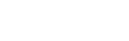 +
82.5y = 39.4
+
82.5y = 39.4
36.90 - 75.91y + 82.5y = 39.4; 6.59 = 2.5; y =
 = 0.3794
x =  =
0.5586
=
0.5586
XLiCl = 1 -  -
-
 = 1 - 0.5586 - 0.3794 = 0.0620
The mole fraction equals the number of moles of each component because
ntotal = 1.00 mol.
mass LiCl = 0.0620 mol LiCl x  = 2.6
g LiCl
= 2.6
g LiCl
mass H2O = 0.5588 mol H2O
x  = 10.1 g H2O
mass CH3OH = 0.3794 mol
CH3OH x 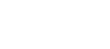 =
12.2 g CH3OH
=
12.2 g CH3OH
total mass = 2.6 g + 10.1 g + 12.2 g = 24.9 g
mass % LiCl =  =
10%
=
10%
mass % H2O =  =
41%
=
41%
mass % CH3OH = 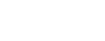 =
49%
=
49%
Multi-Concept Problems
11.119 (a) 382.6 mL = 0.3826 L; 20.0oC = 293.2 K
PV = nRT
 =
=  = 0.0158 mol H2
(b) M + x HCl x/2 H2 + MClx
moles HCl reacted = 0.0158 mol H2 x
 = 0.0316 mol HCl
moles Cl reacted = moles HCl reacted = 0.0316 mol Cl
mass Cl = 0.0316 mol Cl x  =
1.120 g Cl
=
1.120 g Cl
mass MClx = mass M + mass Cl = 1.385 g + 1.120 g = 2.505 g MClx
(c) Tf = Kf · m;
m = = 1.90 m
(d) 25.0 g = 0.0250 kg
1.90 m =  =
=

mol ions = (1.90 mol/kg)(0.0250 kg) = 0.0475 mol ions
(e) mol M = mol ions - mol Cl = 0.0475 mol - 0.0316 mol = 0.0159 mol M
 = 2,
the formula is MCl2.
= 2,
the formula is MCl2.
molar mass =  =
157.5 g/mol; molecular mass = 157.5 amu
=
157.5 g/mol; molecular mass = 157.5 amu
(f) atomic mass of M = 157.5 amu - 2(35.453 amu) = 86.6 amu; M = Sr
11.120 (a) 20.00 mL = 0.02000 L
mol NaOH = (0.02000 L)(2.00 mol/L) = 0.0400 mol NaOH
mol CO2 = 0.0400 mol NaOH x  = 0.0200 mol CO2
mol C = 0.0200 mol CO2 x  = 0.0200 mol C
mass C = 0.0200 mol C x  =
0.240 g C
=
0.240 g C
mass H = mass of compound - mass of C = 0.270 g - 0.240 g = 0.030 g H
mol H = 0.030 g H x  =
0.030 mol H
=
0.030 mol H
The mole ratio of C and H in the molecule is C0.0200 H0.030.
C0.0200 H0.030, divide both subscripts by the smaller of the two, 0.0200.
C0.0200 / 0.0200 H0.030 / 0.0200
C1H1.5, multiply both subscripts by 2.
C(2 x 1) H(2 x 1.5)
C2H3 (27.05 amu) is the empirical formula.
(b) Tf = Kf m;
m =  = 0.050 m
50.0 g = 0.0500 kg
mol solute = (0.050  )(0.0500 kg) = 0.0025 mol
molar mass =  = 108
g/mol; molecular mass = 108 amu
= 108
g/mol; molecular mass = 108 amu
(c) To find the molecular formula, first divide the molecular mass by the mass of the empirical formula unit.
 =
4
=
4
Multiply the subscripts in the empirical formula by the result of this division, 4.
C(4 x 2) H(4 x 3)
C8H12 is the molecular formula of the compound.