
Liquids, Solids, and Changes of State
10.1 µ = Q x
r = (1.60 x 10⁻¹⁹ C)(92 x 10-12 m)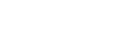 = 4.41
D
= 4.41
D
% ionic character for HF =  x 100%
= 41%
x 100%
= 41%
HF has more ionic character than HCl. HCl has only 17% ionic character.
10.2 (a) SF6 has polar covalent bonds but the molecule is symmetrical (octahedral). The individual bond polarities cancel, and the molecule has no dipole moment.
(b) H2C=CH2 can be assumed to have nonpolar C-H bonds. In addition, the molecule is symmetrical. The molecule has no dipole moment.
(c)  The C-Cl
bonds in CHCl3 are polar covalent bonds, and the molecule is
polar.
The C-Cl
bonds in CHCl3 are polar covalent bonds, and the molecule is
polar.
(d)  The C-Cl
bonds in CH2Cl2 are polar covalent bonds, and the molecule
is polar.
The C-Cl
bonds in CH2Cl2 are polar covalent bonds, and the molecule
is polar.
10.3 
10.4 (a) Of the four substances, only HNO3 has a net dipole moment.
(b) Only HNO3 can hydrogen bond.
(c) Ar has fewer electrons than Cl2 and CCl4, and has the smallest dispersion forces.
10.5 H2S dipole-dipole, dispersion
CH3OH hydrogen bonding, dipole-dipole, dispersion
C2H6 dispersion
Ar dispersion
Ar < C2H6 < H2S < CH3OH
10.6 (a) CO2(s) CO2(g), S is positive.
(b) H2O(g) H2O(l), S is negative.
(c) S is positive (more disorder).
10.7 G = H - TS; at the boiling point (phase change), G = 0.
H = TS; T = 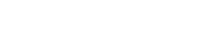 = 334
K
= 334
K
10.8 The boiling point is the temperature where the vapor pressure of a liquid equals the external pressure.
P1 = 760 mm Hg; P2 = 260 mm Hg; T1 = 80.1oC
Hvap = 30.8 kJ/mol
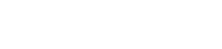

Solve for T2 (the boiling point for benzene at 260 mm Hg).


 =
0.003 121 K-1; T2 = 320 K = 47oC (boiling point
is lower at lower pressure)
=
0.003 121 K-1; T2 = 320 K = 47oC (boiling point
is lower at lower pressure)
10.9 Hvap = 
P1 = 400 mm Hg; T1 = 41.0 oC = 314.2 K
P2 = 760 mm Hg; T2 = 331.9 K
Hvap =  =
31,442 J/mol = 31.4 kJ/mol
=
31,442 J/mol = 31.4 kJ/mol
10.10 (a) 1/8 atom at 8 corners and 1 atom at body center = 2 atoms
(b) 1/8 atom at 8 corners and 1/2 atom at 6 faces = 4 atoms
10.11 For a simple cube, d = 2r; r =  = 167 pm
10.12 For a simple cube, there is one atom per unit cell.
mass of one Po atom = 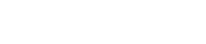 =
3.4706 x 10⁻²² g/atom
=
3.4706 x 10⁻²² g/atom
unit cell edge = d = 334 pm = 334 x 10-12 m = 3.34 x 10⁻⁸ cm
unit cell volume = d3 = (3.34 x 10⁻⁸ cm)3 = 3.7260 x 10⁻²³ cm3
density = 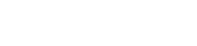 =
9.31 g/cm3
=
9.31 g/cm3
10.13 There are several possibilities. Here's one.
10.14 For CuCl:
1/8 Cl- at 8 corners and 1/2 Cl- at 6 faces = 4 Cl- (4 minuses)
4 Cu+ inside (4 pluses)
For BaCl2:
1/8 Ba2+ at 8 corners and 1/2 Ba2+ at 6 faces = 4 Ba2+ (8 pluses)
8 Cl- inside (8 minuses)
10.15 (a) In the unit cell there is a rhenium atom at each corner of the cube. The number of rhenium atoms in the unit cell = 1/8 Re at 8 corners = 1 Re atom.
In the unit cell there is an oxygen atom in the center of each edge of the cube. The number of oxygen atoms in the unit cell = 1/4 O on 12 edges = 3 O atoms.
(b) ReO3
(c) Each oxide has a -2 charge and there are three of them for a total charge of -6. The charge (oxidation state) of rhenium must be +6 to balance the negative charge of the oxides.
(d) Each oxygen atom is surrounded by two rhenium atoms. The geometry is linear.
(e) Each rhenium atom is surrounded bt six oxygen atoms. The geometry is octahedral.
10.16 The minimum pressure at which liquid CO2 can exist is its triple point pressure of
5.11 atm.
10.17 (a) CO2(s) CO2(g)
(b) CO2(l) CO2(g)
(c) CO2(g) CO2(l) supercritical CO2
10.18 (a)
(b) Gallium has two triple points. The one below 1 atm is a solid, liquid, vapor triple point. The one at 104 atm is a solid(1), solid(2), liquid triple point.
(c) Increasing the pressure favors the liquid phase, giving the solid/liquid boundary a negative slope. At 1 atm pressure the liquid phase is more dense than the solid phase.
10.19 The molecules in a liquid crystal can move around, as in viscous liquids, but they have a restricted range of motion, as in solids.
10.20 Liquid crystal molecules have a rigid rodlike shape with a length four to eight times greater than their diameter.
Understanding Key Concepts
10.21 (a) cubic closest-packed
(b) simple cubic
(c) hexagonal closest-packed
(d) body-centered cubic
10.22 (a) cubic closest-packed
(b) 1/8 S2- at 8 corners and 1/2 S2- at 6 faces = 4 S2-; 4 Zn2+ inside
10.23 (a) 1/8 Ca2+ at 8 corners = 1 Ca2+; 1/2 O2- at 6 faces = 3 O2-; 1 Ti4+ inside
The formula for perovskite is CaTiO3.
(b) The oxidation number of Ti is +4 to maintain charge neutrality in the unit cell.
10.24 (a) normal boiling point 300 K; normal melting point 180 K
(b) (i) solid (ii) gas (iii) supercritical fluid
10.25 
10.26 Here are two possibilities.
10.27 (a), (c), (d)
(b) There are three triple points.
(e) The solid phase that is stable at the higher pressure is more dense. The more dense phase is diamond.
Additional Problems
Dipole Moments and Intermolecular Forces
10.28 If a molecule has polar covalent bonds, the molecular shape (and location of lone pairs of electrons) determines whether a molecule has a dipole moment or not. The molecular shape will determine whether the bond dipoles cancel or not.
10.29 Dipole-dipole forces arise between molecules that have permanent dipole moments. London dispersion forces arise between molecules as a result of induced temporary dipoles.
10.30 (a) CHCl3 has a permanent dipole moment. Dipole-dipole intermolecular forces are important. London dispersion forces are also present.
(b) O2 has no dipole moment. London dispersion intermolecular forces are important.
(c) polyethylene, CnH2n+2. London dispersion intermolecular forces are important.
(d) CH3OH has a permanent dipole moment. Dipole-dipole intermolecular forces and hydrogen bonding are important. London dispersion forces are also present.
10.31 (a) Xe has no dipole-dipole forces
(b) HF has the largest hydrogen bond forces
(c) Xe has the largest dispersion forces
10.32 For CH3OH and CH4, dispersion forces are small. CH3OH can hydrogen bond; CH4 cannot. This accounts for the large difference in boiling points.
For 1-decanol and decane, dispersion forces are comparable and relatively large along the C-H chain. 1-decanol can hydrogen bond; decane cannot. This accounts for the 55oC higher boiling point for 1-decanol.
10.33 (a) C8H18 has the larger dispersion forces because of its longer hydrocarbon chain.
(b) HI has the larger dispersion forces because of the larger, more polarizable iodine.
(c) H2Se has the larger dispersion forces because of the more polarizable and less electronegative Se.
10.34 (a) (b)
(b)
(c) (d)
(d)
10.35 (a)  (b)
(b)
(c) (d)
(d)
10.36 

SO2 is bent and the individual bond dipole moments add to give the molecule a net dipole moment.
CO2 is linear and the individual bond dipole moments point in opposite directions to cancel each other out. CO2 has no net dipole moment.
10.37
In both PCl3 and PCl5 the P-Cl bond is polar covalent. PCl3 is trigonal pyramidal and the bond dipoles add to give the molecule a net dipole moment. PCl5 is trigonal bipyramidal and the bond dipoles cancel. PCl5 has no dipole moment.
10.38 
10.39 
Vapor Pressure and Changes of State
10.40 Hvap is usually larger than Hfusion because Hvap is the heat required to overcome all intermolecular forces.
10.41 Sublimation is the direct conversion of a solid to a gas. A solid can also be converted to a gas in two steps; melting followed by vaporization. The energy to convert a solid to a gas must be the same regardless of the path. Therefore Hsubl = Hfusion + Hvap.
10.42 (a) Hg(l) Hg(g)
(b) no change of state, Hg remains a liquid
(c) Hg(g) Hg(l) Hg(s)
10.43 (a) solid I2 melts to form liquid I2 (b) no change of state, I2 remains a liquid
10.44 As the pressure over the liquid H2O is lowered, H2O vapor is removed by the pump. As H2O vapor is removed, more of the liquid H2O is converted to H2O vapor. This conversion is an endothermic process and the temperature decreases. The combination of both a decrease in pressure and temperature takes the system across the liquid/solid boundary in the phase diagram so the H2O that remains turns to ice.
10.45 The normal boiling point for ether is relatively low (34.6oC). As the pressure is reduced by the pump, the relatively high vapor pressure of the ether equals the external pressure produced by the pump and the liquid boils.
10.46 H2O, 18.02 amu; 5.00 g
H2O x  = 0.2775 mol H2O
q1 = (0.2775 mol)[36.6 x 10⁻³ kJ/(K mol)](273 K - 263 K) = 0.1016 kJ
q2 = (0.2775 mol)(6.01 kJ/mol) = 1.668 kJ
q3 = (0.2775 mol)(75.3 x 10⁻³ kJ/(K mol)](303 K - 273 K) = 0.6269 kJ
qtotal = q1 + q2 + q3 = 2.40 kJ; 2.40 kJ of heat is required.
10.47 H2O, 18.02 amu; 15.3 g
H2O x  = 0.8491 mol H2O
q1 = (0.8491 mol)[33.6 x 10⁻³ kJ/(K mol)](373 K - 388 K) = -0.4279 kJ
q2 = -(0.8491 mol)(40.67 kJ/mol) = -34.53 kJ
q3 = (0.8491 mol)[75.3 x 10⁻³ kJ/(K mol)](348 K - 373 K) = -1.598 kJ
qtotal = q1 + q2 + q3 = -36.6 kJ; 36.6 kJ of heat is released.
10.48 H2O, 18.02 amu; 7.55 g
H2O x  = 0.4190 mol H2O
q1 = (0.4190 mol)[75.3 x 10⁻³ kJ/(K mol)](273.15 K - 306.65 K) = -1.057 kJ
q2 = -(0.4190 mol)(6.01 kJ/mol) = -2.518 kJ
q3 = (0.4190 mol)[36.6 x 10⁻³ kJ/(K mol)](263.15 K - 273.15 K) = -0.1534 kJ
qtotal = q1 + q2 + q3 = -3.73 kJ; 3.73 kJ of heat is released.
10.49 C2H5OH, 46.07 amu;
25.0 g C2H5OH x 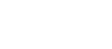 =
0.543 mol C2H5OH
=
0.543 mol C2H5OH
q1 = (0.543 mol)[65.7 x 10⁻³ kJ/(K mol)](351.55 K - 366.15 K) = -0.521 kJ
q2 = -(0.543 mol)(38.56 kJ/mol) = -20.94 kJ
q3 = (0.543 mol)[113 x 10-3 kJ/(K mol)](263.15 K - 351.55 K) = -5.42 kJ
qtotal = q1 + q2 + q3 = -26.9 kJ; 26.9 kJ of heat is released.
10.50 
10.51 
10.52 boiling point = 218oC = 491 K
G = Hvap - TSvap; At the boiling point (phase change), G = 0
Hvap = TSvap;
Svap = 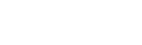 =
0.0882 kJ/(K mol) = 88.2 J/(K mol)
=
0.0882 kJ/(K mol) = 88.2 J/(K mol)
10.53 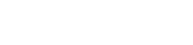 =
0.007 12 kJ/(K· mol) = 7.12 J/(K· mol)
=
0.007 12 kJ/(K· mol) = 7.12 J/(K· mol)
10.54 Hvap = 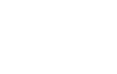
T1 = -5.1oC = 268.0 K; P1 = 100 mm Hg
T2 = 46.5oC = 319.6 K; P2 = 760 mm Hg
Hvap = 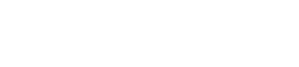 =
28.0 kJ/mol
=
28.0 kJ/mol
10.55 Hvap = 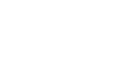
P1 = 100 mm Hg; T1 = 5.4oC = 278.6 K
P2 = 760 mm Hg; T2 = 56.8oC = 330.0 K
Hvap = 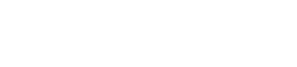 =
30.2 kJ/mol
=
30.2 kJ/mol
10.56 ln P2 = ln P1 + 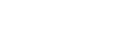
Hvap = 28.0 kJ/mol
P1 = 100 mm Hg; T1 = -5.1oC = 268.0 K; T2 = 20.0oC = 293.2 K
Solve for P2.
ln P2 = ln (100) + 
ln P2 = 5.6852; P2 = 294.5 mm Hg = 294 mm Hg
10.57 ln P2 = ln P1 + 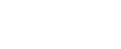
Hvap = 30.2 kJ/mol
P1 = 100 mm Hg; T1 = 5.4oC = 278.6 K; T2 = 30.0oC = 303.2 K
Solve for P2.
ln P2 = ln (100) + 
ln P2 = 5.6630; P2 = 288.0 mm Hg = 288 mm Hg
10.58 T(K) Pvap(mm Hg) ln Pvap 1/T
263 80.1 4.383 0.003 802
273 133.6 4.8949 0.003 663
283 213.3 5.3627 0.003 534
293 329.6 5.7979 0.003 413
303 495.4 6.2054 0.003 300
313 724.4 6.5853 0.003 195
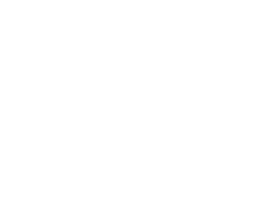
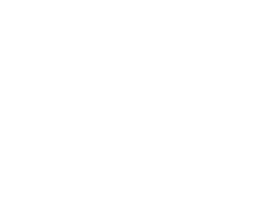
ln Pvap =  +
C
+
C
slope = - 3628 K = 
Hvap = (3628 K)(R)
Hvap = (3628 K)[8.3145 x10⁻³ kJ/(K mol)]
Hvap = 30.1 kJ/mol; C = 18.2
10.59 T(K) Pvap(mm Hg) ln Pvap 1/T
500 39.3 3.671 0.002 000
520 68.5 4.227 0.001 923
540 114.4 4.7397 0.001 852
560 191.6 5.2554 0.001 786
580 286.4 5.6574 0.001 724
600 432.3 6.0691 0.001 667


ln Pvap =  +
C
+
C
slope = -7219 K = 
Hvap = (7219 K)(R)
Hvap = (7219 K)[8.3145 x10⁻³ kJ/(K mol)]
Hvap = 60.0 kJ/mol; C = 18.1
10.60 Hvap = 30.1 kJ/mol
10.61 Hvap = 60.0 kJ/mol
10.62 Hvap = 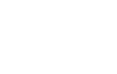
P1 = 80.1 mm Hg; T1 = 263 K
P2 = 724.4 mm Hg; T2 = 313 K
Hvap = 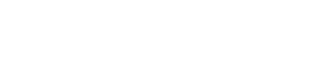 =
30.1 kJ/mol
=
30.1 kJ/mol
The calculated Hvap and that obtained from the plot in Problem 10.60 are the same.
10.63 Hvap = 
P1 = 39.3 mm Hg; T1 = 500 K
P2 = 432.3 mm Hg; T2 = 600 K
Hvap =  =
59.8 kJ/mol
=
59.8 kJ/mol
The calculated Hvap and that obtained from the plot in Problem 10.61 are consistent with each other. The value from the slope is 60.0 kJ/mol
Structures of Solids
10.64 molecular solid, CO2, I2
metallic solid, any metallic element
covalent network solid, diamond
ionic solid, NaCl
10.65 molecular solid, covalent molecules
metallic solid, metal atoms
covalent network solid, nonmetal atoms
ionic solid, cations and anions
10.66 The unit cell is the smallest repeating unit in a crystal.
10.67 From Table 10.10.
Hexagonal and cubic closest packing are the most efficient because 74% of the available space is used.
Simple cubic packing is the least efficient because only 52% of the available space is used.
10.68 Cu is face-centered cubic. d = 362 pm; r =
 = 128 pm
362 pm = 362 x 10-12 m = 3.62 x 10⁻⁸ cm
unit cell volume = (3.62 x 10⁻⁸ cm)3 = 4.74 x 10⁻²³ cm3
mass of one Cu atom = 63.55 g/mol x 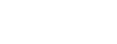 = 1.055 x 10⁻²² g/atom
Cu is face-centered cubic; there are therefore four Cu atoms in the unit cell.
unit cell mass = (4 atoms)(1.055 x 10⁻²² g/atom) = 4.22 x 10⁻²² g
density = 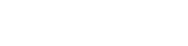 =
8.90 g/cm3
=
8.90 g/cm3
10.69 Pb is face-centered cubic. d = 495 pm = 4.95 x 10⁻⁸ cm
r = 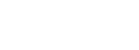 = 175
pm
= 175
pm
unit cell volume = (4.95 x 10⁻⁸ cm)3 = 1.2129 x 10⁻²² cm3
mass of one Pb atom = 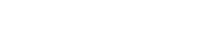 =
3.4407 x 10⁻²² g/atom
=
3.4407 x 10⁻²² g/atom
Pb is face-centered cubic; there are therefore four Pb atoms in the unit cell.
density =  =
11.3 g/cm3
=
11.3 g/cm3
10.70 mass of one Al atom = 26.98 g/mol x  = 4.480 x 10⁻²³ g/atom
Al is face-centered cubic; there are therefore four Al atoms in the unit cell.
unit cell mass = (4 atoms)(4.480 x 10⁻²³ g/atom) = 1.792 x 10⁻²² g
density = 
unit cell volume =  =
= 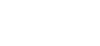 = 6.640 x 10⁻²³ cm3
unit cell edge = d = 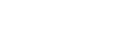 =
4.049 x 10⁻⁸ cm
=
4.049 x 10⁻⁸ cm
d = 4.049 x 10⁻⁸ cm x  =
4.049 x 10⁻¹⁰ m = 404.9 x 10⁻¹² m = 404.9 pm
=
4.049 x 10⁻¹⁰ m = 404.9 x 10⁻¹² m = 404.9 pm
10.71 W is body-centered cubic. d = 317 pm
a = edge = d; b = face diagonal; c = body diagonal
b2 = 2a2
c2 = a2 + b2
c2 = a2 + 2a2 = 3a2
c = 
unit cell body diagonal =  = 549
pm
= 549
pm
10.72 unit cell body diagonal = 4r = 549 pm
For W, r =  = 137
pm
= 137
pm
10.73 mass of one Na atom =  =
3.82 x 10⁻²³ g/atom
=
3.82 x 10⁻²³ g/atom
Because Na is body-centered cubic; there are two Na atoms in the unit cell.
unit cell mass = 2(3.82 x 10⁻²³ g) = 7.64 x 10⁻²³ g
unit cell volume = 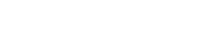 =
7.87 x 10⁻²³ cm3
=
7.87 x 10⁻²³ cm3
unit cell edge = d =  =
4.29 x 10⁻⁸ cm = 429 pm
=
4.29 x 10⁻⁸ cm = 429 pm
4R =  ; R =
; R =
 = 186 pm
10.74 mass of one Ti atom = 47.88 g/mol x  = 7.951 x 10⁻²³ g/atom
r = 144.8 pm = 144.8 x 10⁻¹² m
r = 144.8 x 10⁻¹² m x  =
1.448 x 10⁻⁸ cm
=
1.448 x 10⁻⁸ cm
Calculate the volume and then the density for Ti assuming it is primitive cubic, body-centered cubic, and face-centered cubic. Compare the calculated density with the actual density to identify the unit cell.
For primitive cubic:
d = 2r; volume = d3 = [2(1.448 x 10⁻⁸ cm)]3 = 2.429 x 10⁻²³ cm3
density = 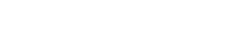 =
3.273 g/cm3
=
3.273 g/cm3
For face-centered cubic:
d = 2 r;
volume = d3 = [2
r;
volume = d3 = [2 (1.448
x 10-8 cm)]3 = 6.870 x 10⁻²³
cm3
(1.448
x 10-8 cm)]3 = 6.870 x 10⁻²³
cm3
density = 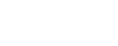 =
4.630 g/cm3
=
4.630 g/cm3
For body-centered cubic:
From Problems 10.71 and 10.72,
d =  ;
volume = d3 =
;
volume = d3 =  =
3.739 x 10⁻²³ cm3
=
3.739 x 10⁻²³ cm3
density = 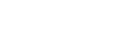 =
4.253 g/cm3
=
4.253 g/cm3
The calculated density for a face-centered cube (4.630 g/cm3) is closest to the actual density of 4.54 g/cm3. Ti crystallizes in the face-centered cubic unit cell.
10.75 mass of one Ca = 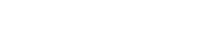 =
6.656 x 10⁻²³ g/atom
=
6.656 x 10⁻²³ g/atom
unit cell edge = d = 558.2 pm = 5.582 x 10⁻⁸ cm
unit cell volume = d3 = (5.582 x 10⁻⁸ cm)3 = 1.739 x 10⁻²² cm3
unit cell mass = (1.739 x 10⁻²² cm3)(1.55 g/cm3) = 2.695 x 10⁻²² g
(a) number of Ca atoms in unit cell = 
= 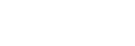 =
4.05 = 4 Ca atoms
=
4.05 = 4 Ca atoms
(b) Because the unit cell contains 4 Ca atoms, the unit cell is face-centered cubic.
10.76 Six Na+ ions touch each H- ion and six H- ions touch each Na+ ion.
10.77 For CsCl: (1/8 x 8 corners), so 1 Cl- and 1 minus per unit cell
1 Cs+ inside, so 1 plus per unit cell
10.78 Na+ H- Na+
488 pm unit cell edge = d = 488 pm; Na-H bond = d/2 = 244 pm
10.79 See Problem 10.71.
body diagonal =  =
=  = 714.12 pm
Cs-Cl bond = body diagonal/2 = (714.12 pm)/2 = 357.1 pm
Cs-Cl bond length =  +
+ 
357.1 pm =  +
+ 
357.1 pm =  + 181
pm
+ 181
pm
 =
357.1 pm - 181 pm = 176 pm
=
357.1 pm - 181 pm = 176 pm
Phase Diagrams
10.80 (a) gas (b) liquid (c) solid
10.81 (a) H2O(l) H2O(s)
(b) 380oC is above the critical temperature; therefore, the water cannot be liquefied. At the higher pressure, it will behave as a supercritical fluid.
10.82 
10.83 
10.84 (a) Br2(s) (b) Br2(l)
10.85 (a) O2(l) (b) O2 - supercritical fluid
10.86 Solid O2 does not melt when pressure is applied because the solid is denser than the liquid and the solid/liquid boundary in the phase diagram slopes to the right.
10.87 Ammonia can be liquefied at 25oC because this temperature is below Tc (132.5oC).
Methane cannot be liquefied at 25oC because this temperature is above Tc (-82.1oC).
Sulfur dioxide can be liquefied at 25oC because this temperature is below Tc (157.8oC).
10.88
The starting phase is benzene as a solid, and the final phase is benzene as a gas.
10.89 
The starting phase is a gas, and the final phase is a liquid.
10.90 solid liquid supercritical fluid liquid solid gas
10.91 gas solid liquid gas liquid
General Problems
10.92 Because chlorine is larger than fluorine, the charge separation is larger in CH3Cl compared to CH3F resulting in CH3Cl having a slightly larger dipole moment.
10.93 Because Ar crystallizes in a face-centered cubic unit cell, there are four Ar atoms in the unit cell.
mass of one Ar atom = 39.95 g/mol x 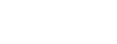 = 6.634 x 10⁻²³ g/atom
unit cell mass = 4 atoms x mass of one Ar atom
= 4 atoms x 6.634 x 10⁻²³ g/atom = 2.654 x 10⁻²² g
density = 
unit cell volume =  =
=
 = 1.635 x 10⁻²² cm3
unit cell edge = d = 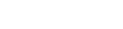 =
5.468 x 10⁻⁸ cm
=
5.468 x 10⁻⁸ cm
d = 5.468 x 10⁻⁸ cm x  =
5.468 x 10⁻¹⁰ m = 546.8 x 10⁻¹² m = 546.8 pm
=
5.468 x 10⁻¹⁰ m = 546.8 x 10⁻¹² m = 546.8 pm
r =  =
193.3 pm
=
193.3 pm
10.94 7.50 g x  =
0.037 39 mol Hg
=
0.037 39 mol Hg
q1 = (0.037 39 mol)[28.2 x 10⁻³ kJ/(K mol)](234.2 K - 223.2 K) = 0.011 60 kJ
q2 = (0.037 39 mol)(2.33 kJ/mol) = 0.087 12 kJ
q3 = (0.037 39 mol)[27.9 x 10⁻³ kJ/(K mol)](323.2 K - 234.2 K) = 0.092 84 kJ
qtotal = q1 + q2 + q3 = 0.192 kJ; 0.192 kJ of heat is required.
10.95 
10.96 ln P2 = ln P1 + 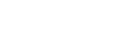
Hvap = 40.67 kJ/mol
At 1 atm, H2O boils at 100oC; therefore set
T1 = 100oC = 373 K, and P1 = 1.00 atm.
Let T2 = 95oC = 368 K, and solve for P2. (P2 is the atmospheric pressure in Denver.)
ln P2 = ln(1) + 
ln P2 = - 0.1782; P2 = 0.837 atm
10.97 
10.98 G = H - TS; at the melting point (phase change), G = 0.
H = TS; T =  =
923 K = 650oC
=
923 K = 650oC
10.99 melting point = -23.2oC = 250.0 K
G = Hfusion - TSfusion
At the melting point (phase change), G = 0
Hfusion = TSfusion
Sfusion =  =
0.0375 kJ/(K mol) = 37.5 J/(K mol)
=
0.0375 kJ/(K mol) = 37.5 J/(K mol)
10.100 Hvap = 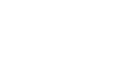
P1 = 40.0 mm Hg; T1 = -81.6oC =191.6 K
P2 = 400 mm Hg; T2 = -43.9oC = 229.2 K
Hvap =  =
22.36 kJ/mol
=
22.36 kJ/mol
Using Hvap = 22.36 kJ/mol
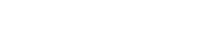


P1 = 40.0 mm Hg; T1 = 191.6 K
P2 = 760 mm Hg
Solve for T2 (the normal boiling point).

 =
0.004 124 33; T2 = 242.46 K = -30.7oC
=
0.004 124 33; T2 = 242.46 K = -30.7oC
10.101 (a) 
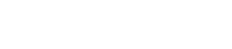

P1 = 100.0 mm Hg; T1 = -23oC = 250 K
P2 = 760.0 mm Hg
Solve for T2, the normal boiling point for CCl3F.

 =
0.003 319; T2 = 301.3 K = 28.1oC
=
0.003 319; T2 = 301.3 K = 28.1oC
(b) Svap =  =
0.082 21 kJ/(K mol) = 82.2 J/(K mol)
=
0.082 21 kJ/(K mol) = 82.2 J/(K mol)
10.102 Hvap = 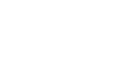
P1 = 100 mm Hg; T1 = -110.3oC = 162.85 K
P2 = 760 mm Hg; T2 = -88.5oC = 184.65 K
Hvap = 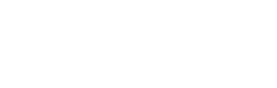 =
23.3 kJ/mol
=
23.3 kJ/mol
10.103 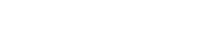
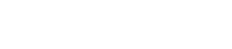

P1 = 760 mm Hg; T1 = 56.2oC = 329.4 K
P2 = 105 mm Hg Solve for T2.

 =
0.003 601; T2 = 277.7 K = 4.5oC
=
0.003 601; T2 = 277.7 K = 4.5oC
10.104 
Kr cannot be liquified at room temperature because room temperature is above Tc (-63oC).
10.105 (a) Kr(l) (b) supercritical Kr
10.106 For a body-centered cube
4r =  edge;
edge =
edge;
edge = 
volume of sphere = 
volume of unit cell =  =
=

volume of 2 spheres =  =
=

% volume occupied =  x
100% = 68%
x
100% = 68%
10.107 From Problem 10.71, 4r =  d; r =
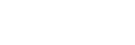 = 124 pm
10.108 unit cell edge = d = 287 pm = 287 x 10-12 m = 2.87 x 10⁻⁸ cm
unit cell volume = d3 = (2.87 x 10⁻⁸ cm)3 = 2.364 x 10⁻²³ cm3
unit cell mass = (2.364 x 10⁻²³ cm3)(7.86 g/cm3) = 1.858 x 10⁻²² g
Fe is body-centered cubic; therefore there are two Fe atoms per unit cell.
mass of one Fe atom =  =
9.290 x 10⁻²³ g/atom
=
9.290 x 10⁻²³ g/atom
Avogadro's number = 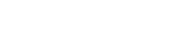 =
6.01 x 10²³ atoms/mol
=
6.01 x 10²³ atoms/mol
10.109 unit cell edge = d = 408 pm = 408 x 10-12 m = 4.08 x 10⁻⁸ cm
unit cell volume = (4.08 x 10⁻⁸ cm)3 = 6.792 x 10⁻²³ cm3
unit cell mass = (10.50 g/cm3)(6.792 x 10-23 cm3) = 7.132 x 10⁻²² g
Ag is face-centered cubic; therefore there are four Ag atoms in the unit cell.
mass of one Ag atom =  =
1.783 x 10⁻²² g/atom
=
1.783 x 10⁻²² g/atom
Avogadro's number =  =
6.05 x 10²³ atoms/mol
=
6.05 x 10²³ atoms/mol
10.110 (a) unit cell edge =  =
2(181 pm) + 2(97 pm) = 556 pm
=
2(181 pm) + 2(97 pm) = 556 pm
(b) unit cell edge = d = 556 pm = 556 x 10-12 m = 5.56 x 10⁻⁸ cm
unit cell volume = (5.56 x 10⁻⁸ cm)3 = 1.719 x 10⁻²² cm3
The unit cell contains 4 Na+ ions and 4 Cl- ions.
mass of one Na+ ion = 22.99 g/mol x
 = 3.818 x 10⁻²³ g/Na+
mass of one Cl- ion = 35.45 g/mol x
 = 5.887 x 10⁻²³ g/Cl-
unit cell mass = 4(3.818 x 10⁻²³ g) + 4(5.887 x 10⁻²³ g) = 3.882 x 10⁻²² g
density =  =
2.26 g/cm3
=
2.26 g/cm3
10.111 (a) (1/2 Nb/face)(6 faces) = 3 Nb; (1/4 O/edge)(12 edges) = 3 O
(b) NbO
(c) The oxidation state of Nb is +2.
Multi-Concept Problems
10.112 (a) Let the formula of magnetite be FexOy, then FexOy + y CO x Fe + y CO2

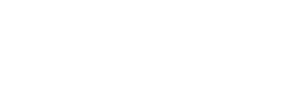 = 0.04590 mol CO2
0.04590 mol CO2 = mol of O in FexOy
mass of O in FexOy =
0.04590 mol O x  = 0.7345 g O
mass of Fe in FexOy = 2.660 g - 0.7345 g = 1.926 g Fe
(b) mol Fe in magnetite = 1.926 g Fe x  = 0.0345 mol Fe
formula of magnetite: Fe 0.0345 O 0.0459 (divide each subscript by the smaller)
Fe 0.0345 / 0.0345 O 0.0459 / 0.0345
FeO 1.33 (multiply both subscripts by 3)
Fe (1 x 3) O (1.33 x 3); Fe3O4
(c) unit cell edge = d = 839 pm = 839 x 10-12 m
d = 839 x 10-12 m x  =
8.39 x 10⁻⁸ cm
=
8.39 x 10⁻⁸ cm
unit cell volume = d3 = (8.39 x 10⁻⁸ cm)3 = 5.91 x 10⁻²² cm3
unit cell mass = (5.91 x 10⁻²² cm3)(5.20 g/cm3) = 3.07 x 10⁻²¹ g
mass of Fe in unit cell =  =
2.22 x 10⁻²¹ g Fe
=
2.22 x 10⁻²¹ g Fe
mass of O in unit cell =  = 8.47 x 10⁻²² g O
Fe atoms in unit cell =  = 24
Fe atoms
= 24
Fe atoms
O atoms in unit cell =  = 32 O
atoms
= 32 O
atoms
10.113 (a)  =
0.160 mol H2
=
0.160 mol H2
M = Group 3A metal; 2 M(s) + 6 H+(aq) 2 M3+(aq) + 3 H2(g)
nM = 0.160 mol H2 x  = 0.107 mol M
mass M = 1.07 cm3 x 2.70 g/cm3 = 2.89 g M
molar mass M =  =
27.0 g/mol; The Group 3A metal is Al
=
27.0 g/mol; The Group 3A metal is Al
(b) mass of one Al atom = 26.98 g/mol x 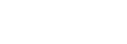 = 4.48 x 10⁻²³ g/atom
unit cell edge = d = 404 pm = 404 x 10-12 m
d = 404 x 10-12 m x  =
4.04 x 10⁻⁸ cm
=
4.04 x 10⁻⁸ cm
unit cell volume = d3 = (4.04 x 10⁻⁸ cm)3 = 6.59 x 10⁻²³ cm3
Calculate the density of Al assuming it is primitive cubic, body-centered cubic, and face-centered cubic. Compare the calculated density with the actual density to identify the unit cell.
For primitive cubic:
density =  =
0.680 g/cm3
=
0.680 g/cm3
For body-centered cubic:
density =  =
1.36 g/cm3
=
1.36 g/cm3
For face-centered cubic:
density =  =
2.72 g/cm3
=
2.72 g/cm3
The calculated density for a face-centered cube (2.72 g/cm3) is closest to the actual density of 2.70 g/cm3. Al crystallizes in the face-centered cubic unit cell.
(c)  =
143 pm
=
143 pm
10.114 (a) M = alkali metal; 500.0 mL = 0.5000 L; 802oC = 1075 K
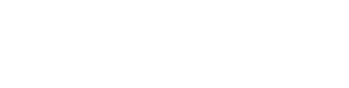 =
9.32 x 10⁻⁵ mol M
=
9.32 x 10⁻⁵ mol M
1.62 mm = 1.62 x 10⁻³ m; crystal volume = (1.62 x 10⁻³ m)3 = 4.25 x 10⁻⁹ m3
M atoms in crystal = (9.32 x 10⁻⁵ mol)(6.022 x 10²³ atoms/mol) = 5.61 x 10¹⁹ M atoms
Because M is body-centered cubic, only 68% (Table 10.10) of the total volume is occupied by M atoms.
volume of M atom =  =
5.15 x 10⁻²⁹ m3/M atom
=
5.15 x 10⁻²⁹ m3/M atom
volume of a sphere =  r3
r3
rM =  =
=
 = 2.31 x 10⁻¹⁰ m = 231 x 10-12 m = 231
pm
= 2.31 x 10⁻¹⁰ m = 231 x 10-12 m = 231
pm
(b) The radius of 231 pm is closest to that of K.
(c) 1.62 mm = 0.162 cm
density of solid = 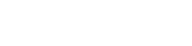 =
0.857 g/cm3
=
0.857 g/cm3
density of vapor =  =
7.29 x 10⁻⁶ g/cm3
=
7.29 x 10⁻⁶ g/cm3
10.115 (a)
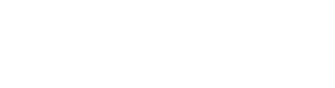 =
0.0203 mol X2
=
0.0203 mol X2
M(s) + 1/2 X2(g) MX(s)
mol M = 0.0203 mol X2 x  = 0.0406 mol M
molar mass M =  = 39.1
g/mol; atomic mass = 39.1 amu ; M = K
= 39.1
g/mol; atomic mass = 39.1 amu ; M = K
(b) From Figure 6.1, the radius for K+ is ~140 pm.
unit cell edge = 535 pm = 
 =
128 pm
=
128 pm
From Figure 6.2, X- = F-
(c) Because the cation and anion are of comparable size, the anions are not in contact with each other.
(d) unit cell contents: 1/8 F- at 8 corners and 1/2 F- at 6 faces = 4 F-
1/4 K+ at 12 edges and 1 K+ inside = 4 K+
mass of one K+ = 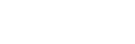 =
6.493 x 10⁻²³ g/K+
=
6.493 x 10⁻²³ g/K+
mass of one F- =  =
3.155 x 10⁻²³ g/F-
=
3.155 x 10⁻²³ g/F-
unit cell mass = (4 K+)(6.493 x 10⁻²³ g/K+) + (4 F-)(3.155 x 10⁻²³ g/F-) = 3.859 x 10⁻²² g
unit cell volume = [(535 x 10-12 m)(100 cm/m)]3 = 1.531 x 10⁻²² cm3
density =  =
2.52 g/cm3
=
2.52 g/cm3
(e) K(s) + 1/2 F2(g) KF(s) is a formation reaction.
Hof(KF) =  = -562
kJ/mol
= -562
kJ/mol