 = 1.93 x
10-2 psi
= 1.93 x
10-2 psiChapter 9
Gases: Their Properties and
Behavior
9.1 1.00 atm = 14.7 psi
1.00 mm Hg x = 1.93 x
10-2 psi
9.2 1.00 atmosphere pressure can support a column of Hg 0.760 m high. Because the density of H2O is 1.00 g/mL and that of Hg is 13.6 g/mL, 1.00 atmosphere pressure can support a column of H2O 13.6 times higher than that of Hg. The column of H2O supported by 1.00 atmosphere will be (0.760 m)(13.6) = 10.3 m.
9.3 The pressure in the flask is less than 0.975 atm because the liquid level is higher on the side connected to the flask. The 24.7 cm of Hg is the difference between the two pressures.
Pressure difference = 24.7 cm Hg x  =
0.325 atm
=
0.325 atm
Pressure in flask = 0.975 atm - 0.325 atm = 0.650 atm
9.4 The pressure in the flask is greater than
750 mm Hg because the liquid level is lower on the side connected to the
flask.
Pressure difference = 25 cm Hg x  = 250 mm
Hg
= 250 mm
Hg
Pressure in flask = 750 mm Hg + 250 mm Hg = 1000 mm Hg
9.5 (a) Assume an initial volume of 1.00
L.
First consider the volume change resulting from a change in the number of
moles with the pressure and temperature constant. ;
Vf =
;
Vf =  = 0.75 L
Now consider the volume change from 0.75 L as
a result of a change in temperature with the number of moles and the pressure
constant. ; Vf =
 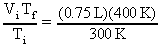 = 1.0
L
= 1.0
L
There is no net change in the volume as a result of the decrease in the
number of moles of gas and a temperature increase.

(b) Assume an initial volume of 1.00 L.
First
consider the volume change resulting from a change in the number of moles with
the pressure and temperature constant. ;
Vf =
;
Vf =  = 0.75 L
Now consider the volume change from 0.75 L as
a result of a change in temperature with the number of moles and the pressure
constant. ; Vf =
 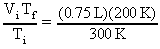 = 0.5
L
= 0.5
L
The volume would be cut in half as a result of the decrease in the number
of moles of gas and a temperature decrease.
9.6 n =  = 4.461 x
103 mol CH4
= 4.461 x
103 mol CH4
CH4, 16.04 amu; mass
CH4 = (4.461 x 10³ mol) = 7.155 x
104 g CH4
= 7.155 x
104 g CH4
9.7 C3H8, 44.10 amu; V
= 350 mL = 0.350 L; T = 20oC = 293 K
n = 3.2 g x  = 0.073
mol C3H8
= 0.073
mol C3H8
P =  =
= 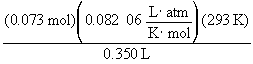 = 5.0 atm
9.8 P = 1.51 x 10⁴ kPa x  = 149 atm;
T = 25.0oC = 298 K
= 149 atm;
T = 25.0oC = 298 K
n = 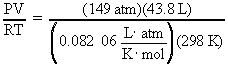 = 267 mol
He
= 267 mol
He
9.9 The volume and number of moles of gas remain
constant.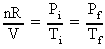 ; Tf =
 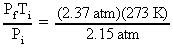 = 301 K =
28oC
= 301 K =
28oC
9.10 CaCO3(s) + 2 HCl(aq)
CaCl2(aq) + CO2(g) +
H2O(l)
CaCO3, 100.1 amu; CO2, 44.01
amu
mole CO2 = 33.7 g CaCO3 x 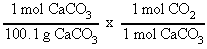 = 0.337
mol CO2
= 0.337
mol CO2
mass CO2 = 0.337 mol CO2 x  = 14.8 g CO2
V = 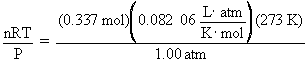 = 7.55
L
= 7.55
L
9.11 C3H8(g) + 5
O2(g) 3 CO2(g) + 4
H2O(l)
npropane = 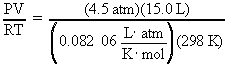 = 2.76
mol C3H8
= 2.76
mol C3H8
2.76 mol C3H8 x  = 8.28 mol CO2
V =  = 186 L =
190 L
= 186 L =
190 L
9.12 n =  = 0.0446
mol
= 0.0446
mol
molar mass =  = 34.1
g/mol; molecular mass = 34.1 amu
= 34.1
g/mol; molecular mass = 34.1 amu
Na2S(aq) + 2 HCl(aq) ® H2S(g) + 2
NaCl(aq)
The foul-smelling gas is H2S, hydrogen sulfide.
9.13
12.45 g H2 x  = 6.176
mol H2
= 6.176
mol H2
60.67 g N2 x  = 2.166
mol N2
= 2.166
mol N2
2.38 g NH3 x  = 0.140
mol NH3
= 0.140
mol NH3
ntotal =  = 6.176
mol + 2.166 mol + 0.140 mol = 8.482 mol
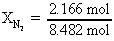
= 6.176
mol + 2.166 mol + 0.140 mol = 8.482 mol = 0.7281;
 = 0.2554;
 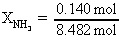 =
0.0165
=
0.0165
9.14 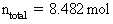 (from
Problem 9.13). T = 90oC = 363 K
(from
Problem 9.13). T = 90oC = 363 K = 25.27
atm
= 25.27
atm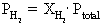 = (0.7281)(25.27 atm) = 18.4 atm
 =
(0.2554)(25.27 atm) = 6.45 atm
=
(0.2554)(25.27 atm) = 6.45 atm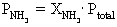 =
(0.0165)(25.27 atm) = 0.417 atm
=
(0.0165)(25.27 atm) = 0.417 atm
9.15  PTotal = (0.0287)(0.977 atm) = 0.0280 atm
9.16 The number of
moles of each gas is proportional to the number of each of the different gas
molecules in the container
ntotal = nred +
nyellow + ngreen = 6 + 2 + 4 = 12
Xred =
 = 0.500; Xyellow =
  = 0.167;
Xgreen =
= 0.167;
Xgreen =  =
0.333
=
0.333
Pred = Xred Ptotal = (0.500)(600 mm
Hg) = 300 mm Hg
Pyellow = Xyellow Ptotal =
(0.167)(600 mm Hg) = 100 mm Hg
Pgreen = Xgreen
Ptotal = (0.333)(600 mm Hg) = 200 mm Hg
9.17  , M =
molar mass, R = 8.314 J/(K mol), 1 J = 1 kg m2/s2
, M =
molar mass, R = 8.314 J/(K mol), 1 J = 1 kg m2/s2
at
37oC = 310 K, 
at -25oC = 248
K, 
9.18 (a)  ;
;  = 1.62
O2 diffuses 1.62 times faster than Kr.
(b)  ;
;  = 1.04
C2H2 diffuses 1.04 times faster than
N2.
9.19 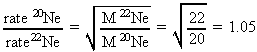 ;
; 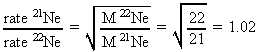
Thus, the relative rates of
diffusion are  .
.
9.20 P = 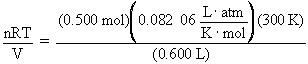 = 20.5
atm
= 20.5
atm
P =  = 20.3
atm
= 20.3
atm
9.21 The amount of ozone is assumed to be
constant.
Therefore nR = 
Because V h, then  where h is the thickness of the O3 layer.
hf =  = 3.8 x 10⁻⁵ m
(Actually, V = 4r2h, where r = the
radius of the earth. When you go out 30 km to get to the ozone layer, the change
in r2 is less than 1%. Therefore you can neglect the change in
r2 and assume that V is proportional to h.)
9.22 For ether, the MAC =  x 100% =
2.0%
x 100% =
2.0%
9.23 (a) Let X = partial pressure of
chloroform.
MAC =  x 100% =
0.77%
x 100% =
0.77%
Solve for X. X = 760 mm Hg x  = 5.9 mm
Hg
= 5.9 mm
Hg
(b) CHCl3, 119.4 amu
PV = nRT; n =
 = 0.00347 mol CHCl3
mass CHCl3 = 0.00347
mol CHCl3 x  = 0.41 g
CHCl3
= 0.41 g
CHCl3
Understanding Key Concepts
9.24 (a)  The volume of a gas
is proportional to the kelvin temperature at constant pressure. As the
temperature increases from 300 K to 450 K, the volume will increase by a factor
of 1.5.
The volume of a gas
is proportional to the kelvin temperature at constant pressure. As the
temperature increases from 300 K to 450 K, the volume will increase by a factor
of 1.5.
(b)  The volume of a gas
is inversely proportional to pressure at constant temperature. As the pressure
increases from 1 atm to 2 atm, the volume will decrease by a factor of
2.
The volume of a gas
is inversely proportional to pressure at constant temperature. As the pressure
increases from 1 atm to 2 atm, the volume will decrease by a factor of
2.
(c)  PV = nRT; The
amount of gas (n) is constant.
PV = nRT; The
amount of gas (n) is constant.
Therefore nR =  .
.
Assume Vi = 1 L and solve for Vf.

There is no change in volume.
9.25 If the sample remains a gas at 150 K, then drawing (c) represents the gas at this temperature. The gas molecules still fill the container.
9.26 The two gases should mix randomly and homogeneously and this is best represented by drawing (c).
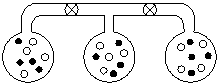
9.27 The two gases will be equally distributed among the three flasks.
9.28 The gas pressure in the bulb in mm Hg is equal to the difference in the height of the Hg in the two arms of the manometer.
9.29 A
When stopcock A is opened, the pressure in the flask will equal the external pressure, and the level of mercury will be the same in both arms of the manometer.
9.30 (a) Because there are more yellow gas
molecules than there are blue, the yellow gas molecules have the higher average
speed.
(b) Each rate is proportional to the number of effused gas molecules
of each type.
Myellow = 25 amu
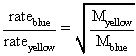 ;
;  ;
;
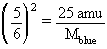
Mblue =  = 36
amu
= 36
amu
9.31 (a) The temperature has increased by about 10% (from 300 K to 325 K) while the amount and the pressure are unchanged. Thus, the volume should increase by about 10%.
(b) The temperature has increased by a factor of 1.5 (from 300 K to 450 K) and the pressure has increased by a factor of 3 (from 0.9 atm to 2.7 atm) while the amount is unchanged. Thus, the volume should decrease by half (1.5/3 = 0.5).
(c) Both the amount and the
pressure have increased by a factor of 3 (from 0.075 mol to 0.22 mol and from
0.9 atm to 2.7 atm) while the temperature is unchanged. Thus, the volume is
unchanged.
Additional
Problems
Gases and Gas Pressure
9.32 Temperature is a measure of the average kinetic energy of gas particles.
9.33 Gases are much more compressible than
solids or liquids because there is a large amount of empty space between
individual gas molecules.
9.34 P = 480 mm Hg x  = 0.632
atm
= 0.632
atm
P = 480 mm Hg x  = 6.40 x
104 Pa
= 6.40 x
104 Pa
9.35 P = 352 torr x  = 46.9
kPa
= 46.9
kPa
P = 0.255 atm x  = 194 mm
Hg
= 194 mm
Hg
P = 0.0382 mm Hg x  = 5.09
Pa
= 5.09
Pa
9.36 Pflask > 754.3 mm Hg; Pflask = 754.3 mm Hg + 176 mm Hg = 930 mm Hg
9.37 Pflask < 1.021 atm (see Figure 9.4)
Pdifference = 28.3 cm Hg x  = 0.372 atm
Pflask = 1.021 atm - Pdifference = 1.021 atm - 0.372 atm = 0.649 atm
9.38 Pflask > 752.3 mm Hg (see Figure 9.4)
If the pressure in the flask can support a column of ethyl alcohol (d = 0.7893 g/mL) 55.1 cm high, then it can only support a column of Hg that is much shorter because of the higher density of Hg.
55.1 cm x  = 3.21 cm
Hg = 32.1 mm Hg
= 3.21 cm
Hg = 32.1 mm Hg
Pflask = 752.3 mm Hg + 32.1 mm Hg = 784.4 mm Hg
Pflask = 784.4 mm Hg x  = 1.046 x
105 Pa
= 1.046 x
105 Pa
9.39 Compute the height of a column of
CHCl3 that 1.00 atm can support.
760 mm Hg x  = 6941 mm
CHCl3; therefore 1.00 atm = 6941 mm CHCl3
= 6941 mm
CHCl3; therefore 1.00 atm = 6941 mm CHCl3
The pressure
in the flask is less than atmospheric pressure.
Patm -
Pflask = 0.849 atm - 0.788 atm = 0.061 atm
0.061 atm x  = 423 mm CHCl3
The chloroform will be 423 mm higher in the
manometer arm connected to the flask.
9.40
| Gas | % by Volume |
| N2 | 78.08 |
| O2 | 20.95 |
| Ar | 0.93 |
| CO2 | 0.037 |
The % volume for a particular gas is
proportional to the number of molecules of that gas in a mixture of
gases.
Average molecular mass of air
= (0.7808)(mol. mass N2) +
(0.2095)(mol. mass O2)
+ (0.0093)(at. mass Ar) + (0.000 37)(mol.
mass CO2)
= (0.7808)(28.01 amu) + (0.2095)(32.00 amu)
+
(0.0093)(39.95 amu) + (0.000 37)(44.01 amu) = 28.96 amu
9.41 The % volume for a particular gas is
proportional to the number of molecules of that gas in a mixture of
gases.
Average molecular mass of a diving-gas = (0.020)(mol. mass
O2) + (0.980)(at. mass He)
= (0.020)(32.00 amu) + (0.980)(4.00
amu) = 4.56 amu
The Gas Laws
9.42 (a) 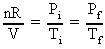 ;
;  = Pf
= Pf
Let Pi = 1 atm, Ti = 100 K, Tf = 300 K
Pf =  = 3
atm
= 3
atm
The pressure would triple.
(b)  ;
;  = Pf
= Pf
Let Pi = 1 atm, ni = 3 mol,
nf = 1 mol
Pf = 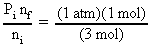 =
=  atm
atm
The pressure would be 1/3 the initial pressure.
(c) nRT = PiVi =
PfVf;  =
Pf
=
Pf
Let Pi = 1 atm, Vi = 1 L, Vf =
1 - 0.45 L = 0.55 L
Pf = 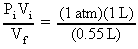 = 1.8
atm
= 1.8
atm
The pressure would increase by 1.8 times.
(d) nR =  ;
;  = Pf
= Pf
Let Pi = 1 atm, Vi = 1 L, Ti
= 200 K, Vf = 3 L, Ti = 100 K
Pf = 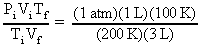 = 0.17 atm
The pressure would be 0.17 times the initial pressure.
9.43 (a) 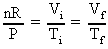 ;
; 
Let Vi = 1 L,
Ti = 400 K, Tf = 200 K = 0.5
L
= 0.5
L
The volume would be halved.
(b) 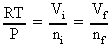 ;
; 
Let Vi = 1 L,
ni = 4 mol, nf = 5 mol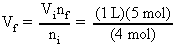 = 1.25
L
= 1.25
L
The volume would increase by 1/4.
(c) nRT = Pi Vi =
Pf Vf; 
Let Vi = 1 L,
Pi = 4 atm, Pf = 1 atm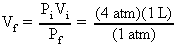 = 4
L
= 4
L
The volume would increase by a factor of 4.
(d) 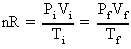 ;
; 
Let Vi = 1 L,
Ti = 200 K, Tf = 400 K, Pi = 1 atm,
Pf = 2atm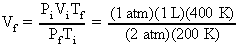 = 1
L
= 1
L
There is no volume change.
9.44 They all contain the same number of gas molecules.
9.45 For air, T = 50oC = 323 K.
n
= 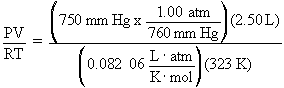 = 0.0931 mol air
For CO2, T = -10oC = 263
K
n = 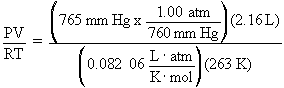 = 0.101 mol CO2
Because the number of
moles of CO2 is larger than the number of moles of air, the
CO2 sample contains more molecules.
9.46 n and T are constant; therefore nRT = 
Vf =  = 7210 L
n and P are constant; therefore 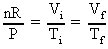
Vf =  = 51.5 L
9.47 Ti = 20oC = 293 K; nR
= 
Vf =  = 1.0 x 10³ L
9.48 15.0 g CO2 x  = 0.341
mol CO2
= 0.341
mol CO2
P = 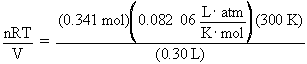 = 27.98
atm
= 27.98
atm
27.98 atm x  = 2.1 x
104 mm Hg
= 2.1 x
104 mm Hg
9.49 20.0 g N2 x  = 0.714 mol N2
T =  = 41
K
= 41
K
9.50  = 1.7 x 10⁻²¹ mol H/L
P =  = 1.4 x
10-20 atm
= 1.4 x
10-20 atm
P = 1.4 x 10⁻²⁰ atm x  = 1 x
10-17 mm Hg
= 1 x
10-17 mm Hg
9.51 CH4, 16.04 amu; 5.54 kg = 5.54 x
103 g; T = 20oC = 293 K
P =  = 189.6
atm
= 189.6
atm
P = 189.6 atm x  = 1.92 x
104 kPa
= 1.92 x
104 kPa
9.52 n = 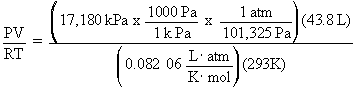 = 308.9
mol
= 308.9
mol
mass Ar = 308.9 mol x  = 12340 g
= 1.23 x 10⁴ g
= 12340 g
= 1.23 x 10⁴ g
9.53 P = 13,800 kPa x 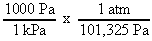 = 136.2
atm
= 136.2
atm
n and T are constant; therefore nRT = PiVi =
PfVf
Vf = 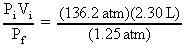 = 250.6
L
= 250.6
L
250.6 L x  = 167 balloons
Gas
Stoichiometry
9.54 For steam, T = 123.0oC = 396
K
n = 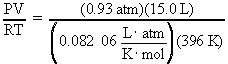 = 0.43 mol steam
For ice, H2O, 18.02 amu;
n = 10.5 g x  = 0.583 mol ice
Because the number of moles of ice is
larger than the number of moles of steam, the ice contains more H2O
molecules.
9.55 T = 85.0oC = 358
K
nAr =  = 0.156
mol Ar
= 0.156
mol Ar
Cl2, 70.91 amu;  = 0.156
mol Cl2
= 0.156
mol Cl2
There are equal numbers of Ar atoms and Cl2
molecules in their respective samples.
9.56 The containers are identical. Both containers contain the same number of gas molecules. Weigh the containers. Because the molecular mass for O2 is greater than the molecular mass for H2, the heavier container contains O2.
9.57 Assuming that you can see through the flask, Cl2 gas is greenish and He is colorless.
9.58 room volume = 4.0 m x 5.0 m x 2.5 m = 50
m3
room volume = 50 m3 x  = 5.0 x
104 L
= 5.0 x
104 L
ntotal = 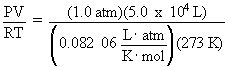 = 2.23 x
103 mol
= 2.23 x
103 mol =
(0.2095)ntotal = (0.2095)(2.23 x 10³ mol) = 467 mol
O2
=
(0.2095)ntotal = (0.2095)(2.23 x 10³ mol) = 467 mol
O2
mass O2 = 467 mol x  = 1.5 x
104 g O2
= 1.5 x
104 g O2
9.59 0.25 g O2 x  = 7.8 x
10-3 mol O2
= 7.8 x
10-3 mol O2
V =  = 0.198
L = 0.200 L = 200 mL O2
= 0.198
L = 0.200 L = 200 mL O2
9.60 (a) CH4, 16.04 amu;
d =  = 0.716 g/L
(b) CO2, 44.01 amu; d =  = 1.96
g/L
= 1.96
g/L
(c) O2, 32.00 amu; d =  = 1.43
g/L
= 1.43
g/L
(d) UF6, 352.0 amu; d =  = 15.7
g/L
= 15.7
g/L
9.61 Average molar mass = (0.270)(molar mass
F2) + (0.730)(molar mass He)
= (0.270)(38.00 g/mol) +
(0.730)(4.003 g/mol) = 13.18 g/mol
Assume 1.00 mole of the gas mixture. T =
27.5oC = 300.6 K
V = 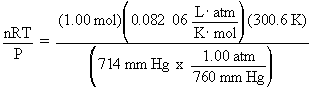 = 26.3
L
= 26.3
L
d =  = 0.501 g/L
9.62 n = 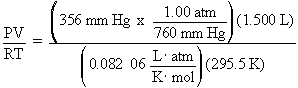 = 0.0290
mol
= 0.0290
mol
molar mass =  = 34.0
g/mol; molecular mass = 34.0 amu
= 34.0
g/mol; molecular mass = 34.0 amu
9.63 (a) Assume 1.000 L gas sample
n =  = 0.0446 mol
molar mass =  = 30.1
g/mol; molecular mass = 30.1 amu
= 30.1
g/mol; molecular mass = 30.1 amu
(b) Assume 1.000 L gas sample
n = 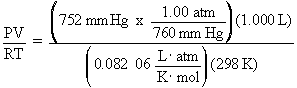 = 0.0405 mol
molar mass =  = 26.0
g/mol; molecular mass = 26.0 amu
= 26.0
g/mol; molecular mass = 26.0 amu
9.64 2 HgO(s) ® 2 Hg(l) + O2(g);
HgO, 216.59 amu
10.57 g HgO x  = 0.024
40 mol O2
= 0.024
40 mol O2
V =  = 0.5469
L
= 0.5469
L
9.65 2 HgO(s) ® 2 Hg(l) +
O2(g); HgO, 216.59 amu
mass HgO = 0.0155 mol O2 x 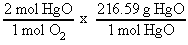 = 6.71 g HgO
9.66 Zn(s) + 2 HCl(aq) ® ZnCl2(aq) +
H2(g)
(a) 25.5 g Zn x  = 0.390
mol H2
= 0.390
mol H2
V =  = 9.44
L
= 9.44
L
(b) n = 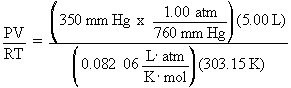 = 0.092
56 mol H2
= 0.092
56 mol H2
0.092 56 mol H2 x  = 6.05 g
Zn
= 6.05 g
Zn
9.67 2
NH4NO3(s) ® 2 N2(g) + 4 H2O(g) +
O2(g); NH4NO3, 80.04 amu
Total moles of gas
= 450 g NH4NO3 x  = 19.68
mol
= 19.68
mol
T = 450oC = 723 K
V =  = 1.17 x
103 L
= 1.17 x
103 L
9.68 (a) V24h = (4.50 L/min)(60
min/h)(24 h/day) = 6480 L =
(0.034)V24h = (0.034)(6480 L) = 220 L
=
(0.034)V24h = (0.034)(6480 L) = 220 L
n = 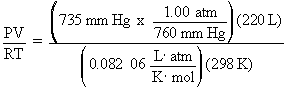 = 8.70
mol CO2
= 8.70
mol CO2
8.70 mol CO2 x  = 383 g =
380 g CO2
= 383 g =
380 g CO2
(b) 2 Na2O2(s) + 2
CO2(g) ®
2 Na2CO3(s) + O2(g);
Na2O2, 77.98 amu
3.65 kg = 3650 g
3650 g
Na2O2 x  = 5.4
days
= 5.4
days
9.69 2 TiCl4(g) +
H2(g) ® 2 TiCl3(s) + 2 HCl(g); TiCl, 189.69
amu
(a) T = 435oC = 708 K = 2.79
mol H2
= 2.79
mol H2
2.79 mol H2 x  = 1058 g
= 1060 g TiCl4
= 1058 g
= 1060 g TiCl4
(b) nHCl = 2.79 mol H2 x
 = 5.58 mol HCl
V = 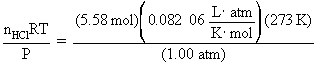 = 125 L
HCl
= 125 L
HCl
Dalton's Law and Mole Fraction
9.70 Because of Avogadro's Law (V µ n), the % volumes are also %
moles.
| Gas | % mole |
| N2 | 78.08 |
| O2 | 20.95 |
| Ar | 0.93 |
| CO2 | 0.037 |
In decimal form, % mole = mole fraction. = (0.7808)(1.000 atm) = 0.7808 atm
 =
(0.2095)(1.000 atm) = 0.2095 atm
=
(0.2095)(1.000 atm) = 0.2095 atm =
(0.0093)(1.000 atm) = 0.0093 atm
=
(0.0093)(1.000 atm) = 0.0093 atm  = (0.000
37)(1.000 atm) = 0.000 37 atm
= (0.000
37)(1.000 atm) = 0.000 37 atm
Pressures of the rest are
negligible.
9.71 

 =
(0.94)(1.48 atm) = 1.4 atm
=
(0.94)(1.48 atm) = 1.4 atm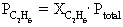 =
(0.040)(1.48 atm) = 0.059 atm
=
(0.040)(1.48 atm) = 0.059 atm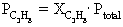 =
(0.015)(1.48 atm) = 0.022 atm
=
(0.015)(1.48 atm) = 0.022 atm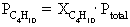 =
(0.0050)(1.48 atm) = 0.0074 atm
=
(0.0050)(1.48 atm) = 0.0074 atm
9.72 Assume a 100.0 g sample. g
CO2 = 1.00 g and g O2 = 99.0 g
mol CO2 =
1.00 g CO2 x  = 0.0227
mol CO2
= 0.0227
mol CO2
mol O2 = 99.0 g O2 x  = 3.094
mol O2
= 3.094
mol O2
ntotal = 3.094 mol + 0.0227 mol = 3.117
mol = 0.993
 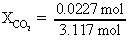 = 0.007
28
= 0.007
28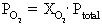 = (0.993)(0.977 atm) = 0.970 atm
 = (0.007
28)(0.977 atm) = 0.007 11 atm
= (0.007
28)(0.977 atm) = 0.007 11 atm
9.73 From Problem 9.74: XHCI = 0.026,

PHCI =
XHCl Ptotal = (0.026)(13,800 kPa) = 3.6 x 10²
kPa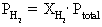 = (0.094)(13,800 kPa) = 1.3 x 10³ kPa
PNe
= XNe Ptotal = (0.88)(13,800) kPa) = 1.2 x 10⁴
kPa
9.74 Assume a 100.0 g
sample.
g HCl = (0.0500)(100.0 g) = 5.00 g; 5.00 g HCl x  = 0.137
mol HCl
= 0.137
mol HCl
g H2 = (0.0100)(100.0 g) = 1.00 g; 1.00 g H2 x
 = 0.496 mol H2
g Ne = (0.94)(100.0 g) = 94 g; 94 g
Ne x  = 4.66 mol Ne
ntotal = 0.137 + 0.496 + 4.66 = 5.3
mol = 0.026
  = 0.094
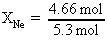 = 0.88
9.75 Assume a 1.000 L gas sample.
n = 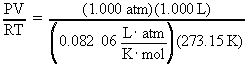 = 0.044 61 mol
average molar mass =  = 31.67
g/mol
= 31.67
g/mol
31.67 = 
Solve for x: x =
0.3064, 1 - x = 0.6936
The mixture contains 30.64% Ar and 69.36%
N2.
Assume 100 moles of gas.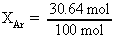 = 0.3064
 = 0.6936
9.76 Ptotal =  ;
; 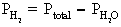 = 747 mm Hg - 23.8 mm Hg = 723 mm Hg
n = 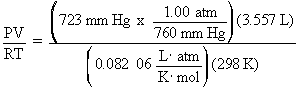 = 0.1384
mol H2
= 0.1384
mol H2
0.1384 mol H2 x 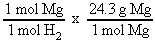 = 3.36 g
Mg
= 3.36 g
Mg
9.77 Ptotal =  = 755 mm
Hg
= 755 mm
Hg = 755 mm Hg - 28.7 mm Hg = 726.3 mm Hg
(a)  =
0.962
=
0.962
(b) NaCl, 58.44 amu
0.0232 mol Cl2
x  = 2.71 g NaCl
Kinetic-Molecular Theory and Graham's Law
9.78 The kinetic-molecular theory is based on
the following assumptions:
1. A gas consists of tiny particles, either atoms
or molecules, moving about at random.
2. The volume of the particles
themselves is negligible compared with the total volume of the gas; most of the
volume of a gas is empty space.
3. The gas particles act independently; there
are no attractive or repulsive forces between particles.
4. Collisions of
the gas particles, either with other particles or with the walls of the
container, are elastic; that is, the total kinetic energy of the gas particles
is constant at constant T.
5. The average kinetic energy of the gas particles
is proportional to the Kelvin temperature of the sample.
9.79 Diffusion -- The mixing of different gases
by random molecular motion and with frequent collisions.
Effusion -- The
process in which gas molecules escape through a tiny hole in a membrane without
collisions.
9.80 Heat is the energy transferred from one
object to another as the result of a temperature difference between
them.
Temperature is a measure of the kinetic energy of molecular
motion.
9.81 The atomic mass of He is much less than the molecular mass of the major components of air (N2 and O2). The rate of effusion of He through the balloon skin is much faster.
9.82  = 443
m/s
= 443
m/s
9.83 For Br2:  = 214 m/s
For Xe: u = 
Square both sides of the
equation and solve for T.
45796 m2/s2 = 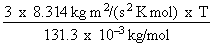
T = 241 K =
-32oC
9.84 For H2,  = 1360 m/s
For He,  = 2010
m/s
= 2010
m/s
He at 375oC has the higher average speed.
9.85 UF6, 352.02 amu; T =
25oC = 298 K = 145
m/s
= 145
m/s
Ferrari:
145  = 64.8
m/s
= 64.8
m/s
The UF6 molecule has the higher average speed.
9.86 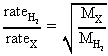 ;
;  ;
; 
MX =
 = 17.2 g/mol; molecular mass = 17.2 amu
9.87  ;
;  ;
;  ;
; 
MZ = 37.9 g/mol;
molecular mass = 37.9 amu; The gas could be F2.
9.88 HCl, 36.5 amu; F2, 38.0 amu; Ar,
39.9 amu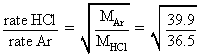 = 1.05
 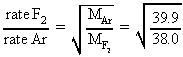 =
1.02
=
1.02
The relative rates of diffusion are HCl(1.05) > F2(1.02)
> Ar(1.00).
9.89 Because CO and N2 have the same mass, they will have the same diffusion rates.
9.90 u = 
Square both sides of the
equation and solve for T.
T = 0.325 K =
-272.83oC (near absolute zero)
9.91 230 km/h x 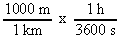 = 63.9
m/s
= 63.9
m/s
u = 63.9 m/s = 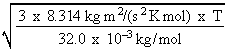
Square both sides of the
equation and solve for T.
4083 m2/s2 = 
T = 5.24 K =
-268oC
General Problems
9.92  =
1.03
=
1.03 = 1.01
The relative rates of diffusion are  .
.
9.93 Average molecular mass of air
= 28.96 amu; CO2, 44.01 amu
P = 760 mm Hg x  = 1155 mm
Hg
= 1155 mm
Hg
9.94  = 1.1
L
= 1.1
L
9.95 1 atm = 1033.228
g/cm2
column height = (1033.228 g/cm2)(1
cm3/0.89g) = 1200 cm = 12 m
9.96 n = 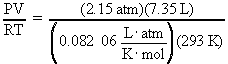 = 0.657
mol Ar
= 0.657
mol Ar
0.657 mol Ar x  = 26.2 g
Ar
= 26.2 g
Ar
mtotal = 478.1 g + 26.2 g = 504.3 g
9.97 This is initially a Boyle's Law problem, because only P and V are changing while n and T remain fixed. The initial volume for each gas is the volume of their individual bulbs. The final volume for each gas is the total volume of the three bulbs.
nRT = PiVi =
PfVf; Vf = 1.50 + 1.00 + 2.00 = 4.50 L
For
CO2: 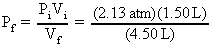 = 0.710 atm
For H2: 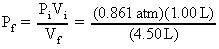 = 0.191
atm
= 0.191
atm
For Ar:  = 0.511 atm
From Dalton's Law, Ptotal =

Ptotal = 0.710
atm + 0.191 atm + 0.511 atm = 1.412 atm
9.98 (a) Bulb A contains CO2(g) and
N2(g); Bulb B contains CO2(g), N2(g), and
H2O(s).
(b) Initial moles of gas = n = 
Initial moles of gas =
0.030 35 mol
mol gas in Bulb A = n = 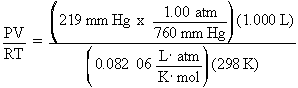 = 0.011
78 mol
= 0.011
78 mol
mol gas in Bulb B = n = 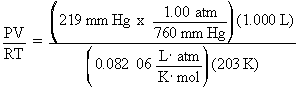 = 0.017
29 mol
= 0.017
29 mol = ninitial - nA - nB =
0.030 35 - 0.011 78 - 0.017 29 = 0.001 28 mol = 0.0013 mol
H2O
= ninitial - nA - nB =
0.030 35 - 0.011 78 - 0.017 29 = 0.001 28 mol = 0.0013 mol
H2O
(c) Bulb A contains N2(g).
Bulb B
contains N2(g) and H2O(s).
Bulb C contains
N2(g) and CO2(s).
(d) nA = 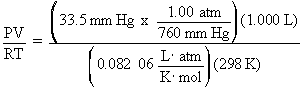 = 0.001
803 mol
= 0.001
803 mol
nB =  = 0.002
646 mol
= 0.002
646 mol
nC =  = 0.006
472 mol
= 0.006
472 mol = nA + nB + nC = 0.001
803 + 0.002 646 + 0.006 472 = 0.010 92 mol N2
= nA + nB + nC = 0.001
803 + 0.002 646 + 0.006 472 = 0.010 92 mol N2
(e)  =
ninitial -
=
ninitial -  -
-  = 0.030 35 - 0.0013 - 0.010 92 = 0.0181 mol CO2
9.99
C3H5N3O9, 227.1 amu
(a) moles
C3H5N3O9 = 1.00 g x  = 0.004
40 mol
= 0.004
40 mol
nair = 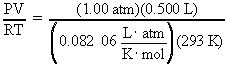 = 0.0208
mol air
= 0.0208
mol air
(b) moles gas from
C3H5N3O9 = 0.004 40 mol x 
moles gas from
C3H5N3O9 = 0.0319 mol gas from
C3H5N3O9
ntotal =
0.0319 mol + 0.0208 mol = 0.0527 mol
(c) P =  = 6.04
atm
= 6.04
atm
9.100 NH3, 17.03 amu; mol
NH3 = 45.0 g x  = 2.64
mol
= 2.64
mol or
or 
(a) At T = 0oC = 273 K
P =  = 59.1 atm
P = 
P = 65.6 atm - 29.1 atm =
36.5 atm
(b) At T = 50oC = 323 K
P = 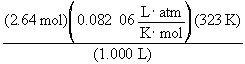 = 70.0 atm
P = 
P = 77.6 atm - 29.1 atm =
48.5 atm
(c) At T = 100oC = 373 K
P =  = 80.8 atm
P = 
P = 89.6 atm - 29.1 atm =
60.5 atm
At the three temperatures, the van der Waals equation predicts a
much lower pressure than does the ideal gas law. This is likely due to the fact
that NH3 can hydrogen bond leading to strong intermolecular
forces.
9.101 (a) ntotal = 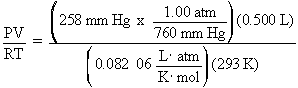 = 0.007
06 mol
= 0.007
06 mol
(b) nB =  = 0.004
71 moles
= 0.004
71 moles
(c) d =  = 0.872
g/L
= 0.872
g/L
(d) molar mass =  = 46.3
g/mol, NO2; mol. mass = 46.3 amu
= 46.3
g/mol, NO2; mol. mass = 46.3 amu
(e)
Hg2CO3(s) + 6 HNO3(aq) ® 2
Hg(NO3)2(aq) + 3 H2O(l) + CO2(g) + 2
NO2(g)
9.102 CO2, 44.01 amu
mol
CO2 = 500.0 g CO2 x  = 11.36
mol CO2
= 11.36
mol CO2
PV = nRT =
=  = 816 atm
9.103 (a) Let x = mol
CnH2n + 2 in reaction mixture.
Combustion of
CnH2n + 2 nCO2 + (n +1)H2O needs
 mol O2
Balanced equation is: CnH2n +
2(g) +  O2(g) ® nCO2(g) + (n + 1)H2O(g)
In
going from reactants to products, the increase in the number of moles is
[n
+ (n + 1)] -  =
=  per mol
of CnH2n + 2 reacted.
per mol
of CnH2n + 2 reacted.
Before reaction: total mol = 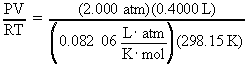 = 0.032 70 mol
After reaction: total mol =  = 0.036
52 mol
= 0.036
52 mol
Difference = 0.032 70 mol - 0.036 52 mol = 0.003 82 mol
Increase in
number of mol =  x = 0.003 82 mol; x =
Also x = 
So  =
=  ; 0.148 n - 0.148 = 0.107 n + 0.0154
0.041 n = 0.163; n =  = 4.0
= 4.0
CnH2n + 2 is C4H10
(butane); molar mass = (4)(12.01) + (10)(1.008) = 58.12 g/mol
(b) 0.148 g C4H10 x  = 0.002 55 mol C4H10
mol O2 initially =
total mol - mol C4H10 = 0.032 70 mol - 0.002 55 mol =
0.030 15 mol O2 = 0.156
atm
= 0.156
atm = 1.844 atm
(c) C4H10(g)
+  O2(g) ® 4 CO2(g) + 5 H2O(g)
0.002 55
mol C4H10 x  = 0.0102
mol CO2
= 0.0102
mol CO2
0.002 55 mol C4H10 x  = 0.012
75 mol H2O
= 0.012
75 mol H2O
mol O2 unreacted = total mol after reaction
- mol CO2 - mol H2O
= 0.03652 mol - 0.0102 mol -
0.01275 = 0.01357 mol O2 = 0.833
atm
= 0.833
atm
 = 1.041
atm
= 1.041
atm
 = 1.108
atm
= 1.108
atm
9.104 (a) average molecular mass for natural
gas
= (0.915)(16.04 amu) + (0.085)(30.07 amu) = 17.2 amu
total moles of
gas = 15.50 g x  = 0.901 mol gas
(b) P = 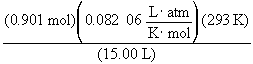 = 1.44
atm
= 1.44
atm
(c)  = (1.44 atm)(0.915) = 1.32 atm
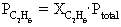 = (1.44
atm)(0.085) = 0.12 atm
= (1.44
atm)(0.085) = 0.12 atm
(d) Hcombustion(CH4) =
-802.3 kJ/mol and Hcombustion(C2H6) = -1427.7
kJ/mol
Heat liberated = (0.915)(0.901 mol)(-802.3 kJ/mol)
+
(0.085)(0.901)(-1427.7 kJ/mol) = -771 kJ
Multi-Concept Problems
9.105 X + 3 O2 2 CO2 + 3 H2O
(a) X = C2H6O
C2H6O + 3 O2 2
CO2 + 3 H2O
(b) It is an empirical formula because it
is the smallest whole number ratio of atoms. It is also a molecular formula
because any higher multiple such as C4H12O2
does not correspond to a stable electron-dot structure.
(c) 
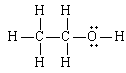
(d)
C2H6O, 46.07 amu
mol C2H6O =
5.000 g C2H6O x 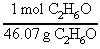 = 0.1085
mol C2H6O
= 0.1085
mol C2H6O
Hcombustion =  = -1328.6
kJ/mol
= -1328.6
kJ/mol
Hcombustion = [2 Hof(CO2)
+ 3 Hof(H2O)] -
Hof(C2H6O)
Hof(C2H6O)
= [2 Hof(CO2) + 3
Hof(H2O)] - Hcombustion
=
[(2mol)(-393.5 kJ/mol) + (3 mol)(-241.8 kJ/mol)] - (-1328.6 kJ)
= -183.8
kJ/mol
9.106 (a) 2 C8H18(l) + 25
O2(g) ® 16 CO2(g) + 18 H2O(g)
(b)
4.6 x 10¹⁰ L C8H18 x  = 3.64 x
1013 g C8H18
= 3.64 x
1013 g C8H18
3.64 x 10¹³ g
C8H18 x  = 2.55 x
1012 mol CO2
= 2.55 x
1012 mol CO2
2.55 x 10¹² mol CO2
x 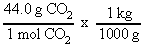 = 1.1 x 10¹¹ kg CO2
(c)  = 5.7 x
1013 L of CO2
= 5.7 x
1013 L of CO2
(d) 12.5 moles of O2 are needed for
each mole of isooctane (from part a).
12.5 mol O2 =
(0.210)(nair); nair =  = 59.5
mol air
= 59.5
mol air = 1.33 x 10³ L
9.107 (a) Freezing point of H2O on
the Rankine scale is (9/5)(273.15) = 492oR.
(b) 
(c) P = 
P = 204.2 atm - 88.0 atm =
116 atm
9.108 n =  = 7.25
mol of all gases
= 7.25
mol of all gases
(a) 0.004 00 mol "nitro" x  = 0.0290
mol hot gases
= 0.0290
mol hot gases
(b) n =  = 0.0190
mol B + C + D
= 0.0190
mol B + C + D
nA = ntotal - n(B+C+D) =
0.0290 - 0.0190 = 0.0100 mol A; A = H2O
(c) n = 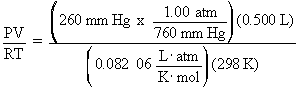 =
0.007 00 mol C + D
=
0.007 00 mol C + D
nB = n(B+C+D) - n(C+D) =
0.0190 - 0.007 00 = 0.0120 mol B; B = CO2
(d) n =  = 0.006
00 mol D
= 0.006
00 mol D
nC = n(C+D) - nD = 0.007 00 - 0.006 00 = 0.001 00 mol C; C = O2
molar mass D =  = 28.0
g/mol; D = N2
= 28.0
g/mol; D = N2
(e) 0.004
C3H5N3O9(l) ® 0.0100 H2O(g)
+ 0.012 CO2(g) + 0.001 O2(g) + 0.006
N2(g)
Multiply each coefficient by 1000 to obtain integers.
4
C3H5N3O9(l) ® 10 H2O(g) + 12
CO2(g) + O2(g) + 6
N2(g