
Chapter 8
Thermochemistry: Chemical
Energy
8.1 Convert lb to kg.
Convert mi/h to m/s. 
1 kg m2/s2 = 1 J; E = ½mv2 = ½(1043 kg)(24.6 m/s)2 = 3.2 x 10⁵ J
E = 3.2 x 105 J x 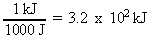
8.2 (a) and (b) are state functions; (c) is not.
8.3 V = (4.3 L - 8.6 L) = -4.3 L
w =
-PDV = -(44 atm)(
-4.3 L) = +189.2 L atm
w = (189.2 L atm)(101  ) = +1.9 x
104 J
) = +1.9 x
104 J
The positive sign for the work indicates that the
surroundings does work on the system. Energy flows into the system.
8.4 w = -PDV = - (2.5 atm)(3 L - 2 L) = - 2.5 Latm
w = (- 2.5
Latm) = - 252.5 J = - 250 J = - 0.25 kJ
The negative sign indicates
that the expanding system loses work energy and does work on the
surroundings.
8.5 (a) w = - PDV is positive and PDV is negative for this reaction
because the system volume is decreased at constant pressure.
(b)
PDV is small
compared to DE.
H = E + PDV; H is negative. Its value is slightly more negative
than E.
8.6 DHo = - 484 
PDV = (1.00 atm)(-5.6 L) = -5.6 L
atm
PDV = (-5.6
L atm)(101  ) = -565.6 J = -570 J = -0.57 kJ
w = -PDV = 570 J = 0.57
kJ
DH = -121

DE
= DH -
PDV = -121 kJ -
(-0.57 kJ) = -120.43 kJ = -120 kJ
8.7 DV = 448 L and assume P = 1.00 atm
w = -PDV = -(1.00 atm)(448 L) = -448 L
atm
w = -(448 L atm)(101  ) = -4.52 x
104 J
) = -4.52 x
104 J
w = - 4.52 x 10⁴ J x  = -45.2
kJ
= -45.2
kJ
8.8 (a)
C3H8, 44.10 amu; DHo = -2219 kJ/mol
C3H8
15.5 g x  = -780.
kJ
= -780.
kJ
780. kJ of heat is evolved.
(b) Ba(OH)2 8 H2O, 315.5
amu; DHo
= +80.3 kJ/mol Ba(OH)2 8 H2O
4.88 g x  = +1.24
kJ
= +1.24
kJ
1.24 kJ of heat is absorbed.
8.9 q = (specific heat) x m x T = (4.18  )(350 g)(3oC - 25oC) = -3.2 x 10⁴
J
)(350 g)(3oC - 25oC) = -3.2 x 10⁴
J
q = -3.2 x 10⁴ x  = -32
kJ
= -32
kJ
8.10 q = (specific heat) x m x DT; specific heat = 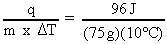 = 0.13
J/(g oC)
= 0.13
J/(g oC)
8.11 q = (specific heat) x m x DT
m = (25.0 mL + 50.0
mL)(1.00  ) = 75.0 g
mol
H2SO4 = 0.0250 L x 1.00  H2SO4 = 0.0250 mol H2SO4
Heat
evolved per mole of H2SO4 
Since the reaction evolves
heat, the sign for H is negative.
DH = -1.1 x 10⁵ J x  = -1.1 x
102 kJ
= -1.1 x
102 kJ
8.12 CH4(g) + Cl2(g)
®
CH3Cl(g) + HCl(g) Ho1 = -98.3
kJ
CH3Cl(g) + Cl2(g) ®
CH2Cl2(g) + HCl(g)
Ho2 = -104 kJ
Sum CH4(g) + 2
Cl2(g) ®
CH2Cl2(g) + 2 HCl(g)
DHo = DHo1 +
DHo2 = -202 kJ
8.13 (a) A + 2 B ® D; DHo = -100 kJ + (-50
kJ) = -150 kJ
(b) The red arrow corresponds to step 1: A + B ® C
The green arrow
corresponds to step 2: C + B ® D
The blue arrow corresponds to the overall
reaction.
(c) The top energy level represents A + 2 B.
The middle energy
level represents C + B.
The bottom energy level represents D.
8.14 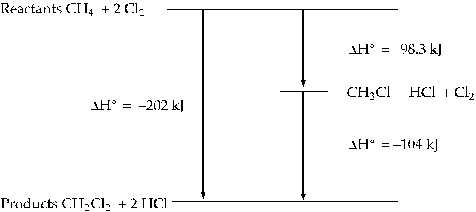
8.15 4 NH3(g) + 5
O2(g) ®
4 NO(g) + 6 H2O(g)
DHorxn = [4 DHof (NO)
+ 6 DHof (H2O)] - [4
DHof
(NH3)]
DHorxn = [(4 mol)(90.2 kJ/mol) + (6
mol)(- 241.8 kJ/mol)] - [(4 mol)(- 46.1 kJ/mol)]
DHorxn =
-905.6 kJ
8.16 6 CO2(g) + 6 H2O(l)
®
C6H12O6(s) + 6 O2(g)
DHorxn =
DHof(C6H12O6)
- [6 DHof(CO2) + 6
DHof(H2O(l)]
DHorxn =
[(1 mol)(-1260 kJ/mol)] - [(6 mol)(-393.5 kJ/mol) + (6 mol)(-285.8
kJ/mol)]
DHorxn = +2815.8 kJ = +2816
kJ
8.17 DHorxn = D (bonds broken) -
D (bonds formed)
H2C=CH2(g) +
H2O(g) ®
C2H5OH(g)
DHorxn = [D(C=C) +
D(O-H)] - [D(C-C) + D(C-O) +
D(C-H)]
DHorxn = [(1 mol)(611 kJ/mol) + (1
mol)(460 kJ/mol)]
- [(1 mol)(350 kJ/mol) + (1 mol)( 350 kJ/mol) + (1
mol)(410 kJ/mol)] = -39 kJ
8.18 2 NH3(g) + Cl2(g)
®
N2H4(g) + 2 HCl(g)
DHorxn =
D (bonds broken) - D (bonds formed)
DHorxn =
[2 x D(N-H) + D(Cl-Cl)] - [D(N-N) + 2 x
D(H-Cl)]
DHorxn = [(2 mol)(390 kJ/mol) + (1
mol)(243 kJ/mol)]
- [(1 mol)(240 kJ/mol) + (2 mol)(432 kJ/mol)] = -81
kJ
8.19 C4H10(l) +  O2(g) 4 CO2(g) + 5 H2O(g)
DHorxn =
[4 DHof (CO2) + 5
DHof (H2O)] -
DHof
(C4H10)
DHorxn = [(4 mol)(-393.5 kJ/mol) +
(5 mol)(-241.8 kJ/mol)] - [(1 mol)(-147.5 kJ/mol)]
DHorxn = -
2635.5 kJ
DHoC = - 2635.5
kJ/mol
C4H10, 58.12 amu; DHoC =

DHoC = 
8.20 DSo is negative because the reaction decreases the number of moles of gaseous molecules.
8.21 The reaction proceeds from a solid and a gas (reactants) to all gas (product). This is more disordered and DSo is positive.
8.22 (a) Because DGo is negative, the
reaction is spontaneous.
(b) Because DGo is positive, the reaction is
nonspontaneous.
8.23 DGo = DHo - TDSo = (-92.2 kJ) - (298 K)(-0.199 kJ/K) = -32.9
kJ
Because DGo is negative, the reaction is
spontaneous.
Set DGo = 0 and solve for T.
DGo = 0 =
DHo -
TDSo
T =  = 463 K =
190oC
= 463 K =
190oC
Understanding Key
Concepts
8.24. (a) w = -PDV, DV > 0; therefore w < 0
and the system is doing work on the surroundings.
(b) Since the temperature
has increased there has been an enthalpy change. The system evolved heat, the
reaction is exothermic, and H < 0.
8.25 
8.26 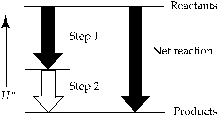
8.27 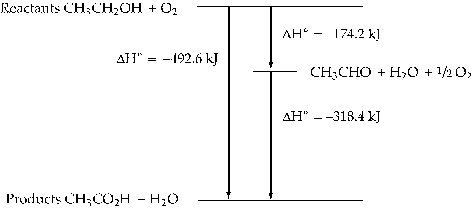
8.28 

DV =  = -2
L
= -2
L
DV = -2 L =
Vfinal - Vinitial = Vfinal - 5 L;
Vfinal = -2 L - (-5 L) = 3 L
The volume decreases from 5 L to 3
L.

8.29 DHo = +55 kJ
So is positive
because the chemical system becomes more disordered in going from reactant to
products.
DGo = DHo - TDSo; For the reaction to be spontaneous,
DGo must
be negative.
Because DHo and DSo are both positive, the reaction is
spontaneous at some higher temperatures but nonspontaneous at some lower
temperatures.
8.30 The change is the spontaneous conversion of a liquid to a gas. DG is negative because the change is spontaneous. The conversion of a liquid to a gas is endothermic, therefore DH is positive. DS is positive because the gas is more disordered than the liquid.
8.31 (a) 2 A3 ® 3 A2
(b) Because
the reaction is spontaneous, DG is negative. DS is positive because the number of molecules increases
in going from reactant to products. DH could be either positive or negative and the reaction
would still be spontaneous. DH is probably positive because there is more bond
breaking than bond making
Additional Problems
Heat, Work, and Energy
8.32 Heat is the energy transferred from one
object to another as the result of a temperature difference between them.
Temperature is a measure of the kinetic energy of molecular motion.
Energy is
the capacity to do work or supply heat. Work is defined as the distance moved
times the force that opposes the motion (w = d x F).
Kinetic energy is the
energy of motion. Potential energy is stored energy.
8.33 Internal energy is the sum of kinetic and potential energies for each particle in the system.
8.34 Car: EK = ½(1400 kg)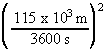 = 7.1 x 10⁵ J
Truck: EK = ½(12,000 kg) = 6.7 x
105 J
= 6.7 x
105 J
The car has more kinetic energy.
8.35 Heat = q = 7.1 x 10⁵ J (from
Problem 8.34)
q = (specific heat) x m x DT
m = 
8.36 w = -PDV = -(3.6 atm)(3.4 L - 3.2 L) =
-0.72 L atm
w = (-0.72 L atm) = -72.7 J
= -70 J; The energy change is negative.
= -72.7 J
= -70 J; The energy change is negative.
8.37 Vinitial = 50.0 mL
+ 50 mL = 100.0 mL = 0.1000 L
Vfinal = 50.0 mL = 0.0500
L
DV =
Vfinal - Vinitial = (0.0500 L - 0.1000 L) = -0.0500 L
w
= -PDV = -(1.5
atm)(-0.0500 L) = +0.075 L atm
w = (+0.075 L atm) = +7.6
J
= +7.6
J
The positive sign for the work indicates that the surroundings does work on
the system. Energy flows into the system.
Energy and Enthalpy
8.38 DE = qv is the heat change associated with a
reaction at constant volume. Since DV = 0, no PV work is done.
DH = qp is the heat
change associated with a reaction at constant pressure. Since DV ¹ 0, PV work can also be
done.
8.39 DH is negative for an exothermic reaction. DH is positive for an endothermic reaction.
8.40D H = DE + PDV; DH and DE are nearly equal when there are no gases involved in a chemical reaction, or, if gases are involved, when DV = 0 (that is, there are the same number of reactant and product gas molecules).
8.41 Heat is lost on going from
H2O(g) ® H2O(l)
® H2O(s).
H2O(g)
has the highest enthalpy content. H2O(s) has the lowest enthalpy
content.
8.42 PDV = -7.6 J (from Problem 8.37)
DH = DE + PDV
DE = DH - PDV = -0.31 kJ - (- 7.6 x
10-3 kJ) = -0.30 kJ
8.43 DH = -244 kJ and w = -PDV = 35 kJ; therefore
PDV = -35
kJ
DE =
DH - PDV = -244 kJ - (-35 kJ) = -209
kJ
For the system: DH = -244 kJ and DE = -209 kJ
DH and DE for the surroundings are just the opposite of what they
are for the system.
For the surroundings: DH = 244 kJ and DE = 209 kJ
8.44 DH = -1255.5 kJ/mol C2H2;
C2H2, 26.04 amu
w = -PDV = -(1.00 atm)(-2.80 L) = 2.80
L atm
w = (2.80 L atm) = 283 J =
0.283 kJ
= 283 J =
0.283 kJ
6.50 g x  = 0.250
mol C2H2
= 0.250
mol C2H2
q = (-1255.5 kJ/mol)(0.250 mol) = -314 kJ
E
= H - PDV = -314 kJ
- (-0.283 kJ) = -314 kJ
8.45 C2H4,
28.05 amu; HCl, 36.46 amu
w = -PDV = -(1.00 atm)(-71.5 L) = 71.5 L atm
w = (71.5 L
atm) = 7222 J = 7.22 kJ
89.5 g C2H4 x  = 3.19 mol C2H4
125 g HCl x  = 3.43 mol
HCl
= 3.43 mol
HCl
Because the reaction stoichiometry between C2H4 and
HCl is one to one, C2H4 is the limiting
reactant.Ho = -72.3 kJ/mol C2H4
q = (-72.3
kJ/mol)(3.19 mol) = -231 kJ
DE = DH - PDV = -231 kJ - (-7.22 kJ) = -224 kJ
8.46 C4H10O, 74.12 amu;
mass of C4H10O = 
mol
C4H10O = 
q = n x DHvap = 0.9626 mol x
26.5 kJ/mol = 25.5 kJ
8.47 Assume 100 mL of H2O = 100 g;
H2O, 18.02 amu
100 g x 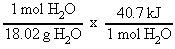 = 226
kJ
= 226
kJ
The heat to vaporize 100 mL of H2O is much greater than that to
vaporize 100 mL of diethyl ether.
8.48 Al, 26.98 amu
mol Al = 5.00 g x 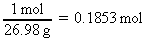
q = n x DHo = 0.1853 mol Al x
 ; 131 kJ is released.
8.49 Na, 22.99 amu; DHo = -368.4 kJ/2 mol
Na = -184.2 kJ/mol Na
1.00 g Na x  = -8.01
kJ
= -8.01
kJ
8.01 kJ of heat is evolved. The reaction is exothermic.
8.50 Fe2O3,
159.7 amu
mol Fe2O3 = 2.50 g x 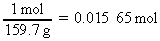
q = n x DHo = 0.015 65 mol
Fe2O3 x 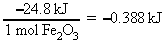 ; 0.388 kJ
is evolved.
; 0.388 kJ
is evolved.
Because DH is negative, the reaction is exothermic.
8.51 CaO, 56.08 amu
mol CaO = 233.0 g x 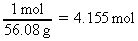
q = n x DHo = 4.155 mol CaO x
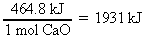 ; 1931 kJ is absorbed.
Because DH is positive, the reaction is
endothermic.
Calorimetry and Heat
Capacity
8.52 Heat capacity is the amount of heat required to raise the temperature of a substance a given amount. Specific heat is the amount of heat necessary to raise the temperature of exactly 1 g of a substance by exactly 1oC.
8.53 A measurement carried out in a bomb calorimeter is done at constant volume and therefore DE is obtained.
8.54 Na, 22.99 amu
specific heat = 28.2 
8.55 q = (specific heat) x m x T
specific
heat = 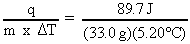 = 0.523 J/(g oC)
Cm = [0.523 J/(g
oC)](47.88 g/mol) = 25.0 J/(mol oC)
8.56 Mass of solution = 50.0 g + 1.045 g = 51.0
g
q = (specific heat) x m x DT
CaO, 56.08 amu; mol CaO =
1.045 g x 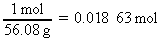
Heat evolved per
mole of CaO 
Because the
reaction evolves heat, the sign for DH is negative. DH = -83.7 kJ
8.57 C6H6, 78.11 amu; 2
C6H6(l) + 15 O2(g) ® 12 CO2(g) + 6
H2O(g)
E = qV =  = -
= - 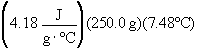 = -7817 J = -7.82 kJ
The volume of a bomb calorimeter does not
change so DV = 0
and, DH =
DE.
DH (per gram) = (-7.82
kJ)/(0.187 g) = -41.8 kJ/g
0.187 g C6H6 x  = 0.002 39 mol C6H6
DH (per mole) = (-7.82
kJ)/(0.002 39 mol) = -3270 kJ/mol
8.58 NaOH, 40.00 amu; HCl, 36.46 amu
8.00 g
NaOH x  = 0.200 mol NaOH
8.00 g HCl x  = 0.219
mol HCl
= 0.219
mol HCl
Because the reaction stoichiometry between NaOH and HCl is one to
one, the NaOH is the limiting reactant.
qP = -qsoln =
-(specific heat) x m x DT = -  = -11.2
kJ
= -11.2
kJ
DH =
qP/n = (-11.2 kJ)/(0.200 mol) = -56 kJ/mol
When 10.00 g of HCl in
248.0 g of water are added the same temperature increase is observed because the
mass of NaOH is the same and it is still the limiting reactant. The mass of the
solution is also the same.
8.59 NH4NO3, 80.04 amu;
assume 125 mL = 125 g H2O
50.0 g NH4NO3 x
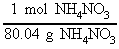 = 0.625 mol NH4NO3
qP =
DH x n = (+25.7
kJ/mol)(0.625 mol) = 16.1 kJ = 16,100 J
qsoln = -qP =
-16,100 J
qsoln = (specific heat) x m x DT
DT = 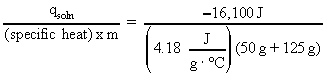 =
-22.0oC
=
-22.0oC
DT = -22.0oC = Tfinal -
Tinitial = Tfinal - 25.0oC
Tfinal
= -22.0oC + 25.0oC = 3.0oC
Hess's Law and Heats of Formation
8.60 The standard state of an element is its most stable form at 1 atm and 25oC.
8.61 A compound's standard heat of formation is the amount of heat associated with the formation of 1 mole of a compound from its elements (in their standard states).
8.62 Hess's Law -- the overall enthalpy change
for a reaction is equal to the sum of the enthalpy changes for the individual
steps in the reaction.
Hess's Law works because of the law of conservation of
energy.
8.63 Elements always have DHof = 0 because the standard state of elements is the reference point from which all enthalpy changes are measured.
8.64
S(s) + O2(g) ® SO2(g)
DHo1 = -296.8
kJ
SO2 + ½ O2(g) ® SO3(g)
DHo2 =
-98.9 kJ
S(s) + 3/2 O2(g) ®
SO3(g) DHo3 =
DHo1 + DHo2
DHof = DHo3 = -296.8 kJ + (-98.9 kJ) = -395.7 kJ/mol
8.65 DHorxn = [12 DHof(CO2) + 6
DHof(H2O)] - [2
DHof(C6H6)]
-6534
kJ = [(12 mol)(-393.5 kJ/mol) + (6 mol)(-285.8 kJ/mol)] - [(2 mol)(DHof(C6H6))]
Solve
for DHof(C6H6).
-6534
kJ = -6436.8 kJ - [(2 mol)(DHof(C6H6))]
97.2
kJ = (2 mol)(DHof(C6H6))
DHof(C6H6) =
+48.6 kJ/mol
8.66
SO3(g) +
H2O(l) ®
H2SO4(aq)
DHo1 = -227.8 kJ
H2(g)
+ ½ O2(g) ® H2O(l)
DHo2 = Hof =
-285.8 kJ
S(s) + 3/2 O2(g)
® SO3(g)
DHo3 = Hof =
-395.7
S(s) + H2(g) + 2 O2(g)
® H2SO4(aq)
DHof (H2SO4) =
?
DHof (H2SO4) = DHo1 + HDo2 + DHo3 = -909.3 kJ
8.67 DHorxn = [DHof(CH3CO2H)
+ DHof(H2O)] - DHof(CH3CH2OH)
DHorxn =
[(1 mol)(-484.5 kJ/mol) + (1mol)(-285.8 kJ/mol)] - [(1 mol)(-277.7
kJ/mol)]
DHorxn = -492.6 kJ
8.68 C8H8(l) + 10
O2(g) ®
8 CO2(g) + 4 H2O(l)
DHorxn =
DHoc = - 4395.2 kJ
DHorxn =
[8 DHof(CO2) + 4
DHof(H2O)] - DHof(C8H8)
-
4395.2 kJ = [(8 mol)(-393.5 kJ/mol) + (4 mol)(-285.8 kJ/mol)]- [(1
mol)(DHof(C8H8))]
Solve
for DHof(C8H8)
-
4395.2 kJ = - 4291.2 kJ - (1 mol)(DHof(C8H8)
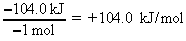
-104.0
kJ = -(1 mol)(DHof(C8H8))
DHof(C8H8) =
8.69 C5H12O(l) + 15/2
O2(g) ® 5 CO2(g) + 6
H2O(l)
DHorxn = [5 DHof(CO2) + 6
DHof(H2O)] - DHof(C5H12O)
DHorxn =
[(5 mol)(-393.5 kJ/mol) + (6 mol)(-285.8 kJ/mol)] - [(1 mol)(-313.6
kJ/mol)]
DHorxn = -3369 kJ
8.70 DHorxn = DHof(MTBE)
- [DHof(2-Methylpropene) + DHof(CH3OH)]
-57.8 kJ
= -313.6 kJ - [(1 mol)(DHof(2-Methylpropene)) + (-238.7
kJ)]
Solve for DHof(2-Methylpropene).
-17.1 kJ =
(1 mol)(DHof(2-Methylpropene))
DHof(2-Methylpropene) = -17.1
kJ/mol
8.71
C51H88O6(l) + 70 O2(g) ® 51 CO2(g) + 44
H2O(l)
DHorxn = [51 DHof(CO2) + 44
DHof(H2O)] - DHof(C51H88O6)
DHorxn =
[(51 mol)(-393.5 kJ/mol) + (44 mol)(-285.8 kJ/mol)] - [(1 mol)(-1310
kJ/mol)]
DHorxn = -3.133 x 10⁴
kJ/mol
C51H88O6
C51H88O6,
797.25 amu
q = -3.133 x 10⁴  ; 37 kJ
released per mL
; 37 kJ
released per mL
Bond Dissociation
Energies
8.72 H2C=CH2(g) +
H2(g) ®
CH3CH3(g)
DHorxn = D (bonds broken) -
D (bonds formed)
DHorxn = [D(C=C) +
D(H2)] - [2 x D(C-H) +
D(C-C)]
DHorxn = [(1 mol)(611 kJ/mol) + (1
mol)(436 kJ/mol)]
- [(2 mol)(410 kJ/mol) + (1 mol)(350 kJ/mol)] = -123
kJ
8.73 CH3CH=CH2 +
H2O ®
CH3CH(OH)CH3
DHorxn = D (bonds broken) -
D (bonds formed)
DHorxn = [D(C=C) +
D(O-H)] - [D(C-C) + D(C-H) +
D(C-O)]
DHorxn = [(1 mol)(611 kJ/mol) + (1
mol)(460 kJ/mol)]
- [(1 mol)(350 kJ/mol) + (1 mol)(410 kJ/mol) + (1 mol)(350
kJ/mol)] = -39 kJ
8.74 C4H10 + 13/2
O2 ® 4
CO2 + 5 H2O
DHorxn = D (bonds broken) -
D (bonds formed)
DHorxn = [3 x D(C-C) + 10 x
D(C-H) + 13/2 x D(O2)] - [8 x D(C=O) + 10
x D(O-H)]
DHorxn = [(3 mol)(350 kJ/mol) + (10
mol)(410 kJ/mol) + (13/2 mol)(498 kJ/mol)]
- [(8 mol)(804 kJ/mol) + (10
mol)(460 kJ/mol)] = -2645 kJ
8.75 CH3CO2H +
CH3CH2OH ® CH3CO2CH2CH3
+ H2O
DHorxn = D (bonds broken) -
D (bonds formed)
DHorxn = [D(C-O) +
D(O-H) ] - [D(C-O) + D(O-H)]
DHorxn =
[(1 mol)(350 kJ/mol) + (1 mol)(460 kJ/mol)]
- [(1 mol)(350 kJ/mol) + (1
mol)(460 kJ/mol)] = 0 kJ
Free Energy and Entropy
8.76 Entropy is a measure of molecular disorder.
8.77 DG = DH - TDS
DH is usually more important because it is usually much
larger than TDS.
8.78 A reaction can be spontaneous yet endothermic if DS is positive (more disorder) and the TDS term is larger than DH.
8.79 A reaction can be nonspontaneous yet exothermic if DS is negative (more order) and the temperature is high enough so that the TDS term is more negative than DH.
8.80 (a) positive (more disorder) (b) negative (more order)
8.81 (a) positive (more disorder) (b) negative (more order) (c) positive (more disorder)
8.82 (a) zero (equilibrium) (b) zero (equilibrium) (c) negative (spontaneous)
8.83 Because the mixing of gas molecules is spontaneous, DG is negative. The mixture of gas molecules is more disordered so SD is positive. For the diffusion of gases, DH is approximately zero.
8.84 DS is positive. The reaction increases the total number of molecules.
8.85 DS < 0. The reaction decreases the number of gas molecules.
8.86 DG = DH - TDS
(a) DG = -48 kJ - (400 K)(135 x 10-3 kJ/K) = -102
kJ
DG < 0,
spontaneous; DH
< 0, exothermic.
(b) GD = -48 kJ - (400 K)(-135 x 10-3 kJ/K) = +6
kJ
DG > 0,
nonspontaneous; DH
< 0, exothermic.
(c) DG = +48 kJ - (400 K)(135 x 10-3 kJ/K) = -6
kJ
DG < 0,
spontaneous; DH
> 0, endothermic.
(d) DG = +48 kJ - (400 K)(-135 x 10-3 kJ/K) = +102
kJ
G > 0, nonspontaneous; H > 0, endothermic.
8.87 DG = DH - TDS
(a) DG = -128 kJ - (500 K)(35 x 10-3 kJ/K) = -146
kJ
DG < 0,
spontaneous; DH
< 0, exothermic
(b) DG = +67 kJ - (250 K)(-140 x 10-3 kJ/K) = +102
kJ
DG > 0,
nonspontaneous; DH
> 0, endothermic
(c) DG = +75 kJ - (800 K)(95 x 10-3 kJ/K) = -1
kJ
DG < 0,
spontaneous; DH
> 0, endothermic
8.88 DG = DH - TDS; Set DG = 0 and solve for T (the crossover temperature).
T =  =
=  = 570 K
8.89 Because DH > 0 and DS < 0, the reaction is nonspontaneous at all temperatures. There is no crossover temperature.
8.90 (a) DH < 0 and DS > 0; reaction is spontaneous at all
temperatures.
(b) DH < 0 and DS < 0; reaction has a crossover temperature.
(c)
DH > 0 and
DS > 0; reaction
has a crossover temperature.
(d) DH > 0 and DS < 0; reaction is nonspontaneous at all
temperatures.
8.91 (a) DH < 0 and DS < 0. The reaction is favored by enthalpy but not by
entropy.
DGo = DHo - TDSo = -217.5 kJ/mol - (298 K)[-233.9 x
10-3 kJ/(K mol)] = -147.8 kJ
(b) The reaction has a crossover
temperature. Set G = 0 and solve for T (the crossover
temperature).
DGo = 0 = DHo - TDSo
T =  =
=  = 929.9 K
8.92 T = -114.1oC = 273.15 + (-114.1)
= 159.0 K
DGfus = DHfus - TDSfus; DG = 0 at the melting point temperature.
Set
DG = 0 and solve
for Sfus.
DG = 0 = DHfus - TDSfus
DSfus = 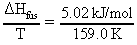 = 0.0316
kJ/(Kmol) = 31.6 J/(Kmol)
= 0.0316
kJ/(Kmol) = 31.6 J/(Kmol)
8.93 T = 61.2oC = 273.15 + (61.2) =
334.4 K
DGvap = DHvap - TDSvap; DG = 0 at the boiling point temperature.
Set
DG = 0 and solve
for DSvap.
DG = 0 = DHvap - TDSvap
DSvap =  = 0.0873 kJ/(Kmol) = 87.3 J/(Kmol)
General
Problems
8.94 Mg(s) + 2 HCl(aq)
® MgCl2(aq) +
H2(g)
mol Mg = 1.50 g x 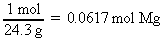
mol HCl = 0.200 L x 6.00

There is an excess of HCl.
Mg is the limiting reactant. = 2.89 x
104 J
= 2.89 x
104 J
q = 2.89 x 10⁴ J x 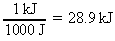
Heat evolved per mole of
Mg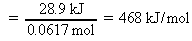
Because the reaction
evolves heat, the sign for DH is negative. DH = -468 kJ
8.95 (a) C(s) + CO2(g) ® 2 CO(g)
DHorxn =
[2 DHof(CO)] - DHof(CO2)
DHorxn =
[(2 mol)(-110.5 kJ/mol)] - [(1 mol)(-393.5 kJ/mol)] = +172.5 kJ
(b) 2
H2O2(l) 2 H2O(l) +
O2(g)
DHorxn = [2
Hof(H2O)] - [2
Hof(H2O2)]
DHorxn =
[(2 mol)(-285.8 kJ/mol)] - [(2 mol)(-187.8 kJ/mol)] = -196.0 kJ
(c)
Fe2O3(s) + 3 CO(g) 2 Fe(s) + 3
CO2(g)
DHorxn = [3
Hof(CO2)] - [DHof(Fe2O3) +
3 DHof(CO)]
DHorxn =
[(3 mol)(-393.5 kJ/mol)]
- [(1 mol)(-824.2 kJ/mol) + (3 mol)(-110.5 kJ/mol)]
= -24.8 kJ
8.96
2 NO(g) + O2(g) ® 2 NO2 (g)
DHo1 = 2(-57.0
kJ)
2 NO2 (g) N2O4(g)
DHo2 = -57.2 kJ
2
NO(g) + O2(g) N2O4(g)
DHo = DHo1 + DHo2 = -171.2 kJ
8.97 DG = DH - TDS; at equilibrium DG = 0. Set GD = 0 and solve for T.
DG = 0 = DH - TDS
T =  =
=  = 332 K = 59oC
8.98 DGfus = DHfus - TDSfus; at the melting point DG = 0. Set DG = 0 and solve for T (the
melting point).
DG = 0 = HDfus - TDSfus
T =  =
= 
8.99 HgS(s) + O2(g) ® Hg(l) +
SO2(g)
(a) DHorxn = DHof(SO2) - DHof(HgS)
DHorxn =
[(1 mol)(-296.8 kJ/mol)] - [(1 mol)(-58.2 kJ/mol)] = -238.6 kJ
(b) and (c)
Because DH < 0
and DS > 0, the
reaction is spontaneous at all temperatures.
8.100 DHorxn = D (bonds broken) -
D (bonds formed)
(a) 2 CH4(g)
® C2H6(g) +
H2(g)
DHorxn = [2 x D(C-H)] -
[D(C-C) + D(H-H)]
DHorxn = [(2 mol)(410 kJ/mol)] - [(1
mol)(350 kJ/mol) + (1 mol)(436 kJ/mol)] = +34 kJ
(b)
C2H6(g) + F2(g)
® C2H5F(g)
+HF(g)
DHorxn = [D(C-H) +
D(F-F)] - [D(C-F) + D(H-F)]
DHorxn =
[(1 mol)(410 kJ/mol) + (1 mol)(159 kJ/mol)]
- [(1 mol)(450 kJ/mol) + (1
mol)(570 kJ/mol)] = -451 kJ
(c) N2(g) + 3 H2(g) 2
NH3(g)
The bond dissociation energy for N2 is 945
kJ/mol.
DHorxn = [D(NN) + 3 x
D(H-H)] - [6 x D(N-H)]
DHorxn =
[(1 mol)(945 kJ/mol) + (3 mol)(436 kJ/mol)] - [(6 mol)(390 kJ/mol)] = -87
kJ
8.101 (a) DHorxn = DHof(CH3OH) -
DHof(CO)
DHorxn =
[(1 mol)(-238.7 kJ/mol)] - [(1 mol)(-110.5 kJ/mol)] = -128.2 kJ
(b)
DGo =
DHo -
TDSo =
-128.2 kJ - (298 K)(-332 x 10-3 kJ/K) = -29.3 kJ
(c) Step 1 is
spontaneous since DGo < 0.
(d) DHo, because it is
larger than TDSo.
(e) Set DG = 0 and solve for
T.
DG = 0 =
DH - TDS
DT =  =
= 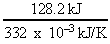 = 386 K; The reaction is spontaneous below 386 K.
(f) DHorxn =
DHof(CH4) - DHof(CH3OH)
DHorxn =
[(1 mol)(-74.8 kJ/mol)] - [(1 mol)(-238.7 kJ/mol)] = +163.9 kJ
(g)
DGo =
DHo -
TDSo =
+163.9 kJ - (298 K)(162 x 10-3 kJ/K) = +115.6 kJ
(h) Step 2 is
nonspontaneous since DGo > 0.
(i) DHo, because it is
larger than TDSo.
(j) Set DG = 0 and solve for
T.
DG = 0 =
DH - TDS
T =  =
=  = 1012 K; The reaction is spontaneous above 1012 K.
(k) DGooverall
= DGo1 + DGo2 =
-29.3 kJ + 115.6 kJ = +86.3 kJ
DHooverall = DHo1 +
DHo2 = -128.2 kJ + 163.9 kJ = +35.7
kJ
DSooverall = DSo1 +
DSo2 = -332 J/K + 162 J/K = -170
J/K
(l) The overall reaction is nonspontaneous since DGooverall
> 0.
(m) The two reactions should be run separately. Run step 1 below 386
K and run step 2 above 1012 K.
8.102 (a) 2 C8H18(l) + 25
O2(g) ®
16 CO2(g) + 18 H2O(g)
(b)
C8H18(l) + 25/2 O2(g)
® 8 CO2(g) + 9
H2O(g)
DHorxn = DHoc =
-5456.6 kJ
DHorxn = [8 DHof(CO2) + 9
DHof(H2O)] - DHof(C8H18)
-5456.6
kJ = [(8 mol)(-393.5 kJ/mol) +(9 mol)(-241.8 kJ/mol)] - [(1 mol)(DHof(C8H18))]
Solve
for DHof(C8H18).
-5456.6
kJ = -5324 kJ - [(1 mol)(DHof(C8H18))]
-132.4
kJ = -(1 mol)(DHof(C8H18))
DHof(C8H18) =
+132.4 kJ/mol
8.103 Assume
1.00 kg of H2O.
Ep = (1.00 kg)(9.81
m/s2)(739 m) = 7250 kgm2/s2 = 7250 J
q =
specific heat x m x DT
T =  =
1.73oC (temperature rise)
=
1.73oC (temperature rise)
8.104 (a) DStotal = DSsystem +
DSsurr
and DSsurr = -DH/T
DStotal =
DSsystem
+ (-DH/T) =
DSsystem
- DH/T
DSsystem = DStotal +
DH/T
DG = DH - TDS (substitute DSsystem for DS in this
equation)
DG =
DH - T(DStotal +
DH/T) =
-TDStotal
DG = -TDStotal For a
spontaneous reaction, if DStotal > 0 then DG < 0.
(b)
DGo =
DHo -
TDSo
DHo = DGo + TDSo
DSsurr = -
DSsurr = -9451 J/(K mol)
8.105 3/2 NO2(g) + 1/2
H2O(l) ®
HNO3(aq) + 1/2 NO(g)
DHo1 = 
3/2 NO(g) + 3/4
O2(g) ®
3/2 NO2(g)
DHo2 = 
1/2 N2(g) + 3/2
H2(g) ®
NH3(g)
DHo3 = - 46.1
kJ
NH3(g) + 5/4 O2(g)
® NO(g) + 6/4 H2O(l)
DHo4 = 
H2O(l)
® 1/2 O2(g) + H2(g)
Ho5 = +285.8 kJ
1/2 H2(g) + 1/2
N2(g) + 3/2 O2(g) ® HNO3(aq)
DHo =
-207.4 kJ
8.106 2 CH4(g) + 4 O2(g)
® 2
CO2(g) + 4 H2O(l) DHo1 =
2(-890.3 kJ)
C2H6(g) ® C2H4(g)
+ H2(g) Ho2 = +137.0 kJ
2 CO2(g)
+ 3 H2O(l) ® C2H6(g) + 7/2 O2(g)
DHo3 = 
H2O(l)
®
H2(g) + 1/2 O2(g)
DHo4 = +285.8 kJ
2
CH4(g) ®
C2H4(g) + 2 H2(g)
DHo =
+201.9 kJ
Multi-Concept Problems
8.107 (a) 2 CH3CO2H(l) +
Na2CO3(s) ® 2 CH3CO2Na(aq) + CO2(g)
+ H2O(l)
CH3CO2H(l) + NaHCO3(s)
®
CH3CO2Na(aq) + CO2(g) + H2O(l)
(b) CH3CO2H, 60.05 amu;
Na2CO3, 105.99 amu; NaHCO3, 84.01 amu
1 gal
x  = 3971 g CH3CO2H
3971 g
CH3CO2H x 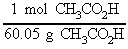 = 66.13
mol CH3CO2H
= 66.13
mol CH3CO2H
For reaction (1) = 3.505 kg
Na2CO3
= 3.505 kg
Na2CO3
For reaction (2) = 5.556 kg
NaHCO3
= 5.556 kg
NaHCO3
(c) 2 CH3CO2H(l) +
Na2CO3(s) ® 2 CH3CO2Na(aq) + CO2(g)
+ H2O(l)
DHorxn = [2 DHof(CH3CO2Na)
+ DHof(CO2) + DHof(H2O)]
- [2
Hof(CH3CO2H) + DHof(Na2CO3)]
DHorxn =
[(2 mol)(-726.1 kJ/mol) + (1 mol)(-393.5 kJ/mol) + (1 mol)(-285.8 kJ/mol)]
-
[(2 mol)(-484.5 kJ/mol) + (1 mol)(-1130.7 kJ/mol)]
DHorxn =
-31.8 kJ for 2 mol CH3CO2H
Heat = - 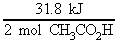 x 66.13
mol CH3CO2H = -1050 kJ
(liberated)
x 66.13
mol CH3CO2H = -1050 kJ
(liberated)
CH3CO2H(l) + NaHCO3(s)
®
CH3CO2Na(aq) + CO2(g) +
H2O(l)
DHorxn = [DHof(CH3CO2Na)
+ DHof(CO2) + DHof(H2O)]
-
[DHof(CH3CO2H)
+ DHof(NaHCO3)]
DHorxn = [(1 mol)(-726.1 kJ/mol) +
(1 mol)(-393.5 kJ/mol) + (1 mol)(-285.8 kJ/mol)]
- [(1 mol)(-484.5 kJ/mol) +
(1 mol)(-950.8 kJ/mol)]
DHorxn = +29.9 kJ for 1 mol
CH3CO2H
Heat = 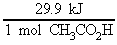 x 66.13
mol CH3CO2H = +1980 kJ (absorbed)
x 66.13
mol CH3CO2H = +1980 kJ (absorbed)
8.108 (a) 2 K(s) + 2 H2O(l)
® 2 KOH(aq) +
H2(g)
(b) Horxn = [2
Hof(KOH)] - [2
Hof(H2O)]
Horxn = [(2
mol)(-482.4 kJ/mol)] - [(2 mol)(-285.8 kJ/mol)] = -393.2 kJ
(c) The reaction
produces 393.2 kJ/ 2 mol K = 196.6 kJ/ mol K.
Assume that the mass of the
water does not change and that the specific heat = 4.18 J/(goC) for
the solution that is produced.
q = 7.55 g K x  = 3.80 x
104 J
= 3.80 x
104 J
q = (specific heat) x m x DT
DT =  =
22.7oC
=
22.7oC
DT = Tfinal -
Tinitial
Tfinal = DT + Tinitial =
22.7oC + 25.0oC = 47.7oC
(d) 7.55 g K x 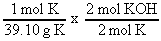 = 0.193
mol KOH
= 0.193
mol KOH
Assume that the mass of the solution does not change during the
reaction and that the solution has a density of 1.00 g/mL.
solution volume =
400.0 g x 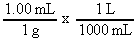 = 0.400 L
molarity = 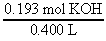 = 0.483
M
= 0.483
M
2 KOH(aq) + H2SO4(aq) ®
K2SO4(aq) + 2 H2O(l)
0.193 mol KOH x 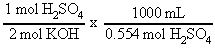 = 174 mL of 0.554 M H2SO4
8.109 (a)  Each N is
sp3 hybridized and the geometry about each N is
pyramidal.
Each N is
sp3 hybridized and the geometry about each N is
pyramidal.
(b) 2/4
NH3(g) + 3/4 N2O(g) ® N2(g) + 3/4 H2O(l)
DHo1 = 
1/4 H2O(l) + 1/4
N2H4(l) ® 1/8 O2(g) + 1/2 NH3(g)
DHo2 = 
3/4
N2H4(l) + 3/4 H2O(l) ® 3/4 N2O(g) + 9/4
H2(g) DHo3 = 
9/4 H2(g) +
9/8 O2(g) ® 9/4 H2O(l)
DHo4 =
N2H4(l) + O2(g) ® N2(g) + 2
H2O(l)
DHo =
-622 kJ
(c) N2H4, 32.045
amu
mol N2H4 = 100.0 g N2H4 x
 = 3.12 mol N2H4
q = (3.12 mol
N2H4)(622 kJ/mol) = 1940 kJ