7. 3 (a)
 (b)
(b) 
Chapter 7
Covalent Bonds and Molecular
Structure
7.1 (a) SiCl4; chlorine EN = 3.0,
silicon EN = 1.8, difference in EN = 1.2;
The Si-Cl bond is polar covalent.
(b) CsBr; bromine EN = 2.8, cesium EN
= 0.7, difference in EN = 2.1; The Cs+Br- bond is
ionic.
(c) FeBr3; bromine EN = 2.8, iron EN = 1.8, difference in
EN = 1.0; The Fe-Br bond is polar covalent.
(d) CH4; carbon EN =
2.5, hydrogen EN = 2.1, difference in EN = 0.4 The C-H bond is polar
covalent.
7.2 (a) CCl4; chlorine EN = 3.0,
carbon EN = 2.5, difference in EN = 0.5
(b) BaCl2; chlorine EN =
3.0, barium EN = 0.9, difference in EN = 2.1
(c) TiCl3; chlorine
EN = 3.0, titanium EN = 1.5, difference in EN = 1.5
(d) Cl2O;
oxygen EN = 3.5, chlorine EN = 3.0, difference in EN = 0.5
Increasing ionic character: CCl4 ~ ClO2 < TiCl3 < BaCl2
7. 3 (a) (b)
7.4 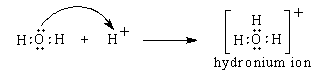
7.5 (a)  (b)
(b)  (c)
(c)
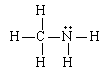
(d)  (e)
(e) (f)
(f)
7.6 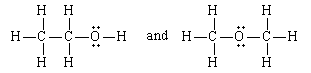
7.7 Molecular formula:
C4H5N3O; 
7.8 
7.9 (a) (b)
(b) 
(c)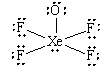 (d)
(d) 
7.10 (a) (b)
(b)  (c)
(c) 
7.11 
7.12 (a)
(b) 
(c)
7.13 
7.14 For nitrogen: Isolated
nitrogen valence electrons 5
Bound nitrogen bonding electrons 8
Bound
nitrogen nonbonding electrons 0
Formal charge = 5 - ½(8) - 0 = +1
For singly bound Isolated oxygen valence
electrons 6
oxygen: Bound oxygen bonding electrons 2
Bound oxygen
nonbonding electrons 6
Formal charge = 6 - ½(2) - 6 = -1
For doubly bound Isolated oxygen valence
electrons 6
oxygen: Bound oxygen bonding electrons 4
Bound oxygen
nonbonding electrons 4
Formal charge = 6 - ½(4) - 4 = 0
7.15 (a) 
For nitrogen: Isolated nitrogen valence
electrons 5
Bound nitrogen bonding electrons 4
Bound nitrogen nonbonding
electrons 4
Formal charge = 5 - ½(4) - 4 = -1
For carbon: Isolated carbon valence electrons
4
Bound carbon bonding electrons 8
Bound carbon nonbonding electrons
0
Formal charge = 4 - ½ (8) - 0 = 0
For oxygen: Isolated oxygen valence electrons
6
Bound oxygen bonding electrons 4
Bound oxygen nonbonding electrons
4
Formal charge = 6 - ½(4) - 4 = 0
(b) 
For left oxygen: Isolated oxygen valence
electrons 6
Bound oxygen bonding electrons 2
Bound oxygen nonbonding
electrons 6
Formal charge = 6 - ½(2) - 6 = -1
For central Isolated oxygen valence electrons
6
oxygen: Bound oxygen bonding electrons 6
Bound oxygen nonbonding
electrons 2
Formal charge = 6 - ½(6) - 2 = +1
For right Isolated oxygen valence electrons
6
oxygen: Bound oxygen bonding electrons 4
Bound oxygen nonbonding
electrons 4
Formal charge = 6 - ½(4) - 4 = 0
7.16
| Species | Number of Bonded Atoms |
Number of Lone Pairs |
Shape | |
| a | 2 | 1 | bent | |
| b | H3O+ | 3 | 1 | trigonal pyramidal |
| c | XeF2 | 2 | 3 | linear |
| d | PF6- | 6 | 0 | octahedral |
| e | XeOF4 | 5 | 1 | square pyramidal |
| f | AlH4- | 4 | 0 | tetrahedral |
| g | BF4- | 4 | 0 | tetrahedral |
| h | SiCl4 | 4 | 0 | tetrahedral |
| i | ICl4- | 4 | 2 | square planar |
| j | AlCl3 | 3 | 0 | trigonal planar |
7.17 
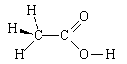
7.18 (a) tetrahedral (b) see-saw
7.19 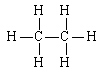
Each C is sp3 hybridized. The C-C bond is formed by the overlap of one singly occupied sp3 hybrid orbital from each C. The C-H bonds are formed by the overlap of one singly occupied sp3 orbital on C with a singly occupied H 1s orbital.
7.20 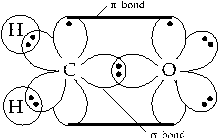
The carbon in formaldehyde is sp2 hybridized.
7.21 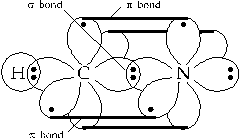
In HCN the carbon is sp hybridized.
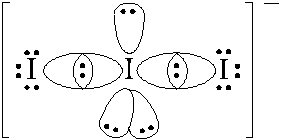
7.22 The central I in I3- has two single bonds and three lone pairs of electrons. The hybridization of the central I is sp3d. A sketch of the ion showing the orbitals involved in bonding is shown below.
7.23
| Single Bonds | Lone Pairs | Hybridization of S Atom | |
| SF2 | 2 | 2 | sp3 |
| SF4 | 4 | 1 | sp3d |
| SF6 | 6 | 0 | sp3d2 |
7.24 (a) sp (b) sp3d
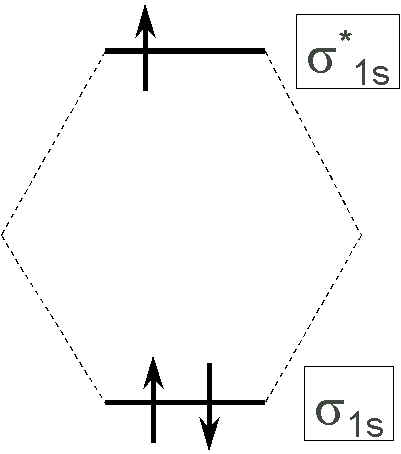
7.25 For He2+
He2+ Bond order = 
He2+ should be stable with a bond
order of 1/2.
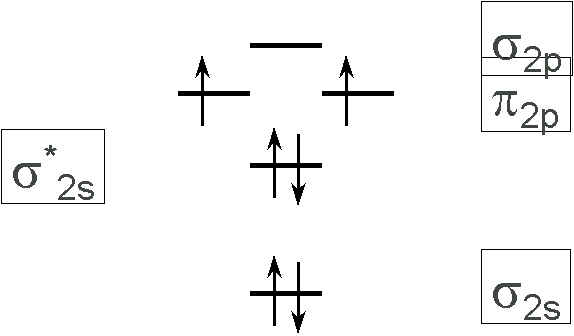
7.26 For B2
B2 Bond order = 
B2 is
paramagnetic because it has two unpaired electrons in the 2p
molecular orbitals.
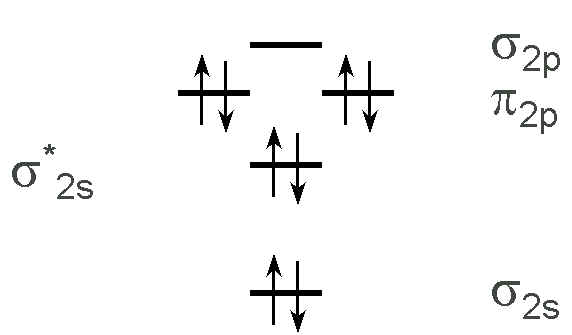
For C2
C2 Bond order =  ;
C2 is diamagnetic because all electrons are paired.
;
C2 is diamagnetic because all electrons are paired.
7.27 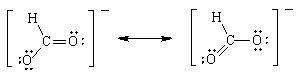

7.28 Handed biomolecules have specific shapes that only match complementary-shaped receptor sites in living systems. The mirror-image forms of the molecules can't fit into the receptor sites and thus don't elicit the same biological response.
7.29 The mirror image of molecule (a) has the same shape as (a) and is identical to it in all respects so there is no handedness associated with it. The mirror image of molecule (b) is different than (b) so there is a handedness to this molecule.
Understanding Key Concepts
7.30 (a) square pyramidal (b) trigonal pyramidal (c) square planar (d) trigonal planar
7.31 (a) trigonal bipyramidal (b) tetrahedral (c) square pyramidal (4 ligands in the horizontal plane, including one hidden)
7.32 Molecular model (c) does not have a tetrahedral central atom. It is square planar.
7.33 (a) sp2 (b) sp3d2 (c) sp3
7.34 (a) C8H9NO2
(b) & (c)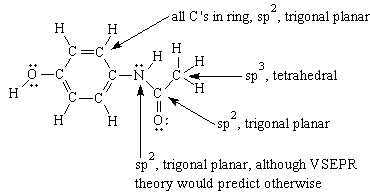
7.35 (a) 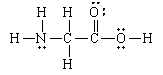
(b) H-C-H, ~109o;
O-C-O, ~120o; H-N-H, ~107o
(c) N, sp3; left
C, sp3; right C, sp2
7.36 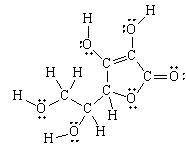
All carbons that have only
single bonds are sp3 hybridized. The three carbons that have double
bonds are sp2 hybridized.
7.37 (a)
C13H10N2O4
(b) and (c)
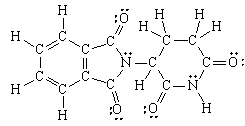
All
carbons that have only single bonds are sp3 hybridized and have a
tetrahedral geometry. All carbons that have double bonds are sp2
hybridized and have a trigonal planar geometry. The two nitrogens are
sp3 hybridized and have a trigonal pyramidal geometry.
Additional Problems
Electronegativity and Polar Covalent Bonds
7.38 Electronegativity increases from left to right across a period and decreases down a group.
7.39 Z = 119 is below francium and would have a very low electronegativity.
7.40 K < Li < Mg < Pb < C < Br
7.41 Cl > C > Cu > Ca > Cs
7.42 (a) HF; fluorine EN = 4.0, hydrogen EN = 2.1, difference in EN = 1.9; HF is polar covalent.
(b) HI; iodine EN = 2.5, hydrogen EN = 2.1, difference in EN = 0.4 HI; is polar covalent.
(c) PdCl2; chlorine EN = 3.0, palladium EN = 2.2, difference in EN = 0.8; PdCl2 is polar covalent.
(d) BBr3; bromine EN = 2.8, boron EN = 2.0, difference in EN = 0.8; BBr3 is polar covalent.
(e) NaOH; Na+ - OH-
is ionic;
OH- oxygen EN = 3.5 hydrogen EN = 2.1, difference in EN
= 1.4; OH- is polar covalent.
7.43 The electronegativity for each element is
shown in parentheses.
(a) C (2.5), H (2.1), Cl (3.0): The C-Cl bond is more
polar than the C-H bond because of the larger electronegativity difference
between the bonded atoms.
(b) Si (1.8), Li (1.0), Cl (3.0): The Si-Cl bond is
more polar than the Si-Li bond because of the larger electronegativity
difference between the bonded atoms.
(c) N (3.0), Cl (3.0), Mg (1.2): The
N-Mg bond is more polar than the N-Cl bond because of the larger
electronegativity difference between the bonded atoms.
7.44 (a) 
 (b)
(b) 
 (c) N - Cl
7.45 (a)  (b)
(b)  (c)
(c)  (d)
(d)  (e)
(e) 
Electron-Dot Structures and
Resonance
7.46 The transition metals are characterized by partially filled d orbitals that can be used to expand their valence shell beyond the normal octet of electrons.
7.47 (a) AlCl3 Al has only 6 electrons around it. (b) PCl5 P has 10 electrons around it.
7.48 (a)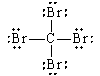 (b)
(b) 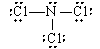 (c)
(c) 
(d)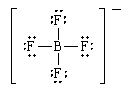 (e)
(e)  (f)
(f) 
7.49 (a) 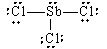 (b)
(b)  (c)
(c)

(d) (e)
(e) 
7.50 (a) 
(b) 
(c) 
7.51 (a) 
(b) 
(c)
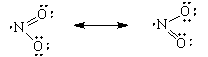
(d) 
7.52 
7.53  ;
CS2 has two double bonds.
;
CS2 has two double bonds.
7.54 (a) yes (b) yes (c) yes (d) yes
7.55 (a) yes (b) no (c) yes
7.56 (a) The anion has 32 valence electrons. Each Cl has seven valence electrons (28 total). The minus one charge on the anion accounts for one valence electron. This leaves three valence electrons for X. X is Al.
(b) The cation has eight valence electrons. Each H has one valence electron (4 total).
X is left with four valence electrons. Since this is a cation, one valence electron was removed from X. X has five valence electrons. X is P.
7.57 (a) This fourth-row element has six valence
electrons. It is Se.
(b) This fourth-row element has eight valence electrons.
It is Kr.
7.58 (a)  (b)
(b) 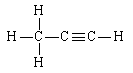
7.59 (a)  (b)
(b) 
Formal Charges
7.60 
For carbon: Isolated carbon
valence electrons 4
Bound carbon bonding electrons 6
Bound carbon
nonbonding electrons 2
Formal charge = 4 - ½(6) - 2 = -1
For oxygen:
Isolated oxygen valence electrons 6
Bound oxygen bonding electrons 6
Bound
oxygen nonbonding electrons 2
Formal charge = 6 - ½(6) - 2 = +1
7.61 (a) 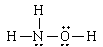
For hydrogen: Isolated
hydrogen valence electrons 1
Bound hydrogen bonding electrons 2
Bound
hydrogen nonbonding electrons 0
Formal charge = 1 - ½(2) - 0 = 0
For nitrogen: Isolated nitrogen valence
electrons 5
Bound nitrogen bonding electrons 6
Bound nitrogen nonbonding
electrons 2
Formal charge = 5 - ½(6) - 2 = 0
For oxygen: Isolated oxygen valence electrons
6
Bound oxygen bonding electrons 4
Bound oxygen nonbonding electrons
4
Formal charge = 6 - ½(4) - 4 = 0
(b) 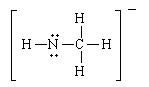
For hydrogen: Isolated
hydrogen valence electrons 1
Bound hydrogen bonding electrons 2
Bound
hydrogen nonbonding electrons 0
Formal charge = 1 - ½(2) - 0 = 0
For nitrogen: Isolated nitrogen valence
electrons 5
Bound nitrogen bonding electrons 4
Bound nitrogen nonbonding
electrons 4
Formal charge = 5 - ½(4) - 4 = -1
For carbon: Isolated carbon valence electrons
4
Bound carbon bonding electrons 8
Bound carbon nonbonding electrons
0
Formal charge = 4 - ½(8) - 0 = 0
(c) 
For chlorine: Isolated chlorine valence
electrons 7
Bound chlorine bonding electrons 2
Bound chlorine nonbonding
electrons 6
Formal charge = 7 - ½(2) - 6 = 0
For oxygen: Isolated oxygen valence electrons
6
Bound oxygen bonding electrons 2
Bound oxygen nonbonding electrons
6
Formal charge = 6 - ½(2) - 6 = -1
For phosphorus: Isolated phosphorus valence electrons
5
Bound phosphorus bonding electrons 8
Bound phosphorus nonbonding
electrons 0
Formal charge = 5 - ½(8) - 0 = +1
7.62 
For both oxygens: Isolated oxygen valence
electrons 6
Bound oxygen bonding electrons 2
Bound oxygen nonbonding
electrons 6
Formal charge = 6 - ½(2) - 6 = -1
For chlorine: Isolated chlorine valence
electrons 7
Bound chlorine bonding electrons 4
Bound chlorine nonbonding
electrons 4
Formal charge = 7 - ½(4) - 4 = +1

For left oxygen: Isolated oxygen valence
electrons 6
Bound oxygen bonding electrons 2
Bound oxygen nonbonding
electrons 6
Formal charge = 6 - ½(2) - 6 = -1
For right oxygen: Isolated oxygen valence
electrons 6
Bound oxygen bonding electrons 4
Bound oxygen nonbonding
electrons 4
Formal charge = 6 - ½(4) - 4 = 0
For chlorine: Isolated chlorine valence
electrons 7
Bound chlorine bonding electrons 6
Bound chlorine nonbonding
electrons 4
Formal charge = 7 - ½(6) - 4 = 0
7.63 
For sulfur: Isolated sulfur valence electrons
6
Bound sulfur bonding electrons 8
Bound sulfur nonbonding electrons
2
Formal charge = 6 - ½(8) - 2 = 0
For doubly Isolated oxygen valence electrons
6
bound oxygen: Bound oxygen bonding electrons 4
Bound oxygen nonbonding
electrons 4
Formal charge = 6 - ½(4) - 4 = 0
For oxygen Isolated oxygen valence electrons
6
bound to Bound oxygen bonding electrons 4
hydrogen: Bound oxygen
nonbonding electrons 4
Formal charge = 6 - ½(4) - 4 = 0
For hydrogen: Isolated hydrogen valence
electrons 1
Bound hydrogen bonding electrons 2
Bound hydrogen nonbonding
electrons 0
Formal charge = 1 - ½(2) - 0 = 0
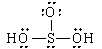
For sulfur: Isolated sulfur valence electrons
6
Bound sulfur bonding electrons 6
Bound sulfur nonbonding electrons
2
Formal charge = 6 - ½(6) - 2 = +1
For oxygen not Isolated oxygen valence electrons
6
bound to Bound oxygen bonding electrons 2
hydrogen: Bound oxygen
nonbonding electrons 6
Formal charge = 6 - ½(2) - 6 = - 1
For oxygen Isolated oxygen valence electrons
6
bound Bound oxygen bonding electrons 4
to hydrogen: Bound oxygen
nonbonding electrons 4
Formal charge = 6 - ½(4) - 4 = 0
For hydrogen: Isolated hydrogen valence
electrons 1
Bound hydrogen bonding electrons 2
Bound hydrogen nonbonding
electrons 0
Formal charge = 1 - ½(2) - 0 = 0
7.64 (a) 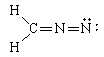
For hydrogen: Isolated hydrogen valence
electrons 1
Bound hydrogen bonding electrons 2
Bound hydrogen nonbonding
electrons 0
Formal charge = 1 - ½(2) - 0 = 0
For nitrogen: Isolated nitrogen valence
electrons 5
(central) Bound nitrogen bonding electrons 8
Bound nitrogen
nonbonding electrons 0
Formal charge = 5 - ½(8) - 0 = +1
For nitrogen: Isolated nitrogen valence
electrons 5
(terminal) Bound nitrogen bonding electrons 4
Bound nitrogen
nonbonding electrons 4
Formal charge = 5 - ½(4) - 4 = -1
For carbon: Isolated carbon valence electrons
4
Bound carbon bonding electrons 8
Bound carbon nonbonding electrons
0
Formal charge = 4 - ½(8) - 0 = 0
(b) 
For hydrogen: Isolated hydrogen valence
electrons 1
Bound hydrogen bonding electrons 2
Bound hydrogen nonbonding
electrons 0
Formal charge = 1 - ½(2) - 0 = 0
For nitrogen: Isolated
nitrogen valence electrons 5
(central) Bound nitrogen bonding electrons
6
Bound nitrogen nonbonding electrons 2
Formal charge = 5 - ½(6) - 2 =
0
For nitrogen: Isolated nitrogen valence
electrons 5
(terminal) Bound nitrogen bonding electrons 4
Bound nitrogen
nonbonding electrons 4
Formal charge = 5 - ½(4) - 4 = -1
For carbon: Isolated carbon valence electrons
4
Bound carbon bonding electrons 6
Bound carbon nonbonding electrons
0
Formal charge = 4 - ½(6) - 0 = +1
Structure (a) is more important because of the octet of electrons around carbon.
7.65 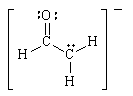
For oxygen: Isolated oxygen valence electrons
6
Bound oxygen bonding electrons 4
Bound oxygen nonbonding electrons
4
Formal charge = 6 - ½(4) - 4 = 0
For left carbon: Isolated carbon valence
electrons 4
Bound carbon bonding electrons 8
Bound carbon nonbonding
electrons 0
Formal charge = 4 - ½(8) - 0 = 0
For right carbon: Isolated carbon valence
electrons 4
Bound carbon bonding electrons 6
Bound carbon nonbonding
electrons 2
Formal charge = 4 - ½(6) - 2 = -1
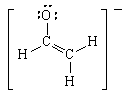
For oxygen: Isolated oxygen valence electrons
6
Bound oxygen bonding electrons 2
Bound oxygen nonbonding electrons
6
Formal charge = 6 - ½(2) - 6 = -1
For left carbon: Isolated carbon valence
electrons 4
Bound carbon bonding electrons 8
Bound carbon nonbonding
electrons 0
Formal charge = 4 - ½(8) - 0 = 0
For right carbon: Isolated carbon valence
electrons 4
Bound carbon bonding electrons 8
Bound carbon nonbonding
electrons 0
Formal charge = 4 - ½(8) - 0 = 0
The second structure is more important because of the -1 formal charge on the more electronegative oxygen.
The VSEPR Model
7.66 From data in Table 7.4: (a) trigonal planar (b) trigonal bipyramidal (c) linear (d) octahedral
7.67 From data in Table 7.4: (a) T shaped (b) bent (c) square planar
7.68 From data in Table 7.4: (a) tetrahedral, 4 (b) octahedral, 6 (c) bent, 3 or 4
(d) linear, 2 or 5 (e) square pyramidal, 6 (f) trigonal pyramidal, 4
7.69 From data in Table 7.4: (a) seesaw, 5 (b) square planar, 6 (c) trigonal bipyramidal, 5
(d) T shaped, 5 (e) trigonal planar, 3 (f) linear, 2 or 5
7.70
| Species | Number of Bonded Atoms |
Number of Lone Pairs |
Shape | |
| a | H2Se | 2 | 2 | bent |
| b | TiCl4 | 4 | 0 | tetrahedral |
| c | O3 | 2 | 1 | bent |
| d | GaH3 | 3 | 0 | trigonal planar |
7.71
| Species | Number of Bonded Atoms |
Number of Lone Pairs |
Shape | |
| a | XeO4 | 4 | 0 | tetrahedral |
| b | SO2Cl2 | 4 | 0 | tetrahedral |
| c | OsO4 | 4 | 0 | tetrahedral |
| d | SeO2 | 2 | 1 | bent |
7.72
| Species | Number of Bonded Atoms |
Number of Lone Pairs |
Shape | |
| a | SbF5 | 5 | 0 | trigonal bipyramidal |
| b | IF4+ | 4 | 1 | see saw |
| c | SeO32- | 3 | 1 | pyramidal |
| d | CrO42- | 4 | 0 | tetrahedral |
7.73
| Species | Number of Bonded Atoms |
Number of Lone Pairs |
Shape | |
| a | NO3- | 3 | 0 | trigonal planar |
| b | NO2+ | 2 | 0 | linear |
| c | NO2- | 2 | 1 | bent |
7.74
| Species | Number of Bonded Atoms |
Number of Lone Pairs |
Shape | |
| a | PO43- | 4 | 0 | tetrahedral |
| b | MnO4- | 4 | 0 | tetrahedral |
| c | SO42- | 4 | 0 | tetrahedral |
| d | SO32- | 3 | 1 | trigonal pyramidal |
| e | ClO4- | 4 | 0 | tetrahedral |
7.75
| Species | Number of Bonded Atoms |
Number of Lone Pairs |
Shape | |
| a | XeF3+ | 3 | 2 | T-shaped |
| b | SF3+ | 3 | 1 | trigonal pyramidal |
| c | ClF2+ | 2 | 2 | bent |
| d | CH3+ | 3 | 0 | trigonal planar |
7.76 (a) In SF2 the sulfur is bound
to two fluorines and contains two lone pairs of electrons. SF2 is
bent and the F-S-F bond angle is approximately 109.
(b) In
N2H2 each nitrogen is bound to the other nitrogen and one
hydrogen. Each nitrogen has one lone pair of electrons. The H-N-N bond angle is
approximately 120.
(c) In KrF4 the krypton is bound to four
fluorines and contains two lone pairs of electrons. KrF4 is square
planar, and the F-Kr-F bond angle is 90.
(d) In NOCl the nitrogen is bound to
one oxygen and one chlorine and contains one lone pair of electrons. NOCl is
bent, and the Cl-N-O bond angle is approximately 120.
7.77 (a) In PCl6- the
phosphorus is bound to six chlorines. There are no lone pairs of electrons on
the phosphorus. PCl6- is octahedral, and the Cl-P-Cl bond
angle is 90o.
(b) In ICl2- the iodine is
bound to two chlorines and contains three lone pairs of electrons.
ICl2- is linear, and the Cl-I-Cl bond angle is
180o.
(c) In SO42- the sulfur is bound to
four oxygens. There are no lone pairs of electrons on the sulfur.
SO42- is tetrahedral, and the O-S-O bond angle is
109.5o.
(d) In BO33- the boron is bound to
three oxygens. There are no lone pairs of electrons on the boron.
BO33- is trigonal planar, and the O-B-O bond angle is
120o.
7.78 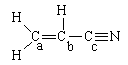 H
- Ca - H ~ 120o Cb - Cc - N
180o
H
- Ca - H ~ 120o Cb - Cc - N
180o
H - Ca - Cb ~
120o Ca - Cb - H ~ 120o
Ca
- Cb - Cc ~ 120o H -
Cb - Cc ~ 120o
7.79 
7.80 All six carbons in cyclohexane are bonded to two other carbons and two hydrogens (i.e. four charge clouds). The geometry about each carbon is tetrahedral with a C-C-C bond angle of approximately 109. Because the geometry about each carbon is tetrahedral, the cyclohexane ring cannot be flat.
7.81 All six carbon atoms are sp2 hybridized and the bond angles are ~120o. The geometry about each carbon is trigonal planar.
Hybrid Orbitals and Molecular Orbital Theory
7.82 In a bond, the shared electrons occupy a region above and below a line connecting the two nuclei. A bond has its shared electrons located along the axis between the two nuclei.
7.83 Electrons in a bonding molecular orbital spend most of their time in the region between the two nuclei, helping to bond the atoms together. Electrons in an antibonding molecular orbital cannot occupy the central region between the nuclei and cannot contribute to bonding.
7.84 See Table 7.5. (a) sp (b) sp3d (c) sp3d2 (d) sp3
7.85 See Table 7.5. (a) tetrahedral (b) octahedral (c) linear
7.86 See Table 7.5. (a) sp3 (b) sp3d2 (c) sp2 or sp3 (d) sp or sp3d (e) sp3d2
7.87 See Tables 7.4 and 7.5.
(a) seesaw, 5
charge clouds, sp3d
(b) square planar, 6 charge clouds,
sp3d2
(c) trigonal bipyramidal, 5 charge clouds,
sp3d
(d) T shaped, 5 charge clouds, sp3d
(e)
trigonal planar, 3 charge clouds, sp2
7.88 (a) sp2 (b) sp3 (c) sp3d2 (d) sp2
7.89 (a) sp3 (b) sp2 (c) sp2 (d) sp3
7.90 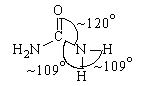 The C is
sp2 hybridized and the N atoms are sp3
hybridized.
The C is
sp2 hybridized and the N atoms are sp3
hybridized.
7.91 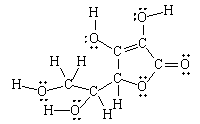
All carbons that have only single bonds are sp3 hybidized. The three carbons that have double bonds are sp2 hybridized.
7.92
O2+:
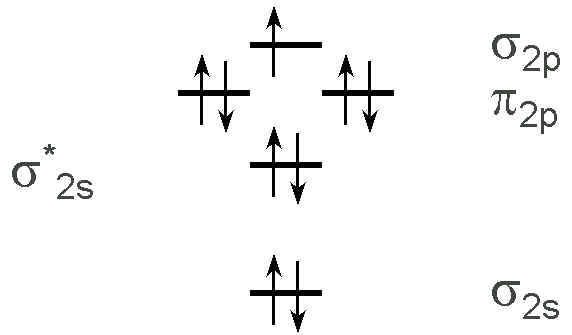
O2:
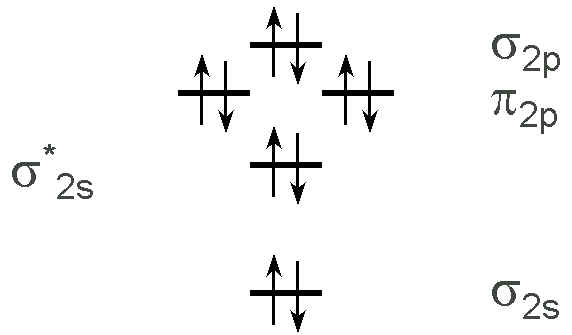
O2-:
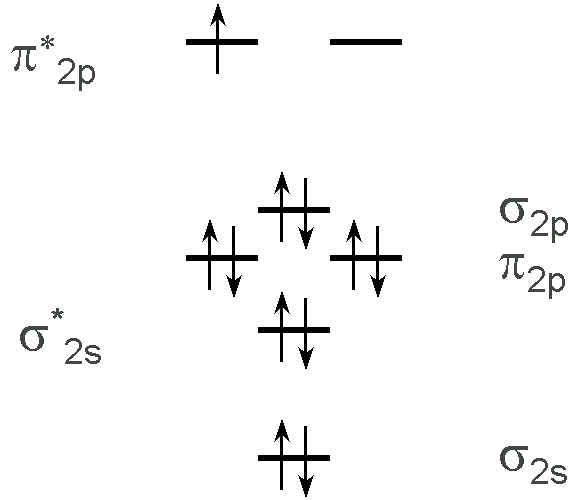
Bond order = 
 ;
;  ,
, 
All are stable
with bond orders between 1.5 and 2.5. All have unpaired electrons.
7.93
N2: 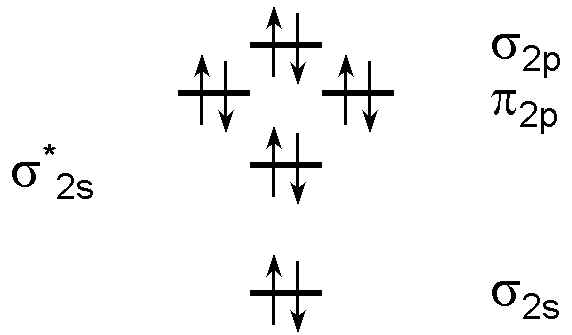
N2+: 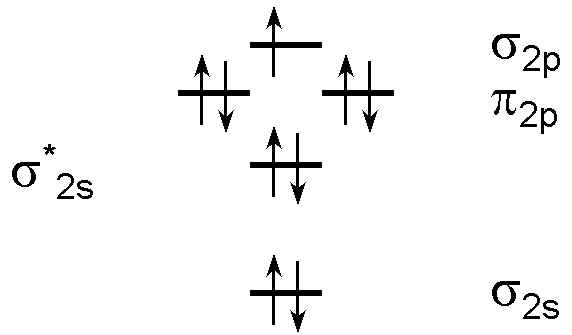
N2-: 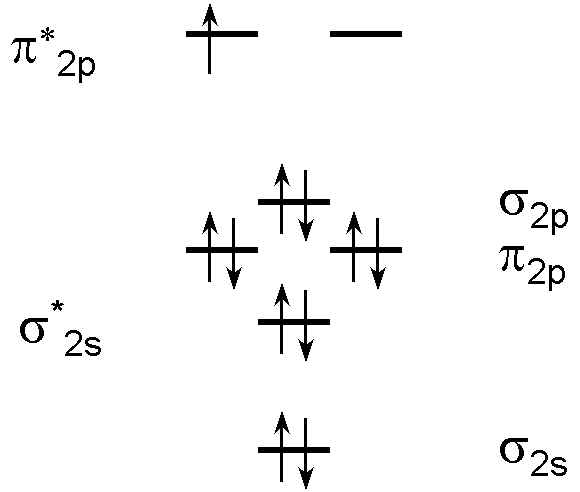
Bond order = 



All are stable with bond
orders of either 3 or 2.5. N2+ and
N2- contain unpaired electrons.
7.94 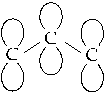 p orbitals in allyl
cation
p orbitals in allyl
cation
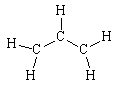 allyl cation
showing only the bonds (each C is sp2 hybridized)
allyl cation
showing only the bonds (each C is sp2 hybridized)
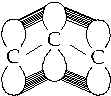 delocalized MO model for bonding in the allyl
cation
delocalized MO model for bonding in the allyl
cation
7.95 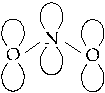 p orbitals in
NO2-
p orbitals in
NO2-
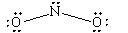 NO2- showing only the bonds (N is sp2
hybridized)
NO2- showing only the bonds (N is sp2
hybridized)
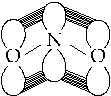 delocalized MO model for bonding in
NO2-
delocalized MO model for bonding in
NO2-
General
Problems
7.96 Every carbon is sp2 hybridized. There are 18 bonds and 5 bonds.
7.97 
For 
For oxygen: Isolated oxygen valence electrons
6
(top) Bound oxygen bonding electrons 2
Bound oxygen nonbonding electrons
6
Formal charge = 6 - ½(2) - 6 = -1
For oxygen: Isolated oxygen valence electrons
6
(middle) Bound oxygen bonding electrons 4
Bound oxygen nonbonding
electrons 4
Formal charge = 6 - ½(4) - 4 = 0
For oxygen: Isolated oxygen valence electrons
6
(left) Bound oxygen bonding electrons 4
Bound oxygen nonbonding
electrons 4
Formal charge = 6 - ½(4) - 4 = 0
For oxygen: Isolated oxygen valence electrons
6
(right) Bound oxygen bonding electrons 2
Bound oxygen nonbonding
electrons 6
Formal charge = 6 - ½(2) - 6 = -1
For sulfur: Isolated sulfur valence electrons
6
Bound sulfur bonding electrons 8
Bound sulfur nonbonding electrons
0
Formal charge = 6 - ½(8) - 0 = +2
For 
For oxygen: Isolated oxygen valence electrons
6
(top) Bound oxygen bonding electrons 2
Bound oxygen nonbonding electrons
6
Formal charge = 6 - ½(2) - 6 = -1
For oxygen: Isolated oxygen valence electrons
6
(middle) Bound oxygen bonding electrons 4
Bound oxygen nonbonding
electrons 4
Formal charge = 6 - ½(4) - 4 = 0
For oxygen: Isolated oxygen valence electrons
6
(left) Bound oxygen bonding electrons 2
Bound oxygen nonbonding
electrons 6
Formal charge = 6 - ½(2) - 6 = -1
For oxygen: Isolated oxygen valence electrons
6
(right) Bound oxygen bonding electrons 4
Bound oxygen nonbonding
electrons 4
Formal charge = 6 - ½(4) - 4 = 0
For sulfur: Isolated sulfur valence electrons
6
Bound sulfur bonding electrons 8
Bound sulfur nonbonding electrons
0
Formal charge = 6 - ½(8) - 0 = +2
For 
For oxygen: Isolated oxygen valence electrons
6
(top) Bound oxygen bonding electrons 2
Bound oxygen nonbonding electrons
6
Formal charge = 6 - ½(2) - 6 = -1
For oxygen: Isolated oxygen valence electrons
6
(middle) Bound oxygen bonding electrons 6
Bound oxygen nonbonding
electrons 2
Formal charge = 6 - ½(6) - 2 = +1
For oxygen: Isolated oxygen valence electrons
6
(left) Bound oxygen bonding electrons 2
Bound oxygen nonbonding
electrons 6
Formal charge = 6 - ½(2) - 6 = -1
For oxygen: Isolated oxygen valence electrons
6
(right) Bound oxygen bonding electrons 2
Bound oxygen nonbonding
electrons 6
Formal charge = 6 - ½(2) - 6 = -1
For sulfur: Isolated sulfur valence electrons
6
Bound sulfur bonding electrons 8
Bound sulfur nonbonding electrons
0
Formal charge = 6 - ½(8) - 0 = +2
7.98 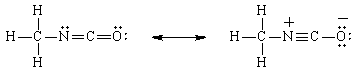
For 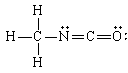
For hydrogen: Isolated hydrogen valence
electrons 1
Bound hydrogen bonding electrons 2
Bound hydrogen nonbonding
electrons 0
Formal charge = 1 - ½(2) - 0 = 0
For carbon: Isolated carbon valence electrons
4
(left) Bound carbon bonding electrons 8
Bound carbon nonbonding
electrons 0
Formal charge = 4 - ½(8) - 0 = 0
For nitrogen: Isolated nitrogen valence
electrons 5
Bound nitrogen bonding electrons 6
Bound nitrogen nonbonding
electrons 2
Formal charge = 5 - ½(6) - 2 = 0
For carbon: Isolated carbon valence electrons
4
(right) Bound carbon bonding electrons 8
Bound carbon nonbonding
electrons 0
Formal charge = 4 - ½(8) - 0 = 0
For oxygen: Isolated oxygen valence electrons
6
Bound oxygen bonding electrons 4
Bound oxygen nonbonding electrons
4
Formal charge = 6 - ½(4) - 4 = 0
For 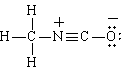
For hydrogen: Isolated hydrogen valence
electrons 1
Bound hydrogen bonding electrons 2
Bound hydrogen nonbonding
electrons 0
Formal charge = 1 - ½(2) - 0 = 0
For carbon: Isolated carbon valence electrons
4
(left) Bound carbon bonding electrons 8
Bound carbon nonbonding
electrons 0
Formal charge = 4 - ½(8) - 0 = 0
For nitrogen: Isolated nitrogen valence
electrons 5
Bound nitrogen bonding electrons 8
Bound nitrogen nonbonding
electrons 0
Formal charge = 5 - ½(8) - 0 = +1
For carbon: Isolated carbon valence electrons
4
(right) Bound carbon bonding electrons 8
Bound carbon nonbonding
electrons 0
Formal charge = 4 - ½(8) - 0 = 0
For oxygen: Isolated oxygen valence electrons
6
Bound oxygen bonding electrons 2
Bound oxygen nonbonding electrons
6
Formal charge = 6 - ½(2) - 6 = -1
7.99 
They are
geometric isomers not resonance forms. In resonance forms the atoms have the
same geometrical arrangement.
7.100 (a) 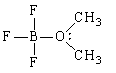
For boron: Isolated boron valence electrons
3
Bound boron bonding electrons 8
Bound boron nonbonding electrons
0
Formal charge = 3 - ½(8) - 0 = -1
For oxygen: Isolated oxygen valence electrons
6
Bound oxygen bonding electrons 6
Bound oxygen nonbonding electrons
2
Formal charge = 6 - ½ (6) - 2 = +1
(b) In BF3 the B has three bonding
pairs of electrons and no lone pairs. The B is sp2 hybridized and
BF3 is trigonal planar. is bent
about the oxygen because of two bonding pairs and two lone pairs of electrons.
The O is sp3 hybridized.
is bent
about the oxygen because of two bonding pairs and two lone pairs of electrons.
The O is sp3 hybridized.
In the product, B is sp3
hybridized (with four bonding pairs of electrons), and the geometry about it is
tetrahedral. The O is also sp3 hybridized (with three bonding pairs
and one lone pair of electrons), and the geometry about it is trigonal
pyramidal.
7.101 Both the B and N are sp2 hybridized. All bond angles are ~120o. The overall geometry of the molecule is planar.
7.102 The triply bonded carbon atoms are sp hybridized. The theoretical bond angle for C-CC is 180o. Benzyne is so reactive because the C-CC bond angle is closer to 120o and is very strained.
7.103 (a) (b)
(b) 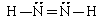 (c)
(c) 
7.104 
7.105 Li2 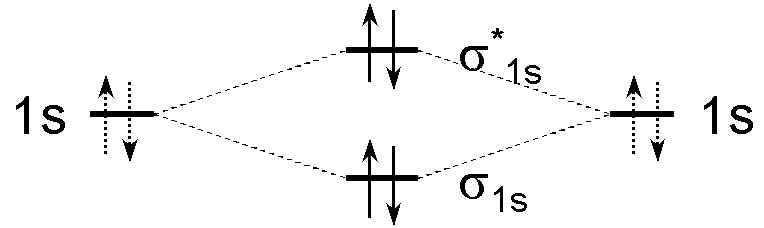
Li2 Bond order = 
The bond order for
Li2 is 1, and the molecule is likely to be stable.
7.106 C22-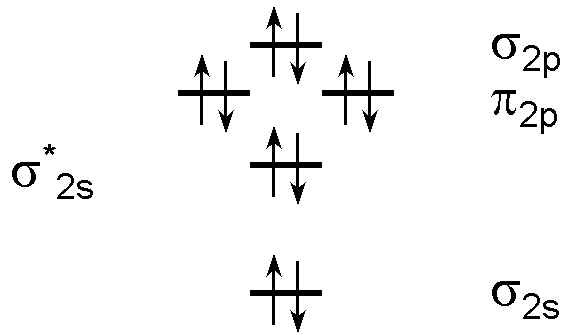
Bond order = 
 ; there
is a triple bond between the two carbons.
; there
is a triple bond between the two carbons.
7.107 (a) 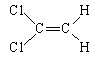 (b)
(b) 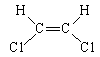 (c)
(c) 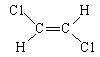
Structure (a) is different from structures (b) and (c) because both chlorines are on the same carbon. Structures (b) and (c) are different because in (b) both chlorines are on the same side of the molecule ("cis") and in (c) they are on opposite sides of the molecule ("trans"). There is no rotation around the carbon-carbon double bond.
7.108 CH4(g) + Cl2(g) ® CH3Cl(g) + HCl(g)
Energy change = D (bonds broken) -
D (bonds formed)
Energy change = [D(C-H) +
D(Cl-Cl)] - [D(C-Cl) + D(H-Cl)]
Energy change =
[(1 mol)(410 kJ/mol) + (1 mol)(243 kJ/mol] - [(1 mol)(330 kJ/mol) + (1 mol)(432
kJ/mol)] = -109 kJ
7.109 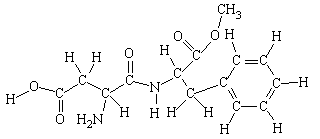
7.110 (a) (b)
(b)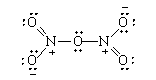 (c)
(c)
(d) (e)
(e)  (f)
(f) 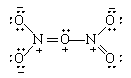
(g)  (h)
(h) 
Structures (a) - (d) make more important contributions to the
resonance hybrid because of only -1 and 0 formal charges on the
oxygens.
7.111 (a) (1) 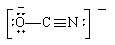 (2)
(2)  (3)
(3) 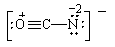
(b) Structure (1) makes the greatest
contribution to the resonance hybrid because of the -1 formal charge on the
oxygen. Structure (3) makes the least contribution to the resonance hybrid
because of the +1 formal charge on the oxygen.
(c) and (d) OCN- is
linear because the C has 2 charge clouds. It is sp hybridized in all three
resonance structures. It forms two bonds.
7.112 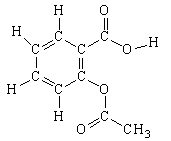
21s bonds
5 p bonds
Each C atom is sp2
hybridized.
Multi-Concept Problems
7.113 (a) (4 orbitals)(3 electrons) = 12
outer-shell electrons
(b) 3 electrons
(c) 1s3 2s3
2p6; 
(d) 
(e) 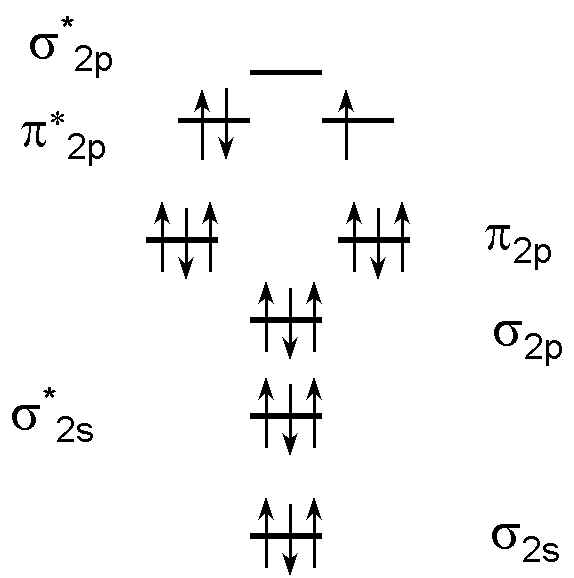
Bond order = 
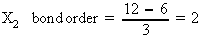
7.114 (a) 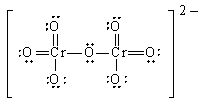
(b) Each Cr atom has 6 pairs of electrons around it. The likely geometry about each Cr atom is tetrahedral because each Cr has 4 charge clouds.
7.115 (a) XOCl2 + 2 H2O
® 2 HCl +
H2XO3
(b) 96.1 mL = 0.0961 L
mol NaOH = (0.1225
mol/L)(0.0961 L) = 0.01177 mol NaOH
mol H+ = 0.01177 mol NaOH x
 = 0.01177 mol H+
Of the total H+
concentration, half comes from HCl and half comes from
H2XO3.
mol H2XO3 =  x
x  = 2.943 x 10⁻³ mol H2XO3
mol
XOCl2 = 2.943 x 10⁻³ mol H2XO3 x
 = 2.943 x 10⁻³ mol XOCl2
molar mass
XOCl2 =  = 118.9
g/mol
= 118.9
g/mol
molecular mass of XOCl2 = 118.9 amu
atomic mass of X =
118.9 amu - 16.0 amu - 2(35.45 amu) = 32.0 amu: X = S
(c) 
(d) trigonal pyramidal