Chapter 6
Ionic Bonds and Some Main-Group
Chemistry
6.1 (a) Ra2+ [Rn] (b) La3+
[Xe] (c) Ti4+ [Ar] (d) N3- [Ne]
Each ion has the
ground-state electron configuration of the noble gas closest to it in the
periodic table.
6.2 The neutral atom contains 30 e-
and is Zn. The ion is Zn2+.
6.3 (a) O2-; decrease
in effective nuclear charge and an increase in electron-electron repulsions lead
to the larger anion.
(b) S; atoms get larger as you go down a group.
(c)
Fe; in Fe3+ electrons are removed from a larger valence shell and
there is an increase in effective nuclear charge leading to the smaller
cation.
(d) H-; decrease in effective nuclear charge and an
increase in electron-electron repulsions lead to the larger anion.
6.4 K+ is smaller than neutral K because the ion has one less electron. K+ and Cl- are isoelectronic, but K+ is smaller than Cl- because of its higher effective nuclear charge. K is larger than Cl- because K has one additional electron and that electron begins the next shell (period). K+, r = 133 pm; Cl-, r = 184 pm; K, r = 227 pm
6.5 (a) Br (b) S (c) Se (d) Ne
6.6 (a) Be 1s2 2s2 N
1s2 2s2 2p3
Be would have the larger third
ionization energy because this electron would come from the 1s orbital.
(b)
Ga [Ar] 4s2 3d10 4p1 Ge [Ar] 4s2
3d10 4p2
Ga would have the larger fourth
ionization energy because this electron would come from the 3d
orbitals.
6.7 (b) Cl has the highest Ei1 and
smallest Ei4.
6.8 Ca (red) would have the largest third
ionization energy of the three because the electron being removed is from a
filled valence shell. For Al (green) and Kr (blue), the electron being removed
is from a partially filled valence shell. The third ionization energy for Kr
would be larger than that for Al because the electron being removed from Kr is
coming out of a set of filled 4p orbitals while the electron being removed from
Al is coming out of a half-filled 3s orbital. In addition, Zeff is
larger for Kr than for Al. The ease of losing its third electron is Al < Kr
< Ca.
6.9 Cr [Ar] 4s1 3d5 Mn [Ar] 4s2 3d5 Fe [Ar] 4s2 3d6
Cr can accept an electron into a 4s orbital. The 4s orbital is lower in energy than a 3d orbital. Both Mn and Fe accept the added electron into a 3d orbital that contains an electron, but Mn has a lower value of Zeff. Therefore, Mn has a less negative Eea than either Cr or Fe.
6.10 The least favorable Eea is for Kr (red) because it is a noble gas with filled set of 4p orbitals. The most favorable Eea is for Ge (blue) because the 4p orbitals would become half filled. In addition, Zeff is larger for Ge than it is for K (green).
6.11 (a) KCl has the higher lattice energy
because of the smaller K+.
(b) CaF2 has the higher
lattice energy because of the smaller Ca2+.
(c) CaO has the higher
lattice energy because of the higher charge on both the cation and
anion.
6.12 K(s) K(g) +89.2 kJ/mol
K(g) ® K+(g) +
e- +418.8 kJ/mol
½ [F2(g) ®2 F(g)] +79 kJ/mol
F(g) +
e- ®
F-(g) -328 kJ/mol
K+(g) + F-(g) ® KF(s) -821
kJ/mol
Sum = -562 kJ/mol
6.13 The cation and anion charges are the same for both (a) and (b). The alkaline earth oxide with the larger lattice energy is (b) because the ions are smaller and the charges are closer to each other. In (a) the lattice energy is smaller because the ions are larger and the charges are farther apart.
6.14 (a) Li2O, O -2 (b) K2O2, O -1 (c) CsO2, O -½
6.15 (a) 2 Cs(s) + 2 H2O(l)
®2
Cs+(aq) + 2 OH-(aq) + H2(g)
(b) Na(s) +
N2(g) ®
N. R.
(c) Rb(s) + O2(g) ®RbO2(s)
(d) 2
K(s) + 2 NH3(g) ®2 KNH2(s) + H2(g)
(e) 2 Rb(s) +
H2(g) ®
2 RbH(s)
6.16 (a) Be(s) + Br2(l) ® BeBr2(s)
(b)
Sr(s) + 2 H2O(l) ® Sr(OH)2(aq) + H2(g)
(c) 2 Mg(s)
+ O2(g) ® 2 MgO(s)
6.17 BeCl2(s) + 2 K(s)
® Be(s) + 2
KCl(s)
6.18 Mg(s) + S(s) ® MgS(s); In MgS, the oxidation number of S is
-2.
6.19 2 Al(s) + 6 H+(aq) ® 2 Al3+(aq) + 3
H2(g)
H+ gains electrons and is the oxidizing agent. Al
loses electrons and is the reducing agent.
6.20 2 Al(s) + 3 S(s) ® Al2S3(s)
6.21 (a) Br2(l) + Cl2(g)
® 2 BrCl(g)
(b)
2 Al(s) + 3 F2(g) ® 2 AlF3(s)
(c) H2(g) +
I2(s) ®
2 HI(g)
6.22 Br2(l) + 2 NaI(s) ® 2 NaBr(s) +
I2(s)
Br2 gains electrons and is the oxidizing agent.
I- (from NaI) loses electrons and is the reducing agent.
6.23 (a) XeF2 F -1, Xe +2
(b)
XeF4 F -1, Xe +4
(c) XeOF4 F -1, O -2, Xe
+6
6.24 (a) Rb would lose one electron and adopt
the Kr noble-gas configuration.
(b) Ba would lose two electrons and adopt the
Xe noble-gas configuration.
(c) Ga would lose three electrons and adopt an
Ar-like noble-gas configuration (note that Ga3+ has ten 3d electrons
in addition to the two 3s and six 3p electrons).
(d) F would gain one
electron and adopt the Ne noble-gas configuration.
6.25 Group 6A elements will gain 2 electrons.
6.26 Only about 10% of current world salt production comes from evaporation of seawater. Most salt is obtained by mining the vast deposits of halite, or rock salt, formed by evaporation of ancient inland seas. These salt beds can be up to hundreds of meters thick and may occur anywhere from a few meters to thousands of meters below the earth's surface.
Understanding Key Concepts
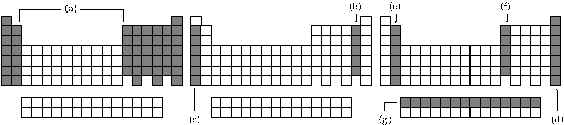
6.27
6.28 (a) shows an extended array,
which represents an ionic compound.
(b) shows discrete units, which represent
a covalent compound.
6.29 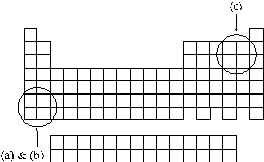
6.30 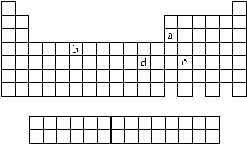
(a) Al3+ (b) Cr3+ (c) Sn2+ (d) Ag+
6.31 The first sphere gets larger
on going from reactant to product. This is consistent with it being a nonmetal
gaining an electron and becoming an anion. The second sphere gets smaller on
going from reactant to product. This is consistent with it being a metal losing
an electron and becoming a cation.
6.32 (a) I2 (b) Na (c) NaCl (d) Cl2
6.33 (c) has the largest lattice energy because
the charges are closest together.
(a) has the smallest lattice energy because
the charges are farthest apart.
6.34 Green CBr4: C, +4; Br,
-1
Blue SrF2: Sr, +2; F, -1
Red PbS: Pb, +2; S, -2 or
PbS2: Pb, +4; S, -2
6.35 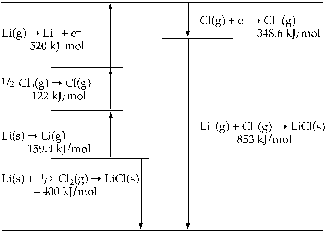
Additional
Problems
Ionization Energy and Electron Affinity
6.36 (a) La3+, [Xe] (b)
Ag+, [Kr] 4d10 (c) Sn2+, [Kr] 5s2
4d10
6.37 (a) Se2-, [Kr] (b) N3-,
[Ne]
6.38 Cr2+ [Ar] 3d4
Fe2+ [Ar]
3d6
6.39 Z = 30, Zn
6.40 Ionization energies have a positive sign because energy is required to remove an electron from an atom of any element.
6.41 Electron affinities have a negative sign because energy is released when an electron is added.
6.42 The largest Ei1 are found in
Group 8A because of the largest values of Zeff.
The smallest
Ei1 are found in Group 1A because of the smallest values of
Zeff.
6.43 Fr would have the smallest ionization energy, and
He would have the largest.
6.44 (a) K [Ar] 4s1 Ca [Ar]
4s2
Ca has the smaller second ionization energy because it is
easier to remove the second 4s valence electron in Ca than it is to remove the
second electron in K from the filled 3p orbitals.
(b) Ca [Ar] 4s2
Ga [Ar] 4s2 3d10 4p1
Ca has the larger third
ionization energy because it is more difficult to remove the third electron in
Ca from the filled 3p orbitals than it is to remove the third electron (second
4s valence electron) from Ga.
6.45 Sn has a smaller fourth ionization
energy than Sb because of a smaller Zeff.
Br has a larger sixth
ionization energy than Se because of a larger Zeff.
6.46 (a)
1s2 2s2 2p6 3s2 3p3 is P
(b) 1s2 2s2 2p6 3s2 3p6
is Ar (c) 1s2 2s2 2p6 3s2
3p6 4s2 is Ca
Ar has the highest Ei2.
Ar has a higher Zeff than P. The 4s electrons in Ca are easier to
remove than any 3p electrons.
Ar has the lowest Ei7. It is
difficult to remove 3p electrons from Ca, and it is difficult to remove 2p
electrons from P.
6.47 The atom in the third row with the lowest Ei4 is the 4A element, Si. 1s2 2s2 2p6 3s2 3p2
6.48 Using Figure 6.3 as a reference:
| Lowest Ei1 | Highest Ei1 | |
| (a) | K | Li |
| (b) | B | Cl |
| (c) | Ca | Cl |
6.49 (a) Group 2A (b) Group
6A
6.50 The relationship between the electron affinity of a univalent cation and the ionization energy of the neutral atom is that they have the same magnitude but opposite sign.
6.51 The relationship between the ionization energy of a univalent anion and the electron affinity of the neutral atom is that they have the same magnitude but opposite sign.
6.52 Na+ has a more negative electron affinity than either Na or Cl because of its positive charge.
6.53 Br would have a more negative electron affinity than Br- because Br- has no room in its valence shell for an additional electron.
6.54 Energy is usually released when an electron is added to a neutral atom but absorbed when an electron is removed from a neutral atom because of the positive Zeff.
6.55 Ei1 increases steadily across the periodic table from Group 1A to Group 8A because electrons are being removed from the same shell and Zeff is increasing. The electron affinity increases irregularly from 1A to 7A and then falls dramatically for Group 8A because the additional electron goes into the next higher shell.
6.56 (a) F; nonmetals have more negative
electron affinities than metals.
(b) Na; Ne (noble gas) has a positive
electron affinity.
(c) Br; nonmetals have more negative electron affinities
than metals.
6.57 Zn, Cd, and Hg all have filled s and d
subshells. An additional electron would have to go into the higher energy p
subshell. This is unfavorable and results in near-zero electron
affinities.
Lattice Energy and Ionic Bonds
6.58 MgCl2 > LiCl > KCl >
KBr
6.59 AlBr3 > CaO > MgBr2 >
LiBr
6.60 Li ® Li+ + e- +520 kJ/mol
Br +
e- ®
Br- -325 kJ/mol
Sum = +195 kJ/mol
6.61 The total energy = (376 kJ/mol) + (-349 kJ/mol) = +27 kJ/mol, which is unfavorable because it is positive.
6.62 Li(s) ® Li(g) +159.4 kJ/mol
Li(s)
Li(g) + e- +520 kJ/mol
½ [Br2(l) ® Br2(g)] +15.4
kJ/mol
½ [Br2(g) ® 2 Br(g)] +112 kJ/mol
Br(g) + e-
® Br-(g)
-325 kJ/mol
Li+ (g) + Br-(g) ® LiBr(s) -807 kJ/mol
Sum = -325 kJ/mol
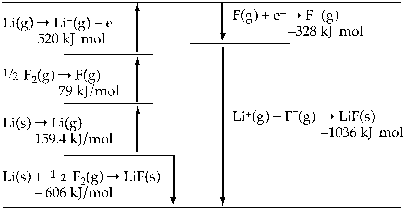
6.63 (a) Li(s) ® Li(g) +159.4 kJ/mol
Li(g)
® Li+(g)
+ e- +520 kJ/mol
½[F2(g) ® 2 F(g)] +79 kJ/mol
F(g) +
e- ®
F-(g) -328 kJ/mol
Li+(g) + F-(g)
® LiF(s) -1036
kJ/mol
Sum = -606 kJ/mol
(b) Ca(s) ® Ca(g) +178.2 kJ/mol
Ca(g) ® Ca+(g) +
e- +589.8 kJ/mol
Ca+(g) ® Ca2+(g) +
e- +1145 kJ/mol
F2(g) ®2 F(g) +158 kJ/mol
2[F(g) +
e- ®F-(g)] 2(-328) kJ/mol
Ca2+(g) +
2 F- ®
CaF2(s) -2630 kJ/mol
Sum = -1215 kJ/mol
6.64 Na(s) ® Na(g) +107.3 kJ/mol
Na(g)
® Na+(g)
+ e- +495.8 kJ/mol
½ [H2(g) ® 2 H(g)] +218.0 kJ/mol
H(g)
+ e- ®
H-(g) -72.8 kJ/mol
Na+(g) + H-(g)
® NaH(s) -U
Sum = -60 kJ/mol
- U = - 60 - 107.3 - 495.8 -  + 72.8 = -
808 kJ/mol; U = 808 kJ/mol
+ 72.8 = -
808 kJ/mol; U = 808 kJ/mol
6.65 Ca(s) ® Ca(g) +178.2 kJ/mol
Ca(g)
® Ca+(g)
+ e- +589.8 kJ/mol
Ca+(g) ® Ca2+(g) +
e- +1145 kJ/mol
H2(g) ® 2 H(g) +435.9 kJ/mol
2[H(g)
+ e- ®
H-(g)] 2(-72.8) kJ/mol
Ca2+(g) + 2 H-(g)
®
CaH2(s) -U
Sum = -186.2 kJ/mol
- U = -186.2 - 178.2 -
589.8 - 1145 - 435.9 + 2(72.8) = -2390 kJ/mol; U = 2390 kJ/mol
6.66 Cs(s) ® Cs(g) +76.1 kJ/mol
Cs(g)
® Cs+(g)
+ e- +375.7 kJ/mol
½ [F2(g) ® 2 F(g)] +79 kJ/mol
F(g) +
e- ®
F-(g) -328 kJ/mol
Cs+(g) + F-(g)
® CsF(g) -740
kJ/mol
Sum = -537 kJ/mol
6.67 Cs(s) Cs(g) +76.1 kJ/mol
Cs(g)
Cs+(g) + e- +375.7 kJ/mol
Cs+(g)
Cs2+(g) + e- +2422 kJ/mol
F2(g) 2 F(g) +158
kJ/mol
2[F(g) + e- F-(g)] 2(-328)
kJ/mol
Cs2+(g) + 2 F-(g) CsF2(s) -2347
kJ/mol
Sum = +29 kJ/mol
The overall reaction absorbs 29 kJ/mol.
In
the reaction of cesium with fluorine, CsF will form because the overall energy
for the formation of CsF is negative, whereas it is positive for
CsF2.
6.68 Ca(s) ® Ca(g) +178.2 kJ/mol
Ca(g)
® Ca+(g)
+ e- +589.8 kJ/mol
½[Cl2(g) ® 2 Cl(g)] +121.5 kJ/mol
Cl(g) + e- ® Cl-(g) -348.6 kJ/mol
Ca+(g) +
Cl-(g) ®
CaCl(s) -717 kJ/mol
Sum = -176 kJ/mol
6.69 Ca(s) ® Ca(g) + e- +178.2
kJ/mol
Ca(g) ®
Ca+(g) + e- +589.8 kJ/mol
Ca+(g)
®
Ca2+(g) +1145 kJ/mol
Cl2(g) ® 2 Cl(g) +243 kJ/mol
2[Cl(g)
+ e- ®
Cl-(g)] 2(-348.6) kJ/mol
Ca2+(g) + 2 Cl-(g)
®
CaCl2(s) -2258 kJ/mol
Sum = -799 kJ/mol
In the reaction of calcium with chlorine, CaCl2 will form because the overall energy for the formation of CaCl2 is much more negative than for the formation of CaCl.
6.70 
6.71
Main-Group
Chemistry
6.72 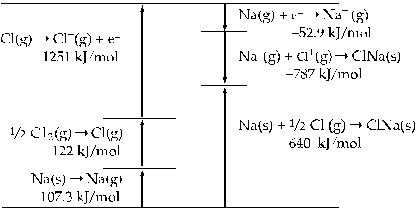
6.73
6.74 Solids: I2;
Liquids: Br2; Gases: F2, Cl2, He, Ne, Ar, Kr,
Xe
6.75 (a) Li is used in automotive grease.
Li2CO3 is a manic depressive drug.
(b) K salts are used
in plant fertilizers.
(c) SrCO3 is used in color TV picture tubes.
Sr salts are used for red fireworks.
(d) Liquid He (bp = 4.2 K) is used for
low temperature studies and for cooling superconducting magnets.
6.76 (a) At is in Group 7A. The
trend going down the group is gas liquid solid. At, being at the bottom of the
group, should be a solid.
(b) At would likely be dark, like I2,
maybe with a metallic sheen.
(c) At is likely to react with Na just like the
other halogens, yielding NaAt.
6.77 Predicted for Fr: melting point 23 oC, boiling point 650 oC, density 2 g/cm3, atomic radius 275 pm
6.78 (a) 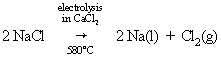
(b) 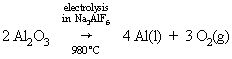
(c) Ar is obtained from the
distillation of liquid air.
(d) 2 Br-(aq) + Cl2(g)
Br2(l) + 2 Cl-(aq)
6.79 Group 1A metals react by losing an electron. Down Group 1A, the valence electron is more easily removed. This trend parallels chemical reactivity.
Group 7A nonmetals react by gaining an electron. The electron affinity generally increases up the group. This trend parallels chemical reactivity.
6.80 Main-group elements tend to undergo reactions that leave them with eight valence electrons. That is, main-group elements react so that they attain a noble-gas electron configuration with filled s and p sublevels in their valence electron shell.
The octet rule works for valence-shell electrons because taking electrons away from a filled octet is difficult because they are tightly held by a high Zeff; adding more electrons to a filled octet is difficult because, with s and p sublevels full, there is no low-energy orbital available.
6.81 Main-group nonmetals in the third period and below occasionally break the octet rule.
6.82 (a) 2 K(s) + H2(g) ® 2 KH(s)
(b) 2 K(s) + 2
H2O(l) ®
2 K+(aq) + 2 OH-(aq) + H2(g)
(c) 2 K(s) + 2
NH3(g) ®
2 KNH2(s) + H2(g)
(d) 2 K(s) + Br2(l)
® 2 KBr(s)
(e)
K(s) + N2(g) ® N. R.
(f) K(s) + O2(g) ® KO2(s)
6.83 (a) Ca(s) + H2(g) ® CaH2(s)
(b)
Ca(s) + 2 H2O(l) ® Ca2+(aq) + 2 OH-(aq) +
H2(g)
(c) Ca(s) + He(g) ® N. R.
(d) Ca(s) + Br2(l) ® CaBr2(s)
(e) 2
Ca(s) + O2(g) ® 2 CaO(s)
6.84 (a) Cl2(g) + H2(g)
® 2 HCl(g)
(b)
Cl2(g) + Ar(g) ® N. R.
(c) Cl2(g) + Br2(l)
® 2 BrCl(g)
(d)
Cl2(g) + N2(g) ® N. R.
6.85 (a) 2 Cl-(aq) + F2(g)
® 2
F-(aq) + Cl2(g)
F2 gains electrons and is
the oxidizing agent. Cl- loses electrons and is the reducing
agent.
(b) 2 Br-(aq) + I2(s) ® N. R.
(c) 2
I-(aq) + Br2(aq) ® 2 Br-(aq) +
I2(aq)
Br2 gains electrons and is the oxidizing agent.
I- loses electrons and is the reducing agent.
6.86 AlCl3 + 3 Na ® Al + 3 NaCl
Al3+
(from AlCl3) gains electrons and is reduced. Na loses electrons and
is oxidized.
6.87 2 Mg(s) + O2(g) ® 2 MgO(s)
MgO(s) +
H2O(l) ®
Mg(OH)2(aq)
6.88 CaIO3, 215.0 amu; 1.00 kg = 1000
g
% I =  x 100% = 59.02%; (0.5902)(1000 g) = 590 g I2
6.89 2 Li(s) + 2 H2O(l) 2 LiOH(aq) +
H2(g); 455 mL = 0.455 L
mass of H2 = (0.0893  )
(0.455 L) = 0.0406 g H2
)
(0.455 L) = 0.0406 g H2

6.90 Ca(s) + H2(g)
CaH2(s); H2, 2.016 amu; CaH2, 42.09 amu
5.65
g Ca x  = 0.141 mol Ca
3.15 L H2 x 0.0893  = 0.140
mol H2
= 0.140
mol H2
Because the reaction stoichiometry between Ca and
H2 is one to one, H2 is the limiting reactant.
0.140
mol H2 x  x 0.943 = 5.56 g CaH2
6.91 6 Li(s) + N2(g) ® 2 Li3N(s);
N2, 28.01 amu; Li3N, 34.83 amu
2.87 g Li x  = 1.54 L N2
6.92 (a) Mg(s) + 2 H+(aq)
®
Mg2+(aq) + H2(g)
H+ gains electrons and is
the oxidizing agent. Mg loses electrons and is the reducing agent.
(b) Kr(g)
+ F2(g) ® KrF2(s)
F2 gains electrons and
is the oxidizing agent. Kr loses electrons and is the reducing agent.
(c)
I2(s) + 3 Cl2(g) ® 2 ICl3(l)
Cl2 gains electrons
and is the oxidizing agent. I2 loses electrons and is the reducing
agent.
6.93 (a) 2 XeF2(s) + 2
H2O(l) ®
2 Xe(g) + 4 HF(aq) + O2(g)
Xe in XeF2 gains electrons
and is the oxidizing agent. O in H2O loses electrons and is the
reducing agent.
(b) NaH(s) + H2O(l) ® Na+(aq) +
OH-(aq) + H2(g)
H in H2O gains electrons and
is the oxidizing agent. H in NaH loses electrons and is the reducing
agent.
(c) 2 TiCl4(l) + H2(g) ® 2 TiCl3(s) + 2
HCl(g)
Ti in TiCl4 gains electrons and is the oxidizing agent.
H2 loses electrons and is the reducing agent.
General Problems
6.94 Cu2+ has fewer electrons and a larger effective nuclear charge; therefore it has the smaller ionic radius.
6.95 S2- > Ca2+ > Sc3+ > Ti4+, Zeff increases on going from S2- to Ti4+.
6.96 Mg(s) ® Mg(g) +147.7 kJ/mol
Mg(g)
® Mg+(g)
+ e- +737.7 kJ/mol
½[F2(g) ® 2 F(g)] +79 kJ/mol
F(g) +
e- ®
F-(g) -328 kJ/mol
Mg+(g) + F-(g)
® MgF(s) -930
kJ/mol
Sum = -294 kJ/mol
Mg(s) ® Mg(g) +147.7 kJ/mol
Mg(g) ® Mg+(g) +
e- +737.7 kJ/mol
Mg+(g) ® Mg2+(g) +
e- +1450.7 kJ/mol
F2(g) ® 2 F(g) +158 kJ/mol
2[F(g) +
e- ®
F-(g)] 2(-328) kJ/mol
Mg2+(g) + 2 F-(g)
®
MgF2(s) -2952 kJ/mol
Sum = -1114 kJ/mol
6.97 In the reaction of magnesium with fluorine, MgF2 will form because the overall energy for the formation of MgF2 is much more negative than for the formation of MgF.
6.98 (a) Na is used in table salt (NaCl), glass,
rubber, and pharmaceutical agents.
(b) Mg is used as a structural material
when alloyed with Al.
(c) F2 is used in the manufacture of Teflon,
(C2F4)n, and in toothpaste as
SnF2.
6.99 (a) 
(b) 
(c) 
6.100 (a) 2 Li(s) + H2(g)
® 2 LiH(s)
(b) 2
Li(s) + 2 H2O(l) ® 2 Li+(aq) + 2 OH-(aq) +
H2(g)
(c) 2 Li(s) + 2 NH3(g) ® 2 LiNH2(s) +
H2(g)
(d) 2 Li(s) + Br2(l) ® 2 LiBr(s)
(e) 6 Li(s) +
N2(g) ®
2 Li3N(s)
(f) 4 Li(s) + O2(g) ® 2
Li2O(s)
6.101 (a) F2(g) + H2(g)
® 2 HF(g)
(b)
F2(g) + 2 Na(s) ® 2 NaF(s)
(c) F2(g) + Br2(l)
® 2 BrF(g)
(d)
F2(g) + 2 NaBr(s) ® 2 NaF(g) + Br2(l)
6.102 When moving diagonally down and right on the periodic table, the increase in atomic radius caused by going to a larger shell is offset by a decrease caused by a higher Zeff. Thus, there is little net change.
6.103 Na(s) ® Na(g) +107.3 kJ/mol
Na(g) +
e- ®
Na-(g) -52.9 kJ/mol
½[Cl2(g) ® 2 Cl(g)] +122 kJ/mol
Cl(g)
® Cl+(g)
+ e- +1251 kJ/mol
Na-(g) + Cl+(g)
® ClNa(s) -787
kJ/mol
Sum = +640 kJ/mol
The formation of Cl+Na- from its elements is not favored because the net energy change is positive whereas for the formation of Na+Cl- it is negative.
6.104
6.105 94.2 mL = 0.0942 L
0.0942 L Cl2 x 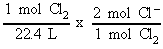 = 8.41 x
10-3 mol Cl-
= 8.41 x
10-3 mol Cl-
Possible formulas for the metal halide are
MCl, MCl2, MCl3, etc.
For MCl, mol M = mol
Cl- = 8.41 x 10⁻³ mol M
molar mass of M = 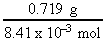 = 85.5
g/mol
= 85.5
g/mol
For MCl2, mol M = 8.41 x 10⁻³ mol Cl-
x  = 4.20 x 10⁻³ mol M
molar mass of M =  = 171
g/mol
= 171
g/mol
For MCl3, mol M = 8.41 x 10⁻³ mol Cl-
x  = 2.80 x 10⁻³ mol M
molar mass of M = 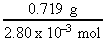 = 257
g/mol
= 257
g/mol
The best match for a metal is with 85.5 g/mol, which is Rb.
6.106 Mg(s) ® Mg(g) +147.7 kJ/mol
Mg(g)
® Mg+(g)
+ e- +738 kJ/mol
Mg+(g) ® Mg2+(g) + e-
+1451 kJ/mol
½[O2(g) ® 2 O(g)] +249.2 kJ/mol
O(g) + e-
® O-(g)
-141.0 kJ/mol
O-(g) + e- ® O2-(g)
Eea2
Mg2+(g) + O2-(g) ® MgO(s) -3791
kJ/mol
Mg(s) + ½O2(g) ® MgO(s) -601.7 kJ/mol
147.7 + 738 + 1451 + 249.2 - 141.0 +
Eea2 - 3791 = -601.7
Eea2 = -147.7 - 738 - 1451 - 249.2
+ 141.0 + 3791 - 601.7 = +744 kJ/mol
Because Eea2 is positive,
O2- is not stable in the gas phase. It is stable in MgO because of
the large lattice energy that results from the +2 and -2 charge of the ions and
their small size.
Multi-Concept Problems
6.107 (a) 58.4 nm = 58.4 x 10⁻⁹
m
E(photon) = 6.626 x 10⁻³⁴ Js x  = 2049
kJ/mol
= 2049
kJ/mol
EK = E(electron) = ½(9.109 x 10⁻³¹ kg)(2.450 x
106 m/s)2
EK = 1646
kJ/mol
E(photon) = Ei + EK; Ei = E(photon) -
EK = 2049 - 1646 = 403 kJ/mol
(b) 142 nm = 142 x
10-9 m

E(photon) = Ei + EK;
Ei = E(photon) - EK = 843 - 422 = 421 kJ/mol
6.108
AgCl, 143.32 amu
(a) mass Cl in AgCl = 1.126 g AgCl x  = 0.279 g Cl
%Cl in alkaline earth chloride =  x 100% =
64.0% Cl
x 100% =
64.0% Cl
(b) Because M is an alkaline earth metal, M is a
2+ cation.
For MCl2, mass of M = 0.436 g - 0.279 g = 0.157 g
M
mol M = 0.279 g Cl x  = 0.003
93 mol M
= 0.003
93 mol M
molar mass for M =  = 39.9
g/mol; M = Ca
= 39.9
g/mol; M = Ca
(c) Ca(s) + Cl2(g) ®
CaCl2(s)
CaCl2(aq) + 2 AgNO3(aq)
® 2 AgCl(s) +
Ca(NO3)2(aq)
(d) 1.005 g Ca x  = 0.0251
mol Ca
= 0.0251
mol Ca
1.91 x 10²² Cl2 molecules x 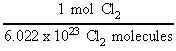 = 0.0317
mol Cl2
= 0.0317
mol Cl2
Because the stoichiometry between Ca and Cl2 is
one to one, the Cl2 is in excess.
Mass Cl2 unreacted =
(0.0317 - 0.0251) mol Cl2 x  = 0.47 g
Cl2 unreacted
= 0.47 g
Cl2 unreacted
6.109 (a) (i) M2O3(s) + 3 C(s) + 3
Cl2(g) ®
2 MCl3(l) + 3 CO(g)
(ii) 2 MCl3(l) + 3 H2(g)
® 2 M(s) + 6
HCl(g)
(b) HCl(aq) + NaOH(aq) ® H2O(l) + NaCl(aq)
144.2 mL = 0.1442
L
mol NaOH = (0.511 mol/L)(0.1442 L) = 0.07369 mol NaOH
mol HCl = 0.07369
mol NaOH x  = 0.07369 mol HCl
mol M = 0.07369 mol HCl x  = 0.02456 mol M
mol M2O3 = 0.02456 mol M x
 x
x  = 0.01228 mol M2O3
molar mass
M2O3 =  = 69.6
g/mol; molecular mass M2O3 = 69.6 amu
= 69.6
g/mol; molecular mass M2O3 = 69.6 amu
atomic mass of M
= 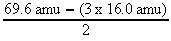 = 10.8 amu; M = B
(c) mass of M = 0.02456 mol M x  = 0.265 g M
6.110 (a) Sr(s) ® Sr(g) +164.44
kJ/mol
Sr(g) ®Sr+(g) + e- +549.5
kJ/mol
Sr+(g) ® Sr2+(g) + e- +1064.2
kJ/mol
Cl2(g) ® 2 Cl(g) +243 kJ/mol
2[Cl(g) + e-
®
Cl-(g)] 2(-348.6) kJ/mol
Sr2+(g) + 2 Cl-(g)
®
SrCl2(s) -2156 kJ/mol
Sum = -832 kJ/mol for Sr(s) +
Cl2(g) ®
SrCl2(s)
(b) Sr, 87.62 amu; Cl2, 70.91 amu;
SrCl2, 158.53 amu
Sr(s) + Cl2(g) ® SrCl2(s)
20.0 g
Sr x  = 0.228 mol Sr and 25.0 g Cl2 x
  = 0.353
mol Cl2
= 0.353
mol Cl2
Because there is a 1:1 stoichiometry between the
reactants, the one with the smaller mole amount is the limiting reactant. Sr is
the limiting reactant.
0.228 mol Sr x 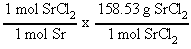 = 36.1 g
SrCl2
= 36.1 g
SrCl2
(c) 0.228 mol SrCl2 x  = -190
kJ
= -190
kJ
190 kJ is released during the reaction of 20.0 g of Sr with 25.0 g
Cl2.