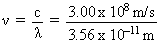
 = 8.43 x 10¹⁸ s-1 = 8.43 x
1018 Hz
= 8.43 x 10¹⁸ s-1 = 8.43 x
1018 HzChapter 5
Periodicity and Atomic
Structure
5.1 Gamma ray = 8.43 x 10¹⁸ s-1 = 8.43 x
1018 Hz
Radar wave 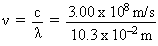 = 2.91 x 10⁹ s-1 = 2.91 x
109 Hz
= 2.91 x 10⁹ s-1 = 2.91 x
109 Hz
5.2 102.5 MHz = 102.5 x10⁶ Hz = 102.5 x10⁶ s-1
 = 9.55 x 10¹⁷ Hz = 9.55 x 10¹⁷
s-1
= 9.55 x 10¹⁷ Hz = 9.55 x 10¹⁷
s-1

5.3 The wave with the shorter wavelength (b) has the higher frequency. The wave with the larger amplitude (b) represents the more intense beam of light. The wave with the shorter wavelength (b) represents blue light. The wave with the longer wavelength (a) represents red light.
5.4 Balmer series: m = 2; R = 1.097 x 10⁻² nm-1
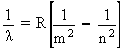 ;
; 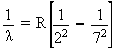 ;
;  2.519 x
10-3 nm-1; = 397.0 nm
2.519 x
10-3 nm-1; = 397.0 nm
5.5 Paschen series: m = 3; R = 1.097 x 10⁻² nm-1
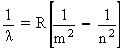 ;
; 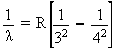 ;
;  = 5.333 x
10-4 nm-1; = 1875 nm
= 5.333 x
10-4 nm-1; = 1875 nm
5.6 Paschen series: m = 3; R = 1.097 x 10⁻² nm-1
 ;
; 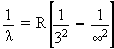 ;
;  = 1.219 x
10-3 nm-1; = 820.4 nm
= 1.219 x
10-3 nm-1; = 820.4 nm
5.7 91.2 nm = 91.2 x 10⁻⁹ m
 = 3.29 x 10¹⁵ s-1
E = h = (6.626 x
10-34 Js)(3.29 x 10¹⁵ s-1) = 2.18 x
10-18 J/photon
E = (2.18 x 10⁻¹⁸ J/photon)(6.022 x
1023 photons/mol) = 1.31 x 10⁶ J/mol = 1310 kJ/mol
5.8 IR, = 1.55 x 10⁻⁶ m
E = 7.72 x 10⁴ J/mol = 77.2
kJ/mol
UV, = 250 nm = 250 x 10-9 m
E = 4.79 x 10⁵
J/mol = 479 kJ/mol
X ray, = 5.49 nm = 5.49 x 10⁻⁹ m
E = 2.18 x
107 J/mol = 2.18 x 10⁴ kJ/mol
5.9  = 2.34 x
10-38 m
= 2.34 x
10-38 m
5.10 (x)(mv)  ;
uncertainty in velocity = (45 m/s)(0.02) = 0.9 m/s
;
uncertainty in velocity = (45 m/s)(0.02) = 0.9 m/s

5.11
| n | l | ml | Orbital | No. of Orbitals |
| 5 | 0 | 0 | 5s | 1 |
| 1 | -1,0,+1 | 5p | 3 | |
| 2 | -2,-1,0,+1,+2 | 5d | 5 | |
| 3 | -3,-2,-1,0,1,2,3 | 5f | 7 | |
| 4 | -4,-3,-2,-1,0,1,2,3,4 | 5g | 9 |
There are 25 possible orbitals in the fifth shell.
5.12 (a) 2p (b) 4f (c) 3d
5.13 (a) 3s orbital: n = 3, l = 0, ml = 0
(b)
2p orbital: n = 2, l = 1, ml = -1, 0, +1
(c) 4d
orbital: n = 4, l = 2, ml = -2, -1, 0, +1, +2
5.14 The g orbitals have four nodal planes.
5.15 The figure represents
a d orbital, n = 4 and l = 2.
5.16 m = 1, n = ; R = 1.097 x
10-2 nm-1 ;
;  ;
;  = 1.097 x 10⁻² nm-1; = 91.2 nm
E = 
E = 1.31 x 10⁶ J/mol = 1.31 x 10³ kJ/mol
5.17
(a) Ti, 1s2 2s2 2p6 3s2 3p6
4s2 3d2 or [Ar] 4s2 3d2
(b) Zn, 1s2 2s2 2p6 3s2 3p6 4s2 3d10 or [Ar] 4s2 3d10
(c) Sn, 1s2 2s2 2p6 3s2 3p6 4s2 3d10 4p6 5s2 4d10 5p2 or [Kr] 5s2 4d10 5p2
(d) Pb, [Xe] 6s2 4f14 5d10 6p2
5.18 For Na+, 1s2 2s2 2p6
5.19 The ground-state electron configuration contains 28 electrons. The atom is Ni.
5.20 Cr, Cu, Nb, Mo, Ru, Rh, Pd, Ag, La, Ce, Gd, Pt, Au, Ac, Th, Pa, U, Np, Cm
5.21 (a) Ba; atoms get larger as you go down a group.
(b) W; atoms get
smaller as you go across a period.
(c) Sn; atoms get larger as you go down a
group.
(d) Ce; atoms get smaller as you go across a period.
5.22 The aurora borealis begins on the surface of the sun with a massive solar flare. These flares eject a solar "gas" of energetic protons and electrons that reach earth after about 2 days and are then attracted toward the north and south magnetic poles. The energetic electrons are deflected by the earth's magnetic field into a series of sheetlike beams. The electrons then collide with O2 and N2 molecules in the upper atmosphere, exciting them, ionizing them, and breaking them apart into O and N atoms. The energetically excited atoms, ions, and molecules generated by collisions with electrons emit energy of characteristic wavelengths when they decay to their ground states. The O2+ ions emit a red light around 630 nm; N2+ ions emit violet and blue light at 391.4 nm and 470.0 nm; and O atoms emit a greenish-yellow light at 557.7 nm and a deep red light at 630.0 nm.
Understanding Key Concepts
5.23 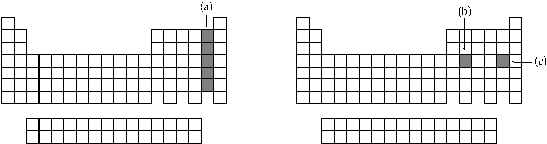
5.24 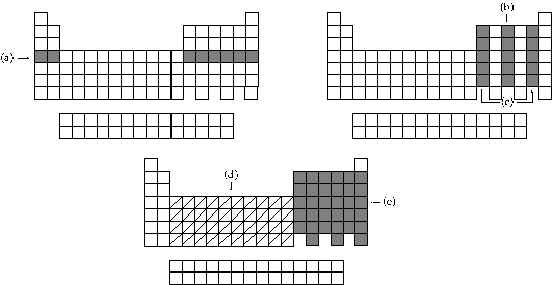
5.25 The wave with the larger amplitude (a) has the greater intensity. The wave with the shorter wavelength (a) has the higher energy radiation. The wave with the shorter wavelength (a) represents yellow light. The wave with the longer wavelength (b) represents infrared radiation.
5.26 [Ar] 4s2 3d10 4p1 is Ga.
5.27
5.28 Ca and Br are in the same period, with Br to the far right of Ca. Ca is larger than Br. Sr is directly below Ca in the same group, and is larger than Ca. The result is
Sr (215 pm) > Ca (197 pm) > Br (114 pm)
5.29 (a) 3py n = 3, l = 1 (b)  n = 4, l = 2
Additional Problems
Electromagnetic Radiation
5.30 Violet has the higher frequency and energy. Red has the higher wavelength.
5.31 Ultraviolet light has the higher frequency and the higher energy. Infrared light has the higher wavelength.
5.32 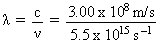 = 5.5 x
10-8 m
= 5.5 x
10-8 m
5.33 
5.34 (a) = 99.5 MHz = 99.5 x
106 s-1
E = h = (6.626 x 10⁻³⁴ Js)(99.5 x
106 s-1)(6.022 x 10²³ /mol)
E = 3.97 ×
10-2 J/mol = 3.97 × 10⁻⁵ kJ/mol
= 115.0 kHz = 115.0 x
103 s-1
E = h = (6.626 x 10⁻³⁴ Js)(115.0 x
103 s-1)(6.022 x 10²³ /mol)
E = 4.589 x
10-5 J/mol = 4.589 x 10⁻⁸ kJ/mol
The FM radio wave
(99.5 MHz) has the higher energy.
(b) = 3.44 x 10⁻⁹ m
E = 3.48 x 10⁷ J/mol = 3.48 x
104 kJ/mol
= 6.71 × 10⁻² m
E = 1.78 J/mol = 1.78 x 10⁻³
kJ/mol
The X ray ( = 3.44 x 10⁻⁹ m) has the higher
energy.
5.35 400 MHz = 400 x 106 s-1
E =
(6.626 x 10⁻³⁴ Js)(400 x 106 s-1)(6.02 x
1023/mol) = 0.160 J/mol = 1.60 x 10⁻⁴ kJ/mol
5.36 (a) E
= 90.5 kJ/mol x  = 1.50 x 10⁻¹⁹ J
 = 2.27 x
1014 s-1
= 2.27 x
1014 s-1
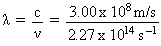 = 1.32 x
10-6 m = 1320 x 10-9 m = 1320 nm, near IR
= 1.32 x
10-6 m = 1320 x 10-9 m = 1320 nm, near IR
(b) E = 8.05 x 10⁻⁴ kJ/mol x 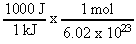 = 1.34 x 10⁻²⁴ J
 = 2.02 x
109 s-1
= 2.02 x
109 s-1
 = 0.149
m, radio wave
= 0.149
m, radio wave
(c) E = 1.83 x 10³ kJ/mol x  = 3.04 x 10⁻¹⁸ J
 = 4.59 x
1015 s-1
= 4.59 x
1015 s-1
 = 6.54 x
10-8 m = 65.4 x 10⁻⁹ m = 65.4 nm, UV
= 6.54 x
10-8 m = 65.4 x 10⁻⁹ m = 65.4 nm, UV
5.37 (a) 
E = 2.38 x 10⁷ kJ/mol
(b) 
E = 5.03 x 10⁻⁷ kJ/mol
(c) 
E = 4.66 x 10⁻⁷ kJ/mol
5.38  = 2.45 x
10-12 m, ray
= 2.45 x
10-12 m, ray
5.39  = 5.28 x
10-15 m, ray
= 5.28 x
10-15 m, ray
5.40 156 km/h = 156 x 103 m/3600 s = 43.3 m/s; 145 g = 0.145 kg

5.41 1.55 mg = 1.55 x 10⁻³ g = 1.55 x 10⁻⁶ kg
 = 3.10 x
10-28 m
= 3.10 x
10-28 m
5.42 145 g = 0.145 kg; 0.500 nm = 0.500 x 10⁻⁹ m

5.43 750 nm = 750 x 10-9 m = 970 m/s
Atomic Spectra
5.44 For n = 3; = 656.3 nm = 656.3 x 10⁻⁹ m

For n = 4; = 486.1 nm = 486.1 x 10⁻⁹ m

For n = 5; = 434.0 nm = 434.0 x 10⁻⁹ m

5.45 m = 2, n = ; R = 1.097 x 10⁻² nm-1
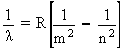 ;
;  ;
;  = 2.74 x 10⁻³ nm-1; = 364.6
nm
= 2.74 x 10⁻³ nm-1; = 364.6
nm
5.46 From problem 5.45, for n = , = 364.6 nm = 364.6 x 10⁻⁹ m

5.47 Brackett series: m = 4, n = 5; R = 1.097 x 10⁻² nm-1
 ;
;  = 2.468 x 10⁻⁴ nm-1; = 4051 nm

Brackett series: m = 4, n = 6; R = 1.097 x 10⁻² nm-1
 ;
;  = 3.809 x 10⁻⁴ nm-1; = 2625 nm

5.48 = 330 nm = 330 x 10-9 m

5.49 795 nm = 795 x 10-9 m

Orbitals and Quantum Numbers
5.50 n is the principal quantum number. The size
and energy level of an orbital depends on n.
l is the
angular-momentum quantum number. l defines the three-dimensional shape
of an orbital.
ml is the magnetic quantum number.
ml defines the spatial orientation of an
orbital.
ms is the spin quantum number. ms indicates
the spin of the electron and can have either of two values, +½ or -½.
5.51 The Heisenberg uncertainty principle states that one can never know both the position and the velocity of an electron beyond a certain level of precision. This means we cannot think of electrons circling the nucleus in specific orbital paths, but we can think of electrons as being found in certain three-dimensional regions of space around the nucleus, called orbitals.
5.52 The probability of finding the electron drops off rapidly as distance from the nucleus increases, although it never drops to zero, even at large distances. As a result, there is no definite boundary or size for an orbital. However, we usually imagine the boundary surface of an orbital enclosing the volume where an electron spends 95% of its time.
5.53 A 4s orbital has three nodal surfaces.
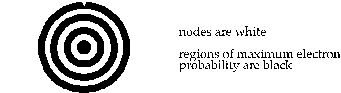
4s orbital
5.54 Part of the electron-nucleus attraction is
canceled by the electron-electron repulsion, an effect we describe by saying
that the electrons are shielded from the nucleus by the other electrons. The net
nuclear charge actually felt by an electron is called the effective nuclear
charge, Zeff, and is often substantially lower than the actual
nuclear charge, Zactual.
Zeff = Zactual -
electron shielding
5.55 Electron shielding gives rise to energy differences among 3s, 3p, and 3d orbitals in multielectron atoms because of the differences in orbital shape. For example, the 3s orbital is spherical and has a large probability density near the nucleus, while the 3p orbital is dumbbell shaped with a node at the nucleus. An electron in a 3s orbital can penetrate closer to the nucleus than an electron in a 3p orbital can and feels less of a shielding effect from other electrons. Generally, for any given value of the principal quantum number n, a lower value of l corresponds to a higher value of Zeff and to a lower energy for the orbital.
5.56 (a) 4s n = 4; l = 0;
ml = 0; ms = ±½
(b) 3p n = 3; l = 1;
ml = -1, 0, +1; ms = ±½
(c) 5f n = 5;
l = 3; ml = -3, -2, -1, 0, +1, +2, +3;
ms = ±½
(d) 5d n = 5; l = 2; ml = -2,
-1, 0, +1, +2; ms = ±½
5.57 (a) 3s (b) 2p (c) 4f (d) 4d
5.58 (a)
is not allowed because for l = 0, ml = 0
only.
(b) is allowed.
(c) is not allowed because for n = 4, l =
0, 1, 2, or 3 only.
5.59 Co 1s2 2s2
2p6 3s2 3p6 4s2
3d7
(a) is not allowed because for l = 0,
ml = 0 only.
(b) is not allowed because n = 4 and
l = 2 is for a 4d orbital.
(c) is allowed because n = 3 and
l = 1 is for a 3p orbital.
5.60 For n = 5, the maximum number of electrons
will occur when the 5g orbital is filled:
[Rn] 7s2 5f14
6d10 7p6 8s2 5g18 = 138
electrons
5.61 n = 4, l = 0 is a 4s orbital. The electron configuration is 1s2 2s2 2p6 3s2 3p6 4s2. The number of electrons is 20.
5.62 0.68 g = 0.68 x 10⁻³ kg
 ;
;

5.63 4.0026 amu x 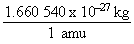 = 6.6465
x 10-27 kg
= 6.6465
x 10-27 kg

 = 5.833 x
10-10 m
= 5.833 x
10-10 m
Electron Configurations
5.64 The number of elements in successive periods of the periodic table increases by the progression 2, 8, 18, 32 because the principal quantum number n increases by 1 from one period to the next. As the principal quantum number increases, the number of orbitals in a shell increases. The progression of elements parallels the number of electrons in a particular shell.
5.65 The n and l quantum numbers determine the energy level of an orbital in a multielectron atom.
5.66 (a) 5d (b) 4s (c) 6s
5.67 (a) 2p < 3p < 5s < 4d (b) 2s < 4s < 3d < 4p (c) 3d < 4p < 5p < 6s
5.68 (a) 3d after 4s (b) 4p after 3d (c) 6d after 5f (d) 6s after 5p
5.69 (a) 3s before 3p (b) 3d before 4p (c) 6s before 4f (d) 4f before 5d
5.70 (a) Ti, Z = 22 1s2 2s2
2p6 3s2 3p6 4s2
3d2
(b) Ru, Z = 44 1s2 2s2 2p6
3s2 3p6 4s2 3d10 4p6
5s2 4d6
(c) Sn, Z = 50 1s2 2s2
2p6 3s2 3p6 4s2 3d10
4p6 5s2 4d10 5p2
(d) Sr, Z
= 38 1s2 2s2 2p6 3s2 3p6
4s2 3d10 4p6 5s2
(e) Se, Z
= 34 1s2 2s2 2p6 3s2 3p6
4s2 3d10 4p4
5.71 (a) Z = 55, Cs [Kr] 5s2 4d10
5p6 6s1 (b) Z = 40, Zr [Kr] 5s2 4d2
(c) Z = 80, Hg [Xe] 6s2 4f14 5d10 (d) Z = 62, Sm [Xe] 6s2 4f6
5.72
5.73
5.74 4s > 4d > 4f
5.75 K < Ca
< Se < Kr
5.76 Z = 118 [Rn] 7s2 5f14
6d10 7p6
5.77 Z = 119 [Rn]
7s25f146d107p68s1
5.78
5.79 (a) Z = 31, Ga (b) Z = 46, Pd
5.80 Order of orbital filling:
1s 2s 2p 3s 3p
4s 3d 4p 5s 4d 5p 6s 4f 5d 6p 7s 5f 6d 7p 8s 5g
Z = 121
5.81 A g orbital would begin filling at atomic number = 121 (see 5.80). There are nine g orbitals that can each hold two electrons. The first element to have a filled g orbital would be atomic number = 138.
Atomic Radii and Periodic Properties
5.82 Atomic radii increase down a group because the electron shells are farther away from the nucleus.
5.83 Across a period, the effective nuclear charge increases, causing a decrease in atomic radii.
5.84 F < O < S
5.85 (a) K, lower in group 1A (b) Ta, lower in
group 5B
(c) V, farther to the left in same period
(d) Ba, four periods
lower and only one group to the right
5.86 Mg has a higher ionization energy than Na because Mg has a higher Zeff and a smaller size.
5.87 F has a higher electron affinity than C because of a higher effective nuclear charge and room in the valence shell for the additional electron. In addition, F- achieves a noble-gas electron configuration.
General Problems
5.88 Balmer series: m = 2; R = 1.097 x 10⁻² nm-1
 ;
;  = 2.438 x 10⁻³ nm-1
= 410.2 nm = 410.2 x
10-9 m
5.89 Pfund series: m = 5; R = 1.097 x
10-2 nm-1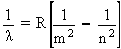
n = 6,  = 1.341 x
10-4 nm-1; = 7458 nm = 7458 x 10-9 m
= 1.341 x
10-4 nm-1; = 7458 nm = 7458 x 10-9 m

n = 7, 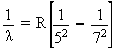 = 2.149 x
10-4 nm-1; = 4653 nm = 4653 x 10-9 m
= 2.149 x
10-4 nm-1; = 4653 nm = 4653 x 10-9 m

These lines in the Pfund series are in the infrared region of the electromagnetic spectrum.
5.90 Pfund series: m = 5, n = ; R = 1.097 x
10-2 nm-1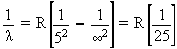 = 4.388 x
10-4 nm-1; = 2279 nm
= 4.388 x
10-4 nm-1; = 2279 nm
5.91 (a) 
 ,
, 
= 8.42 x 10⁻⁷ m (infrared)
(b)

 ,
, 
= 2.63 x 10⁻³ m (microwave)
(c)

 ,
, 
= 2.49 x 10⁻⁹ m (X ray)
5.92 (a) E = h = (6.626 x 10⁻³⁴
Js)(3.79 x 10¹¹ s-1) (6.022 x
1023/mol)
(6.022 x
1023/mol)
E = 0.151 kJ/mol
(b) E = h = (6.626 x
10-34 Js)(5.45 x 10⁴ s-1) (6.022 x
1023/mol)
(6.022 x
1023/mol)
E = 2.17 x 10⁻⁸ kJ/mol
(c) E = h = (6.626
x 10-34 Js)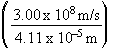
 (6.022 x 10²³/mol)
E = 2.91 kJ/mol
5.93 = 9,192,631,770 s-1 = 9.19263 x 10⁹ s-1
E = h = (6.626 x 10⁻³⁴ Js)(9.19263 x
109 s-1) (6.022 x
1023/mol)
(6.022 x
1023/mol)
E = 3.668 x 10⁻³ kJ/mol
5.94
5.95 (a) row 1 n = 1;
l = 0 1s 2
elements
l = 1 1p 6 elements
l = 2 1d 10
elements
row 2 n = 2;
l = 0 2s 2
elements
l = 1 2p 6 elements
l = 2 2d 10
elements
l = 3 2f 14 elements
There would be 50 elements in the first two rows.
(b) There would be 18 elements in the first row [see (a) above]. The fifth element in the second row would have atomic number = 23.
(c) Z = 12
5.96 206.5 kJ = 206.5 x 10³ J; E =
 = 3.429 x 10⁻¹⁹ J
 ,
,  = 5.797 x 10⁻⁷ m = 580. nm
5.97 780 nm is at the red end of the visible region of the electromagnetic spectrum.
780 nm = 780 x 10-9 m

5.98 (a) Sr, Z = 38 [Kr] 5s2
(b)
Cd, Z = 48 [Kr] 5s2 4d10
(c) Z = 22, Ti, [Ar]
4s2 3d2
(d) Z = 34, Se, [Ar] 4s2
3d10 4p4
5.99 La ([Xe] 6s2 5d1) is directly below Y ([Kr] 5s2 4d1) in the periodic table. Both have similar valence electron configurations, but for La the valence electrons are one shell farther out leading to its larger radius.
Although Hf ([Xe] 6s2 4f14
5d2) is directly below Zr ([Kr] 5s2 4d2) in the
periodic table, Zr and Hf have almost identical atomic radii because the 4f
electrons in Hf are not effective in shielding the valence electrons. The
valence electrons in Hf are drawn in closer to the nucleus by the higher
Zeff.
5.100 For K, Zeff =  =
2.26
=
2.26
For Kr, Zeff = 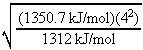 =
4.06
=
4.06
5.101 75 W = 75 J/s; 550 nm = 550 x 10-9 m; (0.05)(75
J/s) = 3.75 J/s
number of photons = 
5.102 q = (350 g)(4.184 J/goC)(95oC - 20oC) = 109,830 J
= 15.0 cm = 15.0 x 10⁻² m
E =
(6.626 x 10⁻³⁴ Js) = 1.33 x
10-24 J/photon
= 1.33 x
10-24 J/photon
number of photons =  = 8.3 x
1028 photons
= 8.3 x
1028 photons
5.103 
 ,
,  = 3.86 x 10⁻⁷ m = 386 nm
5.104 48.2 nm = 48.2 x
10-9 m


E(photon) = Ei + EK; Ei = E(photon) - EK = (2.48 x 10³) - (1.54 x 10³) = 940 kJ/mol
5.105 Charge on electron = 1.602 x
10-19 C; 1 V C = 1 J = 1 kg m2/s2
(a)
EK = (30,000 V)(1.602 x 10⁻¹⁹ C) = 4.806 x
10-15 J
EK = ½mv2; v =  = 1.03 x
108 m/s
= 1.03 x
108 m/s
 = 7.06 x
10-12 m
= 7.06 x
10-12 m
(b) 
5.106
Substitute the equation for the orbit radius, r, into the equation for the
energy level, E, to get 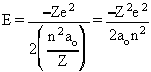
Let E1 be the energy of an electron in a lower orbit and E2 the energy of an electron in a higher orbit. The difference between the two energy levels is
E = E2 - E1 =  =
= 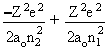 =
= 
E = 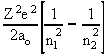
Because Z, e, and ao are constants, this equation
shows that E is proportional to  where
n1 and n2 are integers with n2 >
n1. This is similar to the Balmer-Rydberg equation where 1/ or for
the emission spectra of atoms is proportional to
where
n1 and n2 are integers with n2 >
n1. This is similar to the Balmer-Rydberg equation where 1/ or for
the emission spectra of atoms is proportional to  where m
and n are integers with n > m.
where m
and n are integers with n > m.
Multi-Concept Problem
5.107 (a) Cl2, 70.91 amu
M +
Cl2 ® MCl2
mol Cl2 = 0.8092 g
Cl2 x  = 0.01141 mol Cl2
mol M = 0.01141 mol
Cl2 x  = 0.01141 mol M
molar mass of M =  = 87.64
g/mol
= 87.64
g/mol
atomic mass of M = 87.64 amu; M = Sr
(b) q =  = 829
kJ/mol
= 829
kJ/mol