
Chapter 4
Reactions in Aqueous
Solution
4.1 (a) precipitation (b) redox (c) acid-base neutralization
4.2 FeBr3 contains 3 Br-
ions.
The molar concentration of Br- ions = 3 x 0.225 M = 0.675
M
4.3 A2Y is the strongest electrolyte
because it is completely dissociated into ions.
A2X is the weakest
electrolyte because it is the least dissociated of the three
substances.
4.4 (a) Ionic equation:
2 Ag+(aq)
+ 2 NO3-(aq) + 2 Na+(aq) +
CrO42-(aq) ® Ag2CrO4(s) + 2 Na+(aq) +
2 NO3-(aq)
Delete spectator ions from the ionic
equation to get the net ionic equation.
Net ionic equation: 2
Ag+(aq) + CrO42-(aq)
Ag2CrO4(s)
(b) Ionic equation:
2 H+(aq) +
SO42-(aq) + MgCO3(s) ® H2O(l) +
CO2(g) + Mg2+(aq) +
SO42-(aq)
Delete spectator ions from the ionic equation
to get the net ionic equation.
Net ionic equation: 2 H+(aq) +
MgCO3(s) ® H2O(l) + CO2(g) +
Mg2+(aq)
4.5 (a) CdCO3, insoluble (b) MgO,
insoluble (c) Na2S, soluble
(d) PbSO4, insoluble (e)
(NH4)3PO4, soluble (f) HgCl2,
soluble
4.6 (a) Ionic equation:
Ni2+(aq) +
2 Cl-(aq) + 2 NH4+(aq) + S2-(aq)
® NiS(s) + 2
NH4+(aq) + 2 Cl-(aq)
Delete spectator ions
from the ionic equation to get the net ionic equation.
Net ionic equation:
Ni2+(aq) + S2-(aq) ®
NiS(s)
(b) Ionic equation:
2 Na+(aq) +
CrO42-(aq) + Pb2+(aq) + 2
NO3-(aq) ® PbCrO4(s) + 2 Na+(aq) + 2
NO3-(aq)
Delete spectator ions from the ionic equation
to get the net ionic equation.
Net ionic equation: Pb2+(aq) +
CrO42-(aq) PbCrO4(s)
(c) Ionic equation:
2 Ag+(aq) + 2
ClO4-(aq) + Ca2+(aq) + 2 Br-(aq)
® 2 AgBr(s)
+ Ca2+(aq) + 2 ClO4-(aq)
Delete spectator
ions from the ionic equation, and reduce coefficients to get the net ionic
equation.
Net ionic equation: Ag+(aq) + Br-(aq)
AgBr(s)
4.7 3 CaCl2(aq) + 2
Na3PO4(aq) ® Ca3(PO4)2(s) + 6
NaCl(aq)
Ionic equation:
3 Ca2+(aq) + 6 Cl-(aq) + 6
Na+(aq) + 2 PO43-(aq) ®
Ca3(PO4)2(s) + 6 Na+(aq) + 6
Cl-(aq)
Delete spectator ions from the ionic equation to get the
net ionic equation.
Net ionic equation: 3 Ca2+(aq) + 2
PO43-(aq) ® Ca3(PO4)2(s)
4.8 A precipitate results from the reaction. The precipitate contains 3 cations and 2 anions. The precipitate is either Mg3(PO4)2 or Zn3(PO4)2.
4.9 (a) Ionic equation:
2 Cs+(aq)
+ 2 OH-(aq) + 2 H+(aq) + SO42-(aq)
® 2
Cs+(aq) + SO42-(aq) + 2
H2O(l)
Delete spectator ions from the ionic equation, and reduce
coefficients to get the net ionic equation.
Net ionic equation:
H+(aq) + OH-(aq) ® H2O(l)
(b) Ionic equation:
Ca2+(aq) + 2
OH-(aq) + 2 CH3CO2H(aq) ® Ca2+(aq) + 2
CH3CO2-(aq) + 2 H2O(l)
Delete
spectator ions from the ionic equation, and reduce coefficients to get the net
ionic equation.
Net ionic equation: CH3CO2H(aq) +
OH-(aq) ® CH3CO2-(aq) +
H2O(l)
4.10 HY is the strongest acid because it is
completely dissociated.
HX is the weakest acid because it is the least
dissociated.
4.11 (a) SnCl4: Cl -1, Sn +4 (b)
CrO3: O -2, Cr +6
(c) VOCl3: O -2, Cl -1, V +5 (d)
V2O3: O -2, V +3
(e) HNO3: O -2, H +1, N +5
(f) FeSO4: O -2, S +6, Fe +2
4.12 2 Cu2+(aq) + 4
I-(aq) ® 2 CuI(s) + I2(aq)
oxidation numbers:
Cu2+ +2; I- -1; CuI: Cu +1, I -1; I2:
0
oxidizing agent (oxidation number decreases), Cu2+
reducing
agent (oxidation number increases) , I-
4.13 (a) SnO2(s) + 2 C(s)
® Sn(s) + 2
CO(g)
C is oxidized (its oxidation number increases from 0 to +2). C is the
reducing agent.
The Sn in SnO2 is reduced (its oxidation number
decreases from +4 to 0). SnO2 is the oxidizing agent.
(b) Sn2+(aq) + 2 Fe3+(aq)
®
Sn4+(aq) + 2 Fe2+(aq)
Sn2+ is oxidized (its
oxidation number increases from +2 to +4). Sn2+ is the reducing
agent.
Fe3+ is reduced (its oxidation number decreases from +3 to
+2). Fe3+ is the oxidizing agent.
4.14 (a) Pt is below H in the activity series;
therefore NO REACTION.
(b) Mg is below Ca in the activity series; therefore
NO REACTION.
4.15 Because B will reduce A+, B is above A in the activity series. Because B will not reduce C+, C is above B in the activity series. Therefore C must be above A in the activity series and C will reduce A+.
4.16
8 H+(aq) + Cr2O72-(aq) + I-(aq) ® 2 Cr3+(aq) + IO3-(aq) + 4 H2O(l)
4.17 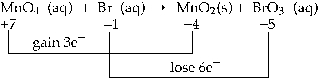
2 MnO4-(aq) +
Br-(aq) ® 2 MnO2(s) +
BrO3-(aq)
2 H+(aq) + 2
MnO4-(aq) + Br-(aq) ® 2 MnO2(s) +
BrO3-(aq) + H2O(l)
2 H+(aq) + 2
OH-(aq) + 2 MnO4-(aq) + Br-(aq)
® 2
MnO2(s) + BrO3-(aq) + H2O(l) + 2
OH-(aq)
H2O(l) + 2 MnO4-(aq) +
Br-(aq) ® 2 MnO2(s) + BrO3-(aq) +
2 OH-(aq)
4.18 (a) MnO4-(aq)
®
MnO2(s) (reduction)
IO3-(aq) ® IO4-(aq)
(oxidation)
(b) NO3-(aq) ® NO2(g)
(reduction)
SO2(aq) ® SO42-(aq) (oxidation)
4.19 NO3-(aq) + Cu(s)
® NO(g) +
Cu2+(aq)
[Cu(s) ® Cu2+(aq) + 2 e-] x 3 (oxidation
half reaction)
NO3-(aq) ®
NO(g)
NO3-(aq) ® NO(g) + 2 H2O(l)
4 H+(aq) +
NO3-(aq) ® NO(g) + 2 H2O(l)
[3 e- + 4
H+(aq) + NO3-(aq) ® NO(g) + 2 H2O(l)] x
2 (reduction half reaction)
Combine the two half reactions.
2
NO3-(aq) + 8 H+(aq) + 3 Cu(s) ® 3 Cu2+(aq) + 2
NO(g) + 4 H2O(l)
4.20 Fe(OH)2(s) + O2(g)
®
Fe(OH)3(s)
[Fe(OH)2(s) + OH-(aq)
®
Fe(OH)3(s) + e-] x 4 (oxidation half
reaction)
O2(g) ® 2 H2O(l)
4 H+(aq) +
O2(g) ®
2 H2O(l)
4 e- + 4 H+(aq) + O2(g)
® 2
H2O(l)
4 e- + 4 H+(aq) + 4
OH-(aq) + O2(g) ® 2 H2O(l) + 4 OH-(aq)
4
e- + 4 H2O(l) + O2(g) ® 2 H2O(l) + 4
OH-(aq)
4 e- + 2 H2O(l) + O2(g)
® 4
OH-(aq) (reduction half reaction)
Combine the two half
reactions.
4 Fe(OH)2(s) + 4 OH-(aq) + 2
H2O(l) + O2(g) ® 4 Fe(OH)3(s) + 4 OH-(aq)
4
Fe(OH)2(s) + 2 H2O(l) + O2(g) ® 4 Fe(OH)3(s)
4.21 31.50 mL = 0.031 50 L; 10.00
mL = 0.010 00 L
0.031 50 L x  = 1.98 x
10-2 mol Fe2+
= 1.98 x
10-2 mol Fe2+
molarity = 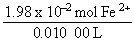 = 1.98 M
Fe2+ solution
= 1.98 M
Fe2+ solution
4.22 The
Na2S2O3, or hypo, is used to solubilize the
remaining unreduced AgBr on the film so that it is no longer sensitive to light.
The reaction is AgBr(s) + 2 S2O32-(aq)
®
Ag(S2O3)23-(aq) +
Br-(aq)
4.23 To convert this negative image into the final printed photograph, the entire photographic procedure is repeated a second time. Light is passed through the negative image onto special photographic paper that is coated with the same kind of gelatin-AgBr emulsion used on the original film. Developing the photographic paper with hydroquinone and fixing the image with sodium thiosulfate reverses the negative image, and a final, positive image is produced.
Understanding Key
Concepts
4.24 (a) 2 Na+(aq) +
CO32-(aq) does not form a precipitate. This is represented
by box (1).
(b) Ba2+(aq) + CrO42-(aq)
BaCrO4(s). This is represented by box (2).
(c) 2
Ag+(aq) + SO42-(aq)
Ag2SO4(s). This is represented by box (3).
4.25 In the precipitate there are two cations (blue) for each anion (green). Looking at the ions in the list, the anion must have a -2 charge and the cation a +1 charge for charge neutrality of the precipitate. The cation must be Ag+ because all Na+ salts are soluble. Ag2CrO4 and Ag2CO3 are insoluble and consistent with the observed result.
4.26 One OH- will react with each
available H+ on the acid forming H2O. The acid is
identified by how many of the 12 OH- react with three molecules of
each acid.
(a) Three HF's react with three OH-, leaving nine
OH- unreacted (box 2).
(b) Three H2SO3's
react with six OH-, leaving six OH- unreacted (box
3).
(c) Three H3PO4's react with nine OH-,
leaving three OH- unreacted (box 1).
4.27 The concentration in the buret is three times that in the flask. The NaOCl concentration is 0.040 M. Because the I- concentration in the buret is three times the OCl- concentration in the flask and the reaction requires 2 I- ions per OCl- ion, 2/3 or 67% of the I- solution from the buret must be added to the flask to react with all of the OCl-.
4.28 "Any element higher in the activity series will react with the ion of any element lower in the activity series."
C + B+ ® C+ + B; therefore C
is higher than B.
A+ + D ® no reaction; therefore A is higher than
D.
C+ + A ® no reaction; therefore C is higher than A.
D +
B+ ®
D+ + B; therefore D is higher than B.
The net result is C > A
> D > B.
29 (a) The reaction, A+ + C
® A +
C+, will occur since C is above A in the activity series.
(b) The
reaction, A+ + B ® A + B+, will not occur since B is below A in
the activity series.
Additional Problems
Aqueous Reactions
and Net Ionic Equations
4.30 (a) precipitation (b) redox (c) acid-base neutralization
4.31 (a) redox (b) precipitation (c) acid-base neutralization
4.32 (a) Ionic equation:
Hg2+(aq)
+ 2 NO3-(aq) + 2 Na+(aq) + 2 I-(aq)
® 2
Na+(aq) + 2 NO3-(aq) +
HgI2(s)
Delete spectator ions from the ionic equation to get the
net ionic equation.
Net ionic equation: Hg2+(aq) + 2
I-(aq) ® HgI2(s)
(b) 2 HgO(s) ® 2 Hg(l) +
O2(g)
(c) Ionic equation:
H3PO4(aq) + 3
K+(aq) + 3 OH-(aq) ® 3 K+(aq) +
PO43-(aq) + 3 H2O(l)
Delete spectator ions
from the ionic equation to get the net ionic equation.
Net ionic equation:
H3PO4(aq) + 3 OH-(aq)
PO43-(aq) + 3 H2O(l)
4.33 (a) S8(s) + 8 O2(g)
® 8
SO2(g)
(b) Ionic equation:
Ni2+(aq) + 2
Cl-(aq) + 2 Na+(aq) + S2-(aq) ® NiS(s) + 2
Na+(aq) + 2 Cl-(aq)
Delete spectator ions from the
ionic equation to get the net ionic equation.
Net ionic equation:
Ni2+(aq) + S2-(aq) ® NiS(s)
(c) Ionic equation:
2
CH3CO2H(aq) + Ba2+(aq) + 2 OH-(aq)
® 2
CH3CO2-(aq) + Ba2+(aq) + 2
H2O(l)
Delete spectator ions from the ionic equation to get the
net ionic equation.
Net ionic equation: CH3CO2H(aq) +
OH-(aq) ® CH3CO2-(aq) +
H2O(l)
4.34 Ba(OH)2 is soluble in aqueous solution, dissociates into Ba2+(aq) and 2 OH-(aq), and conducts electricity. In aqueous solution H2SO4 dissociates into H+(aq) and HSO4-(aq). H2SO4 solutions conduct electricity. When equal molar solutions of Ba(OH)2 and H2SO4 are mixed, the insoluble BaSO4 is formed along with two H2O. In water BaSO4 does not produce any appreciable amount of ions and the mixture does not conduct electricity.
4.35 H2O is polar and a good
H+ acceptor. It allows the polar HCl to dissociate into ions in
aqueous solution:
HCl + H2O ®
H3O+ + Cl-.
CHCl3 is not very
polar and not a H+ acceptor and so does not allow the polar HCl to
dissociate into ions.
4.36 (a) HBr, strong electrolyte (b) HF, weak
electrolyte
(c) NaClO4, strong electrolyte (d)
(NH4)2CO3, strong electrolyte
(e)
NH3, weak electrolyte
4.37 It is possible for a molecular compound to be a strong electrolyte. For example, HCl is a molecular compound when pure but dissociates completely to give H+ and Cl- ions when it dissolves in water.
4.38 (a) K2CO3 contains 3
ions (2 K+ and 1 CO32-).
The molar
concentration of ions = 3 x 0.750 M = 2.25 M.
(b) AlCl3 contains 4
ions (1 Al3+ and 3 Cl-).
The molar concentration of
ions = 4 x 0.355 M = 1.42 M.
4.39 (a) CH3OH is a
nonelectrolyte. The ion concentration from CH3OH is zero.
(b)
HClO4 is a strong acid.
HClO4(aq) ® H+(aq) +
ClO4-(aq)
In solution, there are 2 moles of ions per
mole of HClO4.
The molar concentration of ions = 2 × 0.225 M =
0.450 M.
Precipitation Reactions and Solubility Rules
4.40 (a) Ag2O, insoluble (b)
Ba(NO3)2, soluble
(c) SnCO3, insoluble (d)
Fe2O3, insoluble
4.41 (a) ZnS, insoluble (b)
Au2(CO3)3, insoluble
(c) PbCl2,
insoluble (soluble in hot water) (d) MnO2, insoluble
4.42 (a) No precipitate will form.
(b)
FeCl2(aq) + 2 KOH(aq) ® Fe(OH)2(s) + 2 KCl(aq)
(c) No
precipitate will form.
4.43 (a) MnCl2(aq) +
Na2S(aq) ® MnS(s) + 2 NaCl(aq)
(b) No precipitate will
form.
(c) 3 Hg(NO3)2(aq) + 2
Na3PO4(aq) ® Hg3(PO4)2(s) + 6
NaNO3(aq)
4.44 (a) Pb(NO3)2(aq) +
Na2SO4(aq) ® PbSO4(s) + 2
NaNO3(aq)
(b) 3 MgCl2(aq) + 2
K3PO4(aq) ® Mg3(PO4)2(s) + 6
KCl(aq)
(c) ZnSO4(aq) + Na2CrO4(aq)
®
ZnCrO4(s) + Na2SO4(aq)
4.45 (a) AlCl3(aq) + 3 NaOH(aq)
®
Al(OH)3(s) + 3 NaCl(aq)
(b) Fe(NO3)2(aq) +
Na2S(aq) ® FeS(s) + 2 NaNO3(aq)
(c)
CoSO4(aq) + K2CO3(aq) ® CoCO3(s) +
K2SO4(aq)
4.46 Add HCl(aq); it will selectively precipitate AgCl(s).
4.47 Add Na2SO4(aq); it will selectively precipitate BaSO4(s).
4.48 Ag+ is eliminated because it would have precipitated as AgCl(s); Ba2+ is eliminated because it would have precipitated as BaSO4(s). The solution might contain Cs+ and/or NH4+. Neither of these will precipitate with OH-, SO42-, or Cl-.
4.49 Cl- is eliminated because it would have precipitated as AgCl(s). OH- is eliminated because it would have precipitated as either AgOH(s) or Cu(OH)2(s). SO42- is eliminated because it would have precipitated as BaSO4(s). The solution might contain NO3- because all nitrates are soluble.
Acids, Bases, and Neutralization Reactions
4.50 Add the solution to an active metal, such as magnesium. Bubbles of H2 gas indicate the presence of an acid.
4.51 We use a double arrow to show the dissociation of a weak acid or weak base in aqueous solution to indicate the equilibrium between reactants and products.
4.52 (a) 2 H+(aq) + 2
ClO4-(aq) + Ca2+(aq) + 2 OH-(aq)
®
Ca2+(aq) + 2 ClO4-(aq) + 2
H2O(l)
(b) CH3CO2H(aq) + Na+(aq)
+ OH-(aq) ® CH3CO2-(aq) +
Na+(aq) + H2O(l)
4.53 (a) 2 HF(aq) + Ca2+(aq) + 2
OH-(aq) ® Ca2+(aq) + 2 F-(aq) + 2
H2O(l)
(b) Mg(OH)2(s) + 2 H+(aq) + 2
NO3-(aq) ® Mg2+(aq) + 2
NO3-(aq) + 2 H2O(l)
4.54 (a) LiOH(aq) + HI(aq) ® LiI(aq) +
H2O(l)
Ionic equation: Li+(aq) + OH-(aq) +
H+(aq) + I-(aq) ® Li+(aq) + I-(aq) +
H2O(l)
Delete spectator ions from the ionic equation to get the
net ionic equation.
Net ionic equation: H+(aq) +
OH-(aq) ® H2O(l)
(b) 2 HBr(aq) +
Ca(OH)2(aq) ® CaBr2(aq) + 2
H2O(l)
Ionic equation:
2 H+(aq) + 2
Br-(aq) + Ca2+(aq) + 2 OH-(aq) ® Ca2+(aq) + 2
Br-(aq) + 2 H2O(l)
Delete spectator ions from the ionic
equation to get the net ionic equation.
Net ionic equation: H+(aq)
+ OH-(aq) ® H2O(l)
4.55 (a) 2 Fe(OH)3(s) + 3
H2SO4(aq) ® Fe2(SO4)3(aq) + 6
H2O(l)
Ionic equation and net ionic equation are the same.
2
Fe(OH)3(s) + 3 H+(aq) + 3
HSO4-(aq) ® 2 Fe3+(aq) + 3
SO42-(aq) + 6 H2O(l)
(b)
HClO3(aq) + NaOH(aq) ® NaClO3(aq) + H2O(l)
Ionic
equation: HClO3(aq) + Na+(aq) + OH-(aq)
®
Na+(aq) + ClO3-(aq) +
H2O(l)
Delete spectator ions from the ionic equation to get the
net ionic equation.
Net ionic equation: HClO3(aq) +
OH-(aq) ® ClO3-(aq) +
H2O(l)
Redox Reactions and Oxidation Numbers
4.56 The best reducing agents are at the bottom left of the periodic table. The best oxidizing agents are at the top right of the periodic table (excluding the noble gases).
4.57 The most easily reduced elements in the
periodic table are in the top-right corner, excluding group 8A.
The most
easily oxidized elements in the periodic table are in the bottom-left
corner.
4.58 (a) An oxidizing agent gains
electrons.
(b) A reducing agent loses electrons.
(c) A substance
undergoing oxidation loses electrons.
(d) A substance undergoing reduction
gains electrons.
4.59 (a) In a redox reaction, the oxidation
number decreases for an oxidizing agent.
(b) In a redox reaction, the
oxidation number increases for a reducing agent.
(c) In a redox reaction, the
oxidation number increases for a substance undergoing oxidation.
(d) In a
redox reaction, the oxidation number decreases for a substance undergoing
reduction.
4.60 (a) NO2 O -2, N +4 (b)
SO3 O -2, S +6
(c) COCl2 O -2, Cl -1, C +4 (d)
CH2Cl2 Cl -1, H +1, C 0
(e) KClO3 O -2, K
+1, Cl +5 (f) HNO3 O -2, H +1, N +5
4.61 (a) VOCl3
O -2, Cl -1, V +5
(b) CuSO4 O -2, S +6, Cu +2
(c)
CH2O O -2, H +1, C 0
(d) Mn2O7 O -2, Mn
+7
(e) OsO4 O -2, Os +8
(f) H2PtCl6 Cl
-1, H +1, Pt +4
4.62 (a) ClO3- O -2, Cl +5
(b) SO32- O -2, S +4
(c)
C2O42- O -2, C +3 (d)
NO2- O -2, N +3
(e) BrO- O -2, Br
+1
4.63 (a) Cr(OH)4- O -2, H
+1, Cr +3
(b) S2O32- O -2, S +2
(c)
NO3- O -2, N +5
(d) MnO42- O -2,
Mn +6
(e) HPO42- O -2, H +1, P +5
4.64 (a) Ca(s) + Sn2+(aq)
Ca2+(aq) + Sn(s)
Ca(s) is oxidized (oxidation number increases
from 0 to +2).
Sn2+(aq) is reduced (oxidation number decreases
from +2 to 0).
(b) ICl(s) + H2O(l) ® HCl(aq) + HOI(aq)
No
oxidation numbers change. The reaction is not a redox reaction.
4.65 (a) Si(s) + 2 Cl2(g)
®
SiCl4(l)
Si(s) is oxidized (oxidation number increases from 0 to
+4).
Cl2(g) is reduced (oxidation number decreases from 0 to
-1).
(b) Cl2(g) + 2 NaBr(aq) ® Br2(aq) + 2
NaCl(aq)
Br-(aq) is oxidized (oxidation number increases from -1
to 0).
Cl2(g) is reduced (oxidation number decreases from 0 to
-1).
4.66 (a) Zn is below Na+; therefore
no reaction.
(b) Pt is below H+; therefore no reaction.
(c) Au
is below Ag+; therefore no reaction.
(d) Ag is above
Au3+; the reaction is Au3+(aq) + 3 Ag(s) ® 3 Ag+(aq) +
Au(s).
4.67 Sr is more metallic than
Sb because it is in the same period and to the left of Sb on the periodic table.
Sr is the better reducing agent.
2 Sb3+(aq) + 3 Sr(s) ® 2 Sb(s) + 3
Sr2+(aq) will occur, the reverse will not.
4.68 "Any element higher in the activity series
will react with the ion of any element lower in the activity series."
A +
B+ A+ + B; therefore A is higher than B.
C+
+ D no reaction; therefore C is higher than D.
B + D+
B+ + D; therefore B is higher than D.
B + C+
B+ + C; therefore B is higher than C.
The net result is A > B
> C > D.
4.69 "Any element higher in the activity series
will react with the ion of any element lower in the activity series."
2 A +
B2+ ®
2 A+ + B; therefore A is higher than B.
B + D2+
®
B2+ + D; therefore B is higher than D.
A+ + C
® no
reaction; therefore A is higher than C.
2 C + B2+ ® 2 C+ + B;
therefore C is higher than B.
The net result is A > C > B >
D.
4.70 (a) C is below A+; therefore no
reaction.
(b) D is below A+; therefore no reaction.
4.71
(a) D is below A+; therefore no reaction.
(b) C is above
D2+; therefore the reaction will occur.
Balancing Redox Reactions
4.72 (a) N oxidation number decreases from +5 to
+2; reduction.
(b) Zn oxidation number increases from 0 to +2;
oxidation.
(c) Ti oxidation number increases from +3 to +4; oxidation.
(d)
Sn oxidation number decreases from +4 to +2; reduction.
4.73 (a) O oxidation number decreases from 0 to
-2; reduction.
(b) O oxidation number increases from -1 to 0;
oxidation.
(c) Mn oxidation number decreases from +7 to +6; reduction.
(d)
C oxidation number increases from -2 to 0; oxidation.
4.74 (a) NO3-(aq)
®
NO(g)
NO3-(aq) ® NO(g) + 2 H2O(l)
4 H+(aq)
+ NO3-(aq) ® NO(g) + 2 H2O(l)
3 e- + 4
H+(aq) + NO3-(aq) ® NO(g) + 2
H2O(l)
(b) Zn(s) ® Zn2+(aq) + 2 e-
(c)
Ti3+(aq) ® TiO2(s)
Ti3+(aq) + 2
H2O(l) ® TiO2(s)
Ti3+(aq) + 2
H2O(l) ® TiO2(s) + 4
H+(aq)
Ti3+(aq) + 2 H2O(l) ® TiO2(s) + 4
H+(aq) + e-
(d) Sn4+(aq) + 2 e-
Sn2+(aq)
4.75 (a) O2(g) ®
OH-(aq)
O2(g) ® OH-(aq) + H2O(l)
3
H+(aq) + O2(g) ® OH-(aq) + H2O(l)
3
H+(aq) + 3 OH-(aq) + O2(g) ® 4 OH-(aq) +
H2O(l)
3 H2O(l) + O2(g) ® 4 OH-(aq) +
H2O(l)
4 e- + 2 H2O(l) + O2(g)
® 4
OH-(aq)
(b) H2O2(aq) ®
O2(g)
H2O2(aq) ® O2(g) + 2
H+(aq)
2 OH-(aq) + H2O2(aq)
®
O2(g) + 2 H+(aq) + 2 OH-(aq)
2
OH-(aq) + H2O2(aq) ® O2(g) + 2
H2O(l) + 2 e-
(c)
MnO4-(aq) ®
MnO42-(aq)
MnO4-(aq) +
e- ® MnO42-(aq)
(d)
CH3OH(aq) ® CH2O(aq)
CH3OH(aq)
®
CH2O(aq) + 2 H+(aq)
CH3OH(aq) + 2
OH-(aq) ® CH2O(aq) + 2 H+(aq) + 2
OH-(aq)
CH3OH(aq) + 2 OH-(aq) ® CH2O(aq) + 2
H2O(l)
CH3OH(aq) + 2 OH-(aq) ® CH2O(aq) + 2
H2O(l) + 2 e-
4.76 (a) Te(s) + NO3-(aq)
®
TeO2(s) + NO(g)
oxidation: Te(s) ®
TeO2(s)
reduction: NO3-(aq) ® NO(g)
(b)
H2O2(aq) + Fe2+(aq) ® Fe3+(aq) +
H2O(l)
oxidation: Fe2+(aq) ®
Fe3+(aq)
reduction: H2O2(aq) ®
H2O(l)
4.77 (a) Mn(s) + NO3-(aq)
®
Mn2+(aq) + NO2(g)
oxidation: Mn(s) ®
Mn2+(aq)
reduction: NO3-(aq) ®
NO2(g)
(b) Mn3+(aq) ® MnO2(s) +
Mn2+(aq)
oxidation: Mn3+(aq) ®
MnO2(s)
reduction: Mn3+(aq) ®
Mn2+(aq)
4.78 (a)
Cr2O72-(aq) ®
Cr3+(aq)
Cr2O72-(aq) ® 2
Cr3+(aq)
Cr2O72-(aq) ® 2 Cr3+(aq) +
7 H2O(l)
14 H+(aq) +
Cr2O72-(aq) ® 2 Cr3+(aq) +
7 H2O(l)
14 H+(aq) +
Cr2O72-(aq) + 6 e- ® 2 Cr3+(aq) +
7 H2O(l)
(b) CrO42-(aq) ®
Cr(OH)4-(aq)
4 H+(aq) +
CrO42-(aq) ® Cr(OH)4-(aq)
4
H+(aq) + 4 OH-(aq) + CrO42-(aq)
®
Cr(OH)4-(aq) + 4 OH-(aq)
4
H2O(l) + CrO42-(aq) ®
Cr(OH)4-(aq) + 4 OH-(aq)
4
H2O(l) + CrO42-(aq) + 3 e-
®
Cr(OH)4-(aq) + 4 OH-(aq)
(c)
Bi3+(aq) ®
BiO3-(aq)
Bi3+(aq) + 3 H2O(l)
®
BiO3-(aq)
Bi3+(aq) + 3
H2O(l) ® BiO3-(aq) + 6
H+(aq)
Bi3+(aq) + 3 H2O(l) + 6
OH-(aq) ® BiO3-(aq) + 6
H+(aq) + 6 OH-(aq)
Bi3+(aq) + 3
H2O(l) + 6 OH-(aq) ® BiO3-(aq) + 6
H2O(l)
Bi3+(aq) + 6 OH-(aq) ®
BiO3-(aq) + 3 H2O(l)
Bi3+(aq) + 6
OH-(aq) ® BiO3-(aq) + 3
H2O(l) + 2 e-
(d) ClO-(aq) ®
Cl-(aq)
ClO-(aq) ® Cl-(aq) + H2O(l)
2
H+(aq) + ClO-(aq) ® Cl-(aq) + H2O(l)
2
H+(aq) + 2 OH-(aq) + ClO-(aq) ® Cl-(aq) +
H2O(l) + 2 OH-(aq)
2 H2O(l) +
ClO-(aq) ® Cl-(aq) + H2O(l) + 2
OH-(aq)
H2O(l) + ClO-(aq) ® Cl-(aq) + 2
OH-(aq)
H2O(l) + ClO-(aq) + 2 e-
®
Cl-(aq) + 2 OH-(aq)
4.79 (a) VO2+(aq) ®
V3+(aq)
VO2+(aq) ® V3+(aq) + H2O(l)
2
H+(aq) + VO2+(aq) ® V3+(aq) + H2O(l)
2
H+(aq) + VO2+(aq) + e- ® V3+(aq) +
H2O(l)
(b) Ni(OH)2(s) ®
Ni2O3(s)
2 Ni(OH)2(s) ®
Ni2O3(s) + H2O(l)
2 Ni(OH)2(s)
®
Ni2O3(s) + H2O(l) + 2 H+(aq)
2
Ni(OH)2(s) + 2 OH-(aq) ®
Ni2O3(s) + H2O(l) + 2 H+(aq) + 2
OH-(aq)
2 Ni(OH)2(s) + 2 OH-(aq)
®
Ni2O3(s) + 3 H2O(l) + 2
e-
(c) NO3-(aq) ®
NO2(g)
NO3-(aq) ® NO2(g) +
H2O(l)
2 H+(aq) + NO3-(aq)
®
NO2(g) + H2O(l)
2 H+(aq) +
NO3-(aq) + e- ® NO2(g) +
H2O(l)
(d) Br2(aq) ®
BrO3-(aq)
Br2(aq) ® 2
BrO3-(aq)
Br2(aq) + 6 H2O(l)
® 2
BrO3-(aq)
Br2(aq) + 6 H2O(l)
® 2
BrO3-(aq) + 12 H+(aq)
Br2(aq) + 6
H2O(l) + 12 OH-(aq) ® 2 BrO3-(aq) + 12
H+(aq) + 12 OH-(aq)
Br2(aq) + 6
H2O(l) + 12 OH-(aq) ® 2 BrO3-(aq) + 12
H2O(l)
Br2(aq) + 12 OH-(aq) ® 2
BrO3-(aq) + 6 H2O(l) + 10
e-
4.80 (a) MnO4-(aq)
®
MnO2(s)
MnO4-(aq) ® MnO2(s) + 2
H2O(l)
4 H+(aq) + MnO4-(aq)
®
MnO2(s) + 2 H2O(l)
[4 H+(aq) +
MnO4-(aq) +3 e- ® MnO2(s) + 2
H2O(l)] x 2 (reduction half
reaction)
IO3-(aq) ®
IO4-(aq)
H2O(l) +
IO3-(aq) ®
IO4-(aq)
H2O(l) +
IO3-(aq) ® IO4-(aq) + 2
H+(aq)
[H2O(l) + IO3-(aq)
®
IO4-(aq) + 2 H+(aq) + 2 e-] x 3
(oxidation half reaction)
Combine the two half reactions.
8
H+(aq) + 3 H2O(l) + 2 MnO4-(aq) + 3
IO3-(aq)
6 H+(aq) + 4 H2O(l) + 2
MnO2(s) + 3 IO4-(aq)
2 H+(aq) + 2
MnO4-(aq) + 3 IO3-(aq) ® 2 MnO2(s) + 3
IO4-(aq) + H2O(l)
2 H+(aq) + 2
OH-(aq) + 2 MnO4-(aq) + 3
IO3-(aq) ® 2 MnO2(s) + 3 IO4-(aq)
+ H2O(l) + 2 OH-(aq)
2 H2O(l) + 2
MnO4-(aq) + 3 IO3-(aq)
® 2
MnO2(s) + 3 IO4-(aq) + H2O(l) + 2
OH-(aq)
H2O(l) + 2 MnO4-(aq) + 3
IO3-(aq) ® 2 MnO2(s) + 3
IO4-(aq) + 2 OH-(aq)
(b) Cu(OH)2(s) ®
Cu(s)
Cu(OH)2(s) ® Cu(s) + 2 H2O(l)
2
H+(aq) + Cu(OH)2(s) ® Cu(s) + 2 H2O(l)
[2
H+(aq) + Cu(OH)2(s) + 2 e- ® Cu(s) + 2
H2O(l)] x 2 (reduction half
reaction)
N2H4(aq) ®
N2(g)
N2H4(aq) ® N2(g) + 4
H+(aq)
N2H4(aq) ® N2(g) + 4
H+(aq) + 4 e- (oxidation half reaction)
Combine the two
half reactions.
4 H+(aq) + 2 Cu(OH)2(s) +
N2H4(aq) ® 2 Cu(s) + 4 H2O(l) + N2(g) +
4 H+(aq)
2 Cu(OH)2(s) + N2H4(aq)
® 2 Cu(s) + 4
H2O(l) + N2(g)
(c) Fe(OH)2(s)
®
Fe(OH)3(s)
Fe(OH)2(s) + H2O(l) ®
Fe(OH)3(s)
Fe(OH)2(s) + H2O(l) ® Fe(OH)3(s) +
H+(aq)
[Fe(OH)2(s) + H2O(l) ® Fe(OH)3(s) +
H+(aq) + e-] x 3 (oxidation half
reaction)
CrO42-(aq) ®
Cr(OH)4-(aq)
4 H+(aq) +
CrO42-(aq) ® Cr(OH)4-(aq)
4
H+(aq) + CrO42-(aq) + 3 e-
®
Cr(OH)4-(aq) (reduction half reaction)
Combine the two
half reactions.
3 Fe(OH)2(s) + 3 H2O(l) + 4
H+(aq) + CrO42-(aq) ® 3 Fe(OH)3(s) + 3
H+(aq) + Cr(OH)4-(aq)
3
Fe(OH)2(s) + 3 H2O(l) + H+(aq) +
CrO42-(aq) ® 3 Fe(OH)3(s) +
Cr(OH)4-(aq)
3 Fe(OH)2(s) + 3
H2O(l) + H+(aq) + OH-(aq) +
CrO42-(aq) ® 3 Fe(OH)3(s) +
Cr(OH)4-(aq) + OH-(aq)
3
Fe(OH)2(s) + 4 H2O(l) + CrO42-(aq)
® 3
Fe(OH)3(s) + Cr(OH)4-(aq) +
OH-(aq)
(d) ClO4-(aq) ®
ClO2-(aq)
ClO4-(aq) ®
ClO2-(aq) + 2 H2O(l)
4 H+(aq) +
ClO4-(aq) ® ClO2-(aq) + 2
H2O(l)
4 H+(aq) + ClO4-(aq) + 4
e- ® ClO2-(aq) + 2
H2O(l) (reduction half reaction)
H2O2(aq)
®
O2(g)
H2O2(aq) ® O2(g) + 2
H+(aq)
[H2O2(aq) ® O2(g) + 2
H+(aq) + 2 e-] x 2 (oxidation half reaction)
Combine
the two half reactions.
4 H+(aq) + ClO4-(aq)
+ 2 H2O2(aq) ® ClO2-(aq) + 2 H2O(l) +
2 O2(g) + 4 H+(aq)
ClO4-(aq) + 2
H2O2(aq) ® ClO2-(aq) + 2 H2O(l) +
2 O2(g)
4.81 (a)
S2O32-(aq) ®
S4O62-(aq)
2
S2O32-(aq) ®
S4O62-(aq)
2
S2O32-(aq) ®
S4O62-(aq) + 2 e- (oxidation half
reaction)
I2(aq) ® I-(aq)
I2(aq)
® 2
I-(aq)
I2(aq) + 2 e- ® 2 I-(aq)
(reduction half reaction)
Combine the two half reactions.
2
S2O32-(aq) + I2(aq) ®
S4O62-(aq) + 2 I-(aq)
(b)
Mn2+(aq) ® MnO2(s)
Mn2+(aq) + 2
H2O(l) ® MnO2(s)
Mn2+(aq) + 2
H2O(l) ® MnO2(s) + 4
H+(aq)
Mn2+(aq) + 2 H2O(l) ® MnO2(s) + 4
H+(aq) + 2 e- (oxidation half
reaction)
H2O2(aq) ® 2 H2O(l)
2
H+(aq) + H2O2(aq) ® 2 H2O(l)
2
H+(aq) + H2O2(aq) + 2 e-
® 2
H2O(l) (reduction half reaction)
Combine the two half
reactions.
Mn2+(aq) + 2 H2O(l) + 2 H+(aq) +
H2O2(aq) ® MnO2(s) + 4 H+(aq) + 2
H2O(l)
Mn2+(aq) + H2O2(aq)
®
MnO2(s) + 2 H+(aq)
Mn2+(aq) +
H2O2(aq) + 2 OH-(aq) ® MnO2(s) + 2
H+(aq) + 2 OH-(aq)
Mn2+(aq) +
H2O2(aq) + 2 OH-(aq) ® MnO2(s) + 2
H2O(l)
(c) Zn(s) ® Zn(OH)42-(aq)
4
H2O(l) + Zn(s) ® Zn(OH)42-(aq)
4
H2O(l) + Zn(s) ® Zn(OH)42-(aq) + 4
H+(aq)
[4 H2O(l) + Zn(s) ®
Zn(OH)42-(aq) + 4 H+(aq) + 2 e-] x 4
(oxidation half reaction)
NO3-(aq) ®
NH3(aq)
NO3-(aq) ® NH3(aq) + 3
H2O(l)
9 H+(aq) + NO3-(aq)
®
NH3(aq) + 3 H2O(l)
9 H+(aq) +
NO3-(aq) + 8 e- ® NH3(aq) + 3
H2O(l) (reduction half reaction)
Combine the two half
reactions.
16 H2O(l) + 4 Zn(s) + 9 H+(aq) +
NO3-(aq) ® 4 Zn(OH)42-(aq) + 16
H+(aq) + NH3(aq) + 3 H2O(l)
13
H2O(l) + 4 Zn(s) + NO3-(aq) ® 4
Zn(OH)42-(aq) + 7 H+(aq) +
NH3(aq)
13 H2O(l) + 4 Zn(s) +
NO3-(aq) + 7 OH-(aq) ® 4
Zn(OH)42-(aq) + 7 H+(aq) + 7 OH-(aq)
+ NH3(aq)
13 H2O(l) + 4 Zn(s) +
NO3-(aq) + 7 OH-(aq) ® 4
Zn(OH)42-(aq) + 7 H2O(l) +
NH3(aq)
6 H2O(l) + 4 Zn(s) +
NO3-(aq) + 7 OH-(aq) ® 4
Zn(OH)42-(aq) + NH3(aq)
(d) Bi(OH)3(s) ®
Bi(s)
Bi(OH)3(s) ® Bi(s) + 3 H2O(l)
3 H+(aq) +
Bi(OH)3(s) ® Bi(s) + 3 H2O(l)
[3
H+(aq) + Bi(OH)3(s) + 3 e- ® Bi(s) + 3 H2O(l)] x
2 (reduction half reaction)
Sn(OH)3-(aq) ®
Sn(OH)62-(aq)
Sn(OH)3-(aq) + 3
H2O(l) ®
Sn(OH)62-(aq)
Sn(OH)3-(aq) + 3
H2O(l) ® Sn(OH)62-(aq) + 3
H+(aq)
[Sn(OH)3-(aq) + 3 H2O(l)
®
Sn(OH)62-(aq) + 3 H+(aq) + 2 e-] x 3
(oxidation half reaction)
Combine the two half reactions.
6
H+(aq) + 2 Bi(OH)3(s) + 3
Sn(OH)3-(aq) + 9 H2O(l) ® 2 Bi(s) + 6 H2O(l)
+ 3 Sn(OH)62-(aq) + 9 H+(aq)
2
Bi(OH)3(s) + 3 Sn(OH)3-(aq) + 3
H2O(l) ® 2 Bi(s) + 3 Sn(OH)62-(aq) +
3 H+(aq)
2 Bi(OH)3(s) + 3
Sn(OH)3-(aq) + 3 H2O(l) + 3
OH-(aq) ® 2 Bi(s) + 3 Sn(OH)62-(aq) + 3
H+(aq) + 3 OH-(aq)
2 Bi(OH)3(s) + 3
Sn(OH)3-(aq) + 3 H2O(l) + 3
OH-(aq) ® 2 Bi(s) + 3 Sn(OH)62-(aq) + 3
H2O(l)
2 Bi(OH)3(s) + 3
Sn(OH)3-(aq) + 3 OH-(aq) ® 2 Bi(s) + 3
Sn(OH)62-(aq)
4.82 (a) Zn(s) ®
Zn2+(aq)
Zn(s) Zn2+(aq) + 2 e- (oxidation
half reaction)
VO2+(aq) ® V3+(aq)
VO2+(aq)
®
V3+(aq) + H2O(l)
2 H+(aq) +
VO2+(aq) ® V3+(aq) + H2O(l)
[2
H+(aq) + VO2+(aq) + e- ® V3+(aq) +
H2O(l)] x 2 (reduction half reaction)
Combine the two half
reactions.
Zn(s) + 2 VO2+(aq) + 4 H+(aq) ® Zn2+(aq) + 2
V3+(aq) + 2 H2O(l)
(b) Ag(s) ®
Ag+(aq)
Ag(s) ® Ag+(aq) + e- (oxidation half
reaction)
NO3-(aq) ®
NO2(g)
NO3-(aq) ® NO2(g) +
H2O(l)
2 H+(aq) + NO3-(aq)
® NO2(g)
+ H2O(l)
2 H+(aq) + NO3-(aq) +
e- ® NO2(g) + H2O(l) (reduction
half reaction)
Combine the two half reactions.
2 H+(aq) + Ag(s)
+ NO3-(aq) ® Ag+(aq) + NO2(g) +
H2O(l)
(c) Mg(s)
®
Mg2+(aq)
[Mg(s) ® Mg2+(aq) + 2 e- ] x 3
(oxidation half reaction)
VO43-(aq) ®
V2+(aq)
VO43-(aq) ® V2+(aq) + 4
H2O(l)
8 H+(aq) + VO43-(aq)
®
V2+(aq) + 4 H2O(l)
[8 H+(aq) +
VO43-(aq) + 3 e- ® V2+(aq) + 4
H2O(l)] x 2 (reduction half reaction)
Combine the two half
reactions.
3 Mg(s) + 16 H+(aq) + 2 VO43-(aq)
® 3
Mg2+(aq) + 2 V2+(aq) + 8 H2O(l)
(d)
I-(aq) ®
I3-(aq)
3 I-(aq) ®
I3-(aq)
[3 I-(aq) ®
I3-(aq) + 2 e-] x 8 (oxidation half
reaction)
IO3-(aq) ®
I3-(aq)
3 IO3-(aq) ®
I3-(aq)
3 IO3-(aq)
®
I3-(aq) + 9 H2O(l)
18 H+(aq) + 3
IO3-(aq) ® I3-(aq) + 9
H2O(l)
18 H+(aq) + 3 IO3-(aq) +
16 e- ® I3-(aq) + 9
H2O(l) (reduction half reaction)
Combine the two half
reactions.
18 H+(aq) + 3 IO3-(aq) + 24
I-(aq) ® 9 I3-(aq) + 9
H2O(l)
Divide each coefficient by 3.
6 H+(aq) +
IO3-(aq) + 8 I-(aq) ® 3
I3-(aq) + 3 H2O(l)
4.83 (a) MnO4-(aq)
®
Mn2+(aq)
MnO4-(aq) ® Mn2+(aq) + 4
H2O(l)
8 H+(aq) + MnO4-(aq)
®
Mn2+(aq) + 4 H2O(l)
[8 H+(aq) +
MnO4-(aq) + 5 e- ® Mn2+(aq) + 4
H2O(l)] x 4 (reduction half
reaction)
C2H5OH(aq) ®
CH3CO2H(aq)
C2H5OH(aq) +
H2O(l) ®
CH3CO2H(aq)
C2H5OH(aq) +
H2O(l) ® CH3CO2H(aq) + 4
H+(aq)
[C2H5OH(aq) + H2O(l)
®
CH3CO2H(aq) + 4 H+(aq) + 4 e-] x 5
(oxidation half reaction)
Combine the two half reactions.
32
H+(aq) + 4 MnO4-(aq) + 5
C2H5OH(aq) + 5 H2O(l) ® 4 Mn2+(aq) + 16
H2O(l) + 5 CH3CO2H(aq) + 20
H+(aq)
12 H+(aq) + 4 MnO4-(aq) +
5 C2H5OH(aq) ® 4 Mn2+(aq) + 11 H2O(l) + 5
CH3CO2H(aq)
(b) Cr2O72-(aq)
®
Cr3+(aq)
Cr2O72-(aq)
® 2
Cr3+(aq)
Cr2O72-(aq) ® 2 Cr3+(aq) +
7 H2O(l)
14 H+(aq) +
Cr2O72-(aq) ® 2 Cr3+(aq) +
7 H2O(l)
14 H+(aq) +
Cr2O72-(aq) + 6 e- 2
Cr3+(aq) + 7 H2O(l) (reduction half
reaction)
H2O2(aq) ®
O2(g)
H2O2(aq) ® O2(g) + 2
H+(aq)
[H2O2(aq) ® O2(g) + 2
H+(aq) + 2 e-] x 3 (oxidation half reaction)
Combine
the two half reactions.
14 H+(aq) +
Cr2O72-(aq) + 3 H2O2(aq)
® 2
Cr3+(aq) + 7 H2O(l) + 3 O2(g) + 6
H+(aq)
8 H+(aq) +
Cr2O72-(aq) + 3 H2O2(aq)
® 2
Cr3+(aq) + 7 H2O(l) + 3 O2(g)
(c) Sn2+(aq) ®
Sn4+(aq)
[Sn2+(aq) ® Sn4+(aq) + 2
e-] x 4 (oxidation half reaction)
IO4-(aq)
®
I-(aq)
IO4-(aq) ® I-(aq) + 4
H2O(l)
8 H+(aq) + IO4-(aq)
®
I-(aq) + 4 H2O(l)
8 H+(aq) +
IO4-(aq) + 8 e- ® I-(aq) + 4
H2O(l) (reduction half reaction)
Combine the two half
reactions.
4 Sn2+(aq) + 8 H+(aq) +
IO4-(aq) ® 4 Sn4+(aq) + I-(aq) + 4
H2O(l)
(d) PbO2(s) + Cl-(aq)
®
PbCl2(s)
PbO2(s) + 2 Cl-(aq)
®
PbCl2(s)
PbO2(s) + 2 Cl-(aq) ® PbCl2(s) + 2
H2O(l)
PbO2(s) + 4 H+(aq) + 2
Cl-(aq) ® PbCl2(s) + 2
H2O(l)
[PbO2(s) + 4 H+(aq) + 2
Cl-(aq) + 2 e- ® PbCl2(s) + 2 H2O(l)] x 2
(reduction half reaction)
H2O(l) ® O2(g)
2
H2O(l) ®
O2(g)
2 H2O(l) ® O2(g) + 4
H+(aq)
2 H2O(l) ® O2(g) + 4 H+(aq) + 4
e- (oxidation half reaction)
Combine the two half reactions.
2
PbO2(s) + 8 H+(aq) + 4 Cl-(aq) + 2
H2O(l) ® 2 PbCl2(s) + 4 H2O(l) +
O2(g) + 4 H+(aq)
2 PbO2(s) + 4
H+(aq) + 4 Cl-(aq) ® 2 PbCl2(s) + 2 H2O(l) +
O2(g)
Redox Titrations
4.84 I2(aq) + 2 S2O32-(aq) S4O62-(aq) + 2 I-(aq); 35.20 mL = 0.032 50 L
0.035 20 L x 
4.85 2.486 g I2 x 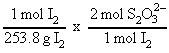 = 1.959 x
10-2 mol S2O32-
= 1.959 x
10-2 mol S2O32-
 = 0.0784
L; 0.0784 L = 78.4 mL
= 0.0784
L; 0.0784 L = 78.4 mL
4.86 3 H3AsO3(aq) +
BrO3-(aq) Br-(aq) + 3
H3AsO4(aq)
22.35 mL = 0.022 35 L and 50.00 mL = 0.050
00 L
0.022 35 L x 
molarity = 
4.87 As2O3,
197.84 amu; 28.55 mL = 0.028 55 L
1.550 g As2O3 x 
= 5.223 x 10⁻³
mol BrO3-; KBrO3 molarity =  = 0.1829
M
= 0.1829
M
4.88 2 Fe3+(aq)
+ Sn2+(aq) 2 Fe2+(aq) + Sn4+(aq); 13.28 mL =
0.013 28 L
0.013 28 L x 
mass % Fe = 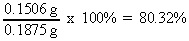
4.89 Fe2O3, 159.69 amu;
23.84 mL = 0.023 84 L
1.4855 g Fe2O3 x  = 0.009
302 mol Sn2+
= 0.009
302 mol Sn2+
Sn2+ molarity = 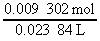 = 0.3902
M
= 0.3902
M
4.90 C2H5OH(aq) + 2
Cr2O72-(aq) + 16 H+(aq) 2
CO2(g) + 4 Cr3+(aq) + 11
H2O(l)
C2H5OH, 46.07 amu; 8.76 mL = 0.008 76
L
mass % C2H5OH = 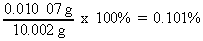
4.91 21.08 mL = 0.021 08 L
0.021 08 L x 
= 0.002 09 g = 2.09 mg
General Problems
4.92 (a) [Fe(CN)6]3-(aq)
®
Fe(CN)6]4-(aq)
([Fe(CN)6]3-(aq) +
e- ® [Fe(CN)6]4-(aq)) x 4
(reduction half reaction)
N2H4(aq) ®
N2(g)
N2H4(aq) ® N2(g) + 4
H+(aq)
N2H4(aq) ® N2(g) + 4
H+(aq) + 4 e-
N2H4(aq) + 4
OH-(aq) ® N2(g) + 4 H+(aq) + 4
OH-(aq) + 4 e-
N2H4(aq) + 4
OH-(aq) ® N2(g) + 4 H2O(l) + 4
e- (oxidation half reaction)
Combine the two half reactions.
4
[Fe(CN)6]3-(aq) + N2H4(aq) + 4
OH-(aq) ® 4 [Fe(CN)6]4-(aq) +
N2(g) + 4 H2O(l)
(b) Cl2(g) ® Cl-(aq)
Cl2(g) ® 2 Cl-(aq)
Cl2(g) + 2
e- ®
2 Cl-(aq) (reduction half reaction)
SeO32-(aq) ®
SeO42-(aq)
SeO32-(aq) +
H2O(l) ®
SeO42-(aq)
SeO32-(aq) +
H2O(l) ® SeO42-(aq) + 2
H+(aq)
SeO32-(aq) + H2O(l)
®
SeO42-(aq) + 2 H+(aq) + 2 e-
SeO32-(aq) + H2O(l) + 2
OH-(aq) ® SeO42-(aq) + 2
H+(aq) + 2 OH-(aq) + 2 e-
SeO32-(aq) + H2O(l) + 2
OH-(aq) ® SeO42-(aq) + 2
H2O(l) + 2 e-
SeO32-(aq) + 2
OH-(aq) ® SeO42-(aq) +
H2O(l) + 2 e- (oxidation half reaction)
Combine the
two half reactions.
SeO32-(aq) + Cl2(g) + 2
OH-(aq) ® SeO42-(aq) + 2
Cl-(aq) + H2O(l)
(c) CoCl2(aq) ® Co(OH)3(s) +
Cl-(aq)
CoCl2(aq) ® Co(OH)3(s) +
2 Cl-(aq)
CoCl2(aq) + 3 H2O(l) ® Co(OH)3(s) +
2 Cl-(aq)
CoCl2(aq) + 3 H2O(l) ® Co(OH)3(s) +
2 Cl-(aq) + 3 H+(aq)
[CoCl2(aq) + 3
H2O(l) ® Co(OH)3(s) + 2 Cl-(aq) + 3
H+(aq) + e-] x 2 (oxidation half reaction)
HO2-(aq) ®
H2O(l)
HO2-(aq) ® 2 H2O(l)
3
H+(aq) + HO2-(aq) ® 2 H2O(l)
3
H+(aq) + HO2-(aq) + 2 e-
® 2
H2O(l) (reduction half reaction)
Combine the two half reactions.
2
CoCl2(aq) + 6 H2O(l) + 3 H+(aq) +
HO2-(aq) ® 2 Co(OH)3(s) + 4 Cl-(aq) + 6
H+(aq) + 2 H2O(l)
2 CoCl2(aq) + 4
H2O(l) + HO2-(aq) ® 2 Co(OH)3(s)
+ 4 Cl-(aq) + 3 H+(aq)
2 CoCl2(aq) + 4
H2O(l) + HO2-(aq) + 3 OH-(aq)
® 2
Co(OH)3(s) + 4 Cl-(aq) + 3 H+(aq) + 3
OH-(aq)
2 CoCl2(aq) + 4 H2O(l) +
HO2-(aq) + 3 OH-(aq) ® 2 Co(OH)3(s) + 4
Cl-(aq) + 3 H2O(l)
2 CoCl2(aq) +
H2O(l) + HO2-(aq) + 3 OH-(aq)
® 2
Co(OH)3(s) + 4 Cl-(aq)
4.93 57.91 mL = 0.057 91 L
0.057 91 L x 
mass % Fe =  x 100% =
26.80%
x 100% =
26.80%
4.94 (a) C2H6 H +1, C
-3
(b) Na2B4O7 O -2, Na +1, B +3
(c)
Mg2SiO4 O -2, Mg +2, Si +4
4.95 (a) PbO2(s) ®
Pb2+(aq)
PbO2(s) ® Pb2+(aq) + 2 H2O(l)
4
H+(aq) + PbO2(s) ® Pb2+(aq) + 2 H2O(l)
[4
H+(aq) + PbO2(s) + 2 e- ® Pb2+(aq) + 2
H2O(l)] x 5 (reduction half reaction)
Mn2+(aq)
®
MnO4-(aq)
4 H2O(l) + Mn2+(aq)
®
MnO4-(aq)
4 H2O(l) + Mn2+(aq)
®
MnO4-(aq) + 8 H+(aq)
[4 H2O(l) +
Mn2+(aq) ® MnO4-(aq) + 8
H+(aq) + 5 e-] x 2 (oxidation half reaction)
Combine
the two half reactions.
20 H+(aq) + 5 PbO2(s) + 8
H2O(l) + 2 Mn2+(aq) ® 5 Pb2+(aq) + 10
H2O(l) + 2 MnO4-(aq) + 16
H+(aq)
4 H+(aq) + 5 PbO2(s) + 2
Mn2+(aq) ® 5 Pb2+(aq) + 2 H2O(l) + 2
MnO4-(aq)
(b) As2O3(s) ®
H3AsO4(aq)
As2O3(s) ® 2
H3AsO4(aq)
5 H2O(l) +
As2O3(s) ® 2 H3AsO4(aq)
5
H2O(l) + As2O3(s) ® 2
H3AsO4(aq) + 4 H+(aq)
5 H2O(l) +
As2O3(s) ® 2 H3AsO4(aq) + 4
H+(aq) + 4 e- (oxidation half
reaction)
NO3-(aq) ®
HNO2(aq)
NO3-(aq) ® HNO2(aq) +
H2O(l)
3 H+(aq) + NO3-(aq)
®
HNO2(aq) + H2O(l)
[3 H+(aq) +
NO3-(aq) + 2 e- ® HNO2(aq) +
H2O(l)] x 2 (reduction half reaction)
Combine the two half
reactions.
5 H2O(l) + As2O3(s) + 6
H+(aq) + 2 NO3-(aq) ® 2
H3AsO4(aq) + 4 H+(aq) + 2 HNO2(aq) +
2 H2O(l)
3 H2O(l) + As2O3(s) + 2
H+(aq) + 2 NO3-(aq) ® 2
H3AsO4(aq) + 2 HNO2(aq)
(c) Br2(aq) ®
Br-(aq)
Br2(aq) ® 2 Br-(aq)
Br2(aq) + 2
e- ® 2 Br-(aq) (reduction half
reaction)
SO2(g) ® HSO4-(aq)
2
H2O(l) + SO2(g) ® HSO4-(aq)
2
H2O(l) + SO2(g) ® HSO4-(aq) + 3
H+(aq)
2 H2O(l) + SO2(g) ®
HSO4-(aq) + 3 H+(aq) + 2 e-
(oxidation half reaction)
Combine the two half reactions.
2
H2O(l) + Br2(aq) + SO2(g) ® 2 Br-(aq) +
HSO4-(aq) + 3 H+(aq)
(d)
I-(aq) ®
I2(s)
2 I-(aq) ® I2(s)
2
I-(aq) ®
I2(s) + 2 e- (oxidation half
reaction)
NO2-(aq) ®
NO(g)
NO2-(aq) ® NO(g) + H2O(l)
2 H+(aq) +
NO2-(aq) ® NO(g) + H2O(l)
[2 H+(aq)
+ NO2-(aq) + e- ® NO(g) +
H2O(l)] x 2 (reduction half reaction)
Combine the two half reactions.
4
H+(aq) + 2 NO2-(aq) + 2 I-(aq)
® 2 NO(g) +
I2(s) + 2 H2O(l)
4.96 Ions below Fe in the activity
series (Table 4.3) can be reduced to their elemental forms by Fe. Of
Ni2+, Au3+, Zn2+, and Ba2+, only
Ni2+ and Au3+ can be reduced to their elemental forms by
Fe.
4.97 (a) Ksp =
[Ag+]2[CrO42-]
(b)
Ag2CrO4(s) ¾ 2 Ag+(aq) +
CrO42-(aq)
In a saturated solution 2x =
[Ag+] and x = [CrO42-].
Ksp =
[Ag+]2[CrO42-] = 1.1 x
10-12 = (2x)2(x) = 4x3; Solve for x; x = 6.5 x
10-5 M
[Ag+] = 2x = 2(6.5 x 10⁻⁵ M) = 1.3 x
10-4 M; [CrO42-] = x = 6.5 x 10⁻⁵
M
4.98 MgF2(s) ¾ Mg2+(aq) + 2
F-(aq)
[Mg2+] = x = 2.6 x 10⁻⁴ M and
[F-] = 2x = 2(2.6 x 10⁻⁴ M) = 5.2 x 10⁻⁴ M in a
saturated solution.
Ksp =
[Mg2+][F-]2 = (2.6 x 10⁻⁴ M)(5.2 x
10-4 M)2 = 7.0 x 10⁻¹¹
4.99 65.20 mL = 0.065 20 L
1.926 g succinic
acid x 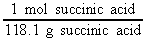 = 0.016 31 mol succinic acid
0.5000  x 0.065 20
L = 0.032 60 mol NaOH
x 0.065 20
L = 0.032 60 mol NaOH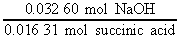 = 2;
therefore succinic acid has two acidic hydrogens.
= 2;
therefore succinic acid has two acidic hydrogens.
4.100 (a) Add HCl to
precipitate Hg2Cl2. Hg22+(aq) +
2Cl-(aq) ® Hg2Cl2(s)
(b) Add
H2SO4 to precipitate PbSO4. Pb2+(aq)
+ SO42-(aq) ® PbSO4(s)
(c) Add
Na2CO3 to precipitate CaCO3.
Ca2+(aq) + CO32-(aq) ®
CaCO3(s)
(d) Add Na2SO4 to precipitate
BaSO4. Ba2+(aq) + SO42-(aq)
®
BaSO4(s)
4.101 (a) Add AgNO3 to precipitate
AgCl. Ag+(aq) + Cl-(aq) ® AgCl(s)
(b) Add
NiCl2 to precipitate NiS. Ni2+(aq) + S2-(aq)
®
NiS(s)
(c) Add CaCl2 to precipitate CaCO3.
Ca2+(aq) + CO32-(aq) ®
CaCO3(s)
(d) Add MgCl2 to precipitate
Mg(OH)2. Mg2+(aq) + 2 OH-(aq) ®
Mg(OH)2(s)
4.102 All four reactions are redox
reactions.
(a) Mn(OH)2(s) ® Mn(OH)3(s)
Mn(OH)2(s) +
OH-(aq) ® Mn(OH)3(s)
[Mn(OH)2(s) +
OH-(aq) ® Mn(OH)3(s) + e-] x 2
(oxidation half reaction)
H2O2(aq) ® 2 H2O(l)
2
H+(aq) + H2O2(aq) ® 2 H2O(l)
2
e- + 2 H+(aq) + H2O2(aq)
® 2
H2O(l)
2 e- + 2 OH-(aq) + 2
H+(aq) + H2O2(aq) ® 2 H2O(l) + 2
OH-(aq)
2 e- + 2 H2O(l) +
H2O2(aq) ® 2 H2O(l) + 2 OH-(aq)
2
e- + H2O2(aq) ® 2 OH-(aq)
(reduction half reaction)
Combine the two half reactions.
2
Mn(OH)2(s) + 2 OH-(aq) +
H2O2(aq) ® 2 Mn(OH)3(s) + 2 OH-(aq)
2
Mn(OH)2(s) + H2O2(aq) ® 2
Mn(OH)3(s)
b)
[MnO42-(aq) ® MnO4-(aq) + e- ]
x 2 (oxidation half reaction)
MnO42-(aq) ®
MnO2(s)
MnO42-(aq) ® MnO2(s) + 2
H2O(l)
4 H+(aq) + MnO42-(aq)
®
MnO2(s) + 2 H2O(l)
2 e- + 4
H+(aq) + MnO42-(aq) ® MnO2(s) + 2
H2O(l) (reduction half reaction)
Combine the two half
reactions.
4 H+(aq) + 3 MnO42-(aq)
®
MnO2(s) + 2 MnO4-(aq) + 2
H2O(l)
(c) I-(aq) ®
I3-(aq)
3 I-(aq) ®
I3-(aq)
[3 I-(aq) ®
I3-(aq) + 2 e- ] x 8 (oxidation half
reaction)
IO3-(aq) ®
I3-(aq)
3 IO3-(aq) ®
I3-(aq)
3 IO3-(aq) ®
I3-(aq) + 9 H2O(l)
18 H+(aq) + 3
IO3-(aq) ® I3-(aq) + 9
H2O(l)
16 e- + 18 H+(aq) + 3
IO3-(aq) ® I3-(aq) + 9 H2O(l)
(reduction half reaction)
Combine the two half reactions.
24
I-(aq) + 3 IO3-(aq) + 18 H+(aq)
® 9
I3-(aq) + 9 H2O(l)
Divide all coefficients
by 3.
8 I-(aq) + IO3-(aq) + 6
H+(aq) ® 3 I3-(aq) + 3
H2O(l)
(d) P(s) ® HPO32-(aq)
3
H2O(l) + P(s) ® HPO32-(aq)
3
H2O(l) + P(s) ® HPO32-(aq) + 5
H+(aq)
[3 H2O(l) + P(s) ®
HPO32-(aq) + 5 H+(aq) + 3 e- ] x 2
(oxidation half reaction)
PO43-(aq) ®
HPO32-(aq)
PO43-(aq) ®
HPO32-(aq) + H2O(l)
3 H+(aq) +
PO43-(aq) ® HPO32-(aq) +
H2O(l)
[2 e- + 3 H+(aq) +
PO43-(aq) ® HPO32-(aq) +
H2O(l)] x 3 (reduction half reaction)
Combine the two half
reactions and add OH-.
6 H2O(l) + 2 P(s) + 9
H+(aq) + 3 PO43-(aq) ® 5
HPO32-(aq) + 10 H+(aq) + 3
H2O(l)
3 H2O(l) + 2 P(s) + 3
PO43-(aq) ® 5 HPO32-(aq) +
H+(aq)
3 H2O(l) + 2 P(s) + 3
PO43-(aq) + OH-(aq) ® 5
HPO32-(aq) + H+(aq) + OH-(aq)
3
H2O(l) + 2 P(s) + 3 PO43-(aq) +
OH-(aq) ® 5 HPO32-(aq) +
H2O(l)
2 H2O(l) + 2 P(s) + 3
PO43-(aq) + OH-(aq) ® 5
HPO32-(aq)
4.103 100.0 mL = 0.1000 L; 47.14 mL = 0.047 14 L
mol
HCl and HBr = mol H+ = 0.1235  x 0.047 14
L = 5.8218 x 10-3 mol
x 0.047 14
L = 5.8218 x 10⁻³ mol
mass of AgCl and AgBr = 0.9974 g; mol Ag =
mol H+ = 5.8218 x 10⁻³ mol
mass of Ag = 5.8218 x
10-3 mol Ag x  = 0.6280 g
Ag
= 0.6280 g
Ag
mass of Cl and Br = 0.9974 g - 0.6280 g = 0.3694 g of Cl and Br
Let Y =
moles Cl and Z = moles Br in 0.3694 g of Cl and Br.
Let (Y + Z) = moles Ag in
0.6280 g Ag.
For Ag: 0.6280 g = (Y + Z) x 107.87 g (EQN 1)
For Cl and Br:
0.3694 g = (Y x 35.453 g) + (Z x 79.904 g) (EQN 2)
Solve the simultaneous
equations for Y and Z.
From EQN 1, 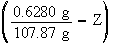 = Y,
Substitute Y into EQN 2.
= Y,
Substitute Y into EQN 2.
0.3694 g = 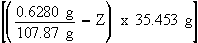 + (Z x
79.904 g)
+ (Z x
79.904 g)
Z =  = 3.667 x 10⁻³
Y = 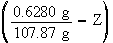 =
= 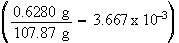 = 2.155 x 10⁻³
HCl molarity =  = 0.021
55 M
= 0.021
55 M
HBr molarity =  = 0.036
67 M
= 0.036
67 M
Multi-Concept
Problems
4.104 (a) Cr2+(aq) +
Cr2O72-(aq) ®
Cr3+(aq)
[Cr2+(aq) ® Cr3+(aq) +
e-] x 6 (oxidation half
reaction)
Cr2O72-(aq) ®
Cr3+(aq)
Cr2O72-(aq) ® 2
Cr3+(aq)
Cr2O72-(aq) ® 2 Cr3+(aq) +
7 H2O(l)
14 H+(aq) +
Cr2O72-(aq) ® 2 Cr3+(aq) +
7 H2O(l)
6 e- + 14 H+(aq) +
Cr2O72-(aq) ® 2 Cr3+(aq) +
7 H2O(l) (reduction half reaction)
Combine the two half
reactions.
14 H+(aq) +
Cr2O72-(aq) + 6 Cr2+(aq)
® 8
Cr3+(aq) + 7 H2O(l)
(b) total volume = 100.0 ml +
20.0 mL = 120.0 mL = 0.1200 L
Initial moles:
0.120  x 0.1000 L
= 0.0120 mol Cr(NO3)2
x 0.1000 L
= 0.0120 mol Cr(NO3)2
0.500  x 0.1000 L
= 0.0500 mol HNO3
x 0.1000 L
= 0.0500 mol HNO3
0.250  x 0.0200 L
= 0.005 00 mol K2Cr2O7
x 0.0200 L
= 0.005 00 mol K2Cr2O7
Check for the limiting reactant. 0.0120 mol of Cr2+ requires (0.0120)/6 = 0.00200 mol Cr2O72- and (14/6)(0.0120) = 0.0280 mol H+. Both are in excess of the required amounts, so Cr2+ is the limiting reactant.
14 H+(aq) +
Cr2O72-(aq) + 6 Cr2+(aq)
® 8
Cr3+(aq) + 7 H2O(l)
Initial moles 0.0500, 0.00500,
0.0120, 0
Change -14x, -x, -6x, +8x
Because Cr2+ is the
limiting reactant, 6x = 0.0120 and x = 0.00200
Final moles 0.0220, 0.00300,
0, 0.00160
mol K+ = 0.00500 mol
K2Cr2O7 x 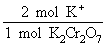 = 0.0100
mol K+
= 0.0100
mol K+
mol NO3- = 0.0120 mol
Cr(NO3)2 x 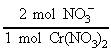
+ 0.0500 mol HNO3 x  = 0.0740
mol NO3-
= 0.0740
mol NO3-
mol H+ = 0.0220 mol; mol
Cr2O72- = 0.00300 mol; mol Cr3+ =
0.01600 mol
Check for charge neutrality.
Total moles of +charge = 0.0100 +
0.0220 + 3 x (0.01600) = 0.0800 mol +charge
Total moles of -charge = 0.0740 +
2 x (0.00300) = 0.0800 mol -charge
The charges balance and there is
electrical neutrality in the solution after the reaction.
K+
molarity = 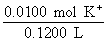 = 0.0833 M
NO3- molarity = 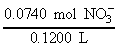 = 0.617 M
H+ molarity =  = 0.183
M
= 0.183
M
Cr2O72-
molarity = 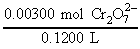 = 0.0250 M
Cr3+ molarity =  = 0.133
M
= 0.133
M
4.105 (a) (1) I-(aq) ®
I3-(aq)
3 I-(aq) ®
I3-(aq)
3 I-(aq) ®
I3-(aq) + 2 e- (oxidation half
reaction)
HNO2(aq) ® NO(g)
HNO2(aq) ® NO(g) +
H2O(l)
H+(aq) + HNO2(aq) ® NO(g) +
H2O(l)
[e- + H+(aq) + HNO2(aq)
® NO(g) +
H2O(l)] x 2 (reduction half reaction)
Combine the two half
reactions.
3 I-(aq) + 2 H+(aq) + 2 HNO2(aq)
®
I3-(aq) + 2 NO(g) + 2 H2O(l)
(2)
S2O32-(aq) ®
S4O62-(aq)
2
S2O32-(aq) ®
S4O62-(aq)
2
S2O32-(aq) ®
S4O62-(aq) + 2 e- (oxidation half
reaction)
I3-(aq) ®
I-(aq)
I3-(aq) ® 3 I-(aq)
2
e- + I3-(aq) ® 3 I-(aq)
(reduction half reaction)
Combine the two half reactions.
2
S2O32-(aq) + I3-(aq)
®
S4O62-(aq) + 3 I-(aq)
(b) 18.77 mL = 0.018 77 L;
NO2-, 46.01 amu
0.1500  x 0.018 77
L = 0.002 815 5 mol S2O32-
x 0.018 77
L = 0.002 815 5 mol S2O32-
mass NO2- = 0.002 815 5
mol S2O32- x  = 0.1295
g NO2-
= 0.1295
g NO2-
mass % NO2- =  x 100% = 4.412%
4.106 (a) (1) Cu(s) ®
Cu2+(aq)
[Cu(s) ® Cu2+(aq) + 2 e-] x 3
(oxidation half reaction)
NO3-(aq) ®
NO(g)
NO3-(aq) ® NO(g) + 2
H2O(l)
4 H+(aq) + NO3-(aq)
® NO(g) + 2
H2O(l)
[3 e- + 4 H+(aq) +
NO3-(aq) ® NO(g) + 2 H2O(l)] x 2 (reduction half
reaction)
Combine the two half reactions.
3 Cu(s) + 8 H+(aq) +
2 NO3-(aq) ® 3 Cu2+(aq) + 2 NO(g) + 4
H2O(l)
(2) Cu2+(aq) + SCN-(aq) ®
CuSCN(s)
[e- + Cu2+(aq) + SCN-(aq)
® CuSCN(s)] x
2 (reduction half reaction)
HSO3-(aq) ®
HSO4-(aq)
H2O(l) +
HSO3-(aq) ®
HSO4-(aq)
H2O(l) +
HSO3-(aq) ® HSO4-(aq) + 2
H+(aq)
H2O(l) + HSO3-(aq)
®
HSO4-(aq) + 2 H+(aq) + 2 e-
(oxidation half reaction)
Combine the two half reactions.
2
Cu2+(aq) + 2 SCN-(aq) + H2O(l) +
HSO3-(aq) ® 2 CuSCN(s) + HSO4-(aq) + 2
H+(aq)
(3) Cu+(aq) ®
Cu2+(aq)
[Cu+(aq) ® Cu2+(aq) +
e-] x 10 (oxidation half reaction)
IO3-(aq)
®
I2(aq)
2 IO3-(aq) ® I2(aq)
2
IO3-(aq) ® I2(aq) + 6 H2O(l)
12
H+(aq) + 2 IO3-(aq) ® I2(aq) + 6
H2O(l)
10 e- + 12 H+(aq) + 2
IO3-(aq) ® I2(aq) + 6 H2O(l) (reduction
half reaction)
Combine the two half reactions.
10 Cu+(aq) + 12
H+(aq) + 2 IO3-(aq) ® 10 Cu2+(aq) +
I2(aq) + 6 H2O(l)
(4) I2(aq)
®
I-(aq)
I2(aq) ® 2 I-(aq)
2 e- +
I2(aq) ® 2 I-(aq) (reduction half
reaction)
S2O32-(aq) ®
S4O62-(aq)
2
S2O32-(aq) ®
S4O62-(aq)
2
S2O32-(aq) ®
S4O62-(aq) + 2 e- (oxidation half
reaction)
Combine the two half reactions.
I2(aq) + 2
S2O32-(aq) ® 2 I-(aq) +
S4O62-(aq)
(5) 2
ZnNH4PO4 ® Zn2P2O7 +
H2O + 2 NH3
(b) 10.82 mL = 0.01082 L
mol
S2O32- = (0.1220 mol/L)(0.01082 L) = 0.00132
mol S2O32-
mol I2 = 0.00132 mol
S2O32- x  = 6.60 x
10-4 mol I2
= 6.60 x
10-4 mol I2
mol Cu+ = 6.60 x 10⁻⁴
mol I2 x  = 6.60 x
10-3 mol Cu+ (Cu)
= 6.60 x
10-3 mol Cu+ (Cu)
g Cu = (6.60 x 10⁻³
mol)(63.546 g/mol) = 0.419 g Cu
mass % Cu in brass = 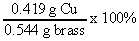 = 77.1%
Cu
= 77.1%
Cu
(c) Zn2P2O7,
304.72 amu
mass % Zn in Zn2P2O7 =  = 42.92%
mass of Zn in Zn2P2O7
= (0.4292)(0.246 g) = 0.106 g Zn
mass % Zn in brass = 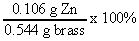 = 19.5%
Zn
= 19.5%
Zn