
Chapter 3
Formulas, Equations, and
Moles
3.1 2 KClO3 ® 2 KCl + 3 O2
3.2
(a) C6H12O6 ®
2 C2H6O + 2
CO2
(b) 4 Fe + 3 O2 ®
2 Fe2O3
(c) 4
NH3 + Cl2 ® N2H4 + 2
NH4Cl
3.3 3 A2 + 2 B ® 2 BA3
3.4 (a) Fe2O3: 2(55.85) +
3(16.00) = 159.7 amu
(b) H2SO4: 2(1.01) + 1(32.07) +
4(16.00) = 98.1 amu
(c) C6H8O7: 6(12.01) +
8(1.01) + 7(16.00) = 192.1 amu
(d)
C16H18N2O4S: 16(12.01) + 18(1.01) +
2(14.01) + 4(16.00) + 1(32.07) = 334.4 amu
3.5 Fe2O3(s) + 3 CO(g) ® 2 Fe(s) + 3 CO2(g)
0.500 mol
3.6 C5H11NO2S: 5(12.01) + 11(1.01) + 1(14.01) + 2(16.00) + 1(32.07) = 149.24 amu
3.7 C9H8O4,
180.2 amu; 500 mg = 500 x 10-3 g = 0.500 g
0.500 g x 
2.77 x 10-3 mol
x 
3.8 salicylic acid,
C7H6O3, 138.1 amu; acetic anhydride,
C4H6O3, 102.1 amu
aspirin,
C9H8O4, 180.2 amu; acetic acid,
C2H4O2, 60.1 amu
4.50 g
C7H6O3 x  = 3.33 g
C4H6O3
= 3.33 g
C4H6O3
4.50 g
C7H6O3 x  = 5.87 g
C9H8O4
= 5.87 g
C9H8O4
4.50 g
C7H6O3 x  = 1.96 g
C2H4O2
= 1.96 g
C2H4O2
3.9 C2H4, 28.1 amu;
C2H6O, 46.1 amu
4.6 g  = 7.5 g
C2H6O (theoretical yield)
= 7.5 g
C2H6O (theoretical yield)
3.10 CH4, 16.04 amu;
CH2Cl2, 84.93 amu; 1.85 kg = 1850 g
850 g
CH4 x  = 9800 g CH2Cl2 (theoretical
yield)
= 9800 g CH2Cl2 (theoretical
yield)
Actual yield = (9800 g)(0.431) = 4220 g
CH2Cl2
3.11 Li2O, 29.9 amu: 65 kg = 65,000
g; H2O, 18.0 amu: 80.0 kg = 80,000 g
65,000 g Li2O x
 = 2.17 x 10³ mol Li2O
80,000 g
H2O x  = 4.44 x 10³ mol H2O
The
reaction stoichiometry between Li2O and H2O is one to one.
There are twice as many moles of H2O as there are moles of
Li2O. Therefore, Li2O is the limiting reactant.
(4.44 x
103 mol - 2.17 x 10³ mol) = 2.27 x 10³ mol
H2O remaining
2.27 x 10³ mol H2O x  = 40,860 g H2O = 40.9 kg = 41 kg H2O
3.12 LiOH, 23.9 amu; CO2, 44.0
amu
3.13 (a) A + B2 ® AB2
There is a
1:1 stoichiometry between the two reactants. A is the limiting reactant because
there are fewer reactant A's than there are reactant B2's.
(b) 1.0
mol of AB2 can be made from 1.0 mol of A and 1.0 mol of
B2.
3.14 (a) 125 mL = 0.125 L; (0.20 mol/L)(0.125 L)
= 0.025 mol NaHCO3
(b) 650.0 mL = 0.6500 L; (2.50 mol/L)(0.650 L)
= 1.62 mol H2SO4
3.15 (a) NaOH, 40.0 amu; 500.0 mL = 0.5000
L
(b) C6H12O6, 180.2 amu
3.16 C6H12O6,
180.2 amu;
25.0 g C6H12O6 x  = 0.1387
mol C6H12O6
= 0.1387
mol C6H12O6 = 0.69 L;
0.69 L = 690 mL
= 0.69 L;
0.69 L = 690 mL
3.17 C27H46O, 386.7 amu;
750 mL = 0.750 L
3.18 Mi x Vi =
Mf x Vf; Mf =  = 0.656
M
= 0.656
M
3.19 Mi x Vi =
Mf x Vf; 
Dilute 6.94 mL of 18.0 M
H2SO4 with enough water to make 250.0 mL of solution. The
resulting solution will be 0.500 M H2SO4.
3.20 50.0 mL = 0.0500 L; (0.100 mol/L)(0.0500 L)
= 5.00 x 10⁻³ mol NaOH
5.00 x 10⁻³ mol NaOH x  = 2.50 x 10⁻³ mol H2SO4
volume =  = 0.0100 L; 0.0100 L = 10.0 mL H2SO4
3.21
HNO3(aq) + KOH(aq)® KNO3(aq) + H2O(l)
25.0 mL =
0.0250 L and 68.5 mL = 0.0685 L

3.22 From the reaction stoichiometry, moles NaOH
= moles CH3CO2H
(0.200 mol/L)(0.0947 L) = 0.018 94 mol
NaOH = 0.018 94 mol CH3CO2H
molarity =  = 0.758
M
= 0.758
M
3.23 For dimethylhydrazine,
C2H8N2, divide each subscript by 2 to obtain
the empirical formula. The empirical formula is CH4N.
C2H8N2, 60.1 amu or 60.1 g/mol


3.24 Assume a 100.0 g sample. From the percent
composition data, a 100.0 g sample contains 14.25 g C, 56.93 g O, and 28.83 g
Mg.
14.25 g C x  = 1.19 mol C
56.93 g O x  = 3.56 mol
O
= 3.56 mol
O
28.83 g Mg x  = 1.19 mol
Mg
= 1.19 mol
Mg
Mg1.19C1.19O3.56; divide each subscript
by the smallest, 1.19.
Mg1.19 / 1.19C1.19 /
1.19O3.56 / 1.19
The empirical formula is
MgCO3.
3.25 1.161 g H2O x 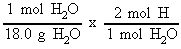 = 0.129
mol H
= 0.129
mol H
2.818 g CO2 x 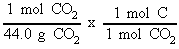 = 0.0640
mol C
= 0.0640
mol C
0.129 mol H x  = 0.130 g
H
= 0.130 g
H
0.0640 mol C x  = 0.768 g
C
= 0.768 g
C
1.00 g total - (0.130 g H + 0.768 g C) = 0.102 g O
0.102 g O x  = 0.006 38 mol O
C0.0640H0.129O0.006 38;
divide each subscript by the smallest, 0.006 38.
C0.0640 / 0.006
38H0.129 / 0.006 38O0.006 38 / 0.006
38
C10.03H20.22O1 The empirical
formula is C10H20O.
3.26 The empirical formula is CH2O,
30 amu: molecular mass = 150 amu. ;
therefore
;
therefore
molecular formula = 5 x empirical formula = C(5 x
1)H(5 x 2)O(5 x 1) =
C5H10O5
3.27 (a) Assume a 100.0 g sample. From the
percent composition data, a 100.0 g sample contains 21.86 g H and 78.14 g
B.

B7.24
H21.6; divide each subscript by the smaller, 7.24.
B7.24 /
7.24 H21.6 / 7.24 The empirical formula is BH3, 13.8
amu.
27.7 amu / 13.8 amu = 2; molecular formula = B(2 x 1)H(2
x 3) = B2H6.
(b) Assume a 100.0 g sample. From the percent
composition data, a 100.0 g sample contains 6.71 g H, 40.00 g C, and 53.28 g
O.


C3.33
H6.64 O3.33; divide each subscript by the smallest,
3.33.
C3.33 / 3.33 H6.64 / 3.33 O3.33 / 3.33
The empirical formula is CH2O, 30.0 amu.
90.08 amu / 30.0 amu = 3;
molecular formula = C(3 x 1)H(3 x 2)O(3 x 1) =
C3H6O3
3.28 Main sources of error in calculating
Avogadro's number by spreading oil on a pond are:
(i) the assumption that the
oil molecules are tiny cubes
(ii) the assumption that the oil layer is one
molecule thick
(iii) the assumption of a molecular mass of 200 for the
oil
3.29 area of oil = 2.0 x 10⁷
cm2
volume of oil = 4.9 cm3 = area x 4l = (2.0 x
107 cm2) x 4l
l =  = 6.125 x
10-8 cm
= 6.125 x
10-8 cm
area of oil = 2.0 x 107 cm2 =
l2 x N = (6.125 x 10⁻⁸ cm)2 x N
N = 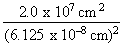 = 5.33 x 10²¹ oil molecules
moles of oil = (4.9
cm3) x (0.95 g/cm3) x  = 0.0233
mol oil
= 0.0233
mol oil
Avogadro's number = 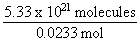 = 2.3 x
1023 molecules/mole
= 2.3 x
1023 molecules/mole
Understanding Key Concepts
3.30 The concentration of a solution is cut in half when the volume is doubled. This is best represented by box (b).
3.31 (c) 2 A + B2® A2B2
3.32 C2H4 + 3
O2 2 CO2 + 2 H2O
3.33 reactants, box (d), and products, box (c)
3.34 C17H18F3NO 17(12.01) + 18(1.01) + 3(19.00) + 1(14.01) + 1(16.00) = 309.36 amu
3.35 Adding a subscript of "2" to the oxygen in N2O would change nitrous oxide (N2O) into a different compound. This is not allowed to balance an equation.
3.36 Because the two volumes are equal (let the
volume = y L), the concentrations are proportional to the number of solute
ions.
OH- concentration = 1.00 M x  = 0.67
M
= 0.67
M
3.37 (a) A2 + 3
B2 ® 2
AB3; B2 is the limiting reactant because it is completely
consumed.
(b) For 1.0 mol of A2, 3.0 mol of B2 are
required. Because only 1.0 mol of B2 is available, B2 is
the limiting reactant.
1 mol B2 x  = 2/3 mol
AB3
= 2/3 mol
AB3
Additional
Problems
Balancing Equations
3.38 Equation (b) is balanced, (a) is not balanced.
3.39 (a) and (c) are not balanced, (b) is
balanced.
(a) 2 Al + Fe2O3 Al2O3
+ 2 Fe (balanced)
(c) 4 Au + 8 NaCN + O2 + 2 H2O 4
NaAu(CN)2 + 4 NaOH (balanced)
3.40 (a) Mg + 2 HNO3 ® H2 +
Mg(NO3)2
(b) CaC2 + 2 H2O
®
Ca(OH)2 + C2H2
(c) 2 S + 3 O2
® 2
SO3
(d) UO2 + 4 HF ® UF4 + 2
H2O
3.41 (a) 2 NH4NO3
® 2 N2 +
O2 + 4 H2O
(b) C2H6O +
O2 ®
C2H4O2 + H2O
(c)
C2H8N2 + 2 N2O4
® 3 N2 +
2 CO2 + 4 H2O
Molecular Masses and Moles
3.42 Hg2Cl2: 2(200.59) +
2(35.45) = 472.1 amu
C4H8O2: 4(12.01) +
8(1.01) + 2(16.00) = 88.1 amu
CF2Cl2: 1(12.01) +
2(19.00) + 2(35.45) = 120.9 amu
3.43 (a) (1 x 30.97 amu) + (Y x 35.45 amu) =
137.3 amu; Solve for Y; Y = 3.
The formula is PCl3.
(b) (10 x 12.01 amu) + (14 x 1.008 amu) + (Z x
14.01 amu) = 162.2 amu.
Solve for Z; Z = 2. The formula is
C10H14N2.
3.44 One mole equals the atomic mass or
molecular mass in grams.
(a) Ti, 47.88 g (b) Br2, 159.81 g (c) Hg,
200.59 g (d) H2O, 18.02 g
3.45 (a) 
(b) 
(c) 
(d) 
3.46 There are 2 ions per each formula unit of NaCl. (2.5 mol)(2 mol ions/mol) = 5.0 mol ions
3.47 There are 2 K+ ions per each
formula unit of K2SO4.
3.48 There are 3 ions (one Mg2+ and 2
Cl-) per each formula unit of MgCl2.
MgCl2,
95.2 amu
27.5 g MgCl2 x 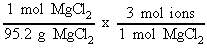 = 0.867
mol ions
= 0.867
mol ions
3.49 There are 3 F- anions per each
formula unit of AlF3.
AlF3, 84.0 amu
35.6 g
AlF3 x 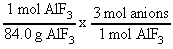 = 1.27 mol F-
3.50 Molar mass =  ;
molecular mass = 119 amu.
;
molecular mass = 119 amu.
3.51 Molar mass =  = 386.7
g/mol; molecular mass = 386.7 amu.
= 386.7
g/mol; molecular mass = 386.7 amu.
3.52 FeSO4 , 151.9 amu; 300 mg =
0.300 g

3.53 0.0001 g C x 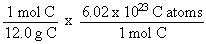 = 5 x
1018 C atoms
= 5 x
1018 C atoms
3.54
C8H10N4O2, 194.2 amu; 125 mg = 0.125
g
0.125 g caffeine x 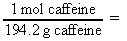 6.44 x
10-4 mol caffeine
6.44 x
10-4 mol caffeine
0.125 g caffeine x  = 3.88 x
1020 caffeine molecules
= 3.88 x
1020 caffeine molecules
3.55 
3.56 (a) 1.0 g Li x  = 0.14 mol
Li
= 0.14 mol
Li
(b) 1.0 g Au x  = 0.0051
mol Au
= 0.0051
mol Au
(c) penicillin G:
C16H17N2O4SK, 372.5 amu
1.0 g x
 = 2.7 x 10⁻³ mol penicillin G
3.57 (a) 
(b) 
(c)
C16H13ClN2O, 284.7 amu

Stoichiometry Calculations
3.58 TiO2, 79.88 amu;  = 167 kg
TiO2
= 167 kg
TiO2
3.59 Fe2O3, 159.7 amu;

mass Fe = (0.6994)(105 kg)
= 73.4 kg
3.60 (a) 2
Fe2O3 + 3 C ® 4 Fe + 3 CO2
(b) Fe2O3, 159.7 amu; 525
g Fe2O3 x 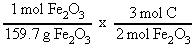 = 4.93
mol C
= 4.93
mol C
(c) 4.93 mol C x  = 59.2 g
C
= 59.2 g
C
3.61 (a) Fe2O3 + 3 CO
® 2 Fe + 3
CO2
(b) Fe2O3, 159.7 amu; CO, 28.01
amu
(c) 
3.62 (a) 2 Mg + O2 ® 2 MgO
(b) Mg, 24.30 amu; O2, 32.00 amu;
MgO, 40.30 amu
25.0 g Mg x  = 16.5 g
O2
= 16.5 g
O2
25.0 g Mg x  = 41.5 g
MgO
= 41.5 g
MgO
(c) 25.0 g O2 x  = 38.0 g
Mg
= 38.0 g
Mg
25.0 g O2 x  = 63.0 g
MgO
= 63.0 g
MgO
3.63 C2H4 + H2O
®
C2H6O; C2H4, 28.05 amu;
H2O, 18.02 amu; C2H6O, 46.07
amu
(a) 

(b) 

3.64 (a) 2 HgO ® 2 Hg + O2
(b)
HgO, 216.6 amu; Hg, 200.6 amu; O2, 32.0 amu
45.5 g HgO x  = 42.1 g Hg
45.5 g HgO x  = 3.36 g
O2
= 3.36 g
O2
(c) 33.3 g O2 x  = 451 g
HgO
= 451 g
HgO
3.65 5.60 kg = 5600 g; TiCl4, 189.7
amu; TiO2, 79.88 amu
3.66 

Ag0.0185Cl0.0185 Divide both
subscripts by 0.0185. The empirical formula is AgCl.
3.67 5.0 g Al x  = 0.19 mol
Al; 4.45 g O x
= 0.19 mol
Al; 4.45 g O x  = 0.28 mol O
Al0.19O0.28; divide
both subscripts by the smaller, 0.19.
Al0.19 / 0.19O0.28 /
0.19
Al1O1.5; multiply both subscripts by 2 to
obtain integers. The empirical formula is
Al2O3.
Limiting Reactants and Reaction Yield
3.68 3.44 mol N2 x  = 10.3 mol
H2 required.
= 10.3 mol
H2 required.
Because there is only 1.39 mol H2,
H2 is the limiting reactant.
1.39 mol H2 x 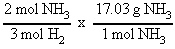 = 15.8 g NH3
1.39 mol H2 x  = 13.0 g
N2 reacted
= 13.0 g
N2 reacted
3.44 mol N2 x  = 96.3 g
N2 initially
= 96.3 g
N2 initially
(96.3 g - 13.0 g) = 83.3 g N2 left
over
3.69 H2, 2.016 amu; Cl2,
70.91 amu; HCl 36.46 amu

Because the reaction
stoichiometry between H2 and Cl2 is one to one,
Cl2 is the limiting reactant.
3.70 C2H4, 28.05 amu;
Cl2, 70.91 amu; C2H4Cl2, 98.96
amu
15.4 g C2H4 x  = 0.549
mol C2H4
= 0.549
mol C2H4
3.74 g Cl2 x  = 0.0527
mol Cl2
= 0.0527
mol Cl2
Because the reaction stoichiometry between
C2H4 and Cl2 is one to one, Cl2 is
the limiting reactant.
0.0527 mol Cl2 x  = 5.22 g
C2H4Cl2
= 5.22 g
C2H4Cl2
3.71 (a) NaCl, 58.44 amu; AgNO3,
169.9 amu; AgCl, 143.3 amu; NaNO3, 85.00 amu
NaCl +
AgNO3 ®
AgCl + NaNO3
1.3 g NaCl x  = 0.0222
mol NaCl
= 0.0222
mol NaCl
3.5 g AgNO3 x 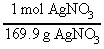 = 0.0206
mol AgNO3
= 0.0206
mol AgNO3
Because the reaction stoichiometry between NaCl
and AgNO3 is one to one, AgNO3 is the limiting
reactant.
0.0206 mol AgNO3 x 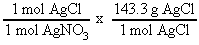 = 3.0 g
AgCl
= 3.0 g
AgCl
0.0206 mol AgNO3 x  = 1.8 g
NaNO3
= 1.8 g
NaNO3
0.0206 mol AgNO3 x 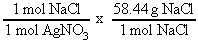 = 1.2 g
NaCl reacted
= 1.2 g
NaCl reacted
(1.3 g - 1.2 g) = 0.1 g NaCl left over
(b) BaCl2, 208.2 amu;
H2SO4, 98.08 amu; BaSO4, 233.4 amu; HCl, 36.46
amu
BaCl2 + H2SO4 ® BaSO4 + 2
HCl
2.65 g BaCl2 x  = 0.0127
mol BaCl2
= 0.0127
mol BaCl2
6.78 g H2SO4 x  = 0.0691
mol H2SO4
= 0.0691
mol H2SO4
Because the reaction stoichiometry between
BaCl2 and H2SO4 is one to one, BaCl2
is the limiting reactant.
0.0127 mol BaCl2 x 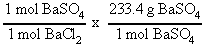 = 2.96 g
BaSO4
= 2.96 g
BaSO4
0.0127 mol BaCl2 x  = 0.926
g HCl
= 0.926
g HCl
0.0127 mol BaCl2 x  = 1.25 g
H2SO4 reacted
= 1.25 g
H2SO4 reacted
(6.78 g - 1.25 g) = 5.53 g
H2SO4 left over
3.72 CaCO3, 100.1 amu; HCl, 36.46
amu
CaCO3 + 2 HCl ® CaCl2 + H2O +
CO2

The reaction stoichiometry
is 1 mole of CaCO3 for every 2 moles of HCl. For 0.0235 mol
CaCO3, we only need 2(0.0235 mol) = 0.0470 mol HCl. We have 0.0645
mol HCl; therefore CaCO3 is the limiting reactant.
3.73 2 NaN3 ® 3 N2 + 2 Na;
NaN3, 65.01 amu; N2, 28.01 amu
38.5 g NaN3 x
 = 41.8 L
3.74 CH3CO2H +
C5H12O ® C7H14O2 +
H2O
CH3CO2H, 60.05 amu;
C5H12O, 88.15 amu;
C7H14O2, 130.19 amu

Because the reaction
stoichiometry between CH3CO2H and
C5H12O is one to one, isopentyl alcohol
(C5H12O) is the limiting reactant.
7.02 g
C7H14O2 is the theoretical yield. Actual yield
= (7.02 g)(0.45) = 3.2 g.
3.75 K2PtCl4 + 2
NH3 ® 2
KCl +
Pt(NH3)2Cl2
K2PtCl4,
415.1 amu; NH3, 17.03 amu;
Pt(NH3)2Cl2, 300.0 amu
55.8 g
K2PtCl4 x  = 0.134
mol K2PtCl4
= 0.134
mol K2PtCl4
35.6 g NH3 x  = 2.09
mol NH3
= 2.09
mol NH3
Only 2(0.134) = 0.268 mol NH3 are needed to
react with 0.134 mol K2PtCl4. Therefore, the
NH3 is in excess and K2PtCl4 is the limiting
reactant.
0.134 mol K2PtCl4 x  = 40.2 g
Pt(NH3)2Cl2
= 40.2 g
Pt(NH3)2Cl2
40.2 g
Pt(NH3)2Cl2 is the theoretical yield.
Actual
yield = (40.2 g)(0.95) = 38 g
Pt(NH3)2Cl2.
3.76 CH3CO2H +
C5H12O ® C7H14O2 +
H2O
CH3CO2H, 60.05 amu;
C5H12O, 88.15 amu;
C7H14O2, 130.19 amu
1.87 g
CH3CO2H x  = 0.0311
mol CH3CO2H
= 0.0311
mol CH3CO2H
2.31 g C5H12O x  = 0.0262 mol C5H12O
Because the reaction
stoichiometry between CH3CO2H and
C5H12O is one to one, isopentyl alcohol
(C5H12O) is the limiting reactant.
0.0262 mol
C5H12O x 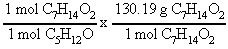 = 3.41 g
C7H14O2
= 3.41 g
C7H14O2
3.41 g
C7H14O2 is the theoretical yield.
% Yield =
 = 86.8%
3.77 K2PtCl4
+ 2 NH3 ® 2 KCl +
Pt(NH3)2Cl2
K2PtCl4,
415.1 amu; NH3, 17.03 amu;
Pt(NH3)2Cl2, 300.0 amu
3.42 g
K2PtCl4 x  = 0.008
24 mol K2PtCl4
= 0.008
24 mol K2PtCl4
1.61 g NH3 x  = 0.0945
mol NH3
= 0.0945
mol NH3
Only 2 x (0.008 24) = 0.0165 mol of NH3 are
needed to react with 0.008 24 mol K2PtCl4. Therefore, the
NH3 is in excess and K2PtCl4 is the limiting
reactant.
0.008 24 mol K2PtCl4 x  = 2.47 g
Pt(NH3)2Cl2
= 2.47 g
Pt(NH3)2Cl2
2.47 g
Pt(NH3)2Cl2 is the theoretical yield. 2.08 g
Pt(NH3)2Cl2 is the actual yield.
% Yield =
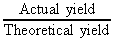 x 100% =
  x 100% =
84.2%
x 100% =
84.2%
Molarity, Solution Stoichiometry, Dilution, and Titration
3.78 (a) 35.0 mL = 0.0350 L; 
(b) 175 mL = 0.175 L; 
3.79 (a) C2H6O, 46.07 amu;
250.0 mL = 0.2500 L = 0.150
mol C2H6O
= 0.150
mol C2H6O
(0.150 mol)(46.07 g/mol) = 6.91 g
C2H6O
(b) H3BO3, 61.83 amu;
167 mL = 0.167 L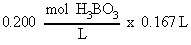 = 0.0334
mol H3BO3
= 0.0334
mol H3BO3
(0.0334 mol)(61.83 g/mol) = 2.07 g
H3BO3
3.80 BaCl2, 208.2 amu

3.81 0.0171 mol KOH x
 = 0.0489 L; 0.0489 L = 48.9 mL
3.82 NaCl, 58.4 amu; 400 mg =
0.400 g; 100 mL = 0.100 L
0.400 g NaCl x  = 0.006
85 mol NaCl
= 0.006
85 mol NaCl
molarity =  = 0.0685
M
= 0.0685
M
3.83 C6H12O6,
180.2 amu; 90 mg = 0.090 g; 100 mL = 0.100 L
molarity =  = 0.0050 M = 5.0 x 10⁻³ M
3.84 NaCl,
58.4 amu; KCl, 74.6 amu; CaCl2, 111.0 amu; 500 mL = 0.500 L
4.30 g
NaCl x  = 0.0736 mol NaCl
0.150 g KCl x  = 0.002
01 mol KCl
= 0.002
01 mol KCl
0.165 g CaCl2 x  = 0.001
49 mol CaCl2
= 0.001
49 mol CaCl2
0.0736 mol + 0.002 01 mol + 2(0.001 49 mol) = 0.0786
mol Cl-
Na+ molarity =  = 0.147
M
= 0.147
M
Ca2+ molarity =  = 0.002
98 M
= 0.002
98 M
K+ molarity =  = 0.004
02 M
= 0.004
02 M
Cl- molarity =  = 0.157
M
= 0.157
M
3.85 3.045 g Cu x  = 0.047
92 mol Cu; 50.0 mL = 0.0500 L
= 0.047
92 mol Cu; 50.0 mL = 0.0500 L
Cu(NO3)2 molarity =  = 0.958 M
3.86 Mf x Vf =
Mi x Vi; 
3.87 Mf x Vf =
Mi x Vi; 
3.88 2 HBr(aq) + K2CO3(aq)
® 2 KBr(aq) +
CO2(g) + H2O(l)
K2CO3, 138.2 amu;
450 mL = 0.450 L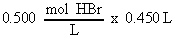 = 0.225
mol HBr
= 0.225
mol HBr
0.225 mol HBr x  = 15.5 g
K2CO3
= 15.5 g
K2CO3
3.89 2 C4H10S + NaOCl
®
C8H18S2 + NaCl +
H2O
C4H10S, 90.19 amu; 5.00 mL = 0.005 00
L
0.0985  x 0.005 00 L = 4.925 x 10⁻⁴ mol NaOCl
4.925
x 10-4 mol NaOCl x 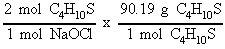 = 0.0888
g C4H10S
= 0.0888
g C4H10S
3.90 H2C2O4,
90.04 amu
 = 57.2
mL
= 57.2
mL
3.91 H2C2O4,
90.04 amu; 400.0 mL = 0.4000 L; 25.0 mL = 0.0250 L
molarity = 
H2C2O4(aq) + 2 KOH(aq)
®
K2C2O4(aq) + 2 H2O(l)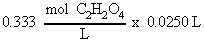 = 0.008 32 mol H2C2O4
0.008 32
mol H2C2O4 x  = 0.0166
mol KOH
= 0.0166
mol KOH = 0.166 L; 0.166 L = 166 mL
Formulas and Elemental Analysis
3.92 CH4N2O, 60.1
amu



3.93 (a)
Cu2(OH)2CO3, 221.1 amu
% Cu =  =
57.4%
=
57.4%
% O =  = 36.2%
% C = 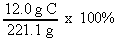 =
5.43%
=
5.43%
% H =  = 0.91%
(b) C8H9NO2,
151.2 amu
% C = 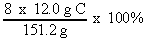 =
63.5%
=
63.5%
% H =  = 6.01%
% N = 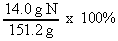 =
9.26%
=
9.26%
% O = 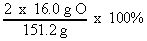 = 21.2%
(c)
Fe4[Fe(CN)6]3, 859.2 amu
% Fe =  = 45.5%
% C = 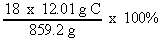 =
25.2%
=
25.2%
% N = 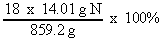 = 29.3%
3.94 Assume a 100.0 g sample. From the percent
composition data, a 100.0 g sample contains 24.25 g F and 75.75 g Sn.

Sn0.6382F1.276; divide each
subscript by the smaller, 0.6382.
Sn0.6382 / 0.6382F1.276 /
0.6382 The empirical formula is SnF2.
3.95 (a) Assume a 100.0 g sample of ibuprofen.
From the percent composition data, a 100.0 g sample contains 75.69 g C, 15.51 g
O, and 8.80 g H.
75.69 g C x  = 6.302
mol C
= 6.302
mol C
15.51 g O x  = 0.9694
mol O
= 0.9694
mol O
8.80 g H x  = 8.71
mol H
= 8.71
mol H
C6.302H8.71O0.9694, divide each
subscript by the smallest, 0.9694.
C6.302 / 0.9694H8.71 /
0.9694O0.9694 / 0.9694
C6.5H9O;
multiply each subscript by 2 to obtain integers.
The empirical formula is
C13H18O2.
(b) Assume a 100.0 g sample of tetraethyllead.
From the percent composition data, a 100.0 g sample contains 29.71 g C, 6.23 g
H, and 64.06 g Pb.
29.71 g C x  = 2.474
mol C
= 2.474
mol C
6.23 g H x  = 6.17
mol H
= 6.17
mol H
64.06 g Pb x  = 0.3092
mol Pb
= 0.3092
mol Pb
Pb0.3092C2.474H6.17; divide each
subscript by the smallest, 0.3092.
Pb0.3092 / 0.3092C2.474 /
0.3092H6.17 / 0.3092 The empirical formula is
PbC8H20.
(c) Assume a 100.0 g sample of zircon. From the
percent composition data, a 100.0 g sample contains 34.91 g O, 15.32 g Si, and
49.76 g Zr.
34.91 g O x  = 2.182
mol O
= 2.182
mol O
15.32 g Si x  = 0.5454
mol Si
= 0.5454
mol Si
49.76 g Zr x  = 0.5455
mol Zr
= 0.5455
mol Zr
Zr0.5455Si0.5454O2.182; divide each
subscript by the smallest, 0.5454.
Zr0.5455 / 0.5454Si0.5454
/ 0.5454O2.182 / 0.5454 The empirical formula is
ZrSiO4.
3.96 Toluene contains only C and H.
152.5 mg
= 0.1525 g and 35.67 mg = 0.035 67 g

C0.003
465H0.003 959; divide each subscript by the smaller, 0.003
465.
C0.003 465 / 0.003 465H0.003 959 / 0.003
465
CH1.14; multiply each subscript by 7 to obtain
integers.
The empirical formula is C7H8.
3.97 5.024 mg = 0.005 024 g; 13.90 mg = 0.013 90
g; 6.048 mg = 0.006 048 g
0.013 90 g CO2 x  = 3.158
x 10-4 mol C
= 3.158
x 10-4 mol C
0.006 048 g H2O x  = 6.713
x 10-4 mol H
= 6.713
x 10-4 mol H
3.158 x 10⁻⁴ mol C x  = 0.003
793 g C
= 0.003
793 g C
6.713 x 10⁻⁴ mol H x  = 0.000
676 7 g H
= 0.000
676 7 g H
mass N = 0.005 024 g - (0.003 793 g + 0.000 676 7 g) = 0.000 554 g
N
0.000 554 g N x  = 3.95 x
10-5 mol N
= 3.95 x
10-5 mol N
Scale each mol quantity to eliminate
exponents.
C3.158H6.713N0.395; divide each
subscript by the smallest, 0.395.
C3.158 / 0.395H6.713 /
0.395N0.395 / 0.395 The empirical formula is
C8H17N.
3.98 Let X equal the molecular mass of
cytochrome c.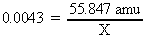 ;
; 
3.99 Let X equal the molecular mass of
nitrogenase.
0.000 872 =  ; X =
; X =  = 220,000 amu
3.100 Let X equal the molecular
mass of disilane. ;
; 
62.23 amu - 2(Si atomic
mass) = 62.23 amu - 2(28.09 amu) = 6.05 amu
6.05 amu is the total mass of H
atoms. ; Disilane is Si2H6.
3.101 Let X equal the molecular mass of
MS2.
0.4006 =  ; X =
; X =  = 160.1 amu
Atomic mass of M = 160.1 amu - 2(S atomic mass)
= 160.1 amu -
2(32.07 amu) = 95.96 amu
M is Mo.
General Problems
3.102 (a)
C6H12O6, 180.2 amu


(b) H2SO4, 98.08
amu


(c) KMnO4, 158.0 amu


(d)
C7H5NO3S, 183.2 amu




3.103 (a) Assume a 100.0 g sample of aspirin.
From the percent composition data, a 100.0 g sample contains 60.00 g C, 35.52 g
O, and 4.48 g H.
60.00 g C x  = 5.00
mol C
= 5.00
mol C
35.52 g O x  = 2.22
mol O
= 2.22
mol O
4.48 g H x  = 4.44
mol H
= 4.44
mol H
C5.00H4.44O2.22; divide each subscript
by the smallest, 2.22.
C5.00 / 2.22H4.44 /
2.22O2.22 / 2.22
C2.25H2O1;
multiply each subscript by 4 to obtain integers.
The empirical formula is
C9H8O4.
(b) Assume a 100.0 g sample of ilmenite. From
the percent composition data, a 100.0 g sample contains 31.63 g O, 31.56 g Ti,
and 36.81 g Fe.
31.63 g O x  = 1.98
mol O
= 1.98
mol O
31.56 g Ti x  = 0.659
mol Ti
= 0.659
mol Ti
36.81 g Fe x  = 0.659
mol Fe
= 0.659
mol Fe
Fe0.659Ti0.659O1.98; divide each
subscript by the smallest, 0.659.
Fe0.659 / 0.659Ti0.659 /
0.659O1.98 / 0.659 The empirical formula is
FeTiO3.
(c) Assume a 100.0 g sample of sodium
thiosulfate. From the percent composition data, a 100.0 g sample contains 30.36
g O, 29.08 g Na, and 40.56 g S.
30.36 g O x  = 1.90
mol O
= 1.90
mol O
29.08 g Na x  = 1.26
mol Na
= 1.26
mol Na
40.56 g S x  = 1.26
mol S
= 1.26
mol S
Na1.26S1.26O1.90; divide each
subscript by the smallest, 1.26.
Na1.26 / 1.26S1.26 /
1.26O1.90 / 1.26
NaSO1.5; multiply each subscript
by 2 to obtain integers.
The empirical formula is
Na2S2O3.
3.104 (a) SiCl4 + 2 H2O
® SiO2 +
4 HCl
(b) P4O10 + 6 H2O ® 4
H3PO4
(c) CaCN2 + 3 H2O
® CaCO3
+ 2 NH3
(d) 3 NO2 + H2O ® 2 HNO3 +
NO
3.105 NaH, 24.00 amu;
B2H6, 27.67 amu; NaBH4, 37.83 amu
2 NaH +
B2H6 2 NaBH4
8.55 g NaH x  = 0.356
mol NaH
= 0.356
mol NaH
6.75 g B2H6 x  = 0.244
mol B2H6
= 0.244
mol B2H6
For 0.244 mol B2H6, 2 x
(0.244) = 0.488 mol NaH are needed. Because only 0.356 mol of NaH is available,
NaH is the limiting reactant.
0.356 mol NaH x  = 13.5 g
NaBH4 produced
= 13.5 g
NaBH4 produced
0.356 mol NaH x 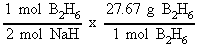 = 4.93 g
B2H6 reacted
= 4.93 g
B2H6 reacted
B2H6 left over =
6.75 g - 4.93 g = 1.82 g B2H6
3.106 Assume a 100.0 g sample of ferrocene. From
the percent composition data, a 100.0 g sample contains 5.42 g H, 64.56 g C, and
30.02 g Fe.
5.42 g H x  = 5.37
mol H
= 5.37
mol H
64.56 g C x  = 5.38
mol C
= 5.38
mol C
30.02 g Fe x  = 0.538
mol Fe
= 0.538
mol Fe
C5.38H5.37Fe0.538; divide each
subscript by the smallest, 0.538.
C5.38 / 0.538H5.37 /
0.538Fe0.538 / 0.538 The empirical formula is
C10H10Fe.
3.107 Mass of 1 HCl molecule = (36.5  )(1.6605 x 10⁻²⁴
  ) = 6.06 x
10-23 g/molecule
) = 6.06 x
10-23 g/molecule
Avogadro's number = 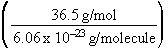 = 6.02 x
1023 molecules/mole
= 6.02 x
1023 molecules/mole
3.108 Na2SO4, 142.04 amu;
Na3PO4, 163.94 amu; Li2SO4, 109.95
amu; 100.00 mL = 0.10000 L
0.550 g Na2SO4 x  = 0.003 872 mol Na2SO4
1.188 g
Na3PO4 x  = 0.007
247 mol Na3PO4
= 0.007
247 mol Na3PO4
0.223 g Li2SO4 x
 = 0.002 028 mol Li2SO4
Na+
molarity =  = 0.295 M
Li+ molarity = 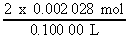 = 0.0406
M
= 0.0406
M
SO42- molarity =  = 0.0590
M
= 0.0590
M
PO43- molarity = 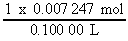 = 0.0725
M
= 0.0725
M
3.109 23.46 mg = 0.023 46 g; 20.42 mg = 0.02042
g; 33.27 mg = 0.033 27 g



mass O = 0.023 46 g -
(0.009 080 g + 0.002 284 g) = 0.012 10 g O
Scale each mol quantity to
eliminate exponents.
C0.7560H2.266O0.7563;
divide each subscript by the smallest, 0.7560.
C0.7560 /
0.7560H2.266 / 0.7560O0.7563 / 0.7560 The empirical
formula is CH3O, 31.0 amu.
62.0 amu / 31.0 amu = 2; molecular
formula = C(2 x 1)H(2 x 3)O(2 x 1) =
C2H6O2
3.110 High resolution mass spectrometry is capable of measuring the mass of molecules with a particular isotopic composition.
3.111 AgCl, 143.32 amu; %Cl in AgCl = 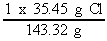 x 100% = 24.73%
Find the mass of Cl in 1.68 g of AgCl. Mass Cl
= 1.68 g x 0.2473 = 0.4155 g Cl
All of the Cl in AgCl came from
XCl3.
Find the mass of X in 0.634 g of XCl3. Mass of X
= 0.634 g - 0.4155 g = 0.2185 g X
0.4155 g Cl x  = 0.011
72 mol Cl
= 0.011
72 mol Cl
0.011 72 mol Cl x  = 0.003
907 mol X
= 0.003
907 mol X
molar mass of X =  = 55.93
g/mol; X = Fe
= 55.93
g/mol; X = Fe
3.112
C6H12O6 + 6 O2 ® 6 CO2 + 6
H2O; C6H12O6, 180.16 amu;
CO2, 44.01 amu
66.3 g C6H12O6 x
 = 97.2 g CO2
66.3 g
C6H12O6 x  = 56.1 L
CO2
= 56.1 L
CO2
3.113 H2C2O4,
90.04 amu; 22.35 mL = 0.02235 L
0.5170 g
H2C2O2 x  = 0.002
297 mol KMnO4
= 0.002
297 mol KMnO4
KMnO4 molarity =  = 0.1028
M
= 0.1028
M
3.114 Mass of Cu = 2.196 g; mass of S = 2.748 g
- 2.196 g = 0.552 g S
(a) %Cu =  x 100% =
79.9%
x 100% =
79.9%
%S =  x 100% = 20.1%
(b) 2.196 g Cu x  = 0.0346
mol Cu
= 0.0346
mol Cu
0.552 g S x  = 0.0172
mol S
= 0.0172
mol S
Cu0.0346S0.0172; divide each subscript by the
smaller, 0.0172.
Cu0.0346 / 0.0172S0.0172 / 0.0172 The
empirical formula is Cu2S.
(c) Cu2S, 159.16 amu
= 4.2 x 10²²
Cu+ ions/cm3
3.115 Mass of added Cl = mass of XCl5
- mass of XCl3 = 13.233 g - 8.729 g = 4.504 g
mass of Cl in
XCl5 = 5 Cl's x  = 11.26 g
Cl
= 11.26 g
Cl
mass of X in XCl5 = 13.233 g - 11.26 g = 1.973 g X
11.26 g
Cl x  = 0.3176 mol Cl
0.3176 mol Cl x  = 0.063
52 mol X
= 0.063
52 mol X
molar mass of X = 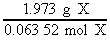 = 31.1
g/mol; atomic mass =31.1 amu, X = P
= 31.1
g/mol; atomic mass =31.1 amu, X = P
3.116 PCl3, 137.33 amu;
PCl5, 208.24 amu
Let Y = mass of PCl3 in the mixture,
and (10.00 - Y) = mass of PCl5 in the mixture.
fraction Cl in
PCl3 =  = 0.774 48
fraction Cl in PCl5 =  = 0.851 25
(mass of Cl in PCl3) + (mass of Cl in
PCl5) = mass of Cl in the mixture
0.774 48Y + 0.851 25(10.00 g -
Y) = (0.8104)(10.00 g)
Y = 5.32 g PCl3 and 10.00 - Y = 4.68 g
PCl5
3.117 100.00 mL = 0.100 00 L; 71.02 mL = 0.071
02 L
mol H2SO4 = 0.1083  x 0.100
00 L = 0.010 83 mol H2SO4
x 0.100
00 L = 0.010 83 mol H2SO4
mol NaOH = 0.1241  x 0.071 02 L = 0.008 814 mol NaOH
H2SO4 + 2 NaOH
®
Na2SO4 + 2 H2O
mol
H2SO4 reacted with NaOH = 0.008 814 mol NaOH x  = 0.004 407 mol H2SO4
mol H2SO4
reacted with MCO3 = 0.010 83 mol - 0.004 407 mol = 0.006 423 mol
H2SO4
mol H2SO4 reacted with
MCO3 = mol CO32- in MCO3 = mol
CO2 produced = 0.006 423 mol CO2
(a)
CO32-, 60.01 amu; 0.006 423 mol
CO32- x  = 0.3854
g CO32-
= 0.3854
g CO32-
mass of M = 1.268 g - 0.3854 g = 0.8826 g
M
molar mass of M = 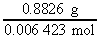 = 137.4
g/mol; M is Ba
= 137.4
g/mol; M is Ba
(b) 0.006 423 mol CO2 x  = 0.1571
L CO2
= 0.1571
L CO2
3.118 NH4NO3, 80.04 amu;
(NH4)2HPO4, 132.06 amu
Assume you have a
100.0 g sample of the mixture.
Let X = grams of NH4NO3
and (100.0 - X) = grams of (NH4)2HPO4.
Both
compounds contain 2 nitrogen atoms per formula unit.
Because the mass % N in
the sample is 30.43%, the 100.0 g sample contains 30.43 g N.
mol
NH4NO3 = 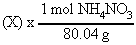
mol
(NH4)2HPO4 = 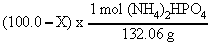
mass N =  x
x
 = 30.43 g
Solve for X. =
30.43
=
30.43 = 1.08627
 =
1.08627
=
1.08627
(132.06)(X) + (100.0 - X)(80.04) =
(1.08627)(80.04)(132.06)
132.06X + 8004 - 80.04X = 11481.96
132.06X -
80.04X = 11481.96 - 8004
52.02X = 3477.96
X =  = 66.86 g
NH4NO3
= 66.86 g
NH4NO3
(100.0 - X) = (100.0 - 66.86) = 33.14 g
(NH4)2HPO4
The mass ratio of
NH4NO3 to (NH4)2HPO4 in
the mixture is 2 to 1.
3.119 (a) 56.0 mL = 0.0560 L
mol
X2 = (0.0560 L X2) = 0.00250
mol X2
= 0.00250
mol X2
mass X2 = 1.12 g MX2 - 0.720 g MX =
0.40 g X2
molar mass X2 =  = 160
g/mol
= 160
g/mol
atomic mass of X = 160/2 = 80 amu; X is Br.
(b) mol MX = 0.00250
mol X2 x  = 0.00500
mol MX
= 0.00500
mol MX
mass of X in MX = 0.00500 mol MX x 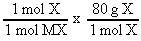 = 0.40 g
X
= 0.40 g
X
mass of M in MX = 0.720 g MX - 0.40 g X = 0.32 g M
molar mass M =  = 64 g/mol
atomic mass of X = 64 amu; M is Cu.