

Chapter 1
Chemistry: Matter and
Measurement
1.1 (a) Cu (b) Pt (c) Pu
1.2 (a) silver (b) rhodium (c) rhenium (d) cesium (e) argon (f) arsenic
1.3 (a) Ti, metal (b) Te, semimetal (c) Se, nonmetal (d) Sc, metal (e) At, semimetal (f) Ar, nonmetal
1.4 The three "coinage metals" are copper (Cu), silver (Ag), and gold (Au).
1.5 (a) The decimal point must be shifted ten places to the right so the exponent is -10. The result is 3.72 x 10⁻¹⁰ m.
(b) The decimal point must be shifted eleven places to the left so the exponent is 11. The result is 1.5 x 10¹¹ m.
1.6 (a) microgram (b) decimeter (c) picosecond (d) kiloampere (e) millimole
1.7
1.8 (a) K = oC + 273.15 = -78 + 273.15 = 195.15 K = 195 K
(b)

(c) oC = K - 273.15 = 375 - 273.15 =
101.85oC = 102oC
1.9 
1.10 
1.11 The actual mass of the bottle and the acetone = 38.0015 g + 0.7791 g = 38.7806 g. The measured values are 38.7798 g, 38.7795 g, and 38.7801 g. These values are both close to each other and close to the actual mass. Therefore the results are both precise and accurate.
1.12 (a) 76.600 kg has 5 significant figures because zeros at the end of a number and after the decimal point are always significant.
(b) 4.502 00 x 103 g has 6 significant figures because zeros in the middle of a number are significant and zeros at the end of a number and after the decimal point are always significant.
(c) 3000 nm has 1, 2, 3, or 4 significant figures because zeros at the end of a number and before the decimal point may or may not be significant.
(d) 0.003 00 mL has 3 significant figures because zeros at the beginning of a number are not significant and zeros at the end of a number and after the decimal point are always significant.
(e) 18 students has an infinite number of significant figures since this is an exact number.
1.13 (a) Since the digit to be dropped (the second 4) is less than 5, round down. The result is 3.774 L.
(b) Since the digit to be dropped (0) is less than 5, round down. The result is 255 K.
(c) Since the digit to be dropped is equal to 5 with nothing following, round down. The result is 55.26 kg.
1.14 (a) 
This result should be expressed with 3 decimal places.
Since the digit to be dropped (7) is greater than 5, round up. The result is
24.612 g (5 significant figures).
(b) 4.6742 g / 0.003 71 L = 1259.89 g/L
0.003 71 has only 3 significant figures so the result of the division should have only 3 significant figures. Since the digit to be dropped (first 9) is greater than 5, round up. The result is 1260 g/L (3 significant figures), or 1.26 x 10³ g/L.
(c) 
This result should be expressed with 1 decimal place. Since the
digit to be dropped (9) is greater than 5, round up. The result is 41.1 mL (3
significant figures).
1.15 The level of the liquid in the thermometer is just past halfway between the 32oC and 33oC marks on the thermometer. The temperature is 32.6oC (3 significant figures).
1.16 (a) Estimate: oF 2 x oC if oC is large. The melting point of gold 2000oF.
Calculation: 
(b) r = d/2 = 3 x 10⁻⁶ m = 3 x 10⁻⁴ cm; h = 2 x 10⁻⁶ m = 2 x 10⁻⁴ cm
Estimate: volume = r2h 3r2h 3(3 x 10⁻⁴ cm)2(2 x 10⁻⁴ cm) 5 x 10-11 cm3
Calculation: volume = r2h = (3.1416)(3 x 10⁻⁴ cm)2(2 x 10⁻⁴ cm) = 6 x 10-11 cm3
1.17 1 carat = 200 mg = 200 x 10-3 g = 0.200 g
Mass of Hope Diamond in grams = 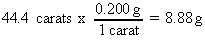
1
ounce = 28.35 g
Mass of Hope Diamond in ounces = 
1.18 An LD50 value is the amount of a substance per kilogram of body weight that is a lethal dose for 50% of the test animals.
1.19 mass of salt =  = 281.2 g
or 300 g
= 281.2 g
or 300 g
Understanding Key Concepts
1.20
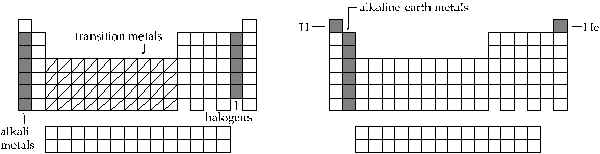
1.21 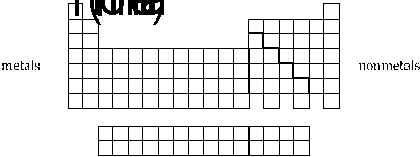
1.22 red - gas; blue - 42; green - sodium
1.23 The element is americium (Am) with atomic number = 95. It is in the actinide series.
1.24 (a) Darts are clustered together (good precision) but are away from the
bullseye (poor accuracy).
(b) Darts are clustered together (good precision)
and hit the bullseye (good accuracy).
(c) Darts are scattered (poor
precision) and are away from the bullseye (poor accuracy).
1.25 (a) 34.2 mL (3 significant figures) (b) 2.68 cm (3 significant figures)
1.26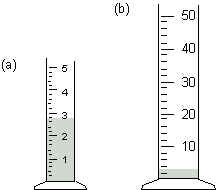
The 5 mL graduated cylinder is marked every 0.2 mL and can be read to ± 0.02 mL. The 50 mL graduated cylinder is marked every 2 mL and can only be read to ± 0.2 mL. The 5 mL graduated cylinder will give more accurate measurements.
1.27 The density of solid lead is less than the density of liquid mercury so the lead will float in the mercury.
Additional Problems
Elements and the Periodic Table
1.28 115 elements are presently known. About 90 elements occur naturally.
1.29 The rows are called periods, and the columns are called groups.
1.30 There are 18 groups in the periodic table. They are labeled as follows:
1A, 2A, 3B, 4B, 5B, 6B, 7B, 8B (3 groups), 1B, 2B, 3A, 4A, 5A, 6A, 7A, 8A
1.31 Elements within a group have similar chemical properties.
1.32 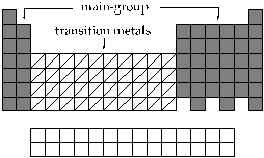
1.33 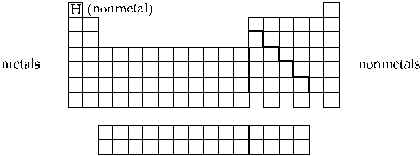
1.34 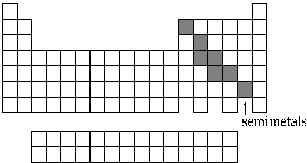
A semimetal is an element with properties that fall between those of metals and nonmetals.
1.35 (a) The alkali metals are shiny, soft, low-melting metals that react rapidly with water to form products that are alkaline.
(b) The noble gases are gases of very low reactivity.
(c) The halogens are nonmetallic and corrosive. They are found in nature only in combination with other elements.
1.36 Li, Na, K, Rb, and Cs
1.37 Be, Mg, Ca, Sr, and Ba
1.38 F, Cl, Br, and I
1.39 He, Ne, Ar, Kr, Xe, and Rn
1.40 (a) gadolinium, Gd (b) germanium, Ge (c) technetium, Tc (d) arsenic, As
1.41 (a) cadmium, Cd (b) iridium, Ir (c) beryllium, Be (d) tungsten, W
1.42 (a) Te, tellurium (b) Re, rhenium (c) Be, beryllium (d) Ar, argon (e) Pu, plutonium
1.43 (a) B, boron (b) Rh, rhodium (c) Cf, californium (d) Os, osmium (e) Ga, gallium
1.44 (a) Tin is Sn: Ti is titanium. (b) Manganese is Mn: Mg is magnesium. (c) Potassium is K: Po is polonium. (d) The symbol for helium is He. The second letter is lowercase.
1.45 (a) The symbol for carbon is C. (b) The symbol for sodium is Na.
(c) The symbol for nitrogen is N. (d) The symbol for chlorine is Cl.
Units and Significant Figures
1.46 Accurate measurement is crucial in science because, if our experiments are to be reproducible, we must be able to describe fully the substances we are working with -- their amounts, sizes, temperatures, etc.
1.47 A physical quantity contains both a number and a unit label. The physical quantity length would contain a number and a unit label such as meter.
1.48 Mass measures the amount of matter in an object, whereas weight measures the pull of gravity on an object by the earth or other celestial body.
1.49 There are only seven fundamental (base) SI units for scientific measurement. A derived SI unit is some combination of two or more base SI units. Base SI unit: Mass, kg; Derived SI unit: Density, kg/m3
1.50 (a) kilogram, kg (b) meter, m (c) kelvin, K (d) cubic meter, m3
1.51 (a) kilo, k (b) micro, (c) giga, G (d) pico, p (e) centi, c
1.52 A Celsius degree is larger than a Fahrenheit degree by a factor of  .
.
1.53 A kelvin and Celsius degree are the same size.
1.54 The volume of a cubic decimeter (dm3) and a liter (L) are the same.
1.55 The volume of a cubic centimeter (cm3) and a milliliter (mL) are the same.
1.56 (a) and (b) are exact because they are obtained by counting. (c) is not exact because it results from a measurement.
1.57 
The result should contain only 1 decimal place. Since the
digit to be dropped (6) is greater than 5, round up. The result is 0.1 g.
1.58 cL is centiliter (10-2 L)
1.59 (a) deciliter (10-1 L) (b) decimeter (10-1 m) (c) micrometer (10-6 m) (d) nanoliter (10-9 L)
1.60 1 mg = 1 x 10⁻³ g and 1 pg = 1 x 10-12 g

35 ng = 35 x 10-9 g 
1.61 1 µL = 10-6 L 
20 mL = 20 x 10-3 L 
1.62 (a) 5 pm = 5 x 10-12 m
5 x 10-12 m x  = 5 x
10-10 cm
= 5 x
10-10 cm
5 x 10-12 m x  = 5 x
10-3 nm
= 5 x
10-3 nm
(b) 8.5 cm3 x  = 8.5 x
10-6 m3
= 8.5 x
10-6 m3
8.5 cm3 x  = 8.5 x
103 mm3
= 8.5 x
103 mm3
(c) 65.2 mg x  = 0.0652 g
65.2 mg x  x
x  = 6.52 x
1010 pg
= 6.52 x
1010 pg
1.63 (a) A liter is just slightly larger than a quart.
(b) A mile is about
twice as long as a kilometer.
(c) An ounce is about 30 times larger than a
gram.
(d) An inch is about 2.5 times larger than a centimeter.
1.64 (a) 35.0445 g has 6 significant figures because zeros in the middle of a
number are significant.
(b) 59.0001 cm has 6 significant figures because
zeros in the middle of a number are significant.
(c) 0.030 03 kg has 4
significant figures because zeros at the beginning of a number are not
significant and zeros in the middle of a number are significant.
(d) 0.004 50
m has 3 significant figures because zeros at the beginning of a number are not
significant and zeros at the end of a number and after the decimal point are
always significant.
(e) 67,000 m2 has 2, 3, 4, or 5 significant
figures because zeros at the end of a number and before the decimal point may or
may not be significant.
(f) 3.8200 x 10³ L has 5 significant
figures because zeros at the end of a number and after the decimal point are
always significant.
1.65 (a) $130.95 is an exact number and has an infinite number of significant
figures.
(b) 2000.003 has 7 significant figures because zeros in the middle
of a number are significant.
(c) The measured quantity, 5 ft 3 in., has 2
significant figures. The 5 ft is certain and the 3 in. is an estimate.
1.66 To convert 3,666,500 m3 to scientific notation, move the decimal point 6 places to the left and include an exponent of 106. The result is 3.6665 x 10⁶ m3.
1.67 Since the digit to be dropped (3) is less than 5, round down. The result to 4 significant figures is 7926 mi or 7.926 x 10³ mi. Since the digit to be dropped (2) is less than 5, round down. The result to 2 significant figures is 7900 mi or 7.9 x 10³ mi.
1.68 (a) To convert 453.32 mg to scientific notation, move the decimal point
2 places to the left and include an exponent of 102. The result is
4.5332 x 10² mg.
(b) To convert 0.000 042 1 mL to scientific
notation, move the decimal point 5 places to the right and include an exponent
of 10-5. The result is 4.21 x 10⁻⁵ mL.
(c) To convert
667,000 g to scientific notation, move the decimal point 5 places to the left
and include an exponent of 105. The result is 6.67 x 10⁵
g.
1.69 (a) Since the exponent is a negative 3, move the decimal
point 3 places to the left to get 0.003 221 mm.
(b) Since the exponent is a
positive 5, move the decimal point 5 places to the right to get 894,000
m.
(c) Since the exponent is a negative 12, move the decimal point 12 places
to the left to get 0.000 000 000 001 350 82 m3.
1.70 (a) Since the digit to be dropped (0) is less than 5, round down. The
result is 3.567 x 10⁴ or 35,670 m (4 significant figures). Since the
digit to be dropped (the second 6) is greater than 5, round up. The result is
35,670.1 m (6 significant figures).
(b) Since the digit to be dropped is 5
with nonzero digits following, round up. The result is 69 g (2 significant
figures).
Since the digit to be dropped (0) is less than 5, round down. The
result is 68.5 g (3 significant figures).
(c) Since the digit to be dropped
is 5 with nothing following, round down. The result is 4.99 x 103 cm
(3 significant figures).
(d) Since the digit to be dropped is 5 with nothing
following, round down. The result is 2.3098 x 10⁻⁴ kg (5 significant
figures).
1.71 (a) Since the digit to be dropped (1) is less than 5, round down. The
result is 7.000 kg.
(b) Since the digit to be dropped is 5 with nothing
following, round down. The result is 1.60 km.
(c) Since the digit to be
dropped (1) is less than 5, round down. The result is 13.2
g/cm3.
(d) Since the digit to be dropped (1) is less than 5, round
down. The result is 2,300,000. or 2.300 000 x 106.
1.72 (a) 4.884 x 2.05 = 10.012
The result should contain only 3
significant figures because 2.05 contains 3 significant figures (the smaller
number of significant figures of the two). Since the digit to be dropped (1) is
less than 5, round down. The result is 10.0.
(b) 94.61 / 3.7 = 25.57
The result should contain only 2
significant figures because 3.7 contains 2 significant figures (the smaller
number of significant figures of the two). Since the digit to be dropped (second
5) is 5 with nonzero digits following, round up. The result is 26.
(c) 3.7 / 94.61 = 0.0391
The result should contain only 2
significant figures because 3.7 contains 2 significant figures (the smaller
number of significant figures of the two). Since the digit to be dropped (1) is
less than 5, round down. The result is 0.039.
(d) 
This result should be expressed with no decimal places. Since the
digit to be dropped (3) is less than 5, round down. The result is 5526.
(e) 
This result should be expressed with only 1 decimal place. Since
the digit to be dropped (3) is less than 5, round down. The result is 87.6.
(f) 5.7 x 2.31 = 13.167
The result should contain only 2 significant
figures because 5.7 contains 2 significant figures (the smaller number of
significant figures of the two). Since the digit to be dropped (second 1) is
less than 5, round down. The result is 13.
1.73 (a) 
Complete the subtraction first. The result has 2 decimal
places and 3 significant figures. The result of the multiplication and division
must have 3 significant figures. Since the digit to be dropped is 5 with nonzero
digits following, round up.
(b) 
Complete the subtraction first. The result of the subtraction
should have 2 decimal places and 3 significant figures (an extra digit is being
carried until the calculation is completed). The result of the multiplication
and division must have 2 significant figures. Since the digit to be dropped (8)
is greater than 5, round up.
Unit Conversions
1.74 (a) 0.25 lb x  = 113.4 g =
110 g
= 113.4 g =
110 g
(b) 1454 ft x 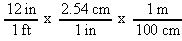 = 443.2 m
(c) 2,941,526 mi2 x  = 7.6181 x
1012 m2
= 7.6181 x
1012 m2
1.75 (a) 
(b) 
(c) 
(d) 
(e) 
1.76 (a) 1 acre-ft x 
(b) 
1.77 (a) 
(b) (6 x 2.5 x15) hands3 x 
1.78 (a) 
(b) 
(c) 
(d) 
(e) 2 g/L x 5 L = 10 g
1.79 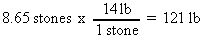
1.80 
1.81 
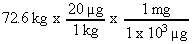 = 1.452 mg = 1.5 mg
Temperature
1.82 
 (goat)
 (Australian spiny anteater)
1.83 For Hg: mp is 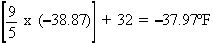
For Br2: mp is 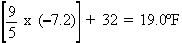
For Cs: mp is 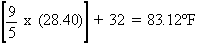
For Ga: mp is 
1.84 
K = oC + 273.15 = 3422 + 273.15 = 3695.15 K or 3695
K
1.85 
1.86 Ethanol boiling point 78.5oC 173.3oF
200oE
Ethanol melting point -117.3oC
-179.1oF 0oE
(a) 
(b) 
(c) 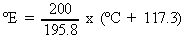
H2O melting point = 0oC; 
H2O boiling point = 100oC; 
(d) 
(e) 
Since the outside temperature is 50.0oF, I would wear a
sweater or light jacket.
1.87 NH3 boiling point -33.4oC
-28.1oF 100oA
NH3 melting point
-77.7oC -107.9oF 0oA
(a) 
(b) 
(c) 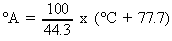
H2O melting point = 0oC; 
H2O boiling point = 100oC; 
(d) 
Density
1.88 

1.89 For H2: 
For Cl2: 
1.90 
1.91 d = 2.40 mm = 0.240 cm
r = d/2 = 0.120 cm and V =
r2h
1.92 
1.93 The explosion was caused by a chemical property. Na reacts violently with H2O.
General Problems
1.94 (a) selenium, Se (b) rhenium, Re (c) cobalt, Co (d) rhodium, Rh
1.95 (a) Element 117 is a halogen because it would be found directly below At
in group 7A.
(b) Element 119
(c) Element 115 would be found directly below
Bi and would be a metal. Element 117 might have the properties of a
semimetal.
(d) Element 119, at the bottom of group 1A, would likely be a
soft, shiny, very reactive metal forming a +1 cation.
1.96 NaCl melting point = 1074 K
oC = K - 273.15 = 1074 -
273.15 = 800.85oC = 801oC
NaCl boiling point = 1686 K
oC = K - 273.15 = 1686 - 273.15 =
1412.85oC = 1413oC
1.97 
1.98 
1.99 
1.100 
1.101 
1.102 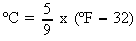 ;
; 

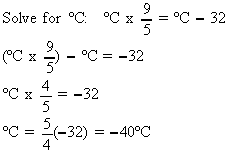
The Celsius and Fahrenheit scales "cross" at -40oC
(-40oF).
1.103 Cork: volume = 1.30 cm x 5.50 cm x 3.00 cm = 21.45
cm3
mass = 
Lead:
volume = (1.15 cm)3 = 1.521 cm3
mass = 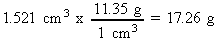
total
mass = 5.041 g + 17.26 g = 22.30 g
total volume = 21.45 cm3 +
1.521 cm3 = 22.97 cm3
average density = 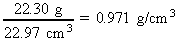 so the
cork and lead will float.
so the
cork and lead will float.
1.104 Convert 8 min, 25 s to s. 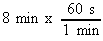 + 25 s =
505 s
+ 25 s =
505 s
Convert 293.2 K to oF 293.2 - 273.15 =
20.05oC
Final temperature = 68.09oF + 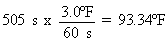
oC = 
1.105 Ethyl alcohol density =  = 0.7893
g/mL
= 0.7893
g/mL
total mass = metal + ethyl alcohol = 43.0725 g
mass of ethyl alcohol
= 43.0725 g - 25.0920 g = 17.9805 g
volume of ethyl alcohol = 17.9805 g x
 = 22.78 mL
volume of metal = 25.00 mL - 22.78 mL = 2.22
mL
metal density =  = 11.3
g/mL
= 11.3
g/mL
1.106 Average brass density = (0.670)(8.92 g/cm3) + (0.330)(7.14
g/cm3) = 8.333 g/cm3
length = 1.62 in x  = 4.115
cm
= 4.115
cm
diameter = 0.514 in x  = 1.306
cm
= 1.306
cm
volume = r2h = (3.1416)[(1.306 cm)/2]2(4.115 cm) =
5.512 cm3
mass = 5.512 cm3 x  = 45.9
g
= 45.9
g
1.107 35 sv = 35 x 109 
(a)
gulf stream flow =  = 2.1 x
1018 mL/min
= 2.1 x
1018 mL/min
(b) mass of H2O =  = 3.0 x
1021 g = 3.0 x 10¹⁸ kg
= 3.0 x
1021 g = 3.0 x 10¹⁸ kg
(c) time =  = 0.48 min
1.108 (a) Gallium is a metal.
(b) Indium, which is right under gallium in
the periodic table, should have similar chemical properties.
(c) Ga density =
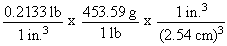 = 5.904 g/cm3
(d) Ga boiling point 2204oC
1000oG
Ga melting point 29.8oC 0oG
 0.4599 oG/oC
oG = 0.4599 x
(oC - 29.8)
oG = 0.4599 x (1474 - 29.8) =
664.2oG
The melting point of sodium chloride (NaCl) on the gallium
scale is 664.2oG.