Control of accidental gene escape
UniCrop develops novel molecular approaches to
eliminate the accidental gene flow from transgenic plants to wild
and cultivated relatives through two systems:
1) Recoverable
Block of Function (RBF) and
2) Repressed Excision System (RES).
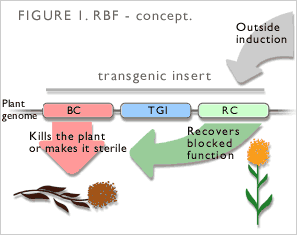
RBF consists of a Blocking construct (BC) linked to the
transgene of interest (TGI) and a Recovering construct (RC). Figure
1.
The Blocking construct blocks a certain molecular or
physiological function of the host plant causing the death or
sterility of the host plant in natural conditions. The Recovering
construct, when artificially induced, prevents the blocked function,
and thus the host plant produces viable fertile offspring.(WO
02/06498).
RES is aimed at removing the transgenic insert,
causing the transgenic plant to produce non-transgenic seeds in
natural conditions.
RES consists of the Excision
construct (EC), which completely cuts off the transgenic insert, and
the Repressor construct (RC), which represses the expression of the
EC. Figure 2 (WO 02/064801). .gif)
Double RBF, Intron-inserted BC and RES technologies
are priority fields of interest of UniCrop in developing gene escape
control methods.
Several molecular models are performed
on tobacco plants as shown in Figure 3. The seeds germinate only
after the artificial heat treatment (left). In natural environmental
conditions the germination is inhibited (right). 
|
