|
These two Pierce
pull-down kits will have you making new discoveries in
protein:protein interaction
fast
Identifying and characterizing the
interactions of a given protein has emerged as the most
valuable information that can be developed in the
post-genomic era. New Pierce ProFound Pull-Down Kits
contain the necessary components to enable the capture
of interacting proteins using the popular pull-down
method. The only item you provide is an appropriately
tagged fusion protein as the "bait." ProFound Pull-Down
Kits are designed to teach the method to the first-time
user and to shorten the time to a result for those
experienced in this method.
How it
works
The pull-down assay is an in vitro
technique that consists of a fusion-tagged "bait"
protein for which a binding partner (i.e., the "prey")
is being sought. For the two pull-down kits described
here, a GST-tagged bait protein is bound to an
immobilized glutathione support or a His-tagged bait is
bound to a metal chelate support. Pierce also offers
a biotinylated protein:protein interaction
kit that uses a biotinylated bait protein and
streptavidin support. In a typical pull-down assay, the
immobilized bait protein is introduced to a protein pool
derived from a cell lysate. After the prescribed washing
steps, the 'interactors" are selectively eluted. The
interacting proteins are then detected in-gel.
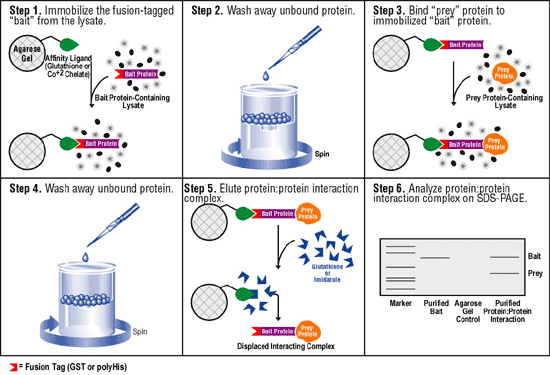 |
| Figure 1. ProFound
Pull-Down Kit
Protocol |
The Pierce Pull-Down
Advantage
- Validated components vs. "homemade" hit-and-miss
assemblies Methodologies for identifying or confirming
protein:protein interactions are readily available in
the literature. Often suggested pull-down assay
formulations can introduce several variables that,
when applied to your specific system, waste valuable
research time that is diverted to troubleshooting
resulting anomalies.
A typical homemade pull-down assay kit includes
a collection of reagents from multiple commercial
vendors. These reagents cannot be validated together
until the researcher incorporates them into his or her
protocol. Pierce ProFound Pull-Down Kits are complete,
assuring you of a validated set of reagents that are
ready to help you elucidate an important protein:protein
interaction using a tagged-fusion protein as bait
directly out of the box. This format saves valuable
research time and eliminates some of the troubleshooting
common to homemade kits.
• Kits supplied
complete with cell lysis buffer
Each kit
contains a broad-spectrum cell lysis buffer suitable for
bacterial, mammalian and insect cell lines. The buffer
is a neutral-pH, Tris-based solution that includes a
gentle/patented nonionic detergent formulation that is
compatible with the pull-down strategy.
• Flexible protocol
aids in the capture of weak or transient
interactions
ProFound Pull-Down Kits
incorporate a spin column format that eliminates resin
loss associated with multiple removals of supernatant
from a microcentrifuge tube. Weak interactions have an
improved probability of detection when the amount of
input resin is constant throughout the assay. In
addition, salt concentration and composition are often
vital for coaxing weaker protein interactions out of
complex protein lysates. ProFound Lysis Buffer Working
Solution contains a low-salt concentration of 75 mM NaCl
that can be increased to determine the optimal
conditions for each unique interaction pair. Similarly,
transient interactions can be assayed by addition of
co-factors specific to the needs of the interacting
pair. Added directly to the lysis buffer, cofactors can
tailor binding conditions to "trap" the targeted
protein:protein interaction.
• More efficient
recovery of interacting complexes
The
high-binding capacity of the kit resins allows the use
of minimal resin volumes. Reduction in resin volume
allows for more efficient elution of interacting
complexes. The result is a higher concentration of
recovered protein for subsequent gel
analysis.
Features and
Benefits:
- Provides a complete,
affordable and easy-to-use strategy for discovery of
protein:protein interactions
- Uses common laboratory
equipment (e.g., microcentrifuges and
mini-gels)
- Adapts to single- or
multiple-sample demands
- Features a flexible
pull-down format
- Assays for and detects
interactors in one day
Applications:
- Discover a new
protein:protein interaction from a cell lysate
- Confirm a putative
interaction from a cell lysate or with a previously
purified protein
- Extract protein:protein
interaction information from in vitro
transcription/translation lysates
Kit
contents
Each kit contains the appropriate
affinity support, a cell lysis buffer, Tris-buffered
saline, a suitable eluent, and a supply of spin cup
columns and collection tubes to enable you to perform 25
individual pull-down experiments.
Interacting pair model
validates the use of Profound Pull-Down Kits for protein
interaction discovery
A model system was necessary to
develop the use conditions and composition of the
components to be provided in kits, enabling the
successful performance of a pull-down assay. The system
selected to illustrate the effectiveness of the
components and protocol in capturing an interaction was
that between human protein X-linked inhibitor of
apoptosis (XIAP) and the second mitochondrial-derived
activator of apoptosis (Smac/DIABLO). The mitochondrial
protein Smac/DIABLO performs a critical function in
apoptosis by eliminating the inhibitory effect of
apoptosis proteins (IAPs) on caspases. The clone set
used in the studies encodes the GST-tagged Smac/DIABLO
binding domain of XIAP (referred to as BIR2) and the
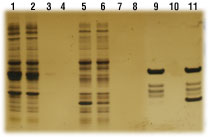
9xHis-tagged Smac/DIABLO proteins. A typical pull-down
result utilizing either the GST- or PolyHis-tagged
formats is illustrated in Figure 2.
 |
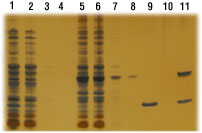 |
| Lane # |
A. GST-Tag Pull-Down |
B. PolyHis-Tag Pull-Down |
| 1 |
Lysate from E. coli expressing
GST-tagged BIR2 (bait protein). |
Lysate from E. coli expressing
9xHis-tagged wild-type Smac (bait
protein). |
| 2 |
Flow-through from the lysate in Lane 1
bound to an immobilized reduced glutathione
support for 1 hour at 4°
C. |
Flow-through from the lysate in Lane 1
bound to an immobilized cobalt metal chelate
support for 1 hour at 4°
C. |
| 3 |
Wash #1 of the support. |
Wash #1 of the support. |
| 4 |
Wash #2 of the support. (Washes 3-5 not
shown.) |
Wash #2 of the support. (Washes 3-5 not
shown.) |
| 5 |
Lysate from E. coli expressing
9xHis-tagged wild-type Smac (prey
protein). |
Lysate from E. coli expressing
GST-tagged BIR2 (prey
protein). |
| 6 |
Flow-through from the lysate in Lane 5 is
allowed to interact with the immobilized bait for
1 hour at 4° C. |
Flow-through from the lysate in Lane 5 is
allowed to interact with the immobilized bait for
1 hour at 4°
C. |
| 7 |
Wash #1 of the support. |
Wash #1 of the support. |
|
8 |
Wash #2 of the support. (Washes 3-5 not
shown.) |
Wash #2 of the support. (Washes 3-5 not
shown.) |
| 9 |
Bait control. Bait treated as described in
Lanes 1-8 and subsequently eluted. No prey added –
just binding buffer. |
Bait control. Bait treated as described in
Lanes 1-8 and subsequently eluted. No prey added –
just binding buffer. |
| 10 |
Prey control. Prey treated as described in
Lanes 1-8 and subsequently eluted. No bait added –
just binding buffer. |
Prey control. Prey treated as described in
Lanes 1-8 and subsequently eluted. No bait added –
just binding buffer. |
| 11 |
Elution of bait:prey complex (prepared in
Lanes 1-8) from the support with 250 mM
Imidazole. |
Elution of bait:prey complex (prepared in
Lanes 1-8) from the support with 100 mM reduced
glutathione. |
Note:
Gels were stained with the Pierce GelCode SilverSNAP
Stain Kit (Product # 24602).
Acknowledgment
Pierce
gratefully acknowledges Dr. Yigong Shi of Princeton
University for supplying the GST-BIR2- and 9xHis
Smac/DIABlO-expressing clones. Dr Shi's laboratory is
engaged in research aimed at understanding the
structural and molecular mechanisms involved in
tumorigenesis and apoptosis.1
References
- Chai, J., Wu, J.-W., Kyin, S., Wang, X. and Shi,
Y. (2000). Structural and biochemical basis of
apoptotic activation by Smac/DIABLO. Nature 406,
855-862.
- Kaelin, W.G., Jr., Pallas, D.D., DeCaprio, J.A.,
Kaye, F.J. and Livingston, D.M. (1991). Identification
of cellular proteins that can interact specifically
with the T/E1A-binding region of the retinoblastoma
gene product. Cell 64, 521-532. (Discusses the GST
pull-down assay)
- Soutoglou, E., Katrakili, N. and Talianidis, I.
(2000). Acetylation regulates transcription factor
activity at multiple levels. Mol. Cell 5, 745-751.
(Discusses the polyHis pull-down assay)
- Sambrook, J. and Russell, D.W. (2001). Molecular
Cloning: A Laboratory Manual 3rd Edition. Chapter 18:
Protein Interaction Technologies, Protocol #3:
Detection of Protein-Protein Interactions using the
GST Fusion Protein Pull-Down Technique. Cold Spring
Harbor Laboratory Press: Plainview, NY.
Ordering Information
|
 Instruction
Book Instruction
Book  MSDS MSDS |
| Buy |
Product # |
Description |
Pkg. Size |
Files |
Price |
| Add |
21516 |
ProFound Pull-Down GST
Protein:Protein Interaction Kit
Includes:
Immobilized Glutathione, 750 µl settled
gel
ProFound Lysis Buffer, 250
ml
Glutathione, 1 gm
BupH Tris Buffered
Saline, 1 pack (makes 500 ml)
Handee
Mini-Spin Columns Accessory Pack, 27 columns
with pre-inserted frit and top and bottom
caps
Collection Tubes and Caps Accessory
Pack, 100 graduated 2 ml tubes and plug
caps |
Kit |
|
$325.00 |
| Add |
21277 |
ProFound Pull-Down PolyHis
Protein:Protein Interaction Kit
Includes:
Immobilized Cobalt Chelate, 750 µl settled
gel
ProFound Lysis Buffer, 250 ml
4 M
Imidazole Stock Solution, 5 ml
BupH Tris
Buffered Saline, 1 pack (makes 500 ml)
Handee
Mini-Spin Columns Accessory Pack, 27 columns
with pre-inserted frit and top and bottom
caps
Collection Tubes and Caps Accessory
Pack, 100 graduated 2 ml tubes and plug
caps |
Kit |
|
$325.00 | |
|
|