|
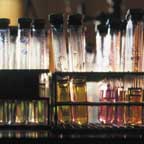
Test tubes containing
methanogens, methane-producing microorganisms, line the shelves of
Tim Kral's laboratory. Kral has successfully grown the microbes
under some of the conditions found on Mars.
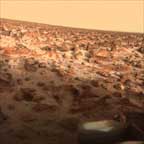
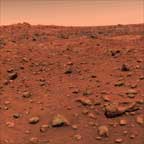
Above top, University
of Arkansas researchers hope to directly study rocks from the Red
Planet one day. In the meantime, they continue to examine the
possibilities of the planet's history from the standpoint of what is
known about earth. Above bottom, Harsh conditions on the surface of
Mars seem to rule out the possibility of life. It's still possible,
Kral contends, that life could occur below the surface, assuming
limited water conditions.
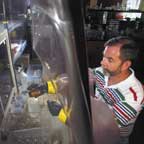
Biology professor Tim
Kral extracts methanogens from a solution, then injects them into
test tubes in an anaerobic chamber. Methanogens thrive under harsh
conditions, and Kral's experiments examine how the microbes grow
under Mars-like conditions.
|
Alien Enviroment:
Searching for Life on
Mars
By Melissa
Blouin
University of
Arkansas researchers work to unlock the Red Planet's
secrets
Imagine life on a
planet with a temperature so cold you would freeze in minutes, while
the high radiation levels would fry your skin at the same time. You
couldn't breathe without an oxygen mask, because carbon dioxide is
almost the only gas around, and walking would be impossible because
of the thin atmosphere and low gravity.
Welcome to the surface
of the planet Mars. With a pressure at 0.6 percent that of the
Earth's surface, an average temperature of -60 degrees C and an
atmosphere of 95 percent carbon dioxide, it seems like a harsh,
barren, lifeless world. Despite its hostile environment, scientists
have long thought Mars the most likely candidate in the solar system
for possible life, according to University of Arkansas chemistry
professor Derek Sears.
"We see evidence that
the atmosphere was once very different from what it is now," Sears
said. "It's hard to believe that life didn't form at some point in
the history of Mars."
Mars, the fourth
planet from the sun, named for the god of war and discord, is the
closest planet to our own. Its history appears to be similar to that
of Earth in terms of volcanic activity and meteorite impacts. The
days have similar lengths, and the planet is sometimes bathed in
clouds and fog. Mars' pockmarked surface tells of a history of
bombardment and volcanic events. It also displays evidence of old
oceans, carved canyons, islands and vast river beds, which may once
have contained tons of water, Sears said.
However, the Viking
voyages to Mars in the 1970s found no evidence of organic life, or
liquid water, on the planet's surface. The hope of finding life on
Mars seemed to die with the lack of carbon-based life forms and the
brutal conditions on the planet's surface.
But over the past two
decades, notions of the tree of life have changed drastically.
Scientists used to believe that life originated in an oxygen-rich
environment, but they have found increasing evidence that life
started under anaerobic conditions.
Armed with this new
look at life's origins, biology professor Tim Kral has turned his
microscope toward the interior of Mars to search for life beneath
the rocky terrain.
A journey below Mars'
surface takes speculation, but researchers assume the pressure and
temperature rise as you go closer to the planet's center. This leads
to the possibility of liquid water -- and therefore life --
somewhere below the surface. Any organisms found there, however,
would have to survive without organic matter or oxygen.
Kral began his search
for likely candidates on Earth by looking at extremophiles,
microorganisms that live in the bottom of the ocean or in the cone
of a volcano, among other places. He focused his attention on
methanogens, methane-producing microorganisms from a group of
microbes called Archaea, thought to be one of the most ancient
branches on the tree of life. Although people have labeled these
organisms "extreme," human beings and other oxygen-loving creatures
actually deserve that title, Kral said. Archaea and other anaerobes
comprise most of the biomass on Earth.
"Oxygen-liking life is
on a limb of the tree of life. Anaerobic organisms form the trunk,"
Sears said.
Kral knew methanogens
could survive extreme temperatures and thrived in an anaerobic
environment. So he and graduate student Curtis Bekkum designed a
series of experiments to see if methanogens could grow under some of
the conditions found below the surface of Mars.
The researchers
created a biological model of what life on Mars might be like based
on what is known about the Martian landscape.
"There's nothing from
Mars for us to work with," Kral said. "So you have to play the game
from the standpoint of Earth."
To grow methanogens
under some of the conditions found on Mars, Kral and Bekkum used ash
from Hawaiian volcanoes -- known to share chemical characteristics
with Mars soil. They also used carbon dioxide, hydrogen and limited
amounts of water while growing the microbes in test tubes.
The methanogens grew
successfully in the Mars soil simulant, obtaining all the macro and
trace minerals they needed to survive, and they even grew with a
limited water supply. Kral and Bekkum presented their results at the
1999 American Society for Microbiology meeting in Chicago.
Using large, black,
rubber gloves and peering through a plastic window, Kral and Bekkum
drew washed methanogen cells from a buffer solution and injected
them into soil-filled test tubes inside an anaerobic chamber. They
stored the sealed test tubes at different temperatures and checked
them for methane production and hydrogen uptake -- two measures of
microbe health. At any given time Kral has 100 methanogen test tubes
in the lab, and each experiment takes anywhere from three weeks to
two months.
Kral and his graduate
students are currently removing small amounts of water from the
methanogen test tubes to see if the organisms will adapt to life
with less water.
Kral also plans to
change the methanogen's energy source from hydrogen to carbon
monoxide, which is known to be found in the atmosphere of Mars.
"This is a hodgepodge of things that come together and tell a
story," Kral said.
Kral said scientists
can extrapolate research like this to search for life on
Mars.
"When you're looking
for life there -- what do you look for?" he said. "If you have an
idea of what life might look like, you may form better ideas about
where to look."
Scientists seeking
signs of extraterrestrial life outside the solar system have debated
about what chemical signals to look for in space. Methane may be one
of the signatures they should seek, Kral said.
"If they find methane,
there would be a reasonable chance that it would be produced by
organisms," he said.
Kral's research on
Earth can go at least one step beyond the test tube to a larger
environment.
|





