Tutorial #12
Intermolecular Forces
The forces determine many physical properties of substances. The forces range from weak (i.e. dispersion type forces) to moderate (dipole-dipole, of which H-bonds are a specific case) to stron (e.g. forces involving ions).
e.g. in a sample of liquid Argon, what forces are holding the molecules to each other?
Argon exists as discreet atoms, which are spherically symmetrical. Thus, there are no dipoles present. The atoms are not charged, so no ionic forces exist. The only way for two Ar atoms to attract one another is through dispersion (London) forces.
e.g. in a sample of HCl(g), what forces exist between two HCl molecules?
HCl is a polar molecule, since the Cl is so much more electronegative than the H. Thus, there will be dipole-dipole forces, as well as the usual dispersion forces.
e.g. Fe+2(aq) in H2O(l)
Fe+2 is an ion and H2O is a polar molecule, so we expect ion-dipole forces, as well as the usual dispersion forces.
e.g. CH3Cl in H2O
CH3Cl is polar, as is H2O. We thus expect dipole-dipole interactions, as well as the usual dispersion forces.
CH3F in H2O
CH3F is polar, as is H2O. We thus expect dipole-dipole interactions, as well as the usual dispersion forces. You might be tempted to think that H-bonds are involved here, but note that the F atom is bound to the C atom. For H-bonds, we need the H to be bound to F, O or N.
e.g. NH3(g)
Dispersion and dipole-dipole forces here. In fact, the dipole-dipole forces are H-bonds, since the H is bound to the N.
e.g. Arrange the following in increasing order of melting point: NaCl, Na2O, He, Xe, H2O
The one with the lowest MP will have the weakest intermolecular forces, i.e. dispersion forces only. He and Xe have only dispersion intermolecular forces. Xe is larger, therefore more polarizable, therefore has larger dispersion forces.
Thus, He < Xe
The next weakest forces are dipole-dipole. Only water has these forces, in the form of H-bonds
Thus, He < Xe < H2O
Ionic forces are the largest. Both NaCl and Na2O are ionic substances. The difference in electronegativities is greatest in NaCl, thus it has the higher melting point. The overall order is thus.
He < Xe < H2O < Na2O < NaCl
The order of boiling points will be the same.
Vapor Pressure
ln p2 = ln p1 + (DHvap/R) (1/T1 - 1/T2)
e.g. ethyl ether (C2H5 - O - C2H5); pvap = 401 Torr at 18oC (1 Torr = 1 mm Hg), and DHvap = +26.0 kJ/mol; find pvap at 32oC
p1 = 401 Torr
T1 = 18oC = 291
K
T2 = 32oC = 305 K
ln p2 = ln(401) + (26000 J mol-1/8.314 J K-1
mol-1)(1/291K - 1/305 K)
= 6.49
Thus, p2 = e6.49 = 657 Torr
e.g. carbon disulfide, CS2 has pvap = 100 mm Hg at -5.1oC and DHvap = 27.99 kJ/mol. Find the normal boiling point.
p1 = 100 mm Hg, T1 = -5.1oC = 268.0
K
p2 = 760 mm Hg (since we are looking for the normal boiling
point!) and T2 = the normal boiling point
Starting from ln p2 = ln p1 + (DHvap/R) (1/T1 - 1/T2), we
can rearrange the equation to solve for T2:
(ln p2 - ln
p1) / (DHvap/R) = 1/T1
- 1/T2
or,
1/T2 = 1/T1 - (ln
p2 - ln p1) / (DHvap/R)
or,
T2 =
(1/T1 - (ln p2 - ln p1) / (DHvap/R))-1
or,
T2 =
(1/T1 - (ln (p2/p1)) / (DHvap/R))-1 (since ln a - ln b =
ln(a/b))
= (1/268.0 - (ln(760/100))/(27990/8.314))-1
= 319.6 K
=
46.5oC
e.g. liquid mercury, Hg(l); pvap = 17.3 Torr at 200oC (473 K), pvap = 74.4 Torr at 250oC (523 K); find DHvap for Hg(l).
Rearranging the above equation, DHvap =
(R ln(p2/p1))/(1/T1 - 1/T2) (note that ln a - ln b = ln(a/b))
= 8.314 J
K-1 mol-1 ln (74.4/17.3) / (1/473 - 1/523)
= 60 x
103 J mol-1
= 60 kJ mol-1
Phase Diagrams
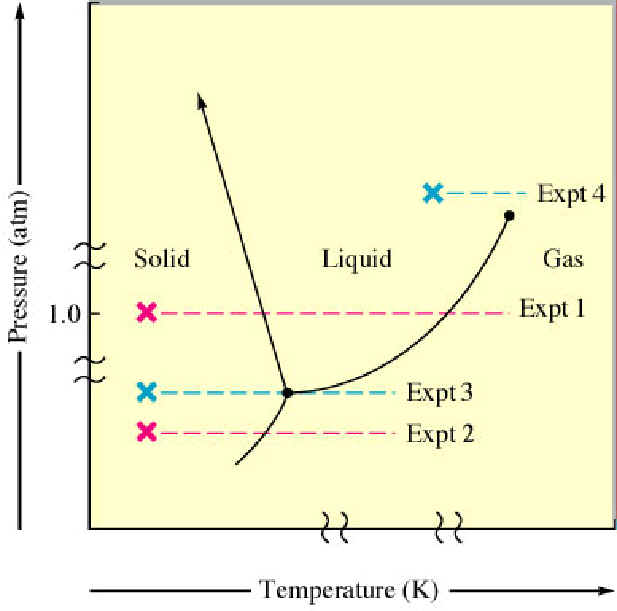
Looking at the phase diagram for water below, explain what will happen when starting at the points labelled "X" and increasing the temperature in the four experiments shown:
Experiment #1: The pressure is 1.0 atm. The initial poimt "X: is in the solid region, i.e.ice. As we increase T, at some point, we cross the S-L equilibrium line. This must be the normal melting point, 0oC. Liquid forms. As long as we are on the S-L line, both phases can coexist. Increasing the temperature will cause the ice to melt completely, leaving only liquid water. When we reach 100oC (the normal boiling point), liquid and gas coexist . Above this temperature, only gas exists.
Experiment #2: The pressure is less than the triple point temperature. Increasing T, we cross the S-G line. On the line, S and G coexist. Higher temperatures result in only gas. Note that no liquid formed, since we are below the triple point temperature!
Experiment #3: Starting with ice at the triple point pressure, increasing the temperature brings us to the triple point. Here, S, L and G can coexist. Increasing the T further results in only gas.
Experiment #4: Initially we have a liquid. As the T is increased, we move into the gas region, but at no time do we cross the L-G line, i.e. at no time do these two phases coexist. There will be a smooth transition from the properties of a liquid to those of a gas.
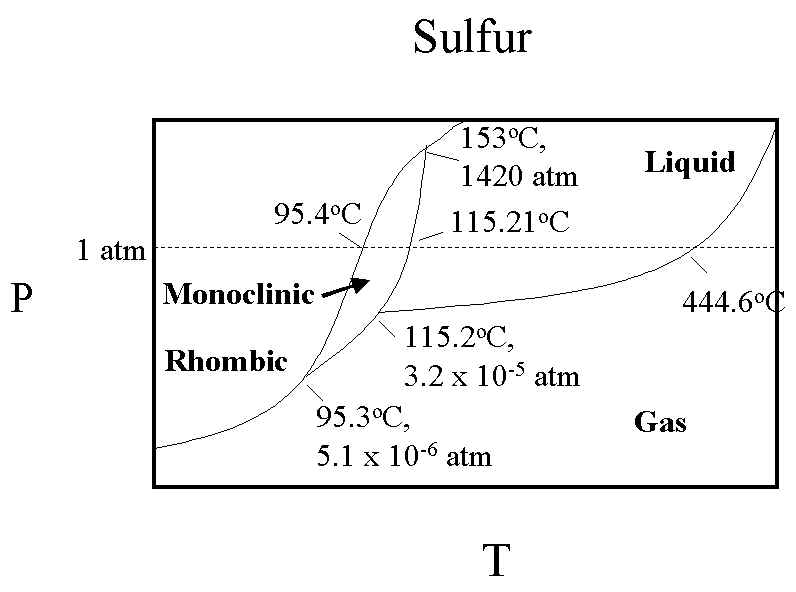
Looking at the phase diagram below for sulphur, answer the following questions:
1. How many triple points are there? Which phases coexist at the triple
points?
There are three. They are:
(i) Monoclinic, Rhombic, Liquid at
153oC, 1420 atm
(ii) Monoclinic, Rhombic, Gas at
95.3oC, 5.1 x 10⁻⁶ atm
(iii) Monoclinic, Liquid, Gas at
115.2oC, 3.2 x 10⁻⁵ atm
3. What is the standard state of sulfur?
The standard state is the state
of the element at 1 atm, 25o C. From the figure, this is the rhombic
form of the solid.
3. What is the stable phase at 1 atm and 100oC?
Following the 1
atm line from the left, we see that at lower temepratures, the rhombic form is
the most stable. At 95.4oC, rhombic and monoclinic are in
coexistence. From 95.4oC to 115.21oC, the monoclinic form
is the most stable.
4. What are the normal melting and boiling points of sulfur?
Tm =
temperature of coexistence of solid and liquid at 1 atm pressure. Note that this
only occurs for one solid phase, the monoclinic in this case, at
115.21oC.
Tb = temperature of coexistence of the liquid and
gaseous phases at 1 atm, or 444.6oC.
5. Which is the densest phase?
The densest phase occurs at the highest
pressures! Note that all of the coesistence lines slope up to the right.This
means that as we pressurize gaseous sulfur at low temperature, it will change
the rhombic form, and stay that way no matter how high the pressure is. At
moderate temperatures, it will change to the monoclinic form then at higher
pressure back to the rhombic form. At high temperatures, as the pressure is
increased, the liquid will form, then the rhombic solid form. In other words, no
matter what the temperature is, the rhombic form is dominant at high pressure,
i.e. it has the highest density.