


 Cameras
 Camcorders
 Cell Phones
 Components
 Desktops
 HDTV
HDTV Home Theater
 GPS
GPS Laptops
 Monitors
 MP3 Players
 Networking &
 Printers
 Storage


These days, no popular movement goes without an Internet presence of some kind, whether it's organizing on Facebook or spreading the word through Twitter. And as we've seen in Egypt, that means that your Internet connection can be the first to go. Whether you're trying to check in with your family, contact your friends, or simply spread the word, here are a few ways to build some basic network connectivity when you can't rely on your cellular or landline Internet connections.
Do-It-Yourself Internet With Ad-Hoc Wi-Fi
Even if you've managed to find an Internet connection for yourself, it won't be that helpful in reaching out to your fellow locals if they can't get online to find you. If you're trying to coordinate a group of people in your area and can't rely on an Internet connection, cell phones, or SMS, your best bet could be a wireless mesh network of sorts--essentially, a distributed network of wireless networking devices that can all find each other and communicate with each other. Even if none of those devices have a working Internet connection, they can still find each other, which, if your network covers the city you're in, might be all you need. At the moment, wireless mesh networking isn't really anywhere close to market-ready, though we have seen an implementation of the 802.11s draft standard, which extends the 802.11 Wi-Fi standard to include wireless mesh networking, in the One Laptop Per Child (OLPC) XO laptop.
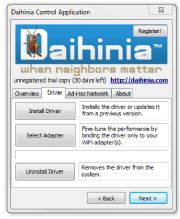 However, a prepared guerrilla networker with a handful of PCs could make good use of Daihinia
($25, 30-day free trial), an app that piggybacks on your Wi-Fi adapter
driver to turn your normal ad-hoc Wi-Fi network into a multihop ad-hoc
network (disclaimer: we haven't tried this ourselves yet), meaning that
instead of requiring each device on the network to be within range of
the original access point, you simply need to be within range of a
device on the network that has Daihinia installed, effectively allowing
you to add a wireless mesh layer to your ad-hoc network.
However, a prepared guerrilla networker with a handful of PCs could make good use of Daihinia
($25, 30-day free trial), an app that piggybacks on your Wi-Fi adapter
driver to turn your normal ad-hoc Wi-Fi network into a multihop ad-hoc
network (disclaimer: we haven't tried this ourselves yet), meaning that
instead of requiring each device on the network to be within range of
the original access point, you simply need to be within range of a
device on the network that has Daihinia installed, effectively allowing
you to add a wireless mesh layer to your ad-hoc network.
Advanced freedom fighters can set up a portal Web page on their network that explains the way the setup works, with Daihinia instructions and a local download link so they can spread the network even further. Lastly, just add a Bonjour-compatible chat client like Pidgin or iChat, and you'll be able to talk to your neighbors across the city without needing an Internet connection.
Back to Basics
Remember when you stashed your old modems in the closet because you thought you might need them some day? In the event of a total communications blackout--as we're seeing in Egypt, for example--you'll be glad you did. Older and simpler tools, like dial-up Internet or even ham radio, could still work, since these "abandoned" tech avenues aren't being policed nearly as hard.
In order to get around the total shutdown of all of the ISPs within Egypt, several international ISPs are offering dial-up access to the Internet to get protesters online, since phone service is still operational. It's slow, but it still works--the hard part is getting the access numbers without an Internet connection to find them.
 Unfortunately,
such dial-up numbers can also be fairly easily shut down by the
Egyptian government, so you could also try returning to FidoNet--a
distributed networking system for BBSes that was popular in the 1980s.
FidoNet is limited to sending only simple text messages, and it's
slow, but it has two virtues: Users connect asynchronously, so the
network traffic is harder to track, and any user can act as the server,
which means that even if the government shuts down one number in the
network, another one can quickly pop up to take its place.
Unfortunately,
such dial-up numbers can also be fairly easily shut down by the
Egyptian government, so you could also try returning to FidoNet--a
distributed networking system for BBSes that was popular in the 1980s.
FidoNet is limited to sending only simple text messages, and it's
slow, but it has two virtues: Users connect asynchronously, so the
network traffic is harder to track, and any user can act as the server,
which means that even if the government shuts down one number in the
network, another one can quickly pop up to take its place.
You could also take inspiration from groups that are working to create an ad-hoc communications network into and out of Egypt using Ham Radio, since the signals are rarely tracked and extremely hard to shut down or block. Most of these efforts are still getting off the ground, but hackers are already cobbling together ways to make it a viable form of communication into and out of the country.
Always Be Prepared
In the land of no Internet connection, the man with dial-up is king. Here are a few gadgets that you could use to prepare for the day they cut the lines.
Given enough time and preparation, your ham radio networks could even be adapted into your own ad-hoc network using Packet Radio, a radio communications protocol that you can use to create simple long-distance wireless networks to transfer text and other messages between computers. Packet Radio is rather slow and not particularly popular (don't try to stream any videos with this, now), but it's exactly the kind of networking device that would fly under the radar.
 In
response to the crisis in Egypt, nerds everywhere have risen to call
for new and exciting tools for use in the next government-mandated
shutdown. Bre Pettis, founder of the hackerspace NYC Resistor and creator of the Makerbot 3D printer, has called for "Apps for the Appocalypse,"
including a quick and easy way to set up chats on a local network so
you can talk with your friends and neighbors in an emergency even
without access to the Internet. If his comments are any indication,
Appocalypse apps may be headed your way soon.
In
response to the crisis in Egypt, nerds everywhere have risen to call
for new and exciting tools for use in the next government-mandated
shutdown. Bre Pettis, founder of the hackerspace NYC Resistor and creator of the Makerbot 3D printer, has called for "Apps for the Appocalypse,"
including a quick and easy way to set up chats on a local network so
you can talk with your friends and neighbors in an emergency even
without access to the Internet. If his comments are any indication,
Appocalypse apps may be headed your way soon.
Tons of cool tech are also just waiting to be retrofitted for these purposes. David Dart's Pirate Box is a one-step local network in a box originally conceived for file sharing and local P2P purposes, but it wouldn't take much work to adapt the Pirate Box as a local networking tool able to communicate with other pirate boxes to form a compact, mobile set of local networks in the event of an Internet shutdown.
Whether you're in Egypt or Eagle Rock, you rely on your Internet access to stay in touch with friends and family, get your news, and find information you need. (And read PCWorld, of course.) Hopefully with these apps, tools, and techniques, you won't have to worry about anyone--even your government--keeping you from doing just that.
Patrick Miller hopes he isn't first against the wall when the revolution comes. Find him on Twitter or Facebook--if you have a working Internet connection, anyway.
David Daw is an accidental expert in ad-hoc networks since his apartment gets no cell reception. Find him on Twitter or send him a ham radio signal.






















This is an excellent idea for revolutions, but it also worksfor floods, hurricanes, and manaical tech-terrorists with chain saws in your local phone CO. Maybe this is the wake up call that we need to startg taking responsibility for our networks and stop relying on Ma Bell and her children to do it all for us. Now, does someone have an instruction set for how to do security to protect your own machine while you are acting as a node in a multi-hop ad-hoc mesh network? And maybe a simple way to reuse all of those old 802.11 a/b/g AP/routers which have been sitting in your closet since you bought that shiny new 802.11N unit? Maybe how to flash your old Linksys to become forwarding bridge for your local Freedom Net (we need some inspiring name to market this concept to the masses, right?) And, of course, this puts a whole new spin on Net Neutrality.
It has seemed to me for years that any digital media is more vulnerable than analog:
a CDR dies instantly, a cassette tape rots slowly.
Same with cell phones, and the internet, and also with digital radio - which scares me because a child used to be able to make a simple crystal set and tune in to anything.
Shortwave is also vulnerable, because governments can (and were) blocking it.
But you can't stop it - change broadcasting frequency.
But all this is nonsense if there is no electricity!
This is where this artical scores - going back to basics, learning simple skills.
In the worst emergency, you need to know what plants you can eat, and how to skin a rabbit.
First, Everyone must ask themselves if they truly believe that the government would shut down the Internet. Personally, I believe they would in a heart beat.
I know that in Northern lower Michigan here, we will have a huge network. I know this because I own it and I'll telling everyone right now, there is NO WAY I'm going to turn over control of this network to the government.
I built this network for the people and businesses in the area, not just so the Fed can pull the plug and shut it all down. It's not happening on my watch.
Glenn Wilson
Rose City, MI
http://www.open-mesh.com/
Inexpensive, open source. If you want to cover a neighborhood or even a city that's how I'd do it. You'll need to look into directional antennas and possibly higher-power radios for long-range links of course.
Would our govt really shut the ENTIRE Internet down? Just think of the economic implications to the world's #1 economy.
Think of how much commerce is conducted over the Internet: Amazon, WalMart, Target, etc.
I think a more likely scenario is that they would shut down parts of the Internet, constructed a "tiered" access system: certain web sites would be banned in the name of "national security" or "threats" that never seem to go away.
It's time to start getting to work on these "Apocalypse Apps", boys and girls. Get ready for the next natural disaster: that's when they will try to sneak their plans into actions. It won't be a "security threat" (they already tried that one). It has to be something that everyone already accepts as "necessary".
Imagine this scenario: a huge snowstorm blankets the East Coast, knocking out power and Internet nodes. The power eventually comes back on, but the Internet web sites only come back partially...big business sites are back online, but other "free speech" web sites never see the light of day again. In the meantime the Big Boys make endless promises and excuses as to why it is taking so long, hoping everyone forgets that those web sites were ever there.
wonder how we lived before the internet
There are way too many people out there who would, in the instant the government tried to take away our internet,would be finding every way to bring it back. These websites disappearing that you theorize about would never happen...you really think even if the government shut down Facebook, twitter, popular blogging sites ect. people wouldn't fight back...hell nevermind just people using cyberspace, we have more registered gun owners than any other developed nation and I can only imagine how many unregistered...go ahead government try it, this nation would make whats going on in Egypt look like slight civil unrest if this were to happen here.
Trying to save the world has become a full time job for activists. They'll claim that "We The People" are the terrorists. I'm just a messenger and a pure blooded American and now a U.S. Political Refugee living in America! God, help us all!
http://www.theteapartytruther.com
What this article didn't cover is the fact that all this tech DOES NOT WORK without power.
If things really get out of hand, the Governments can easily kill the power grid to an entire region.
What good is your meshnet gonna do you then?
I have to give Obama congratulations by asking to have an Internet kill switch. Obama is challenging all those young kids and this got all the young people coming out with a lot of innovations on how to communicate without the internet.
These kids are simpleu nstoppable .That was a brilliant idea to challenge them like that, by the time they finish the Internet is going to be irrelevant for them.
This is just an example:
http://www.youtube.com/watch?v=A3pKF6gREFw
What is a "pureblooded American", anyway? You an American Indian? Or just suffering a messiah complex, Mr. "messenger"? You cay your not an activist? Why you messaging this wall with your BS? Sheesh.
Just noted that my ISP would not let me read your web mail story "Get Internet Service when ... govt .. shuts it down" by letting it time out - PCWorld will, by this time have noted that the Canadian govt is taking nefarious steps to add more control over Canada's internet using our willing ISPs to back their intent Perhaps PCWorld could write a bit on this not-so-new subject & the dangers involved? - geffen7
I have to give Obama congratulations by asking to have an Internet kill switch. Obama is challenging all those young kids and this got all the young people coming out with a lot of innovations on how to communicate without the internet.
The "kill switch" was Joe Lieberman's idea:
http://en.wikipedia.org/wiki/Joe_Lieberman#cite_ref-75
Posting comment ...